Category: CoachingResources

  • Tranquillity by Tuesday

    I’ve really enjoyed reading Laura Vanderkam’s Tranquillity by Tuesday: 9 Ways to Calm the Chaos and Make Time for What Matters. From an anthropological perspective, it’s interesting to read a book rooted in the experiences of a group of people putting the productivity and time management ideas into practice and I especially enjoyed reading why things did and didn’t work for particular individuals. I found it helpful to read about their experiences alongside the expert guidance provided, as it helped me think through how and why certain things might work for me or my coaching clients.

    Being on a journey of trying to work less hard and find more balance made this book appeal to me more with a central focus on calm and wellbeing alongside more traditional productivity techniques. The first ‘rule’ that I put to the test for me is Rule Two: Plan on Fridays.

    The basic idea is to plan for the week ahead on a Friday afternoon and the chapter goes into explaining why this is a helpful practice and how to do it. I already plan on a weekly basis, but it was still interesting to read more about why this is effective. Two things jumped out at me:

    Plan across three key categories: career (which I took to be short-hand for all types of work, paid and unpaid), relationships (which encompasses partners, family, friends, any we care for and spend time with, including pets) and self (this is the category that is easy to overlook).

    Plan on Fridays: there is a good section on why Friday afternoon is a good time to plan (provided you follow a Monday – Friday work or school schedule):

    1. there is little opportunity cost: for many of us, Friday afternoon is close to the weekend, it’s not a good time to start something new and this less busy time can be extra productive if used for planning;
    2. You can make Monday productive: start the week knowing what your day is going to bring and focusing on it;
    3. Upgrade your weekends: making more time to make plans for leisure or family time or self care rather than using the weekend for planning;
    4. Calm the ‘Sunday scaries’: meaning that going into the weekend with a clear plan for the following week helps you switch off and stop worrying about or planning for what’s ahead.

    This last reason resonates with me in particular, as I usually do planning on Sunday evenings and I have definitely found that to have downsides.

    So, that’s the strategy I am planning to adopt from Tranquillity by Tuesday, and if you are interested in exploring more, I’d definitely recommend this as a very well written, interesting read which comes with a lot of resources which are free to download on the book’s website 🙂
  • Changing habits with a Pie Chart Diary

    Recently I have been working with a number of clients who are finding hybrid working habits hard to change. Busy days blend into each other, and at the end of a week or even a month, routine tasks like answering emails or attending meetings have taken up all the time and other priorities or more creative work have had to take a back seat.

    I have struggled with this for years. Changing habits to make more time for writing, research or simply finding a moment to hear yourself think can be a challenge. Particularly when your working days are punctuated by the ping of notifications, endless emails or mandatory meetings, finding what some call the right cadence, a balance between busy work and creative tasks merits our attention.

    Setting abstract targets like “make more time for…” or “be more research-focused” can feel unachievable. So where do you start? One place to start is to get a new perspective on how you spend your time, so that you can pick a good moment to change your habits.

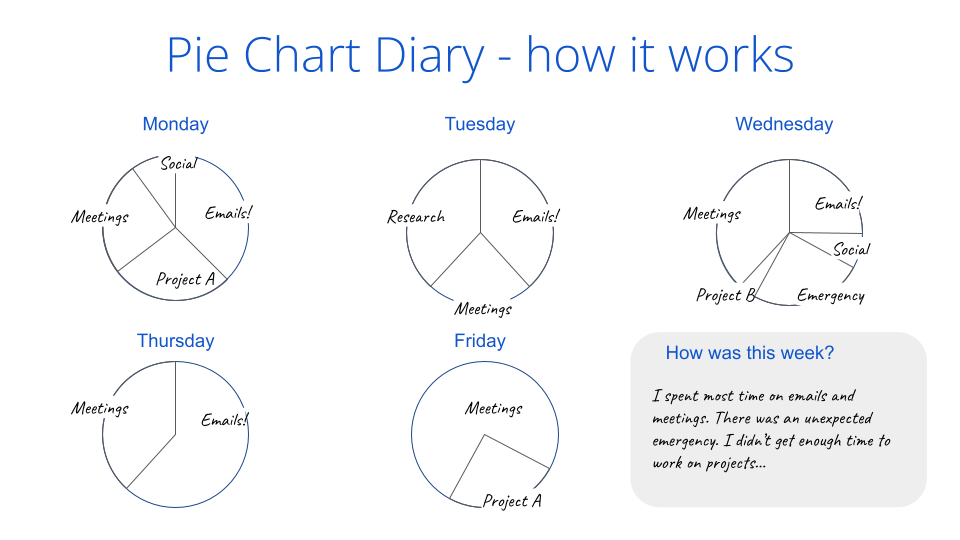
    For me, a bit of a spreadsheet nerd, I decided to track my time manually. I spend 2-3 minutes at the end of each day making a pie chart of what I had done that day. I continued to do this every day, always just before leaving my desk, and over the period of a month or two, I learnt some things about how I work:

    • I found that Tuesday, for example, were days when I never achieved my goals because they are dominated by meetings.
    • Wednesday mornings and Friday mornings were most productive for me.
    • I generally found time for things once I had a firm deadline.

    Here is an example of the Pie Chart Diary tool and how it can be used:

    Use it over a period of a few weeks or months, and reflect on:

    What do you spend most/least time on?
    What days of the week are you more likely to you achieve your goals?
    What is missing from your days?
    What could you change most easily to find better balance
    or to meet your goals?

    You can download this template if you’d like to try it out for yourself. Depending on your preference, you may want to print the template and write on it or simply use a blank piece of paper to make your charts. Or, if you prefer, use a spreadsheet or similar to track your categories and how you spend your time.

    The important part is to take a moment at the end of each day, and honestly reflect on what you actually did during the day. If there is something that takes up time, distracts you or interrupts you, consider adding it to your chart.

    When my dog was a puppy, my pie chart diary would have definitely included a “puppy” category as it took a lot of time out of my day to look after her.

    Look out for a podcast episode exploring the pie chart diary. As always, I’m curious to hear from you, what tools you use to track your days and what you learn along the way.

  • Creating space in a packed schedule

    It feels like it’s been a very busy week (month, year, decade…) and if your schedule is anything like mine, you probably don’t have enough time for being creative, taking breaks or anything else that injects a little bit of joy into the routine.

    There are many strategies for tackling this problem, and one approach I have been experimenting with is pairing habits.

    What’s pairing and how does it work?

    I first came across the concept in Gretchen Rubin’s Better Than Before and basically this strategy is about pairing a new habit you want to adopt, such as doing a short meditation session, with an established behaviour, such as getting up.

    There are two ways in which pairing can work: in positive ways (for example listening to an audiobook whilst walking the dog to create extra time for reading) and also in negative ways (buying too many snacks in the cinema).

    Finding focus

    I found for example that I associate standing at my desk with being responsive on chat and email. That focus on being available and the consequent constant interruptions made it very hard to focus on tasks that require space to think.

    Although I was still productive and got a lot done, I was putting off tasks that would need more focus and started on other things that I could fit around communicating.

    The solution was to pair tasks that need more focus with stepping away from my desk. Now I take my laptop with all email or DM apps closed to a table and write away from my inbox. When I sit down, even though I am physically less than 3 feet away from where I usually stand, I find it easier to focus on the task without distractions.

    Lunchtime reset

    Another example from my own experience is a negative pairing: I was good at taking lunch breaks but I was bad at actually resting. Instead, especially on days when I work from home, I started doing chores or life admin or watched things on my phone. I stopped working but I still kept going.

    Over time, I found that really exhausting and I was craving a break that would help me reset. The start of my day may be four hours of stressful meetings, so I wanted to find a way to help me break the negative pairing of lunch with getting things done.

    I identified things I wanted to stop (doing admin, chores, screen time) with things I wanted to do instead (go outside, play with the dogs, close my eyes for a few minutes).

    Initially, I found it hard to change my habits. I caught myself staring at my screen or sorting things out around the house. When I sat down to do something like a breathing exercise or a short meditation, I found myself thinking about work.

    Gradually however, I found ways to stick to and even enjoy my new lunchtime habit. I use a mindfulness app or other videos for 5-10 minutes and the guidance they provide helps me reset more easily. Weather permitting I have lunch outside, and my phone stays inside. I have stopped planning to complete chores during lunchtime instead making time outside of lunch.

    What could work for you?

    What habits are present in your life? Do you have any positive pairings that work for you or negative ones you’d like to change? How could pairing habits work for you?

    If you’d like to try this strategy for yourself, here are some questions to get you started:

    • What habits work well for you (at work, for your wellbeing, or another area of your life?)
    • Why do they work well?
    • Can you identify any pairings that you would like to change?
    • How would you like to change them?
    • What single change would have an immediate positive impact on you?

    Resources

  • Coaching news – July 2022

    As we head into summer, I have been taking a break from work and headed to the Welsh coast for a well earned break. I am continuing my work with a number of clients over the summer, but having just completed my current coach training I will also have time to focus on other aspects of my practice including catching up on a whole host of books I am hoping to read. 

    Whatever your plans for the coming months, I hope you find some rest ahead of the new academic year and enjoy the warmer weather. 

    Blog posts and resources

    This month I am sharing a blog post reflecting on different frameworks to think with. Not necessarily to adopt them whole, but because they usually offer me small nuggets of inspiration. It’s helped me find new ways to explore traits, motivations or fears and also where to turn if you can’t find a framework that feels right for you: Read Nuggets of inspiration: how we work and what works for us .You can find free coaching resources via my website and this time I have two new posts to share: try out a resource to help you reflect on different modes of working, whether from home, hybrid or in the office and exploring Gretchen Rubin’s Four Tendencies and find out about what type of accountability works best for you: 

    Current coaching offers

    For existing clients who feel like you are just getting started or want to continue our work together I offer a discounted package of six sessions for £210 which includes six one hour sessions, a coaching plan, resources and accountability check-ins. 
    Although I currently have no slots for new pro-bono clients, I do have a wait-list for new pro-bono clients looking to start coaching with me in autumn.

  • Nuggets of inspiration: how we work and what works for us

    I like revisiting or exploring different frameworks to think with, not necessarily to adopt them whole, but because they usually offer me small nuggets of inspiration. Here are some examples of what I explored and what I found out along the way:

    Ways to explore your traits, motivations or fears

    • Enneagram Core Motivations: This is a tool which combines modern psychology with an ancient personality system, and it helps you identify one of nine core motivations. There is a helpful post that explains how to choose your type, and plenty of free online tests available to experiment with. I found this really helpful as a prompt for reflection and enjoyed thinking about which core motivations I would NOT choose and why.
    • Gallup Clifton Strengths Assessment: this is a popular assessment tool, particularly in a work context. Whilst the assessment tools either require a paid subscription or one off fee for completion, there is a wealth of articles, tools and resources online via the official site. This could be good fit for you if you are working in a large organisation for example, and may be something employers offer.
    • Myers Briggs Personality Types: This is probably one of the best known frameworks, and it offers free online tests as well as resources to explore. I have done several of these over the years as part of recruitment and coaching, and always found it helpful not least because it’s interesting to see if your answers change over time.
    • Spark Types: This framework offers a free test to help you find your Spark Type and is based on the work of Jonathan Fields, and his accompanying book ‘Sparked – Discover your unique imprint for work and what makes you come alive’.
    • Harvard Business Review: If you prefer to explore rather than do an assessment, there are plenty of examples online to help you reflect on different leadership styles or personality types. I found the later video especially helpful as it focuses on potential limits rather than strengths.

    Beyond finding a fit

    At times, finding a framework you feel affinity with can be hard or feel unproductive. So here are some ideas for what I explored in that situation, starting with Emilie Wapnick’s TED talk and related book, How to Be Everything (and you can be a ‘multi-potentional-ite’). I have always been interested in working (and thinking) at the intersection of different interests, different disciplines, and so the perspective Wapnick shares chimes with me.

  • Exploring Gretchen Rubin’s Four Tendencies

    I was curious to explore this particular framework, especially as I sometimes listen to the Gretchen Rubin podcasts.

    Four Tendencies described

    There is a dedicated book that makes for interesting reading, however to get started, here is how Gretchen Rubin explore the concept:

    By asking the one simple question, â€œHow do I respond to expectations?” we gain exciting insight into ourselves. And when we know how other people respond to expectations, we understand them far more effectively, as well.

    We all face two kinds of expectations—outer expectations (meet work deadlines, answer a request from a friend) and inner expectations (keep a New Year’s resolution, start meditating). Our response to expectations determines our “Tendency”—that is, whether we fit into the category of Upholder, Questioner, Obliger, or Rebel.

    Knowing our Tendency can help us set up situations in the ways that make it more likely that we’ll achieve our aims. We can make better decisions, meet deadlines, meet our promises to ourselves, suffer less stress, and engage more deeply with others.

    https://quiz.gretchenrubin.com/?utm_source=website&utm_medium=homepage

    Taking the quiz and what I got from it

    Whilst you do need to provide an email address to complete the short quiz, it is free and has been taken by 3 million users. I always find myself choosing between options and feel a little that none of them really describe me particularly well, but it is not too long and the result feels authentic: My dominant tendency is to be an Upholder (“I do what others expect of me—and what I expect from myself.”) and that rings true to how I see myself.

    The report I receive is four pages long and I find it helpful to read through it. It mentions both upsides and challenges of this particular tendency when it comes to communication, work and daily habits.

    A new insight I take away from the quiz is that whilst there is a ‘relentlessness’ about this kind of person, which can be tiring for me and those around me (something I AM familiar with) there is also a suggestion that being good at keeping commitments to myself and a strong sense of self preservation helps protect me from burnout.

    There are quite a few books by Gretchen Rubin that I haven’t read, including the Happiness Project, and the one that appeals to me the most is about daily habits, called Better Than Before. So that is going on my reading list 🙂

    Explore for yourself

    If you’d like to explore the quiz for yourself, head to the online quiz page and get started.