Category: CoachingResources

  • Reflect, reframe, regroup. Inspiration for when life is messy.

    Reflect, reframe, regroup. Inspiration for when life is messy.

    I struggled to find a title for this post, because describing what it is about will lead to expectations it is not likely to meet. This post is about how to stick with things, be they new habits or intentions, plans or commitments.

    In my work as a coach I often read and share books about habits and how to stick to them, and there is a huge wealth of information out there about how to be more productive from the ever popular Atomic Habits by James Clear to Oliver Burkeman’s Four Thousand Weeks and so on. I go through phases of finding one of these titles or authors that really chime with me at a particular time in my life, and I love their approach for a while, find the inspiration I am looking for and… move on.

    Alongside the books there is an army of podcasts about the same subject, and I am guilty of adding to the genre with my own weekly episode of Leading Virtual Teams. Through my coach training I have discovered a lot of amazing coaches many of whom share their expertise on habits and productivity on their shows, and my favourite of these is Katie Linder’s podcast for Higher Education professionals, You’ve Got This. Katie led the coach training I completed and I find her particular mix of reading, writing, being creative and productive really appealing. Definitely a recommended listen!

    But…

    And yet, of course, there is a but… . Because life is messy. Life keeps changing, and evolving and however much the data we collect through the devices and platforms we use would like us to believe otherwise, moving forward is not always a straight, upwards curving line. And not every season of life can be productive. I recently read a wonderful book, Ebb & Flow by Easkey Britton, which beautifully explored the concept of periods of ebb in life as necessary and valuable.

    That’s where for me conflicting desires arise: one the one hand I understand and appreciate that not every week, month or year can be super productive. Sometimes life just gets in the way. On the other hand, I am very used to pushing ahead with things or sometimes have a sense of being behind already, feeling frustrated and keen to make a change. At times like that, I use a couple of approaches to help find a path through the messy reality:

    Reflect: Need vs. want

    First, I find some headspace to reflect on what I need versus what I want. I think best when I actually write things down or talk to someone about it. Here are some prompts to think through this:

    • What do you want more of?
    • What do you want less of?
    • What would make things lighter?
    • What do you need to prioritise?
    • What do you need to finish?
    • What do you need to pause/stop?
    • What do you need to start?

    Reframe: Essential vs. desirable

    Next, I try to reframe the situation, to look at things in a different light. My own high expectations or sense of accomplishment is often the biggest barrier to feeling contentment, so my aim here is to be very clear with myself what is absolutely essential to accomplish and what is desirable. I often find that things drop off my plate once I can clearly articulate to myself what I really need to do, rather than all possible things I could be doing. Here are some criteria I use to sort things into the two buckets:

    • Essentials often are: time sensitive, external (i.e. someone else is waiting for this), income generating, high impact
    • Desirables often are: open ended, internal (i.e. only I wait for this to happen), unknown/low impact

    Once I have sorted my long list of things to do into these two categories, I take a look at what I identified in the first step, needs vs. wants and check that everything makes sense. For example, if I have a writing project I absolutely love doing and it helps to get me out of bed in the morning, then it might move from desirable to essential. Likewise, if I find I have overcommitted myself and I need to say no to more things, I go over my list of essentials again to identify things I can finish quickly or stop all together.

    Regroup: Grind vs. joy

    Then, I look at the practicalities and set out to tweak things to prioritise joy. What that looks like may be different for you, but these starting points should give you a sense of what to consider:

    Determine how many weeks stand between you and your next break. How long before you can take time off, go on retreat, travel or something else that offers a break from routine for you. A break, whether a change or a rest is essential to my mind. If you find there’s no let up in sight, take a moment and think hard about whether you can change that. What would it take to get a few days off?

    Once you found out how long you have to go, add a countdown to your calendar or other app.

    Then take a look at each week ahead of you. In my case I found certain days of the week in which I had much fewer commitments, so I moved things around to block out time for what I wanted more of (in my case creativity and time to get outside). I also took a look at what would be the hardest/busiest of times and started to schedule some time and activities around those days that would offer me some balance.

    Time to rest, read, walk the dogs and so on.

    I saw a post recently my a fellow coach, Mrs T, who coaches Headteachers, and in it she described how when days got very busy, her initial tendency was to fit in even more in any moments of calm. Fit in more tasks during breaks and taking work home in the evenings or at weekends. She then shared how nowadays her instinct is to step back and take a breath instead. I could really relate to that. When things get hectic, I used to try to be more productive, more busy still. The steps I have outlined above, to reflect, reframe and then regroup offer an alternative to being ever more busy. In that direction burnout looms.

    I hope you find more pockets of joy. Even when life gets messy. Let me know how you get on.

    Related posts

    Subscribe to my free monthly newsletter:
    [newsletter_form type=”minimal”]
  • Autumn ramble: Pocket edition

    Autumn ramble: Pocket edition

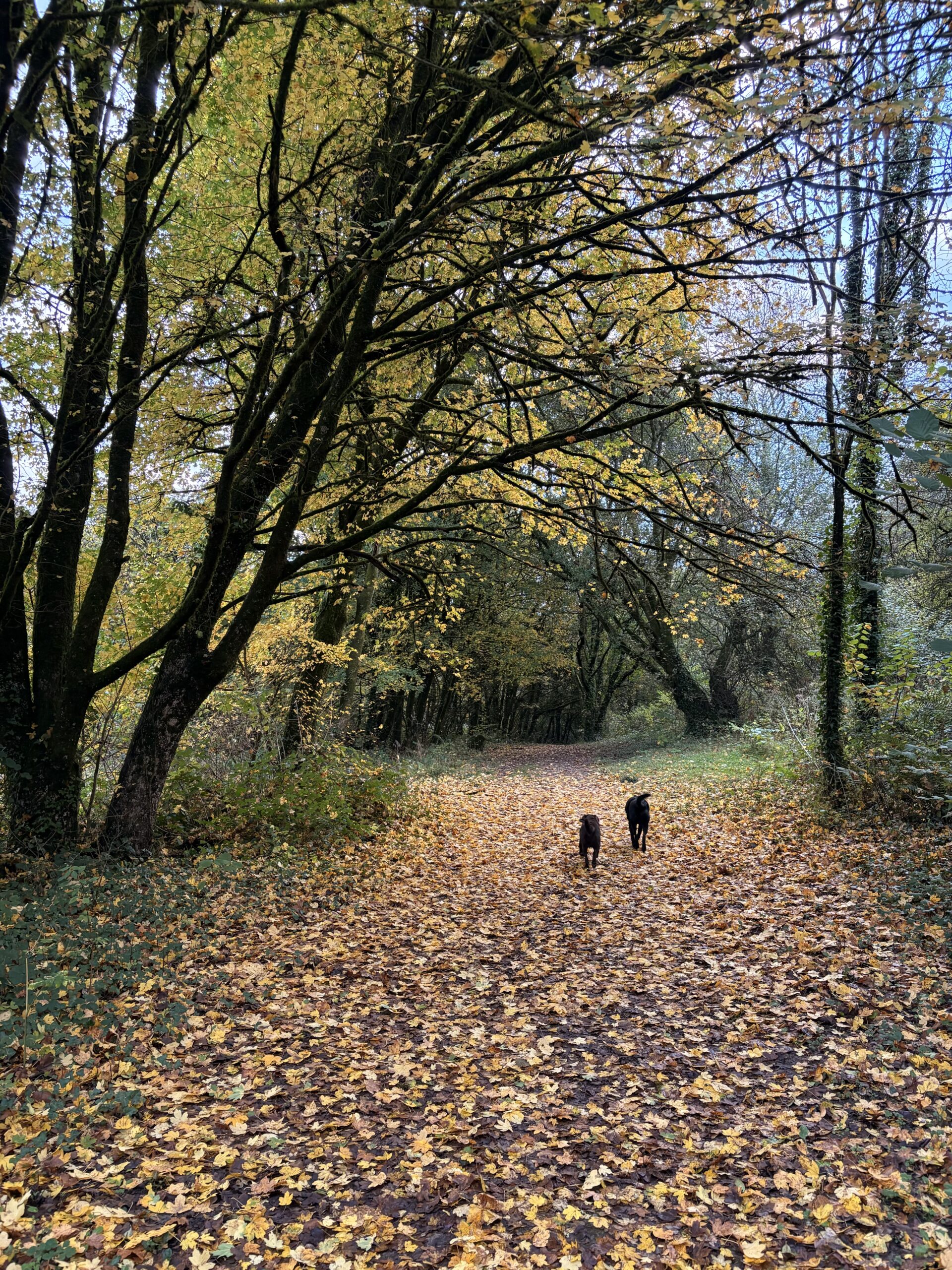
    I love this time of year and I love walking whilst talking. On a personal level that is one reason why having dogs is a good fit for me, as it prompts me outside daily for long, rambling walks through the colourful woods and along the river.

    However until recently I hadn’t found a way to translate my love for a good autumn ramble into my work… . That all changes in recent weeks as I embarked on creating the first of what I call ‘coaching walks’: It’s an autumn ramble, pocket edition.

    What is it?

    The idea for this format comes from my own experience of having wonderful reflective conversations with my then mentor Margaret as we walked our way through parks discussing strategy and solving the knotty problems I encountered as a CEO.

    We didn’t get to meet very often, but when we did and had time and space to head outside instead of limiting our sessions to a phone call or even an in person meeting, it was transformative.

    I think better when I walk, and I love following my train of thought and my feet, with an open mind about where they might take me.

    As a coach I now offer a walking format, both in person and remotely via a phone call, but the logistics of aligning diaries as and when important moments arise can make it challenging to actually make it happen.

    What I wanted to offer instead as a walk on demand, an option to take time away and find some headspace as and when my clients really need it. And so the idea for the coaching walk mini course was born.

    How does it work?

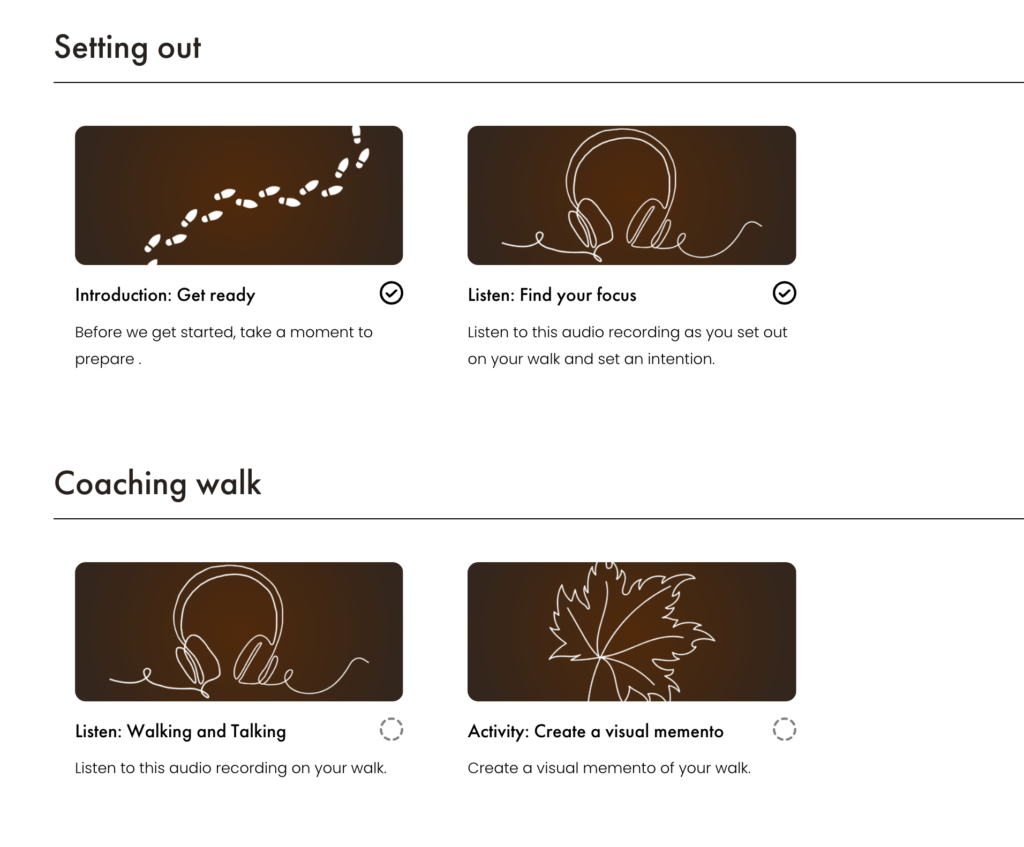
    The format is quite straight forward: it’s a mini online course in six parts, which covers setting out on the walk, the actual walk itself and coming back again. The screenshot of the course overview gives you an idea of the structure: each section has a narrative and activity as well as an audio recording to listen to (which you can download to listen to out and about):

    I have designed the activities so that you can choose to simply listen and walk and come back to the written version of the reflective prompts I share along the way later. Each element of the course includes pictures I have taken myself as I go on the walk.

    As you will be able to hear, I actually recorded a lot of the audio as I was walking myself, and I found that the most enjoyable part of creating the course.

    Where can I try it?

    You can preview and try out the full course for yourself for free. Simply head to the course homepage to get started. I think my coaching clients are very much going to enjoy trying this new format and I look forward to hearing what you think.

    Hopefully I’ll get a chance to create more seasonal resources like this, so let me know what you’d find helpful for the next edition. I’m already thinking about a coastal path coaching adventure… .

    Subscribe to my free monthly newsletter:
    [newsletter_form type=”minimal”]
  • Congrats Cohort! Coaching course completion

    Congrats Cohort! Coaching course completion

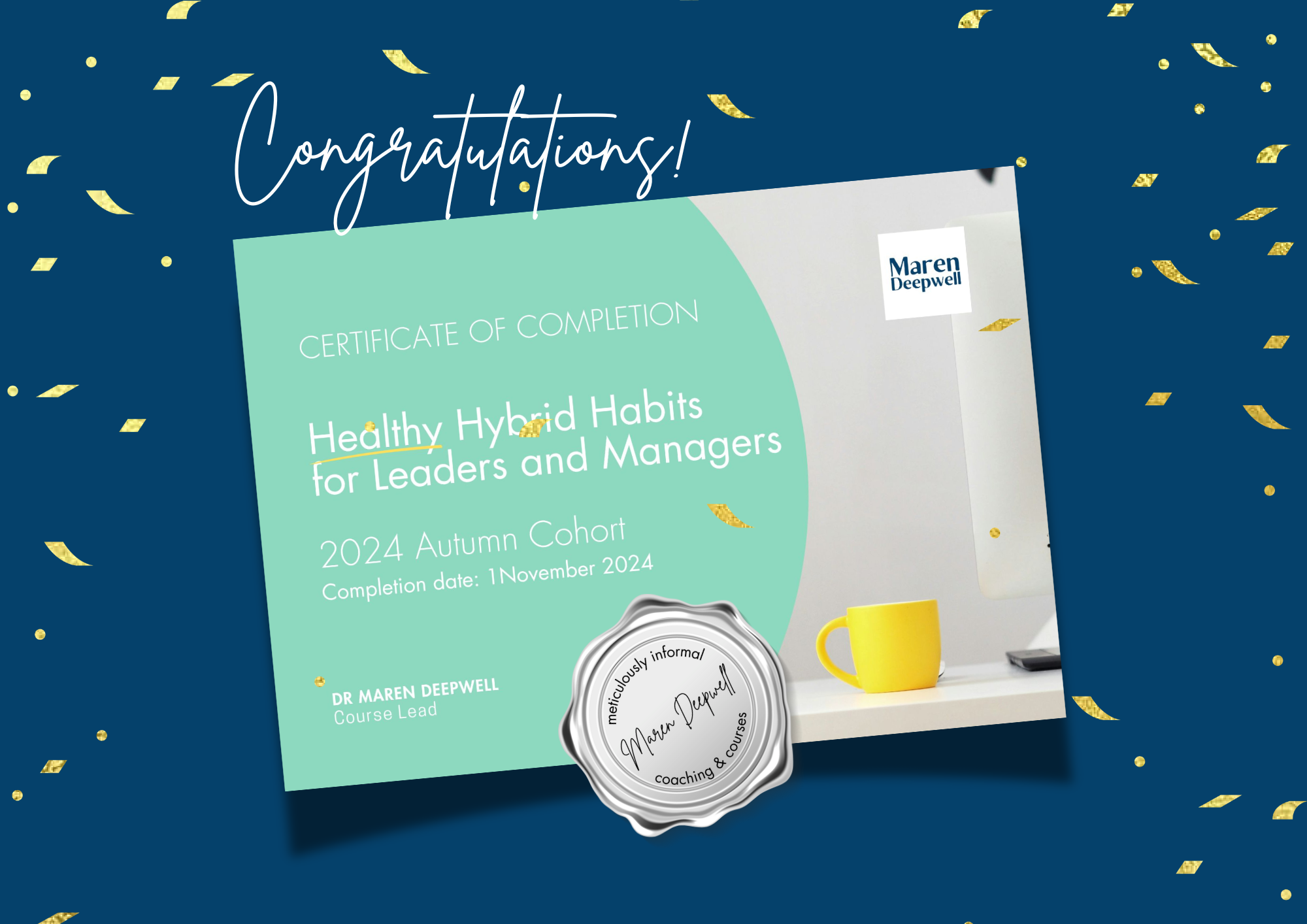
    Today is an exciting day as my coaching course Healthy Hybrid Habits for Leaders and Managers wraps up after four weeks. It’s been a wonderful experience to work with a cohort of 20 individuals this month, and if you haven’t yet discovered this project, you can find out all about the course on the dedicated course page.

    Time to celebrate…!

    As this is the final week of the course, it’s time to celebrate. It’s been a joy to work with everyone participating in the course over the past few weeks and initial feedback has been really positive. For my part, I hope that the course has been both inspiring and helpful.

    Healthy habits take time to get right and can be hard to make stick… . All the tools, readings and resources included in the course are there to support participants on their journey. For now, it’s time to celebrate your achievement – and there’s a course certificate and digital badge to collect.

    Some favourite moments 🙂

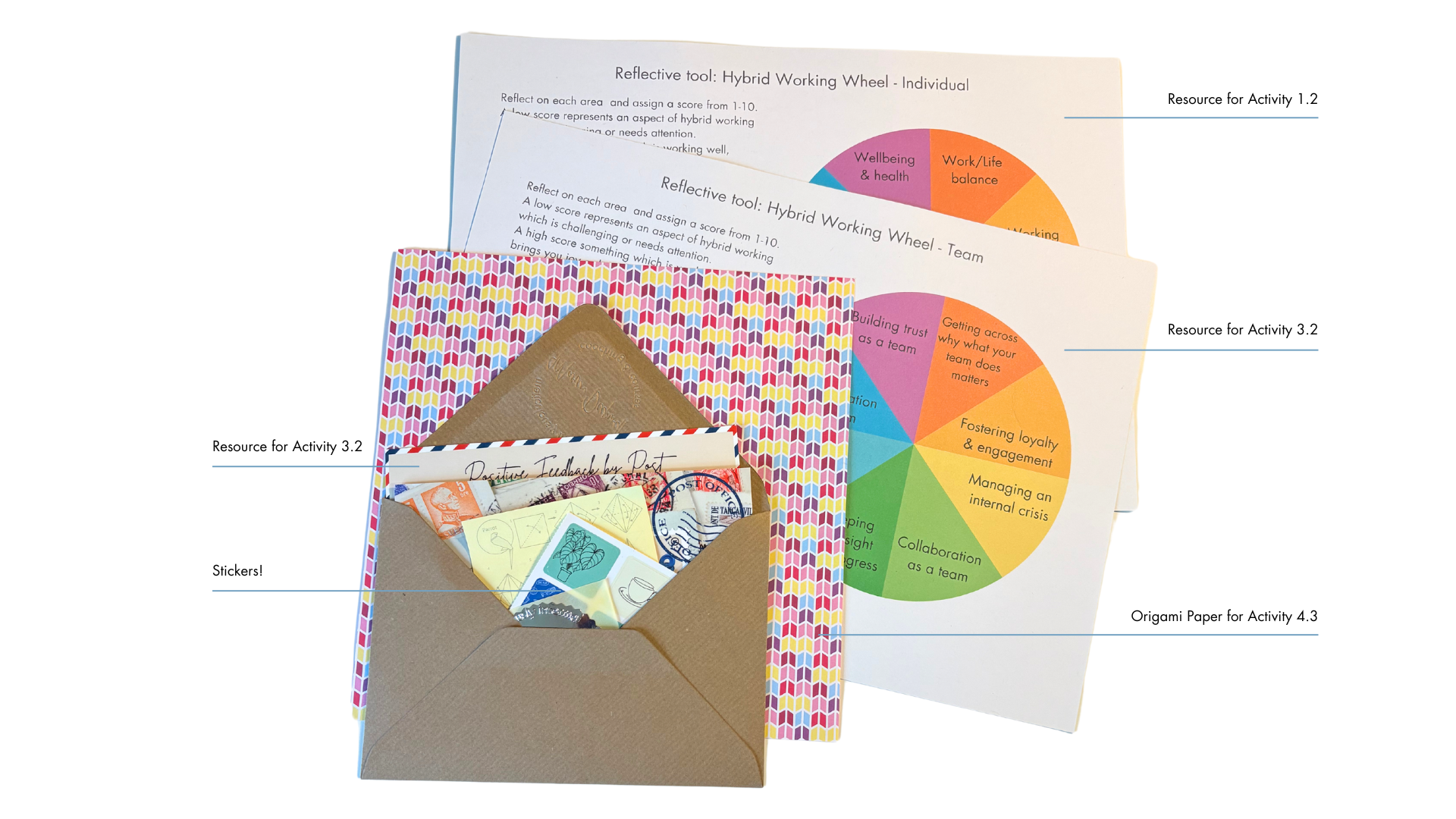
    There was a lot to enjoy over the past month, and I found the weekly live group coaching sessions especially energising and inspiring. I loved hearing the group reflections and questions… and I was very happy to see folk playing along with the activities, too, from office origami to writing postcards with Positive Feedback by Post.

    I decided early on to include a course letter in the design, and this element was one of my favourite parts of the course delivery.

    Another element that has been great for the course is welcoming participants from different sectors and timezones. Although a group of 20 isn’t that large in itself, the group coaching format I had designed into the course doesn’t work as well with groups larger than 10, so that was the maximum number of participants for each live session.

    As the course was designed to be taken largely asynchronously, and audio based, which received a lot of positive feedback, the live session weren’t essential to attend, but proved very popular.

    Audio first wins!

    Given that the aim of the course is to establish healthy habits for hybrid working, it was my intention from the start to create audio instead of video content. Although video is very prevalent in this kind of course usually, providing audio recordings ready to download accompanied by transcripts and (mostly) openly licenced resources proved to be a very effective approach.

    Participants loved being able to download the recordings (usually around 30 min per topic) and listen whilst walking, or simply away from their desk. I am really delighted that this approach landed well… and I am definitely planning to use a similar format for future developments. Which brings us to…

    What’s next?

    First up, registration for the next run of the Healthy Hybrid Habits for Leaders and Managers is already open, and a few early birds have already signed up. Both free and paid places are available, and as before I’ll be accepting group registration (at a discounted rate), too! The next cohort gets underway on 20 January 2025… so if you are looking for a bit of a ray of light in the dark days of January, this might be the course for you.

    Also, I am VERY excited to have a new offering to unveil… Ta Da! Come and join me for a Coaching Walk: Autumn Ramble. If you are looking for some space to reflect and take a step back, then join me for a walk.

    Try a free, self-paced coaching walk I have designed as a seasonal guide to accompany you on an autumn ramble. This is the first of my seasonal offerings designed to give you some creative and fun ways to find time to reflect and focus. Enjoy!

    Don’t miss out on new offerings. Subscribe to my monthly newsletter:

    [newsletter_form type=”minimal”]
  • Open leadership in practice: Unsung hero skills

    Open leadership in practice: Unsung hero skills

    Recently, I have done much work in leadership development. Both in the workplace and when I coach clients, I come across emerging and established leaders who have developed strengths and skills gradually over time, whether through informal learning or through practice or also outside of work. Especially where skills have come easily, grown over a period of time or when we have learnt something just for fun, these are often overlooked in favour of those skills we find hard to acquire or that are formally accredited by others. These strengths and skills often serve us well, but don’t get recognised. I am curious how we identify and appreciate such strengths or skills, and how we can move from seeing them as something we can simply do, to something we’re good at.

    Recognising and celebrating our ‘unsung hero’ skills is a powerful habit to cultivate in order to build confidence and develop as a leader. For example, when I coach leaders I always listen out for how they well they recognise their own strengths. Knowing your own strengths (and weaknesses) helps enormously with everything from effective delegation to seeking expert input. For instance, we might explore a narrative in which someone has applied their considerable skills to a problem, analysed the issues, found a solution and prepared to present this at a meeting – only to miss the chance to speak because something else comes up. Often this individual will end up with a sense of failure because they didn’t achieve the outcome they desired. All the good stuff that happened along the way fades into the background, and the most recent, negative interaction stays at the forefront of their mind. Sounds familiar?

    On my own journey as a leader I have certainly had experiences like this, and in my haste to keep up with the pace and to move from one milestone to the next I can easily forget to take a moment to appreciate what I have accomplished or learned along the way (regardless of whether I did get to speak at the meeting or whether others even saw my effort). Cultivating a habit of recognising and even celebrating the skills and strengths that help me accomplish my goals especially when constructive feedback, recognition and positive reinforcement are lacking, helps me value my own work.

    Yoga, one of my unsung hero skills

    One of my unsung hero skills is yoga. It’s probably been seven or eight years since I started practicing yoga, and it’s not a skill I ever really think about as something I am good at. I am neither as flexible nor as strong as I’d like to be, and even after years of practice, my down dog pose has me bending my knees and my heels have never yet touched the ground (thank you, hamstrings!).

    Still, when I take a moment to think about it, I quickly realise that I value my yoga practice deeply, and the benefits it brings for my physical and mental health. It’s also incredibly helpful to get out of my head and away from the screen, shifting my focus away from the digital realm and on my body and my breath.

    How did I develop this skill?

    I have been fortunate to have found teachers who I find both inspiring and practical, I have enough yoga stuff at home to make my practice as comfortable or as challenging as I want and I also have excellent online video classes. Each mode of engaging brings me something different:

    Home-practice: I started yoga with one to one lessons with a new teacher, who was developing her way of teaching as I learnt. I loved it and I benefited enormously from the attention of someone who got to know me and my body very well. I also got to explore a whole range of poses that take up too much space, set up or wobbling to be practical in a busy class. I love putting on music and setting myself up for a good session at home, knowing that I can spread out and wobble as much as I wish, repeating poses that feel good and make me happy. I love setting my own pace of practice and I enjoy the creativity of following the flow of movement according to what feels good.

    Online classes: It’s been only in the past year that I found an online/video class platform that I enjoy (Apple Fitness) and up to this point my only good experiences of online yoga was with teachers I personally knew. Unfortunately my current schedule is pretty unpredictable and changes from week to week, which is fun but makes attending a class regularly a challenge. And that is where the online classes are a great help. I tend to not push myself as much in terms of speed and strength when I practice on my own, and these classes help me build stamina and strength. I know enough about what I can and can’t do to modify when I need to rather than attempt to follow each and every pose the instructor show.

    Taught classes: My favourite way to practice by far is to attend a class, and I am very fortunate to have found several teachers that I love, which has made a big difference to me when I moved cities. My current teacher, Osk, who runs classes at Physio Space here in Cardiff, is not only a wonderful teacher, but also has a real gift for holding space. Her holistic approach to yoga provides just the right balance between being mindful and challenging. In her classes my form has improved just as much as my enjoyment of the practice.

    I’ve never sat down and thought about how I developed yoga as a practice, and even now that I have written it down, it very much feels like something that happened on the side or along the way as many of these kinds of strengths and skills often do. It’s also a skill that isn’t directly related to my work, so it feels less… I am not sure what the right term is.

    There are plenty of skills, my own unsung hero skills, that I would never put on a resume or list on a profile simply because I either take it for granted that this is something ‘everyone knows’ or a strength that is hard to quantify.

    Listen to the podcast :

    Identify your unsung hero skills

    What is important to reflect on here is that leadership is a holistic, embodied practice. Being a leader doesn’t just happen through formally recognised work skills or on good days, and by extension the skills and strengths we utilise aren’t limited to those that we earn degrees for or that are hardest to gain. The unsung heroes in our skills and strengths often make a bigger difference to our journey.

    If you’d like to identify some of your own unsung hero strengths or skills, here are some prompts to get you started:

    • What activities do you enjoy?
    • What skills or strengths do you use for these activities?
    • What would a friend or colleague say you are good at?
    • What skills did you enjoy learning?
    • What comes easily to you?

    Use these for reflection, journalling or in a conversation to get you thinking about what in your toolkit might deserve more recognition.

    Image credit: Photo by Markus Spiske on Unsplash

    Enjoyed this post? Subscribe to my free monthly newsletter:
    [newsletter_form type=”minimal”]
  • What happens to our senses in the hybrid workplace?

    What happens to our senses in the hybrid workplace?

    When I was a research student I came across David Abram’s The Spell of the Sensuous: Perception and Language in a More-than-Human World, an ecological philosophy book. At the time, I was deeply interested in phenomenology, and as part of my research in Anthropology I was learning much about how human beings relate to and experience the world. Specifically how we relate to the world through our senses as embodied beings.

    From the articles and blog posts on his website, it looks like David Abram’s thinking has evolved much since then, and he is now a visiting Senior Visiting Scholar in Ecology and Natural Philosophy at Harvard University. Lots of fascinting things to dig into if you’re interested in these topics. Meanwhile my interest in this topic has also evolved, from thinking about human beings and the material world and landscape to human beings in the workplace, specifically in the increasingly hybrid workplace.

    Which brings me to considering what happens to our senses when we work in a hybrid or fully remote setting for long periods. How does our embodied experience of work change as we spend more time in front of screens, alone in our studies or on kitchen chairs? And also, how does our perception of work shift as our senses of sight, smell, touch, taste and hearing adjust to hybrid working?

    I am curious to start exploring some aspects of this and how our embodied experience of hybrid working may influence of sense of wellbeing.

    Sight

    The sense I read the most about in the context of hybrid working, digital wellness and technology is sight. Given the amount of time spent in front of screens, scrolling, staring and not blinking, implementing screen time limits or wearing blue-light-blocking glasses to alleviate eyestrain is becoming more common. Mobile phones now offer a different light mode closer to bedtime and monitor screen time in order to alert us when levels increase, and smart watches can remind you to move a little every hour. Other tips include taking a break from the screen, going outside to adjust to daylight, look into the distance or look at something green/natural to help your eyes relax and recover. The traditional 5-10 minutes of screen breaks every hour is part of every Display Screen Equipment safety training I have come across.

    Hybrid working typically provides fewer distractions and more reliance on online interaction for communication and collaboration, making it less likely that regular screen breaks are taken. Even when we step away from the screen, notifications and messages on mobile devices usually stay switched on, making it more likely that we end up with more screen time.

    Hybrid working has also led to more hybrid and online meetings. Depending on the role you work in, you probably find meeting free hours have become more rare and back-to-back video calls more common. Zoom fatigue impact us beyond our sense of sight alone, this article in Medial News Today summarises how “headaches, migraines, eye irritation and pain, blurred and double vision, excessive tearing and blinking are the most common and immediately visible physical symptoms of Zoom fatigue”.

    This week, how many times have you taken a 5-10 minute break every hour? For me, I would estimate I take a short break for each hour less than half of the time. On busy days maybe 10-20% of the time, but generally somewhere around 30-40% of the time.

    Healthy habit: step away from the screen

    If you are looking to improve your digital wellness by taking more regular screen breaks, here are some tips to get started:

    • What is your starting point? To begin with, reflect on how regularly you step away from the screen for a short break at the moment. If you are spending 8 hours a day in back-to-back video calls, then even one or two breaks a day might seem like a stretch. If you are already taking a break at lunch or making tea mid-morning, building in a few extra breaks might feel more achievable. Be honest with yourself about where you are starting from so that you can set yourself an achievable goal.
    • Easy does it. No matter where you are starting from, find the least busy time of your working day or week. It might be Friday afternoon or Monday evening. It might be the hour after lunch when there’re fewer meetings. Whenever it is, focus on that time first and plan in an extra break.
      You can use your calendar, phone reminders, post-it notes or whatever else will help you remember to take a break.
      Then, when the time comes, step away from your screen and do something that is not screen related for 5 minutes.
      I often go downstairs to get some water, water my plants or make a hot drink. If the weather is nice I might step outside. It doesn’t matter what you do.
      As you get up and start to move, notice how you feel. Are you stiff? Is there any part of you (or all parts…) that feel tense?
      Get back to work after 5-10 minutes.
    • Make it a habit: you might decide to set yourself a goal to take an extra break every day or a number of breaks a week to begin with. Observe any physical symptoms of taking regular breaks away from the screen or how your mood changes. If you have a busy day or a busy week and you end up forgetting to step away from the screen or you don’t have time, just get back to it when you can. The overall aim is to get into the habit of having breaks, and even one additional break is better than none.
    • Share your habit: one of the best ways to make this habit stick is to share and normalise stepping away from the screen. If you use direct messages or chat at work, post a quick update like “Just stepping away from the screen for a break” or “Back online in 10 minutes. Taking a screen break”. It’s a powerful way to promote digital wellbeing in any workplace, and if you happen to lead people or projects, your example can help others, too.

    In the next post in this series I’ll be focusing on a different aspect of embodied hybrid working and share a new healthy habit to try out.

    Enjoyed this post? Subscribe to my free monthly newsletter:
    [newsletter_form type=”minimal”]

    Image credit: Photo by Annie Spratt on Unsplash

  • Non-fiction reading for February

    Non-fiction reading for February

    The book that really stayed with me last month was Coach the Person not the Problem by Marcia Reynolds. It’s a fascinating read full of practical guidance and insightful ideas, and a great read if you are interested in developing a coaching approach to leadership or your coaching and mentoring skills.

    There was a lot to take away from the book, such as a really useful habit to set an intention for a conversation or a coaching session at the start. For example, you might choose to focus on feeling open or curious or caring, and focus on that before the conversation starts. It sounds obvious, but in my experience that’s harder to put into practice than it sounds.

    I have a whole spectrum of interactions in any given week, and I am about to start mentoring young adults as part of a national programme, too. I don’t really know what to expect or what unexpected emotions, situations or challenges the clients I work with may bring into our session on any given day. I found the step by step guidance on how to establish and maintain a certain focus extremely helpful!

    On my radar for this month

    I read a lot of fiction in January, so these two titles are still on my list to read from last month:

    • Goth – A History by Lol Tolhurst
    • The Coaching Habit. Say Less, Ask More & Change the Way You Lead Forever by Michael Bungay Stanier

    Non-fiction reading 2024

    Creativity and culture

    • Art Matters by Neil Gaiman and Chris Riddell
    • Big Magic by Elizabeth Gilbert

    Hybrid working and leadership

    • Flow: The Psychology of Optimal Experience by Mihaly Csikszentmihalyi
    • Rooms of Their Own (Where Great Writers Write), Improbable Libraries and Shedworking, all three by Alex Johnson
    • Working Identity: Unconventional Strategies for Reinventing Your Career by Herminia Ibarra

    Coaching and reflective inquiry

    • The Big Book of Beautiful Questions by Warren Berger
    • Coach the Person not the Problem by Marcia Reynolds

    Liked this post? Subscribe to my free monthly newsletter:
    [newsletter_form type=”minimal”]