Category: coaching

  • Coaching moment: Focusing energy

    Coaching moment: Focusing energy

    This time of year always feels busy, with so much going on, and yet it’s also a season when there’s less daylight time, and colder months are starting here in the Northern Hemisphere. Whether at work, in leadership practice or in relation to personal goals I often have conversations with my coaching clients about wanting to accomplish more whilst feeling that there is less energy.

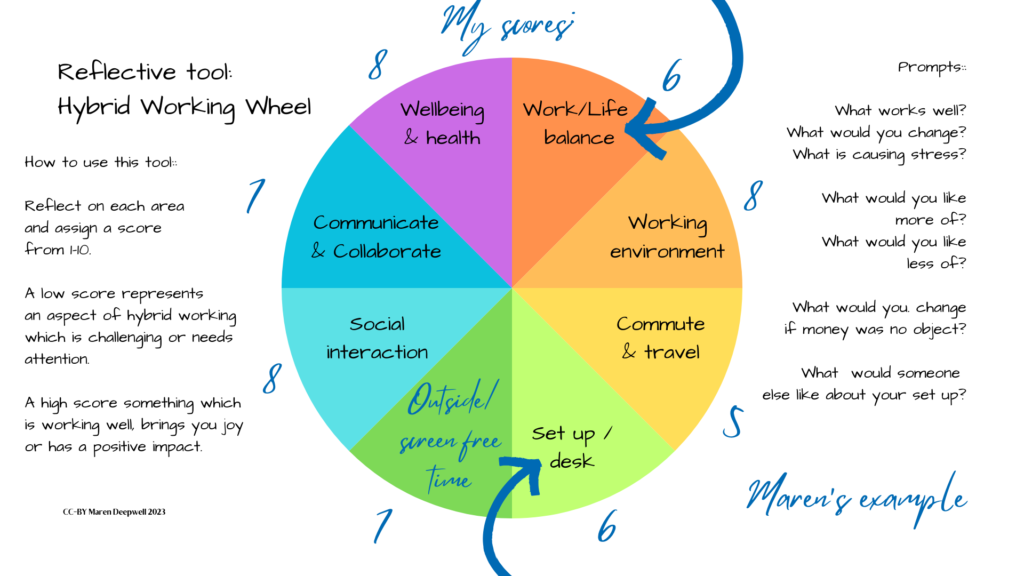
    One of the tools I find really helpful to think through these kinds of moments is a remix of the Wheel of Life (a popular coaching tool used to reflect on different priorities). I find this tool very versatile, and have adapted it for example in the context of hybrid working. In my work coaching leaders and managers, we use this for quick self-assessment that always offers some new insights. If you’d like to give the hybrid working version a go, there is a dedicated episode of my podcast complete with resources you can check out.

    Example of the Hybrid Working Wheel resource

    Identifying priorities and focusing energy

    Typically however the focus of this exercise is on assigning a score reflecting how things are currently going, and then reflecting on these, e.g. what was easy to score or hard; what scores feel satisfactory, and which don’t and so forth. It’s designed to help identify priorities, and to check in with how things are going. What I find especially helpful at this time of year, however, is to focus more on what energy I have and how I want to spend it between now and the end of the year. This small shift in emphasis opens up a different reflective frame and I use a basic template of the resource to help do that.

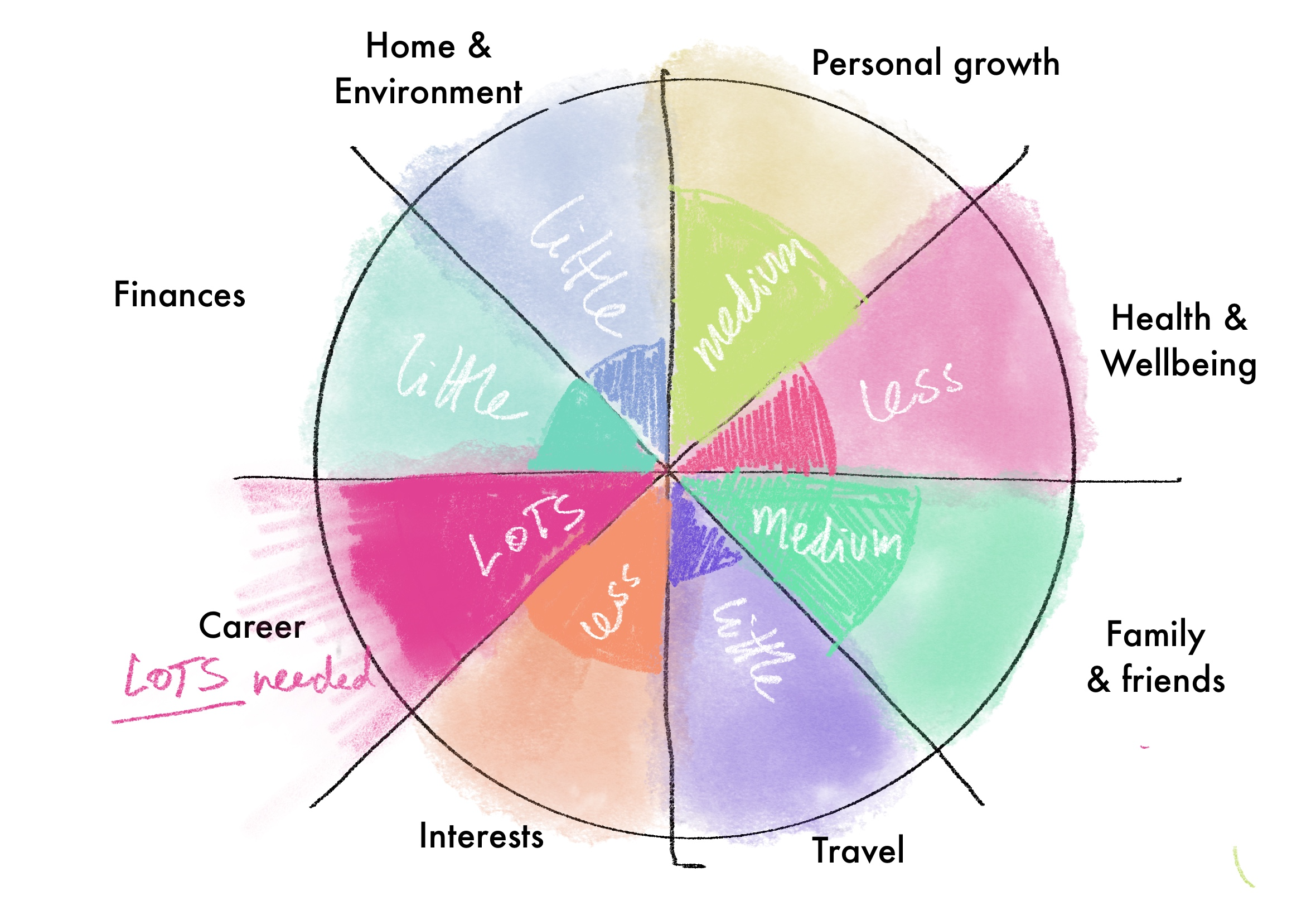
    In the example below, I have used general categories to reflect, using darker shading to indicate in each area how much energy to spend. It can be hard at first to recognise that there isn’t enough energy to spend maximal effort on everything, all of the time. Often what happens during this exercise is that we can identify several areas which can be maintained fairly easily, and find one or two areas which require more energy. That helps giving a sense of not being as thinly stretched and instead focus energy where is really matters. I have used the terms “little” or “medium” but you could also use a number scale, i.e. energy out of a max of 10 for example.

    Example of a completed Wheel of Life with energy indicated.

    Reflective prompts

    If you’d like to give this a go yourself, here are some reflective prompts to get you started. There are not listen in any particular order, but simply designed to help get you thinking.

    • What areas can be maintained with minimal energy?
    • Where do I spend most energy?
    • Where does my effort have the biggest impact?
    • What can I do less or pause?
    • When do I next have time to replenish my energy?

    Don’t miss future resources. Subscribe to my newsletter!

    [newsletter_form type=”minimal”]
  • Reflection: Volunteering as a mentor

    Reflection: Volunteering as a mentor

    For the last few years I’ve volunteered as a mentor with the One Million Mentor programme:

    1MM mentoring empowers young people to become the best version of themselves: building relationships -free of assumption and judgement – where they benefit from another’s experience and perspective and can think bigger, find their own answers and take the next meaningful step into their future. We recruit, train and deploy volunteer mentors, matching them with mentees, providing high quality support to both so that they are well prepared and can have an effective and impactful mentoring relationship. Our mentoring is one to one, for young people aged 14-25 years old, for 1 hour, once a month, for up to a year.

    https://onemillionmentors.org.uk/

    It’s a great national initiative that I am glad to be part of and I found the training really interesting, especially as most of my work normally focuses on coaching and mentoring leaders and managers. Being part of the journey to support a much younger mentee is a different proposition and I’ve learnt a lot along the way.

    Entering a career

    One of the key questions that I work on with my mentees is finding a way into a career, either via higher education or an apprenticeship, or maybe through local initiatives and training schemes. Most of the time, the kind of questions they have are very similar to the questions my coaching clients ponder: they think about what they want to do, what needs a new job needs to meet and what progressing pathways are available. They often wonder about whether certain qualifications or certificates are worth having, and are always keen to hear from peers who have gone through similar experiences.

    Articulating skills

    We also work a lot on articulating skills and strengths. Just like the reflective approaches needed later in one’s career in order to determine and champion one’s achievements, so do early career mentees need strategies that help translate capabilities into their CVs and applications.

    It’s an awareness that’s very valuable to develop, but it can be difficult at any stage of professional practice. Developing confidence and reflective practice on what types of work might suit best is even harder when you don’t have a lot of experience to draw on.

    Reading the landscape

    One other question that we spend a lot of time thinking about is how to read the landscape of the sector or the broader area that the mentee is interested in. Is it growing or are there issues to be aware of? Are there a lot of jobs? What kind of professional bodies are there? What is the sector like for someone like them?

    Often we come across really interesting sounding initiatives that are designed to help young people into the sector, but are clearly not designed for anyone to actually reach out directly. It can be intimidating and difficult to find a route in.

    As we are just at the beginning of a new year of volunteering, I am mindful that there’s now more uncertainty in the job markets, and I am looking forward to supporting my mentee through the ups and downs of finding their first role.

  • Free resource: Coaching Walk

    Free resource: Coaching Walk

    Over the past year I have deepened my executive coaching practice to include walk’n’coach sessions. In order to give clients a taste of how this practice could work I’ve created an online resource, which is free to try.

    What is it?

    The idea for this format comes from my own experience of having wonderful reflective conversations with my then mentor Margaret as we walked our way through parks discussing strategy and solving the knotty problems I encountered as a CEO.

    We didn’t get to meet very often, but when we did and had time and space to head outside instead of limiting our sessions to a phone call or even an in person meeting, it was transformative.

    I think better when I walk, and I love following my train of thought and my feet, with an open mind about where they might take me.

    As a coach I now offer a walking format, both in person and remotely via a phone call, but the logistics of aligning diaries as and when important moments arise can make it challenging to actually make it happen.

    What I wanted to offer instead as a walk on demand, an option to take time away and find some headspace as and when my clients really need it. And so the idea for the coaching walk mini course was born.

    How does it work?

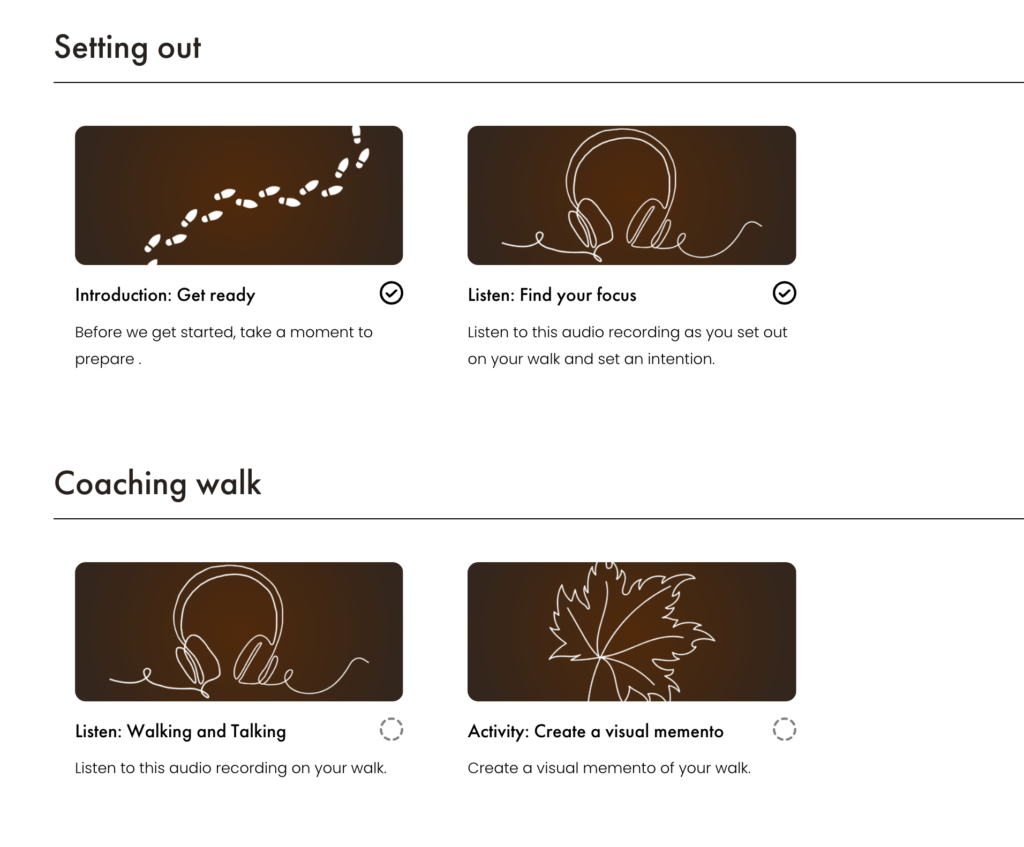
    The format is quite straight forward: it’s a mini online course in six parts, which covers setting out on the walk, the actual walk itself and coming back again. The screenshot of the course overview gives you an idea of the structure: each section has a narrative and activity as well as an audio recording to listen to (which you can download to listen to out and about).

    Screenshot of the course
  • Coaching tips from my year of 10k races

    Coaching tips from my year of 10k races

    This year I got back into running, and regular readers will know that this comeback has been years in the making. I started blogging about it in 2022.. and in 2023. So I am pleased to report that I have finally managed to get there! From a personal perspective starting the day with a morning run is a joy for me, and the photo at the start of this post is a snap shot from earlier this morning, as I was jogging down the river near my house and passed my favourite river oak tree. It’s a majestic sight and today the water was clear and still, reflecting the beauty of this glorious sunny morning.

    So it’s a personal win, and it’s also professionally interesting because the coach in me is reflecting on what’s changed this time round? Why did I succeed this time when I have failed to do the same thing since 2021? Plenty of us struggle to stick to habits or achieve goals, and so I want to use my example to share some coaching tips that have helped me along the way.

    Picking the right place to start

    Now, I love running but I also have quite a few physical and mental health challenges that can make it tricky for me. From long term injuries to asthma, there’s something to contend with most days. When I tried and failed to get back into running one of the key things I didn’t do was to pick the right place to start. I had high expectations of what I wanted to achieve, and set goals that didn’t take into account where I was starting from. This time round, when I started training again in autumn, I started from scratch. I basically went back to the ‘Couch to 5K’ model and went out for walks with short, i.e. one minute, run elements. And even that felt hard. Step by step, minute by minute, I got a little more movement and felt a little more confident. It took months before I ran the first mile.

    Setting a pattern to build a habit

    The next thing I did right this time was to establish a pattern that was actually achievable. I used an app to begin with, following a simple training plan that had me running three times a week. Three times a week was a lot, but it felt OK. The first week I did all three runs. The next week I did only one. The week after that I managed two… and so on. Over the past six months I probably ran three times a week about half of the time. Some weeks I was sick and didn’t run at all. Or I was on holiday, or work was too busy, or it was too cold. What mattered is that I set an intention that I felt committed to, and it didn’t matter whether or not I actually went for the run, just that I kept trying.

    Choosing a goal (and then repeating it)

    My goal for this year is that by the end of the year I want to be able to go for a casual 10k run whenever I fancy. Once a week, or maybe once a month. I don’t want to feel that it’s a big deal or wipes me out for the rest of the day. And so I decided to sign up for several 10k races throughout the year, 6-10 weeks apart, and keep trying to get comfortable in the distance. So far, I managed to complete 2 of these, and I have another one coming up in 6 weeks, and then two more scheduled in for the autumn. I intentionally picked races that are all local, all 10k and nearly all a similar route, to keep these firmly in my comfort zone. I also wanted to minimise the impact of being injured for a race or having a bad race day. If I miss a race, then I have another one coming up to make up for it. I always found it disheartening when I trained for longe races for over six months only to then be unable to participate when it came to it.

    Making it fun

    One of the key issues I had to contend with over the past few years is that I was simply not enjoying running. There were a few things at play, but basically the fun had gone. So when I set out to get back into running this time round, I tried to make it as fun as possible. The first race I signed up for was a holiday-themed Santa Run, in full costume. Then I made extensive playlists that are so sunny and soulful that I can’t help but enjoy listening to the tunes. A friend suggested doing a race together, and we all went for a delicious pub lunch afterwards. Then we signed up for a beach-side race with sea views. You get the idea.

    The way I want to run, in the morning, by myself, doesn’t really align well with having a running buddy or joining a club, which is why I didn’t go down that route, although I imagine it would have offered a lot of support and motivation. Instead, I am now on track to regain a really precious element of my weekly routine, enjoying quiet mornings whilst clocking up the miles and getting a bit fitter along the way.

    Subscribe to my free newsletter, and get a little inspiration from me every month:

    [newsletter_form type=”minimal”]
  • Celebrating my next coaching milestone

    Celebrating my next coaching milestone

    The professional development and ethical framework aspect of coaching is the main reason why I am an accredited coach via the International Coaching Federation, and since gaining my ACC credential last year, my practice has evolved.

    So when I recently passed my next milestone, namely completing 200 professional coaching hours, it prompted me to take a moment to take stock and publish this update, which picks up the story of the posts I previously published on my coaching practice.

    Blogging about work that is nearly always confidential is a challenge, and as a coach my role is support my client in celebrating their achievements, their progress. It is after all the client who does all the work of moving towards their goals. Being part of that journey, and it isn’t always a straight line of progress from A to B, is hugely rewarding. Working with established clients of periods of months or even years as I have now begun to do has opened up a new perspective on coaching relationship to me.

    Keeping my pro bono commitment

    When I first started my own business, I committed to offering 10% pro bono places for both my 1:1 coaching and courses, enabling emerging leaders to get the coaching they need or for anyone try it for the first time, absolutely free. Over the past year I have been able to keep and even slightly increased those pro bono hours, and I am committed to continuing to do so. I also publish my pricing for individual and organisations up front, so that there are no surprises.

    Exploring my coaching niche

    When I set out to become a coach, I had no idea who I would best like to work with, and in coach training, I pondered much about my so called “coaching niche”. Although I still struggle to narrow it down at times (because sometimes an unexpected client comes along, and they bring an interesting problem to the table), but here is how I usually describe my particular approach to executive coaching:

    My clients partner with me to develop their vision of what they want to change, where to go next or what they dream of achieving. I coach executive leaders, emerging leaders, reluctant leaders, and those that haven’t yet found their way into a senior role… and those who would never call themselves a ‘leader’.3

    What my clients all have in common is that they are prepared to be curious and open to exploring what’s next. They want to make a change, but maybe they are still figuring out what to do or how to get there: whether that’s a career change, growing an organisation, developing as a leader or achieving a milestone goal.

    Together we identify what needs to change and then work out a plan of how to get there. As the coach, I am the trusted thinking partner with whom my clients can think through challenges and roadblocks. Creativity is at the heart of meticulously informal leadership coaching and each coaching engagement is as unique as each individual client.

    Recent coaching CPD

    • Coaching Ethics: updating my understanding of coaching ethics, especially as I work more with groups of leaders and within institutions.
    • Workplace Wellbeing: it is really interesting to see what other coaches are doing in this space, especially on a larger scale across industry and Higher Education. Unsurprisingly AI plays a role, which I am skeptical about.
    • Team Coaching: this is a relatively new area of professional coaching practice for me, as I have started to coach teams and groups and run coaching based courses over the past year.

    Curious about coaching with me?

    Head over to my coaching page or find out what clients say about coaching with me. I always offer some free initial sessions to help us assess whether what I can offer is a good fit for you, so get in touch to arrange a free initial chat to see how I can support you as a coach.

    Subscribe to my monthly newsletter!

    [newsletter_form type=”minimal”]
  • Reflect, reframe, regroup. Inspiration for when life is messy.

    Reflect, reframe, regroup. Inspiration for when life is messy.

    I struggled to find a title for this post, because describing what it is about will lead to expectations it is not likely to meet. This post is about how to stick with things, be they new habits or intentions, plans or commitments.

    In my work as a coach I often read and share books about habits and how to stick to them, and there is a huge wealth of information out there about how to be more productive from the ever popular Atomic Habits by James Clear to Oliver Burkeman’s Four Thousand Weeks and so on. I go through phases of finding one of these titles or authors that really chime with me at a particular time in my life, and I love their approach for a while, find the inspiration I am looking for and… move on.

    Alongside the books there is an army of podcasts about the same subject, and I am guilty of adding to the genre with my own weekly episode of Leading Virtual Teams. Through my coach training I have discovered a lot of amazing coaches many of whom share their expertise on habits and productivity on their shows, and my favourite of these is Katie Linder’s podcast for Higher Education professionals, You’ve Got This. Katie led the coach training I completed and I find her particular mix of reading, writing, being creative and productive really appealing. Definitely a recommended listen!

    But…

    And yet, of course, there is a but… . Because life is messy. Life keeps changing, and evolving and however much the data we collect through the devices and platforms we use would like us to believe otherwise, moving forward is not always a straight, upwards curving line. And not every season of life can be productive. I recently read a wonderful book, Ebb & Flow by Easkey Britton, which beautifully explored the concept of periods of ebb in life as necessary and valuable.

    That’s where for me conflicting desires arise: one the one hand I understand and appreciate that not every week, month or year can be super productive. Sometimes life just gets in the way. On the other hand, I am very used to pushing ahead with things or sometimes have a sense of being behind already, feeling frustrated and keen to make a change. At times like that, I use a couple of approaches to help find a path through the messy reality:

    Reflect: Need vs. want

    First, I find some headspace to reflect on what I need versus what I want. I think best when I actually write things down or talk to someone about it. Here are some prompts to think through this:

    • What do you want more of?
    • What do you want less of?
    • What would make things lighter?
    • What do you need to prioritise?
    • What do you need to finish?
    • What do you need to pause/stop?
    • What do you need to start?

    Reframe: Essential vs. desirable

    Next, I try to reframe the situation, to look at things in a different light. My own high expectations or sense of accomplishment is often the biggest barrier to feeling contentment, so my aim here is to be very clear with myself what is absolutely essential to accomplish and what is desirable. I often find that things drop off my plate once I can clearly articulate to myself what I really need to do, rather than all possible things I could be doing. Here are some criteria I use to sort things into the two buckets:

    • Essentials often are: time sensitive, external (i.e. someone else is waiting for this), income generating, high impact
    • Desirables often are: open ended, internal (i.e. only I wait for this to happen), unknown/low impact

    Once I have sorted my long list of things to do into these two categories, I take a look at what I identified in the first step, needs vs. wants and check that everything makes sense. For example, if I have a writing project I absolutely love doing and it helps to get me out of bed in the morning, then it might move from desirable to essential. Likewise, if I find I have overcommitted myself and I need to say no to more things, I go over my list of essentials again to identify things I can finish quickly or stop all together.

    Regroup: Grind vs. joy

    Then, I look at the practicalities and set out to tweak things to prioritise joy. What that looks like may be different for you, but these starting points should give you a sense of what to consider:

    Determine how many weeks stand between you and your next break. How long before you can take time off, go on retreat, travel or something else that offers a break from routine for you. A break, whether a change or a rest is essential to my mind. If you find there’s no let up in sight, take a moment and think hard about whether you can change that. What would it take to get a few days off?

    Once you found out how long you have to go, add a countdown to your calendar or other app.

    Then take a look at each week ahead of you. In my case I found certain days of the week in which I had much fewer commitments, so I moved things around to block out time for what I wanted more of (in my case creativity and time to get outside). I also took a look at what would be the hardest/busiest of times and started to schedule some time and activities around those days that would offer me some balance.

    Time to rest, read, walk the dogs and so on.

    I saw a post recently my a fellow coach, Mrs T, who coaches Headteachers, and in it she described how when days got very busy, her initial tendency was to fit in even more in any moments of calm. Fit in more tasks during breaks and taking work home in the evenings or at weekends. She then shared how nowadays her instinct is to step back and take a breath instead. I could really relate to that. When things get hectic, I used to try to be more productive, more busy still. The steps I have outlined above, to reflect, reframe and then regroup offer an alternative to being ever more busy. In that direction burnout looms.

    I hope you find more pockets of joy. Even when life gets messy. Let me know how you get on.

    Related posts

    Subscribe to my free monthly newsletter:

    [newsletter_form type=”minimal”]