Category: coaching

  • The One Percent

    The One Percent

    What will it take to make your day 1% more… of what you need?

    Working life for is busy and keeping a grip on things takes a lot of energy and focus. So what do you do when you grip on so tightly that you can’t see beyond what’s in front of you?

    This post is inspired by some recent coaching sessions which prompted me to reflect on how you can make small, incremental changes when adopting a new healthy habit or tackling a big change may seem out of reach. What would make a real difference to my clients, either in the way they work or how to disconnect from work?

    Listen to the podcast episode

    Starting with very small increments, even just 1%, can lead to quick wins and solve niggling issues along the way. Whether you feel like trying out a playful or pragmatic approach, you can always find ways to make yourself 1% more comfortable, even on a bad day. And along the way, you might gain a little more awareness and distance from being lost in digital productivity curves.

    Getting started

    Here is a little inspiration to get you started. Make a small change, or maybe two, and see how things shift:

    Add a sprinkling of analogue…

    • a plant
    • a nice coaster
    • photos/pictures/art
    • a rock or shell from somewhere you like
    • record player
    • scented candle or a diffuser for aromatherapy oils
    • music
    • new flavour hot (or cold) drinks to try such as new herbal teas or coffees
    • a secret snack stash (healthy or not)
    • something tactile like a soft throw or a fidget toy

    Get 1% more comfortable…

    • a new mouse mat or a mouse you like
    • wrist rest/mouse rest
    • glare protector
    • foot rest (cushion or yoga bolster can work, too)
    • headphones that suit your ears
    • eye mist and glasses that help filter blue light
    • a water bottle
    • cleaning products for your workspace, i.e. eco wipes, disinfectant, screen cleaner
    • find a window sill or high shelf you can use as a place to have meetings with your laptop or a sit stand desk or desk shelf

    Step away from your screens

    • an alarm or similar that reminds you to take regular screen breaks
    • a physical reminder to go to a different room/downstairs/outside
    • cushioned slippers or shoes (particularly handy for standing desks)
    • a paper planner/diary you can use away from the screen to think/plan
    • a lunch date/appointment with someone away from your desk
    • plant care
    • play with your pet
  • The Power of (the right) Prompts (Part 2)

    The Power of (the right) Prompts (Part 2)

    In my last post I explored how a journal of professional practice can easily turn into a superpower at work. Whether you are writing by hand, typing away on your laptop, dictating into your phone or sketching with pen and paper, I am a BIG fan of journalling (and after over 30 years of journalling for both work and in my personal life, I have tried every which way to make it work).

    As a coach, I often work with clients who just need to find the right way to articulate their thoughts, and once they’ve unlocked that, they are good to go. You know it’s working when you are able to sustain a reflective journal when you need it, and over time it becomes a habit that turns into a superpower: for example, I find it helps me enormously with gaining perspective, making a big decision or finding my path forward that I can revisit the pages I wrote on my first day as a CEO or the day I got my PhD. I can also revisit times when things were tough, like during the pandemic.

    But… what if the thoughts don’t come?

    Some of my clients find that regardless of the approach they use, words don’t flow. It can be hard at times to know where to start or what to reflect on. Instead of finding clarity or deep reflection, you end up narrating days, or making lists of things to do. Or maybe you are just staring at a blank page, and your mind goes blank.

    If you find that a particular method doesn’t unlock things for you, I would suggest you leverage the power of prompts, or rather, the right prompt for you. Prompts are powerful and can be transformative to our thinking (which is why so called “powerful questions” are the foundational tool in coaching and coaching leadership).

    A few years ago I struggled to effectively reflect. Finding the right prompts for your context can be difficult, so I looked for inspiration in Warren Berger’s The Book of Beautiful Questions, Hermina Ibarra’s Working Identity and Elizabeth Gilbert’s Big Magic.

    I found three types of prompts that helped me and subsequently many of my clients through this kind of block: first, prompts that related to the physical self, next prompts that help identify tangible examples and last, prompts that helped us understand our reactions to situations.

    Example prompts and why they work

    Prompts that help you get out of your own head

    In much of the work I do I coach and train highly skilled professionals who spend a lot of time in their head. I can empathise, as it’s one of my favourite places to be as well. That said, being in one’s head isn’t always conduce to reflective journalling or finding clarity. Which is why when I am stuck, I find prompts that relate to my senses or focus on my physical self super helpful.

    Example prompts to try:

    • What physical signals do you perceive when you contemplate this decision?
    • How does it feel to be in this place [i.e. an office, a lecture hall, a stage]?
    • What activities give you energy?

    Prompts that help calm overwhelm

    Another common reason why reflection can feel hard is a sense of overwhelm. I often work with clients facing big decisions or very high workloads, or juggling A LOT. In situations like that, everything feels… too much, too difficult, too complicated. That’s when prompts that focus on specific examples can help.

    Example prompts to try:

    • Describe a recent positive interaction?
    • What has boosted your mood or encouraged you?
    • When did you find yourself enjoying an activity or experience?

    Prompts to think through reactions

    One of the things my clients tell me they value the most about coaching with me is to have a trusted thinking partner to think through difficult situations with. To talk about awkward or emotional encounters, and to reflect on how they reacted in the moment. This is a difficult thing to do on your own, as usually the focus is on how it feels. My role is to offer prompts that shift that perspective from how it feels to why, and to help us understand the reactions.

    Example prompts to try:

    • How did it feel?
    • How did those feelings manifest themselves?
    • How did you react?
    • What would you do differently in future?
    • What can you learn from the situation?

    I’m always curious about how the power of the right prompts unlocks reflection and opens up new perspectives. If you have different prompts you use in situations like this, I’d love to learn about them, so get in touch.

  • More than words (Part 1)

    More than words (Part 1)

    A journal of professional practice can easily turn into a superpower at work.

    One of the things I know to be true is that there’s hardly ever a perfect moment when everything is done, your inbox is empty and the ocean of professional life is lies calm and still in front of you; giving you space and time to reset.

    The closest I ever got to the ideal blank slate day is the start of a new academic year, the season of new pencil cases and school starts. It’s my favourite time of year, and I love making plans for the year ahead… which usually turn out to be busy, ambitious and a lot to accomplish.

    I love the perspective it gives me, looking at the year ahead, and planning for all the things I’d like to do, at work and in my personal life. What I’d ideally like is moments of that “blank slate’ feeling or that start of term vibe throughout the year, prompting me to pause and reflect.

    For over two decades, I have used different forms of professional journalling to create just those moments for myself, and post is an invitation to try out some new approaches to this fundamental practice.

    If you’re not a fan of writing, read on, as I have included some approaches below that use voice recording, conversational reflection and drawing, too and I talk more about this on the podcast episode about this leadership superpower.

    Listen on Apple Podcasts

    Keep a journal your way

    Writing Journals

    There is no shortage of journalling inspiration out there: beautiful paper journals complete with prompts and templates, journalling techniques designed to help you reflect, develop gratitude or promote mindfulness and a plethora of apps designed to help you stick with the habits.

    I don’t think it matters how you journal, and any way that works for you is valid.

    Over the years I have come to value:

    • handwriting because it slows down my thinking and helps me focus;
    • being open and honest with myself, no matter what I end up writing and not giving into the temptation to self-edit;
    • changing formats to suit what’s on my mind, i.e. from completely private to sharing with specific colleagues to publishing openly.

    Voice Journals

    f you’re curious about using your voice for professional journalling, this activity is for you: use your phone or another device to make a voice recording (you don’t even need to transcribe or save the recording for it to be useful. It’s the recording practice that’s important).

    Dictation can help you practice articulating your thoughts to someone else as well as to yourself. It also improves self realisation in my case. For example, the other day I felt angry about something and when I said it out loud I realised how angry I really was. It helped me reflect and understand more fully how I felt. The feelings dissipated quickly, but the realisation stayed with me.

    Check out this blog post in which I have given further examples and ideas.

    Visual Journals

    I love the idea of visual journals, and for a couple of years I used little notebooks to make a simple black and white drawing every day. If doodling, sketching, or visually journalling about your days appeals to you, you might like to take a look at Bryan Mather’s approach using REFLECTO-GLYPHS 🙂 .

  • Mentoring and Coaching Podcasthon Special

    Mentoring and Coaching Podcasthon Special

    This is the first year I am taking part in Podcasthon, the biggest charity event in the podcasting world! There’s no money involved—it’s all about raising awareness for various charitable causes and for my podcast, Leading Virtual Teams, I’ll be dedicating this week’s episode to support a charity and a cause that truly matters to me – mentoring emerging leaders with One Million Mentors.

    Podcast Charity Logo

    Out Friday, 20 March!

    Listen to the PodCasthon Charity Special from 20 March 2026. The podcast is available on different podcast platforms and I hope you enjoy the show.

    As always, share your ideas and feedback in the comments, or on social media. If you have a specific questions or comment, contact me . I look forward to hearing from you.

    Learn more about my chosen charity: 1MM (One Million Mentors)

    1MM mentoring empowers young people to become the best version of themselves: building relationships – free of assumption and judgement – where they benefit from another’s experience and perspective and can think bigger, find their own answers and take the next meaningful step into their future.

    I trained as a mentor with 1MM a few years ago and in the episode I share my experience and what made volunteering as a 1MM Mentor so rewarding 🙂

  • There and back again.

    There and back again.

    This week I have spent a lot of time on trains. Monday: Cardiff – Sheffield. Tuesday: Sheffield – Edinburgh. Wednesday: Edinburgh. Thursday: Edinburgh – Glasgow. Friday: Glasgow – Cardiff.

    It’s been a joy to connect with colleagues and friends around the edges of a rewarding work trip and I made extra time to see more and connect with some of my favourite people who I haven’t seen in person for a long time. Work travel, when it’s not a weekly chore, turns out to be a lot more enjoyable when you can combine these different elements into one trip.

    I used to travel a lot and was very used to working on the train, and this week reminded me of all the skills I don’t practice as frequently these days. Typing on my lap, tuning out the busy train, and getting things done before arriving at my destination for the day (although I must admit I am getting distracted as I am typing this, as outside the sun has come out momentarily and the beautiful and dramatic landscape of the Lake District is passing by my train window). It was good to be able to keep in touch with my work at Reclaim and complete some assessments whilst on the road.

    Like the travel, in person meetings and facilitation was a really rewarding experience. It was a welcome contrast to much of my work online to connect, coach and communicate in person. The venues for work this week couldn’t have been more different: I visited the Edinburgh Futures Institute, and enjoyed use of a quiet study space to catch up on emails. It’s all tall ceilings, beautiful materials and unexpected views. It’s a lovely juxtaposition to the historic elements of the building and although it cost A LOT to build, it is clearly loved by the buzzing student population that has made a home here.

    Outside view of a student space in the Edinburgh Futures Institute

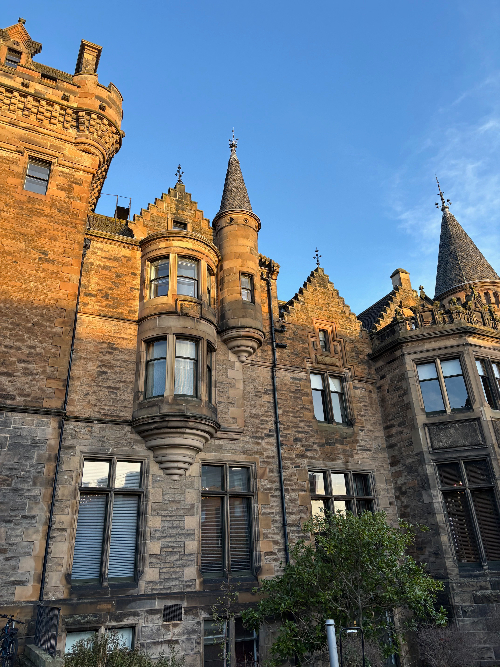
    My main work day, a day of leadership coaching and facilitation, took place in the spectacular St Leonard’s Hall, situation just at the foot of Arthur’s Seat. I always relish the opportunity to facilitate strategy or away days and designing these is a lot of fun, as well as challenging. Working with the team here combines my interest in coaching and educational technology, so it is one of my favourite engagements of the year already.

    Thank you to Melissa Highton and her team for having me back again 🙂

    The historic facade of St Leonard’s Hall

    It was lucky indeed that many of my former colleagues from my ALT days found time for a coffee or even dinner, and it was fabulous to see my long-time co-blogger Martin Hawksey and Simon Horrocks complete with the rather famous Bailey (he is even cuter in “pawson”) in Edinburgh, as well as Joe Wilson, Sheila MacNeill and Lorna Campbell in Glasgow.

    It’s invigorating and feels important to swap tales of what it’s like to work in education and technology in 2026, and have a chance to talk about all the things that Zoom meetings just don’t seem to be suited for.

    My trip began with a long-overdue visit to my first mentor, Margaret Bennett, with whom I worked for many years when I first became a CEO. We met in a cafe in Sheffield, in exactly the same spot as we first met in 2012. Margaret has been an enormous inspiration to me throughout my career, and her incredible support for me as a leader has certainly had a lot to do with me stepping into coaching and mentoring EdTech leaders and leadership teams on a professional basis.

    Ending January on a high inspired by such varied professional and social interaction has encouraged me to plan more such trips for the coming year, and reminded me powerfully just how much I sometimes miss the energy of in person interaction. More blogging to come on that topic in the coming months, I am sure.

    I hope your January has had some bright spots, too.

  • Co-Leadership: Fruits of Collaboration

    Co-Leadership: Fruits of Collaboration

    At the moment, there are a lot of senior leaders moving jobs, either switching to new organisations, moving to a new sector or setting up their own businesses. Many of the clients and communities I work and connect with are thus having to navigate change at the most senior level, and get through transitions in leadership and out on the other side again.

    Whilst these types of transitions are never easy, they also bring opportunities to re-imagine what leadership might look like and I am excited to see more organisations exploring less traditional models of leadership, including co-leadership models. Sharing the responsibility of leadership has many advantages, such as two individuals combining their strengths and skills to lead an organisation, resulting in better decision-making and accountability. It’s also a wise strategy for small organisations, especially non-profits, who need to create a more resilient leadership model, and manage risk.

    From a personal perspective, having served in my first CEO role for over a decade in a solo capacity, I think one of the great advantages of co-leadership is that it can make it much less lonely, offering support and trust for each co-leader, and hopefully leading to less burnout and more collaborative decision making.

    One of the areas in which this can be more challenging however is building relationships with staff and members of the board. Especially when times are as uncertain as they are just now, leading change and bringing people with you requires a lot of personal investment, it requires trust and close communication, which means that you need to spend more time on how you get the job done, not only on getting it done. There are a range of conversational approaches that I have used to create the space needed to do just that, including senior team days (in person and virtual), walking conversations and joint blogging.

    If you’re exploring co-leadership approaches, get in touch. I’d love to hear about your experiences. If you are just getting started or looking for fresh inspiration, you might be interested in the podcast episodes below.

    Listen to co-leadership conversations

    One of my favourite interviews to record was this conversation with Marcela Morales and Igor Lesko, Co-Directors of Open Education Global:

    I loved learning more about a co-leadership model they use to run their organisation and how they approach open leadership. It was especially interesting to hear about sharing documents and folders, as an example of very practical ways of embedding openness in their operations. This seemingly small gesture is transformative and symbolises the way they set an example as leaders.

    There are a number of episodes from the past two years that focus on co-leadership and collaborative approaches, including the episode that kicked off the trend, with long term collaborator and colleague, Martin Hawksey, in which we revisit our long term project blogging about leading virtual teams.

    Interested to learn more? Subscribe to my free monthly newsletter 🙂

    [newsletter_form type=”minimal”]