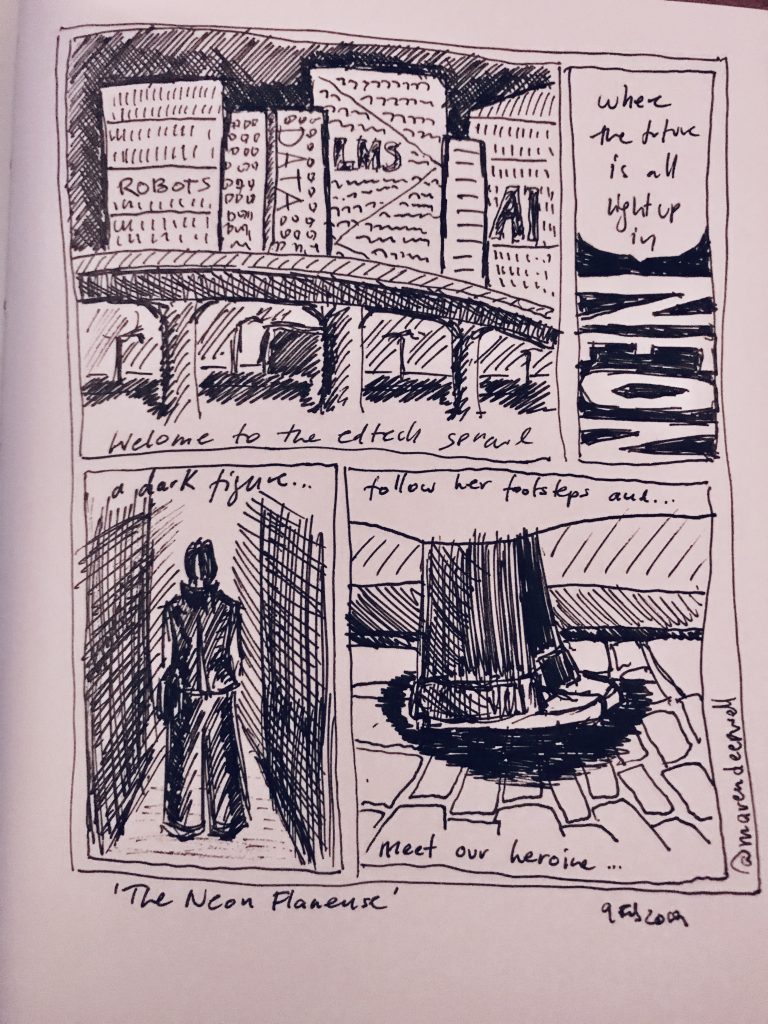
It was a rainy night and the neon lights of the arcades were reflected in the pools of water on the streets… in the air was the smell of wok fried herbs and spices from the street food vendors and a chill wind was coming up from the docks. Above the rushing crowd of late night shoppers and workers hurrying to the train home stood the towering office blocks and residential high rises. … Welcome to the edtech sprawl… where the future is all light up in neon… a dark figure… follow her footsteps… and meet our heroine:
The ‘Neon Flaneuse’ 2019
Welcome dear reader…
This is the first post of a brand new blogging project and that’s a special moment. But before we jump right in, here is how this all began:
The idea of the Neon Flaneuse was originally inspired by the Call for Proposals of the Domains19 conference for which I wrote the following submission:
The Neon Flaneuse: taking steps towards empowered professional practice
The flaneur or flaneuse, a person who saunters around observing society, a loafer, a lounger, was a popular figure in 19th century Paris. A model of the urban explorer in shopping arcades lit with gas lights. Walter Benjamin later popularised the figure of the flaneur in his Passagenwerk as an archetype of the modern, urban experience.
The flaneur combines a keen sense of observation and curiosity with a the slow pace of leisure and contemplation. A tortoise, the preferred pet of the flaneur, could set the pace of exploration. Yet as the industrialisation of cities increased and the pace of life grew more rapid, the figure disappeared. Enter: the neon flaneuse, the explorer of edtech sprawls who turns her critical gaze on the rapid pace of innovation, who poses questions about our relationship with technology, data and an uncertain future.
This short talk lights up in neon light not students or institutions but the people that make it all happen: whether your work is teaching, technology or training others, you can take steps towards empowered professional practice by exploring:
How to work in the critical age of educational technology?
What are the risks and upsides to working, thinking and reflecting in the open?
How can we promote equality through empowered professional practice?
Like the flaneuse of the 19th century, it can feel like we are running out of space to wander, explore and ponder and out of time and privacy in a world of social networks and constant connectivity. Like the flaneuse of the 19th century we work in a context where the dominant perspective is still that of the privileged, male, white classes – a gaze that we need to develop awareness of and critical approaches to challenge and subvert.
The final avenue of exploration will be the growing #femedtech network, a professional network curated via the @femedtech Twitter account. As one of the volunteers active in the network I will share ideas and lessons learnt as well as a call to action to get involved in promoting equality for everyone in educational technology and establish a more empowered professional practice in the process.
So join me and the Neon Flaneuse on this saunter through the edtech sprawl of professional practice as we explore how we might light up the future. Hoverboards welcome 🙂
… As it happens, I wasn’t able to go to the conference or deliver that session as planned, but I liked the idea so much that it kind of stayed with me. At the same time, I have been thinking about how I could make something more of my fledgling thoughts about edtech, art and anthropology.
So this newly minted blogging project, which will hopefully become a sketchbook of drawings and words and maybe even GIFs, is a bit of an exercise in connecting the dots between my different academic interests but also a prompt for me to think about educational technology in a different way, taking a step back from the work I do day to day.
It’s the darkest time of year and like many I sometimes struggle to find ways to express my thoughts or find the will to keep writing, to keep articulating and sharing, to use the voice I have and value it regardless of what else might be going on. So as well as being about art, anthropology and edtech this is a venture of joy and resistance.
I want to use the metaphor of the Neon Flaneuse to explore, to wander, to get lost in new ideas and ramblings. To create something that will give me joy and provide inspiration. It’s about the kind of alternative futures, the hope that Laura Czerniewicz so eloquently searched for (and found) in her OEB keynote. It’s my way of thinking about the stories that Audrey Watters reminds us we need to tell about edtech, its history, theory and its future. Our future.
I’m not sure where this will go over the next year and that is a good thing. I have this big blank canvas on my own domain to play with and I’m going to follow my feet and see where it takes me, tortoise in tow.
Soundtrack for this post: A rainy night in Soho by The Pogues – further listening suggestions for the playlist are welcome 🙂
Now, an ‘I love me’ wall is something Jim Groom introduced me to, ‘basically a space dedicated to all the stuff you’ve done..’. And I’ve come to embrace that concept wholeheartedly in my work space at home. Home working has never looked so stimulating and that’s a major plus on days when the heating is broken, the cat has been sick on the carpet and the doorbell rings with yet another delivery for next door.
In that spirit, this is the ‘I love me wall’ of the past year, celebrating the stuff I’ve done, been part of, am proud of and am inspired by…
Photo by Sandra Huskinson (@FieryRed1)
One of the absolute highlights of my year was giving a keynote at the Social Media for Learning in Higher Education Conference in January, which led to conversations and collaborations that last for the whole year including this excellent webinar Academic online identity and social media .
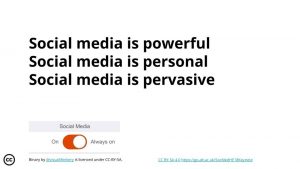
I really enjoyed working on this ‘keynote in three hashtags’… it was a great way to start the year, thinking about how social media often comes with a general sense of the superficial, showing just the best side of myself, trying not to avoid being vulnerable for social media can be a toxic space for many, particularly for women, for people of colour, for anyone whom the trolls choose to single out. The talk focuses on three questions:
How is social media changing professional practice?
How does social media support openness in education?
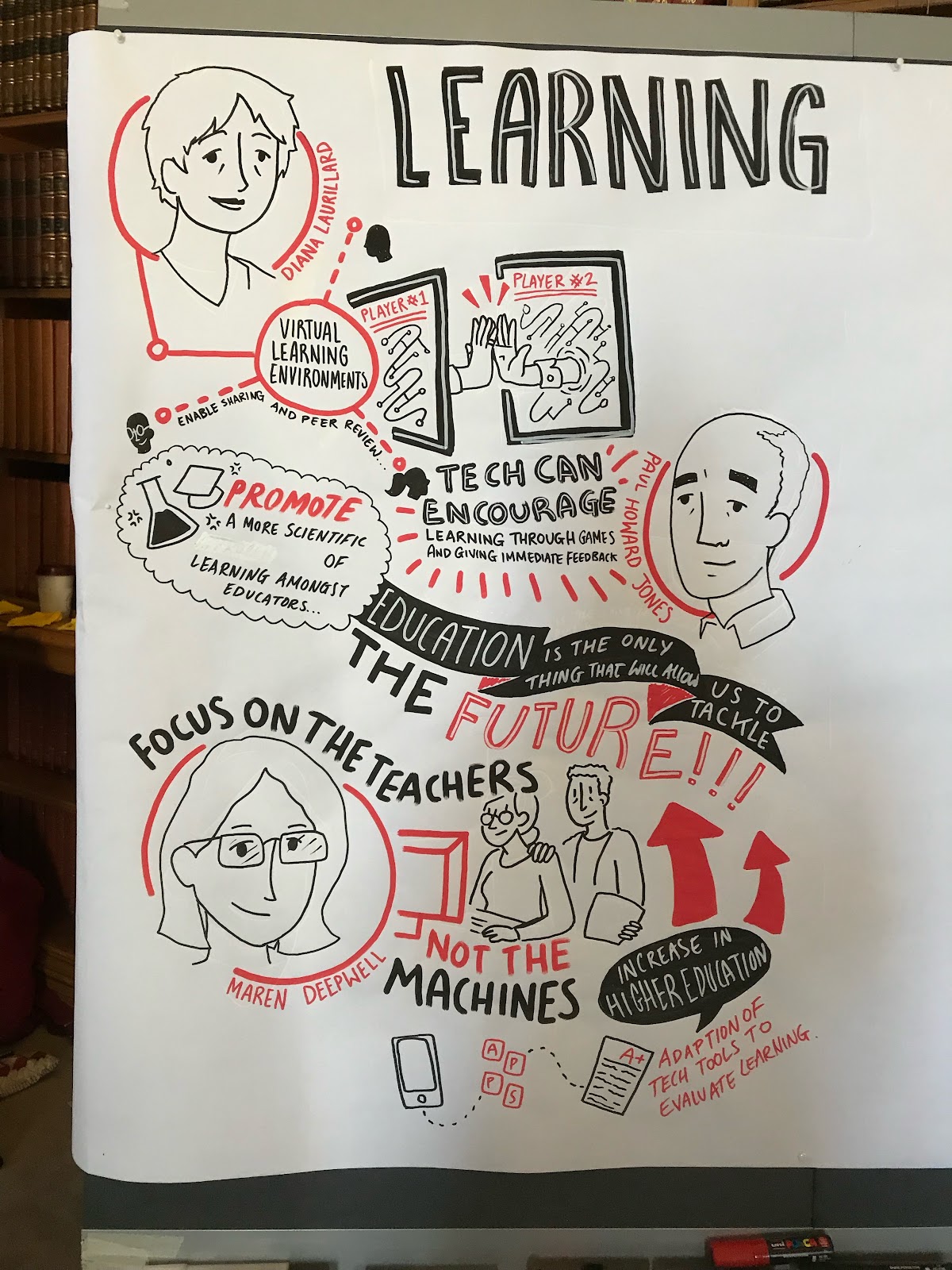
A completely different kind of conversation started a month later, when I took part in a panel discussion at the Royal Society in London on Human Transformation Remembering and Learning alongside Diana Laurillard and Diana made a point that really resonated with me: Diana reminded us of the enormous scale of the demand for education (at all levels) worldwide. Diana reflected on how many hundreds of thousands of teachers will be needed to provide education and training as more and more learners in the global South in particular gain access to education and come online.
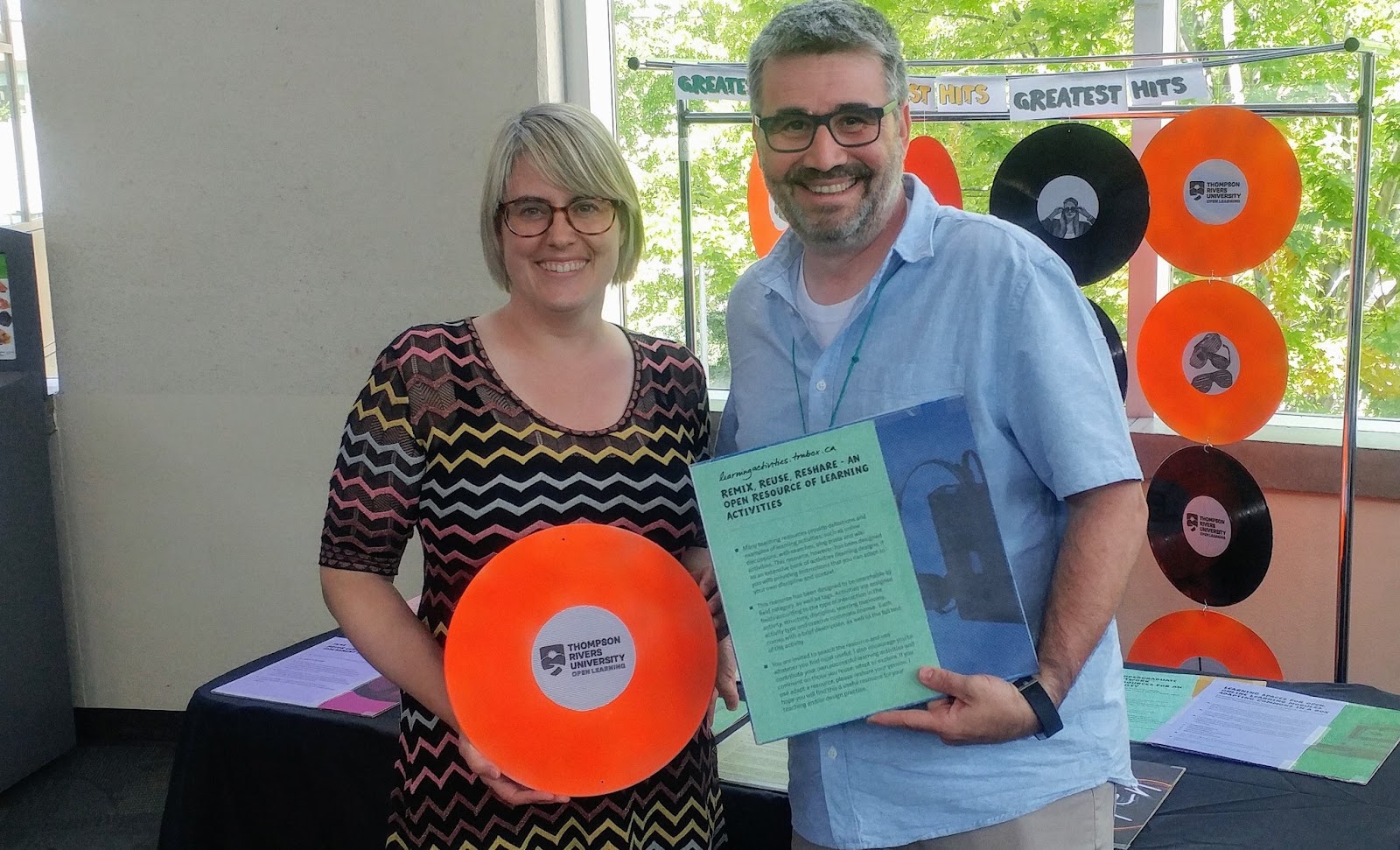
Keynoting at the RIDE Conference. Image: Sarah Sherman
It was the interplay between learning and technology, how they effect each other to change our understanding and our practice, that is of particular interest. One of the areas of high priority I discussed is measuring learning, an interest in assessment and in a wide range of methods to quantify, track and chart all aspects of the learner experience. There is always a promise that with enough data and dashboards we can gain insights, leverage the power of learning analytics to understand more about how what we do impacts on progress, skills development and learning outcomes. It is up to us to develop our own capabilities in order to be able to understand fully how the more complex systems we use work, what determines when a ‘red flag’ goes up and how we should interpret and act on the information we gain in this manner. One of the last points I mad in this part of the talk picks up on a section of the 2018 Horizon Report, which describes rethinking the role of educators not as a solvable or even a difficult challenge, but a wicked one, as ‘complex to define, much less address’. This is why I think the work that my organisation does is so important, charting the changing role of professionals across sectors. This particular was a really valuable opportunity for me to explore this further with experts in distance education.
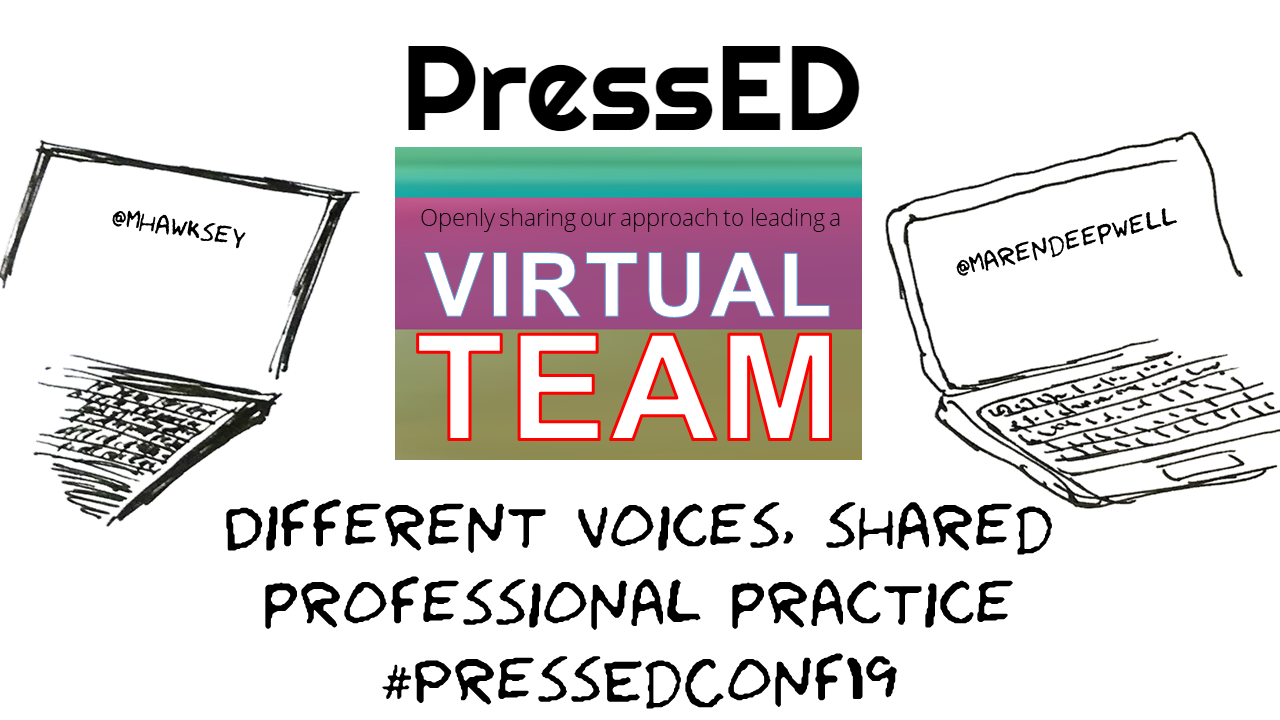
April had many highlights and a particularly special moment for me was to be joining #PressEdConf19 for a session that explored a conversational post format can be used to support reflective practice (read more here). The idea for the session came from an ongoing blog project in which Martin Hawksey (@mhawksey) and I write a monthly series of blog posts to openly share our approach to leadership. You can catch up on earlier posts and podcasts on this blog.
It was a great experience to present at a Twitter only conference. I took part in quite a few virtual conferences this year, as a speaker and a participant and it is extremely useful to have those experiencing when you are have a role in organising events yourself.
May brought both online and in person interaction with the Creative Commons community as I was able to attend the CC Global Summit for the first time and it was a fantastic experience. I have long been involved in the Creative Commons community and various activities but this was my first visit to the event which is at the heart of it all and I was met with real warmth and welcoming acceptance. The creative and joyful atmosphere of the conference, from the handmade designs on the badges to the samba music playing throughout the museum conference venue conveyed a sense of celebration and joy at this meeting of so many in the Commons but also motivated to pull up your sleeves, get stuck in and do plenty of work (and there was A LOT to be done). Here I wrote about my experience in 10 tweets.
Photo: Clint Lalonde
In June I had the pleasure of participating in the ETUG conference in Kamloops, Canada. It was a real privilege for me to be there, to have been invited to contribute a keynote ‘You are more than a data point. Weaving a tapestry of hope and humanity’ to ETUG’s 25th Anniversary Conference, and also to have the honour of taking part in National Indigenous Peoples Day. I learnt a lot from my time in Kamloops and I wrote a couple of posts reflecting on the experience and the keynote I contributed:
“I felt very much at home at the ETUG conference because just like the ALT community it is all about collaboration, reflection and sharing of best practice. After 25 years of working together (celebrated with a great donut birthday cake) this community has come to hold dear very much the same values as I do, recognising the power of sharing practice and research and working together to make change happen for students and staff alike.
And you could tell that this event was very much organised with heart. Little touches everywhere made participants and speakers feel welcome from the start and created a space in which the moving narrative from Elder Mike on National Indigenous Peoples Day found an equally receptive audience as the newest members of the community sharing research findings or #femedtech conversations about equality and women in #edtech.”
This talk was one of the most satisfying pieces of work I did this year and it brought together some different elements of my thinking that I subsequently published as a rewritten article in Educause Review.
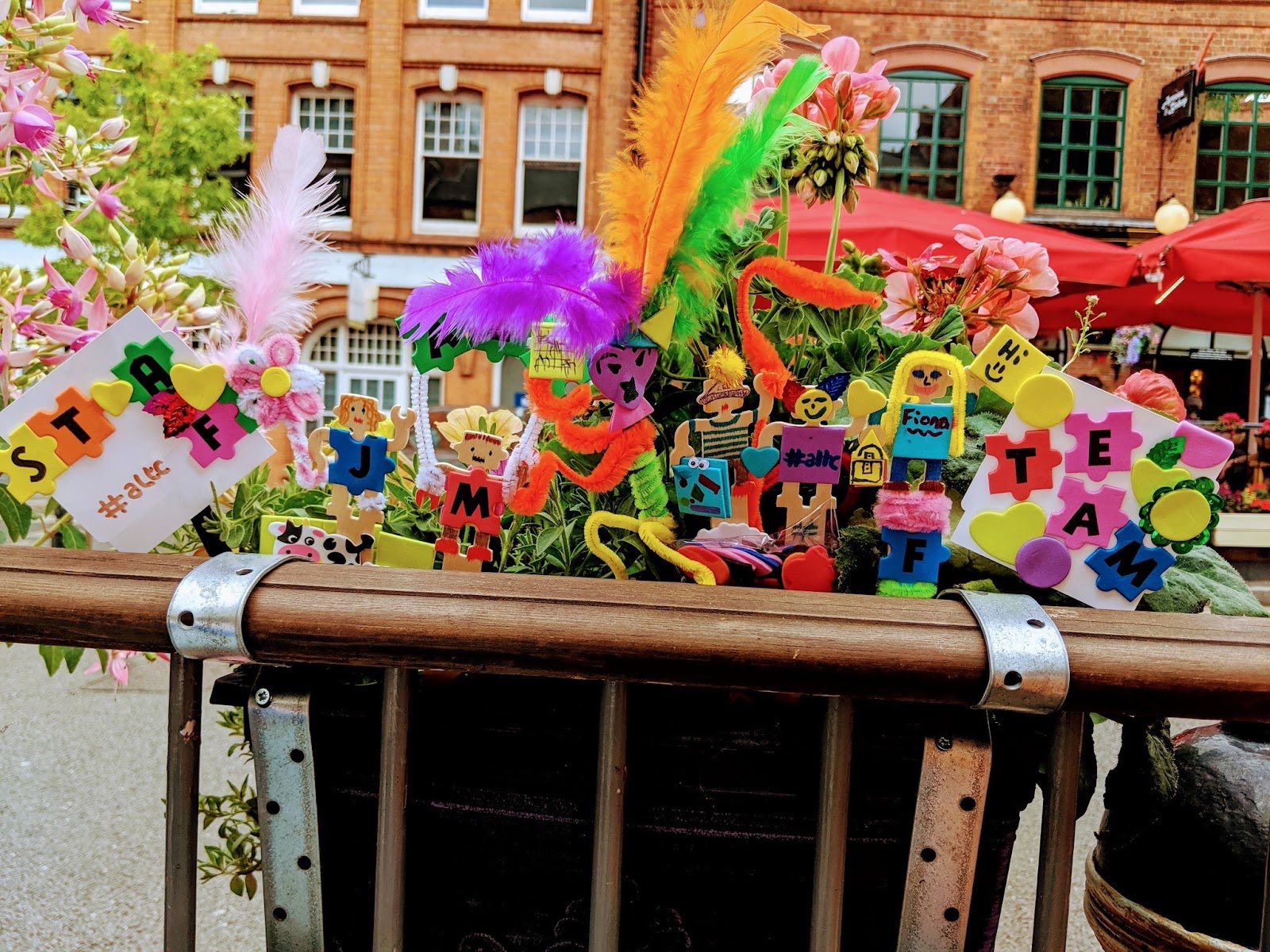
#altc staff team portrait
As you may know, we are a virtual team and everyone works from home (even during a heatwave). This way, we can better work with Members throughout the UK. Being a virtual team has many upsides but one downside is that I don’t get to see my colleagues very often. When we do get together, as we did in July, we sometimes create a team portrait (alternatives to photos as we are mostly a bit camera shy) and this is one of my all time favourites. I enjoy planning our team days and I put a lot of effort into the preparations, just like I would for an event. Writing about the Annual Conference Martin Weller called our approach ‘meticulously informal’ and that captures not just the way we run events but also the way we work together precisely.
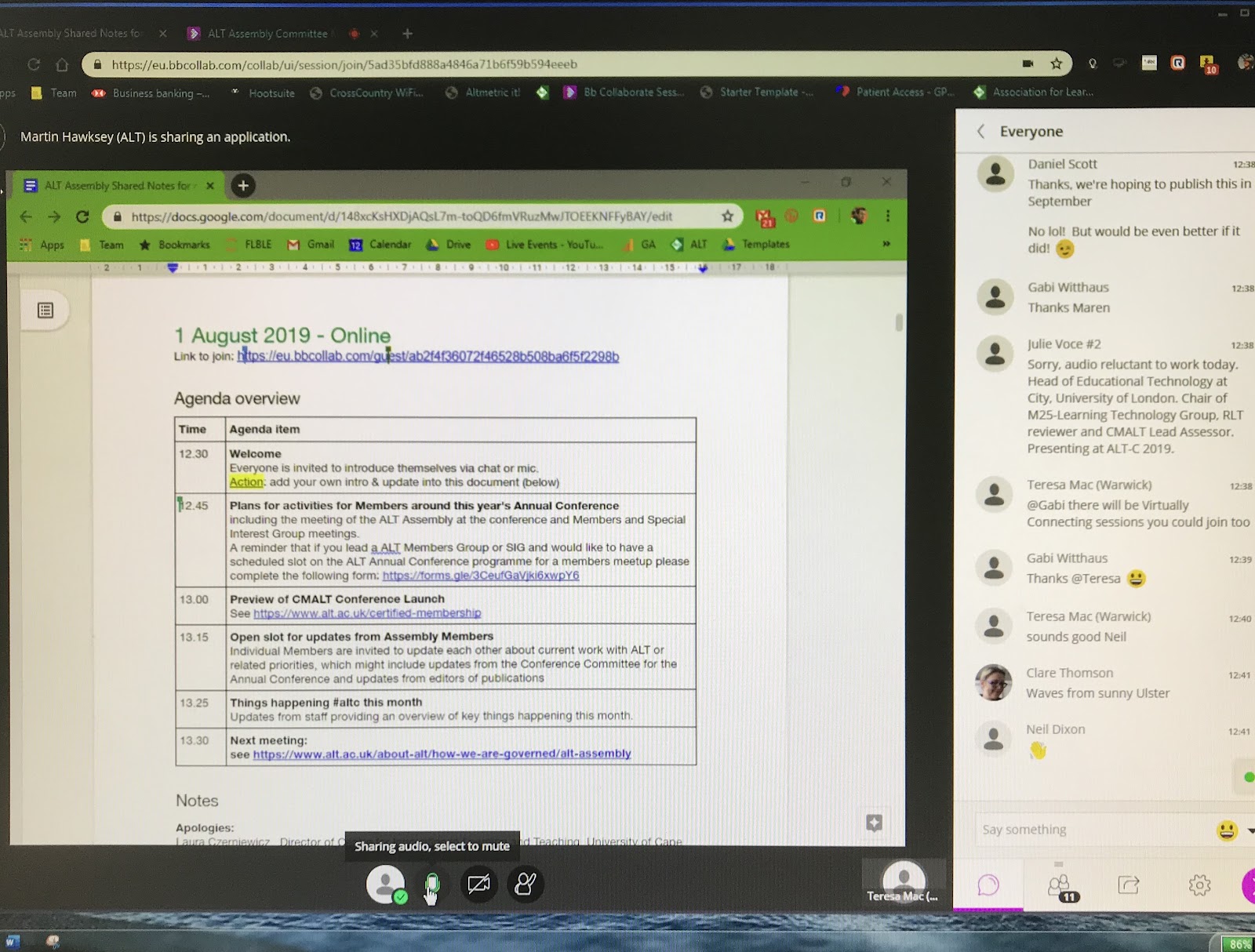
In early August, when the weather was hot and most people were on their summer holiday, I went to our monthly online Members Assembly meeting. Most of these meetings are virtual and the reason why I took a screenshot was that I found it so inspiring that despite the heat, holidays and probably a heavy workload, the room was full of volunteers, engaging, taking action. That’s the secret sauce of building sustainable communities of practice: share power, have a purpose, provide consistent, robust structures and put the time in. Even in August, during a heatwave.
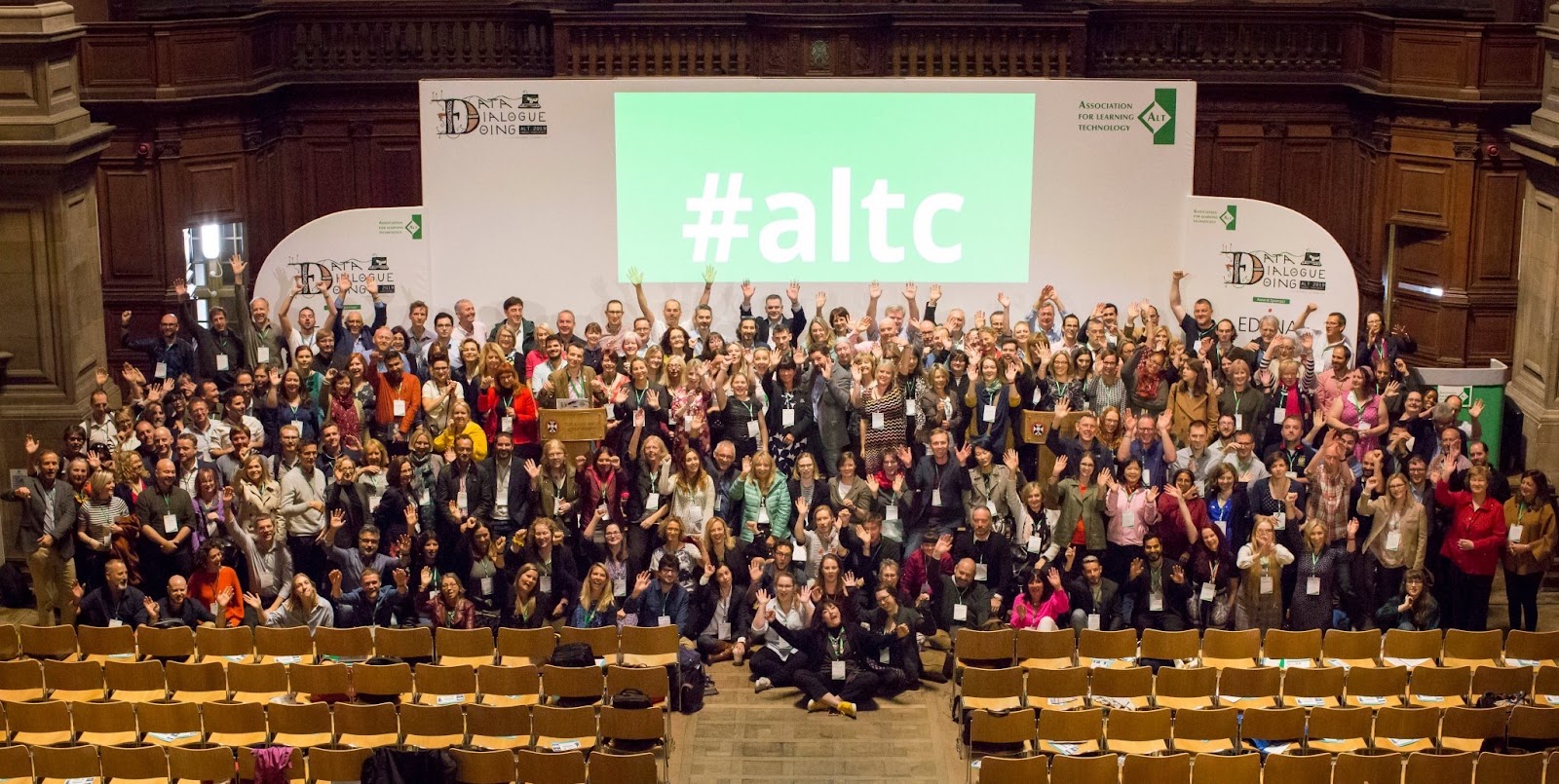
Picture by Chris Bull for Association for Learning Technology on Flickr
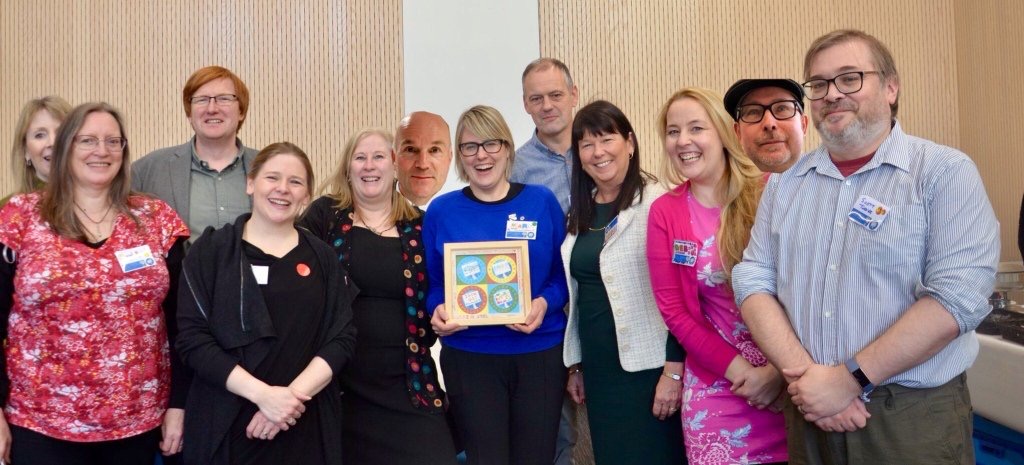
This community portrait taken at the ALT Annual Conference is the first of it’s kind for us. The moment of that photo means a lot to me. It captures a few hundred participants. I keep it on my desktop to remind me each day that we serve ten times as many Members. It helps illustrate the scale of the core community I represent, it makes something that is largely a virtual network more tangible. Over the past ten years I have probably met more than half of our Members in person or connected with them directly online. Each voice matters. My job is to listen and to make them heard.
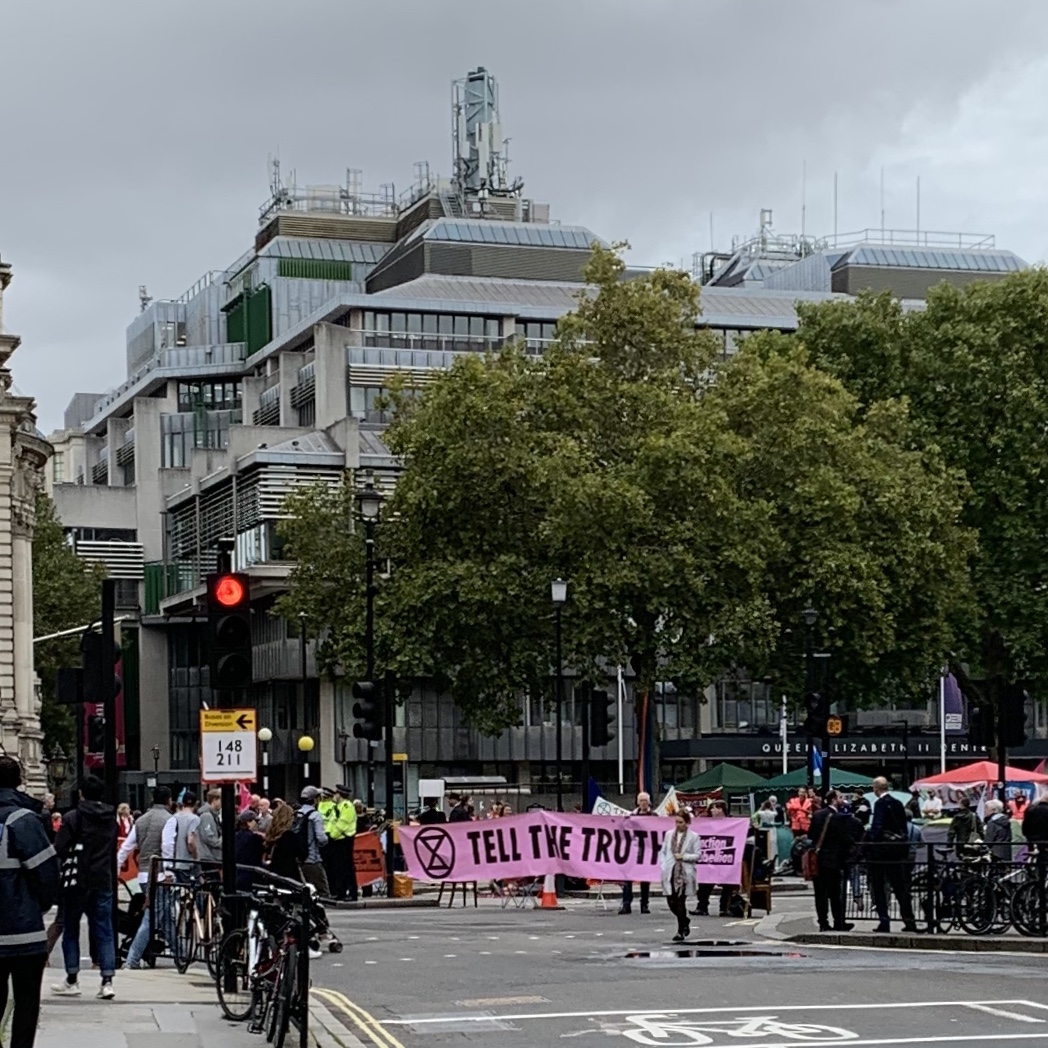
This is a photo I took of the Extinction Rebellion Protest in Westminster on a day I had a meeting with senior Edtech policy officials. We sat inside the building discussing essentially how to make change happen whilst outside, on improvised barricades, thousands were singing songs of fear and hope.
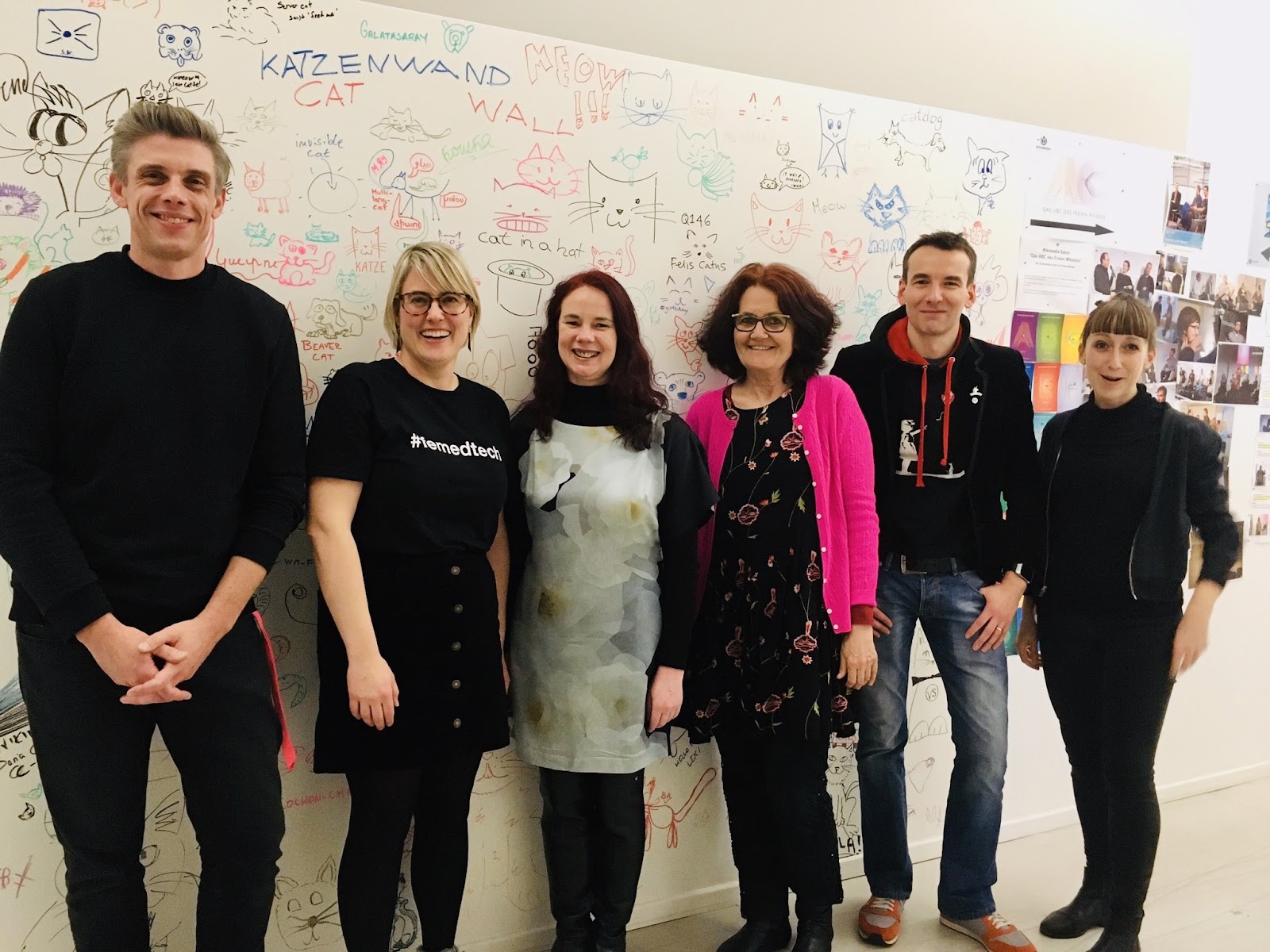
From left to right: Christian Friedrich, Maren Deepwell, Lorna Campbell, Laura Czerniewicz, Martin Hawksey, Christina Rupprecht (at the cat wall, Wikimedia Deutschland offices), Source: Tweet
Working in partnership with Wikimedia Germany I was involved in organising an event in late November, an evening of discussion and debate on education, open participation and democracy and critical reflections. It was a very special collaboration and part of our work for the OER20 coming up in April next year.
There is one more big item to add to the ‘wall’ for this year, and that’s ALT’s Impact Report 2017-20 which was published yesterday. Because, of course, the whole ‘wall’ is green… the tapestry through which bright threads of my year are woven spells #altc.
It is a huge privilege to be a CEO and it most definitely is hard work as well. Being in a leadership position brings into focus all elements of who I am and that is reflected in the way I think and work. Borrowing from my ETUG talk to close my reflections on 2019:
…”That brings us back to my own story, my own perspective and professional journey as a Learning Technologist, an Anthropologist, an Artist, Star Trek fan, a carer and a woman. Some of you may be familiar with the OER Conferences that we organise and with the wonderful work of Kate Bowles who gave one of the keynotes at OER19 this year entitled ‘A quilt of stars: time, work and open pedagogy’. Kate and many other speakers and participants created a strong narrative of hope, a thread of open practice that stitches us together, a tapestry, a patchwork, a weaving together. In her blog post about the conference, Kate described her reflections as “a scrap of practice that makes sense through the labour of others who take time to read it, think about it, share it, ask questions of it, extend it” and I feel her words eloquently highlight all the invisible work, the unbilled effort, that is so often crucial to making change happen, from grassroots activism to academic practice.
And this message of hope and kindness very much inspired my year. It reminds me that … we are all more than the data we create and our professional practice is more than can be tracked in time spent, papers marked or support tickets answered. Our practice becomes fully realised when we adopt a more mature and reflective, a more critical perspective that is informed by our stories and recognises the importance of the labour of others. Communities such as ALT are key to us collaborating and communicating in order to create a future for Learning Technology that is more open and equitable for all, to weave that tapestry of hope and humanity.”
If you don’t think gender inequality (in Learning Technology) is an issue that concerns you, this post is especially for you. Welcome!
For those readers who are already interested in this topic, welcome back. It’s been a #femEdTech kind of year 🙂
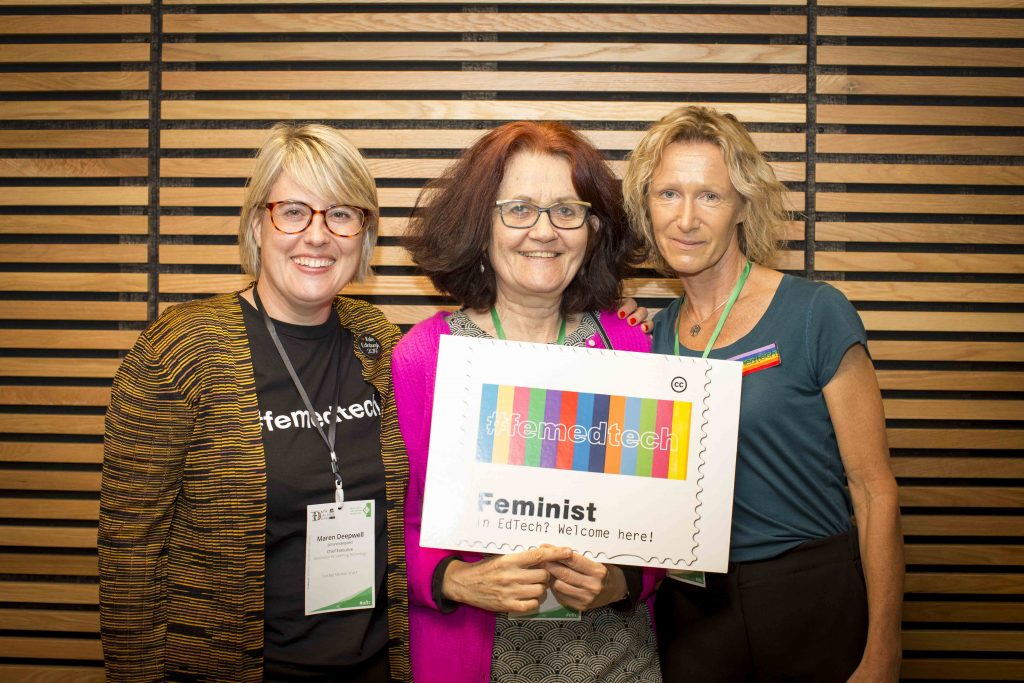
Maren Deepwell, Laura Czerniewicz, Helen Beetham
For the last few years I have been actively involved as a volunteer in community efforts to promote gender equality in Learning Technology but this year my day job as CEO of the Association for Learning Technology took on a decidedly more #femEdTech flavour.
Now, it’s important to acknowledge that gender inequality is certainly not the only issue we are facing in Learning Technology and that there are other forms of inequality and discrimination that we need to continue to address and challenge.
But nonetheless it remains an issue from the gender pay gap to the gender data gap, representation at conferences and on executive boards, in policy making, on social media and so forth.
As I am in a position of relative privilege I can often exert influence over who I work with, who gets invited and who has a voice in what I do. But as soon as I leave my sphere of influence I am back to being the token female speaker on the agenda, the only woman around the table, the woman who gets trolled. Sigh. Sometimes cry. Often shout!
In this post, I am going to share the key pieces of my work on equality in Learning Technology from 2019. I hope they will be useful to you to explore, share, reuse:
My year started at with a talk that brought together the threads of community, openness and equality: Community, Openness, Equality: a keynote in three hashtags #SocMedHE18 (talk, video): Social Media for Learning in Higher Education conference, 9 January 2019.
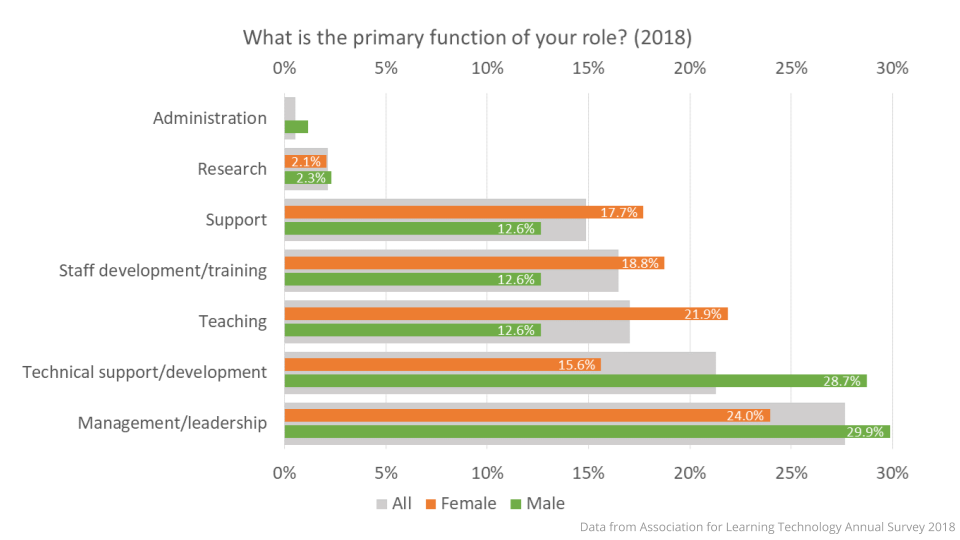
Promoting equality in a distributed organisation, joint keynote with Martin Hawksey for International Women’s Day, University of the Highlands and Islands, 8 March 2019; this particular talk and the work we presented from the ALT Annual Survey provided a basis for other talks later this year, particular in relation to exploring a gender perspective of the professionalisation in Learning Technology, job roles and changes to this over the past 5 years:
“… the only rule is to make use of your voice, to continue to engage and question, not to become indifferent or disengaged no matter how difficult that can seem at times. …It is, for me, a powerful reminder that we each have agency, and that taking part, contributing something that helps others understand our way of seeing the world, our perspective on open, our world view (as a women, as a feminist, as a contributor in my case) is a meaningful and important act.”
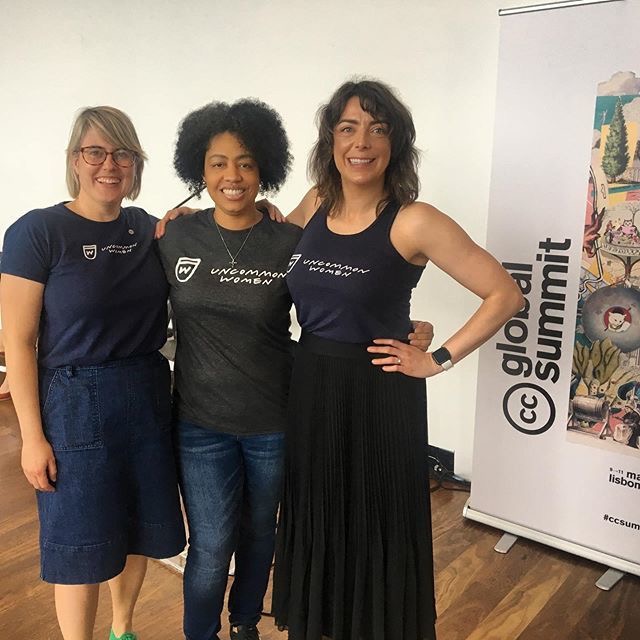
UnCommon Women meet up at the Creative Commons Global Summit 2019
And this certainly isn’t limited to the work we do here in the UK, or even the #femEdTech network, as there are many other communities and projects with similar aims.
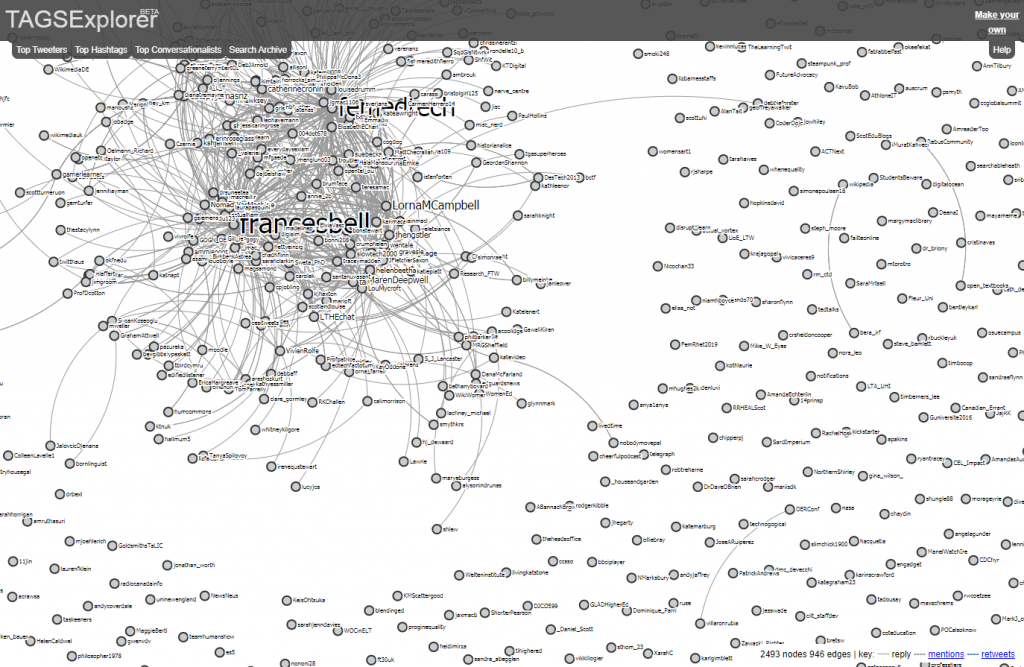
The #femEdTech network is made up of activists all of whom ‘represent’ the network in their own contexts. But we, and who that ‘we’ is changes quite often, get regular requests to write about what we do and I volunteered to write this particular post: Building a Network for Curation – the #femedtech movement, blog post for WCET, 22 August 2019; the post gives a short summary of what the network is, what activities members engage in and examples of the types of things we have done in the past.
And there was a lot of talk of #femEdTech also with Terry on the podcast: Gettin’ Air with Terry Greene, 23 August 2019; which I really enjoyed. You can listen to the episode here.
I also want to reflect briefly on how to challenge the status quo and keep going… .
Male only conference, event, panel? No! I no longer accept invitations to male only events or panels and I always ask to see the list of speakers/full agenda. Many organisers I respond to to ask about other female speakers seemingly have not thought about this. Full stop. In many cases the conversation leads to changes to the agenda to be more balanced and I have plenty of lists of speakers I can refer them to if they are looking for speakers on particular topics. This is an old problem, but I figure that I can be one less person to accept it and if more and more people join in then ‘manels’ will soon be a thing of the past.
Women’s issue? No! As you can see from the list above, this year I started to include something about gender equality in pretty much every talk I have given, regardless of context or audience. I reject the idea that gender equality as an issue should be confined to women’s networks or International Women’s Days etc. It’s everyone’s responsibility. It’s fundamental to the work we do in any sector. Eye rolling, sighing and other ‘oh, here she goes again’ reactions are common. Regardless of how many graphs I show or stats I include to provide a dispassionate, well-referenced and balanced argument, the uncomfortable truth is that gender equality requires change and disruption for every single one of us.
Vote = equality? No! I often come across the perception that gender inequality is no longer a thing. That at least in the UK the fact that women have the vote means that the problem has been sorted. Be content already. This is precisely why I include something to address this misconception in every talk. I’d also recommend reading up on the research (Invisible Women – exposing data bias in a world designed for men by Caroline Criado-Perez is a good place to start).
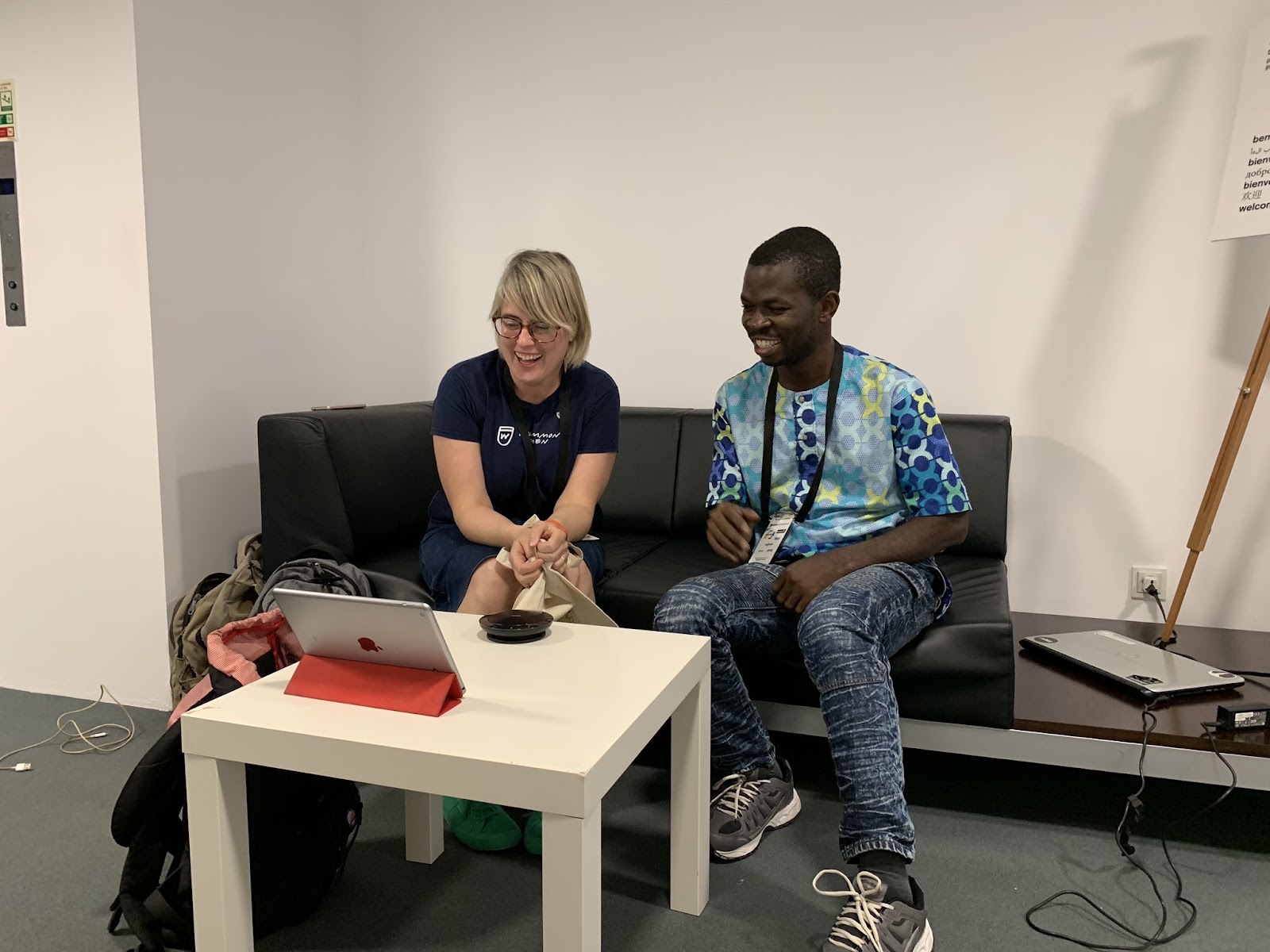
Allies – thank you! I am fortunately not high profile enough on social media to attract a lot of trolling, but keeping up this work year in, year out is hard enough given what I do have to contend with. Luckily I have allies, both men and women and those who identify differently, whom I am grateful for. Every time I hear their voices, see their actions, notice their efforts, I am glad that they are there. Some of them are very visible and others work behind the scenes, but all of them make a difference and they inspire me to do what I can to make change, too. Some moments of this year, like this VConnecting session at the ETUG 25th Anniversary Conference, have stayed with me:
So, gender inequality in Learning Technology, we are coming to get you… from collecting data about pay, promotions and professional practice to calling out harassment, discrimination and ignorance on the web and in the physical world.
Welcome to this month’s post (cross-posted here) in which we, that is Martin Hawksey (@mhawksey) and Maren Deepwell (@marendeepwell), openly share our approach to leading a virtual team.
If you haven’t come across our work before or like to find out more, you can catch up on earlier posts on our blogs, podcasts or find out more about ALT, the organisation we work for.
This time we talk about staff benefits and CPD opportunities for virtual teams, the environmental impact of work travel and discuss the advantages of connecting both virtually and in person.
November
Maren: we’ve done two new pieces of work recently: creating a new guide about what benefits our organisation offers to staff and running the first couple of team sprints. Before now, the information about staff benefits was in quite a few different places and drawing it all together into one doc really brought home to me how much there is! What’s particularly interesting is to look at it from the perspective of leading a virtual team. Funding staff to attend training or CPD events for instance doesn’t in essence change – but it does make a difference where an individual lives, and subsequently which activities make for viable choices in terms of logistics and/or offer opportunities for meeting up in person for a catch up and so forth. Another realisation for me was how much more we now offer in contrast to a few years ago, when our organisation was still hosted within a university. As a team of less than 10 people, being hosted within a large building, a big institution, there was a much stronger reliance on whatever was already being offered, and often that did not meet our requirements. Subsequently a lot of the mandatory CPD felt a bit pointless but used up time. Something you added to the guide was how ALT supports staff to undertake mentoring. I was lucky to have an amazing mentor for many years and I really valued the work we did together. Looking back I realise that my mentor’s support was partly so essential because our internal set up didn’t actually offer what I really needed in my role. Much of what my mentor and I worked on was to navigate the structures we were working within and ultimately to move our organisation away from them. Now, I feel, we offer much more relevant benefits and flexible opportunities such as our weekly show & tell sessions at team meetings, CPD at team days, in-house training and recently virtual team sprints.
Martin: Your comment on staff attending CPD opportunities and where the person lives got me thinking. October/November turned out to be an exceptionally busy month for me in terms of travel. As well as our two day staff and Board meeting in London we were also at OEB in Berlin. In terms of my personal CPD I also had a weekend in Sunnyvale, CA for the Google Developer Experts Summit and various weekend excursions to present as part of DevFest. My Summit attendance was supported by ALT with time off, Google picking up the bill for travel and accommodation. I was embarrassed to tell people I was jumping on the plane for California for the weekend and in my heart felt it was the last time I could make that particular trip given the environmental impact it causes. The thought I have is with the predicted increase in flexible working are virtual or hybrid events becoming more feasible. With a growing proportion of the population confident with a virtual presence what does this look like in terms of conferences? You could perhaps argue it both ways, whilst traditional conferences have greater environmental impact when incorporated into a virtual teams calendar they provide opportunities for social interaction at the levels you can’t currently achieve with technology. ALT has personal experience of a range of delivery modes, both live streaming and supporting remote participation at our face-to-face events as well as fully online events such as the ALT Online Winter Conference, which starts next week and is free to attend. At the end of the day we are incredibly social animals and sometimes you can’t beat just hanging out, in the physical sense, with others. Something to also remember is ALT has a UK wide network of regional members groups and I wonder if there is more we can do to either support these by shifting the balance away from one big annual conference to regional events with an emphasis on allowing those from further afield to fully participate?
Maren: Reflecting on my personal experience, I’ve been on five long(ish) haul flights in the past ten years if you count flights within Europe, and since I started working for ALT in 2008, I’ve attended fewer than 15 events outside of the UK, on average 1-2 a year since I became CEO. Nearly every journey I take is by train and the majority of our team never travel outside of the UK for work. In contrast to countries like the US or Canada, the distances we generally have to manage are tiny and more often than not the majority of us can avoid air travel all together. So from the perspective of our team, I feel we have the right balance … When it comes to larger events, we only run 2 international face to face events a year and probably 50-75 regional or online ones – both centrally and locally organised. Whilst our biggest event of the year does attract an international audience the majority of participants come from the UK and travel by train. The OER conference is probably the event with most air miles to its name, with maybe 50-100 international travellers. And just like you and many of the participants I value that opportunity to connect in person very much. Some of the people who influence my thinking most I might only see once in a blue moon and whilst I share the environmental concerns you highlight, I think there are other strategies to address that at the scale on which we operate … My thoughts are now turning to planning for 2020 and making the most effective logistical plan for meeting in person as a team is a big challenge. Wherever possible I try to plan in such a way so as to save extra travel and combine trips, eg board meetings and site visits or conferences and team catch ups, appraisals and strategy days and so forth. The blended approach we have means that we can find affordances for both modes of working, rather than having to rigidly stick to one way of doing things. On a personal note, I have lived in a different country or far away from most of my family and friends for all of my adult life. For me, being able to connect in person has always been important and whilst I am now more capable than ever before to do so virtually, it doesn’t mean the same to me, neither in a personal context nor at work. I am not sure I would say one is better than the other and I would regret having to give up either.
Martin: I thought I’d do some maths – so working from home rather than my nearest city is approximately 1 tonne of CO2 (according to carbonfootprint.com) which is almost the same as 4 return flights from Edinburgh to London. I’m probably a couple of return flights over in terms of zero gain, but if I opt for rail I could reduce my personal carbon footprint substantially. One of the reasons I often end up on a flight is a combination of needing to be somewhere for an early start and unable to travel the day before as it’s an extra day we have to work out childcare cover. Anyway, this is all very much an aside, but discussing this has made me realise that I need to consider how I travel in 2020, but perhaps there is also something we can agree as a team to make rail travel easier like agreeing a later start time for staff days? Sometimes the small things can make big differences. If we agree on this it will be another detail in our staff handbook which after two years still feels like a robust document without getting lost in bureaucracy. Recently following a request that came into our inboxes I published the ‘ALT Virtual Teams Stack’, which summarised some of the main technology and services we use as part of our distributed team. Again it’s nice to start thinking beyond 2019 knowing we have a well established set of technology and services to build on what we do in 2020 and beyond. As part of our discussions for our next strategy for 2020-2025 one of the questions raised was evolution or revolution. With our infrastructure I feel it’s in a good place so I feel it makes more sense to continue to evolve (our decision to predominantly use Chromebooks also make us more energy efficient). Looking to 2020 and beyond I am looking forward to getting us on the Eduroam network and larger monitors, energy efficient ones of course. Next month we also have a podcast special where we had a chance to speak to Olaf Hubel who is a team leader at Google for the G Suite Developer Relations team, which has thrown up lots of useful guidance so stay tuned for the recording and our reflections.
This is a special #OEB19 post (cross-posted here) sharing our conference session: Leading Change through Open Conversational Digital Practice. In the session the two of us, that is Martin Hawksey (@mhawksey) and Maren Deepwell (@marendeepwell), openly share our approach to leading a virtual team.
As a senior staff team working in educational technology we have worked for the past two years to develop a conversational digital professional practice that enables us to focus on mission-led innovation, develop an open approach to leadership and to lead our virtual team, both digitally and geographically distributed.
In our session we discussed why this kind of practice should happen in the open and why it is important; why and how you, as a learning professional/educator, can try to adopt this approach; and what the barriers you may encounter are.
Do you have your own approaches to open leadership or working in or leading virtual teams you would like to share? If so we’d love to hear from you. Comments on Martin’s blog are open or you can reach us on Twitter @mhawksey and @marendeepwell.
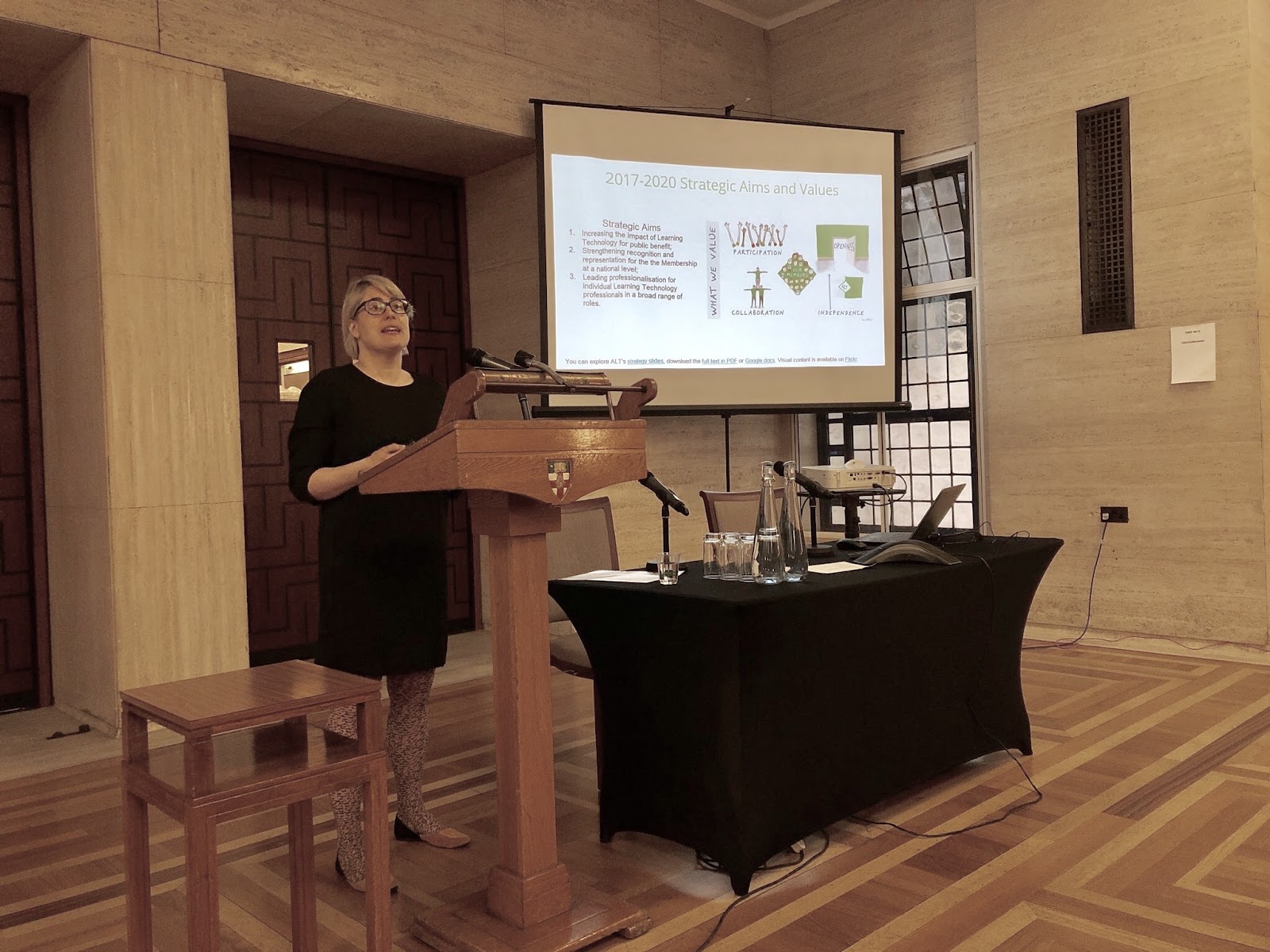
Creating strategies is a big part of my work. Some are small and fit a particular purpose, others span an entire organisation and many years. It’s the second kind that I am currently working on as ALT is half way through setting out a new strategy for 2020-2025.
Our process involves many people, with their own views, ideas and voices and it’s all the richer for it. ALT’s Chair, Sheila, and I, blog about our progress regularly and if you haven’t already, I would encourage you to engage and make your voice heard.
For me, this new strategy will be a living, breathing, practical framework for pretty much everything I work on for the next five years, just as the last one has been. So every ounce of effort, every speck of gold dust that I can help channel into it now, is going to make a big difference further down the line.
A lot of my thinking as ALT’s chief executive develops alongside and through the wider consultation process with our Board of Trustees, staff, Members and the wider network. But there are some things I think through on an individual basis.
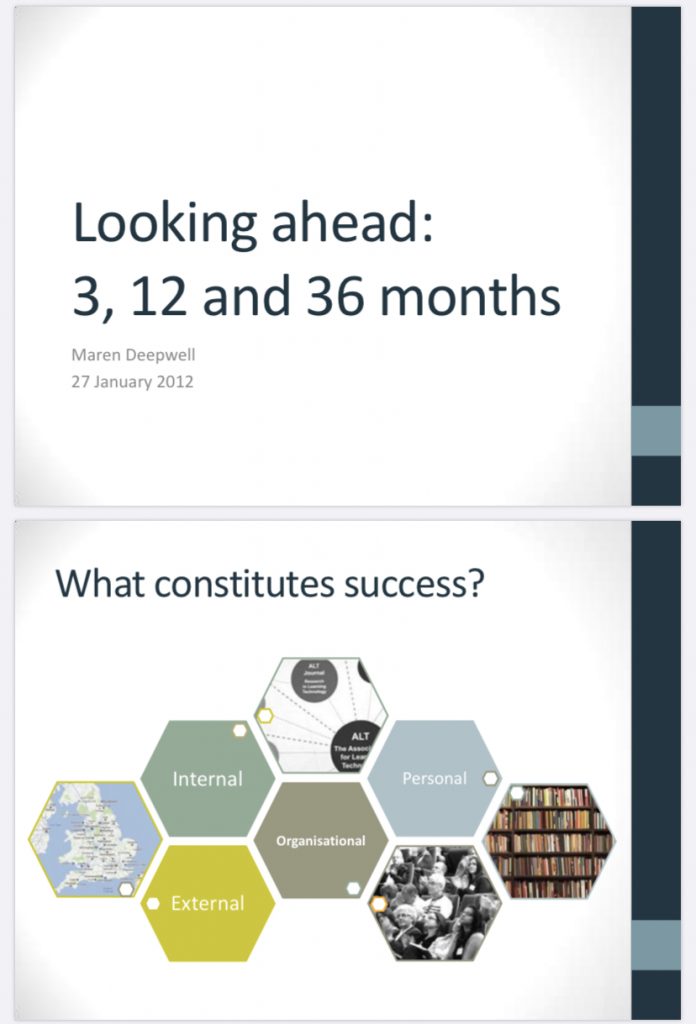
For example, when I applied for my job in 2012, part of the interview process involved giving a presentation about my vision for ALT. I still have that slide deck…
Since then, ever few years when we start to write a new strategy, I sit down, and I prepare another presentation pretending to be applying for my job all over again. It’s a useful tool I find. It helps me to step outside of what I think I already know about the organisation and try to see it with fresh eyes. It prompts me to ignore all practicalities and focus on vision instead. As a new ceo you never quite know what you are going to inherit. How many skeletons in the closet.. how much willingness to change.. what kind of internal agendas that dictate what can and cannot happen. You have an excuse to clean house, to start from a blank slate. A new strategy has a similar power… it can help reset the board. It gives you the freedom to start afresh. It’s an exciting moment.
As we began working on the strategy, one of my colleagues asked me whether a strategy is all about the future. That’s a very useful question. I suppose, in a practical sense, much of the strategy itself will focus on what’s ahead. But in many ways I don’t think creating a strategy is all about the future because you also want to understand, learn from and build on where you have already been. Making meaningful progress and change depends on not ignoring what you already know, problems you have already identified. In many ways it’s the opposite of what Sir Humphries does in Yes, Minister in order to manage his Ministers. Dusting off the same old idea and repackaging it in brand new marketing is a successful way of avoiding change whilst always hailing the next big thing. It doesn’t challenge the status quo.
Change is good to think about in the context of strategies. The more radical your vision, the more work it takes to bring everyone with you. The more things change, the more effort it takes to communicate that change and make everyone notice. Here’s where working closely with the tech sector is not always an easy thing because the narratives of change in technology tend to be about shininess, all about seamless transitions and problem solving. Often I come across sexy must have solutions to problems I didn’t know existed. That’s the kind of change that’s easy to buy in to, literally. Change that takes years to plan and longer to bed in and real effort to implement for years and at scale is far less sexy and so much more meaningful for an organisation like mine. That’s why looking at the landscape, listening to what’s at the heart of the community, taking time to step back and really look at where we’ve come from is so valuable.
I like to dabble in doing some development work. I can’t do the really tech heavy bits, but I like doing design, documentation and bug testing. Sometimes I get too ambitious about how many things can be improved or changed in one iteration, and getting others to test the workflow is a good way of identifying those things and improving the design in response. Strategies are quite similar for me. I start from a point of where I can see we will be in 5 years time and then work backwards until my ideas converge with everyone else’s. Sticking with my tech metaphor, the strategy becomes like a user interface for where we are headed.
The last time we created a strategy the process taught me much about the value of listening and collaborating, of what can be achieved when you work together, share power and responsibility. It was an rewarding experience for me on a personal basis as well as greatly beneficial for the organisation. It also taught me the value of setting aside time to dream about the future.