Author: Maren Deepwell

  • Letter making and reflection

    I have been watching a documentary series recently on the art of design, and one episode about Jonathan Hoefler: Typeface Design in particular captured my imagination. It’s an amazing glimpse into a professional and creative practice that combines material and digital elements effortlessly. Anything from maps in museum collections to books and wooden blocks to visualisation tools and digital pens is part of the process of creating a new typeface, which then is used both in the virtual and physical world. I love watching the series partly because I get to see some of the most beautiful work spaces, kitted out with everything you can possibly imagine and also because the production values of the series are high. It’s a glossy glimpse into the cult of contemporary design. It’s also a refreshing change of perspective coming from a context in which we revisit the tension between digital and more traditional ways of working all the time.

    From the book “Envelopes” by Harriett Russel

    Learning more about typeface design fits in well with two discoveries I recently made: first, a charity shop book find, a volume called Envelopes. This book documents a project, a postal art project, of letters sent via the Royal Mail with extraordinary envelopes. Some of the envelopes are more cryptic than others, and all of them were delivered by the postal service.

    Another recent discovery, and an absolute joy, has been a blog of weekly letters written between two women called ROG & SHINCH A CREATIVE SPACE FOR TWO. I really love the project, which is described as “an exploration of writing, conversation, collaboration and curation” and I have enjoyed exploring the archive of now over a year’s worth of weekly letters.

    The letters share glimpses of daily life, work, seasons and events, thoughts and ideas explored, shared and reflected on. It makes for amazing reading and it also speaks eloquently of the value of conversation and reflection – of making a connection across geographical distance, of setting aside time and space for writing and sharing.

    I’ve written before about my love of letters, postcards and stationary, and setting aside time for writing… and this project has been a wonderful discovery that has inspired me anew to think more about the role writing, conversations and blogging have for me. Significance that is both personal and professional and a reflection of how distributed many of the people who are important to me have been since childhood, from school-sponsored pen pals that grew into long term friendships, to family relationships maintained over great distances to working in a distributed team resulting in a huge volume of letters, voicemails, video calls, emails, blog posts, postcards, parcels… that has steadily grown over the decades.

    The complete mix of different media of communication practice is one of the things I relate to from the documentary series. When I first started writing letters as a child some of the options I have now, such as recording voice messages or sending a DM were not available to me. But even though there is more choice now, what is of primary importance is not the way I write, communicate or reflect but when, how and with whom.

    I am inspired by the work of the creative people who have designed the typeface which renders these words. I am inspired by artists who create envelopes as an art form celebrating the journeys words go on between people. I am inspired by the sharing of conversations such as these two women who write letters to each other. These sources of inspiration form part of the space that my words are part of, where my voice finds room to sound. They remind me that it is important to practice communicating, reflecting, articulating my experience of the world. To keep making letters and to share, contribute, value my thoughts, my voice.

  • Virtual Teams outtakes: Home-worker / house-worker…

    This post, which is an ‘outtake’ from my regular series of Virtual Teams posts with Martin Hawksey, is me thinking out loud about how working from home can lead to doing a lot of housework. I reflect on how to avoid being landed with all the chores because you are based at home and how maybe you can make housework work for you for reclaiming some balance.

    Working from home = doing the work of the home
    When I started working from home full-time, I suddenly started doing lots more chores. I didn’t mean to or plan to and it look a couple of weeks before I even noticed. I was fast turning from a home-worker to a house-worker….! Although I have a dedicated work space, it is also where we dry laundry. So part of my day to day routine from day 1 involved sorting out the laundry in order to clear my work space. Then, when I go to make tea in the kitchen, I see mess. Last night’s dishes. Bins that need emptying. The coffee maker that needs to be descaled. Every time I went anywhere in the house, I saw chores that needed doing. I seriously envy people who don’t see those things. Maybe it is a gendered perspective, too. In any case, being at home also meant I was able to accept deliveries, sort out meter reading visits, engineers, plumbers etc. It became quickly normal for me to do things at home because I was at home. And it sucked up time and energy that I wouldn’t have spent on chores and housework before I was working from home… . It made me realise that in order to find a better way to work from home for myself, I needed to adjust my idea of what my own professionalism means to me.

    Avoiding the trap…
    Now, other home workers may not have encountered this issue or indeed welcomed the opportunity to sort things out around their homes. I did not.
    So as well as building new habits myself (setting aside time to do chores rather than doing them as I saw them, learning to ignore things that weren’t urgent, reminding myself of sticking to my working hours…) I also had to communicate that to everyone around me (no, mum, you can’t come over this morning, I am at work… or no, I can’t do this on Wednesday afternoon, I am working…).
    It took a while, but eventually I developed the awareness to build new habits and norms of behaviour that supported my professional work, stopped me from doing more chores than I need to and helped my family to acclimatise to me being home-based on a full-time basis.

    Upsides 🙂
    That said, there are many upsides I discovered once I felt I had achieved a better sense of balance. For example, going to the post office or popping to the shop to buy milk is a welcome bit of exercise that fits well into my working days. I like getting outside, getting some fresh air and seeing something other than the fours walls inside my office.
    Also, doing laundry and drying laundry gets me up and down the stairs every few hours, and also prompts me to take breaks from staring at my screen – so that’s a win.
    My cat, who doesn’t usually fall into the “chores” category, but who still needs caring, is always good for an unpredictable break and we often end up sitting outside the back door for 5 min and watch the world go by (me) or the birds in the garden (him). The fact that food and water bowls get replenished on the way is a nice side effect of a short break away from my desk.
    What’s also helped over the last two years is learning from colleagues, who have built similar routines and found their own rhythms to their days… so some days there is a flurry of “going to go walk the dog…”, “going to lunchtime gym class…”, “popping to the shops…”, “going for a walk” messages in the middle of the day, when each of us departs for lunch. Walking through the kitchen, I am now perfectly happy to ignore any chores that may need doing. They can wait.

  • Virtual Teams: Strategy unpacked… how being a virtual team is changing our organisation

    Welcome to this month’s post (cross-posted here) in which we, that is Martin Hawksey (@mhawksey) and Maren Deepwell (@marendeepwell), openly share our approach to leading a virtual team. 

    This time we talk about how much strategic progress we have made in the last few years and how being a virtual team has contributed to that. We also discuss our values as an organisation, how we have tried to reduce our impact on the environment and the upsides of being geographically distributed. 

    New here? Catch up on earlier posts, podcasts or find out more about ALT

    September 

    Maren: in our last podcast we talked about approaching our second anniversary of becoming a distributed team. Given that it took a year to execute the transition it was about this time three years ago that the strategy for this organisational change was set out. We are currently in the process of reviewing our strategy so this seems like a good time to take stock: let’s start with money. Financial efficiency was not a key driver for becoming a digitally and geographically distributed organisation but it was part of our strategy to spend less of our resources on renting under-utilised office space and all the costs associated with it, and instead increase resources for the services we provide to our members. Even taking into account one off transition costs, we have been able to redistribute between 5-10% of our annual turnover and that has begun to make a real positive difference to our budget each year. In this series we often focus on our experience of leading a distributed team day to day and in our last podcast we discussed how the distributed nature of our work has become a benefit to how we deliver events. It’s interesting for me to take a step back and see what other benefits it has delivered. Another example is our aim to recruit staff located in many different parts of the UK in order to better collaborate with our national community. We have previously talked about the positive experience of recruiting for our virtual team and how being independent of location has enabled us to attract a much wider pool of high calibre applicants. 

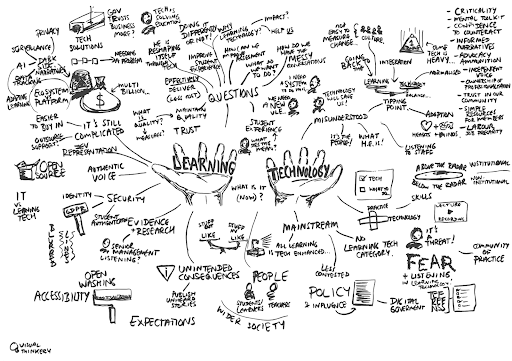
    Image credit: Voronoi by @visualthinkery is licenced under CC-BY-SA.

    Whilst a charity with a staff team of six can’t cover all parts of the country, we are now far more geographically distributed and able to travel to local events and meetings than before. In contrast to only two years ago when nearly the whole team was Oxford based and our ability to support remote working was limited, our reach has significantly increased! That’s two big wins: more financial resources for what matters most and more people power where it makes a difference. 

    Martin: It’s interesting to reflect on the bigger picture and the differences from 2-3 years ago. Something I’ve not analysed but is at the back of my mind is differences in travel and in particular air travel. With a team located across the country more travel is required for us all to come together. We try to be efficient in terms using other commitments like the face-to-face events we run our our Board meetings to minimise additional travel. In terms of whether we are generating more carbon emissions the calculation is complicated because when our office was located in Oxford I would fly down approximately once a month. In a distributed team my need to meet face-to-face is less frequent, but there are more of us to move around the country. In terms of carbon cost none of us need to commute to work. As a distributed team we’ve also greatly reduced our print requirements moving to a virtual filing system. Even our expenses are entirely electronic and we’ve no need to print or post receipts. Some of our changes are by design, others are born from practicalities. For example, I know that you will often take the train for events in Scotland because it is impractical for you to get to an airport. For this year’s Annual Conference it was fortunately on my doorstep making it easier to transport the equipment we require. How much equipment we need varies from event to event, but with the environmental impact or air travel I’m rethinking how our get to our events and meetups. 

    Maren: I suppose it’s all relative.. and there is always more we can do – but having reviewed our operations over the past 3 years, we can see that we have definitely reduced our impact on the environment overall. A different kind of strategic change I’ve been thinking about and which relates directly to our organisational values is creating and using openly licenced content, anything from our strategy documents, call for proposals, photos from events, artworks, member badges and more. The call for proposals and guidance for reviewers have been adopted by other conferences and remixed to fit their purpose, whilst some of our policies, such as our privacy policy, and governance documents have likewise been used by other organisations and referenced back to us. We have also been working with Visual Thinkery to create a number of remixes and those often take on a life of their own in the wider community. For me, these are examples of how our values shape our operations and a contrast to how ALT operated when I first joined. In a recent blog post Frances Bell wrote about her sense of the Association being a generous organisation and that made me reflect on how generosity is a big part of our approach to leadership and one of the motivations behind our open practice. 

    Martin: I’d also read Frances’ post and it was interesting to reflect on whether having a virtual team with an inclination towards “generalised reciprocity” makes things easier. In terms of qualities I think it does make a difference to have people willing to support others particularly when contact time in a distributed team can reduce those serendipitous ‘watercooler’ moments – this is not so say those opportunities don’t happen instead they take place in other spaces, there however has to be a willingness and culture that values sharing and values supporting others.

    Just coming back to the environmental factors for homeworkers. We’ve previously talked about the advantages of working from and having more control on your working environment. At the recent Labour Conference shadow equalities minister Dawn Butler announced a proposed policy which is designed to consider the specific needs of menopausal women in the workplace. As part of this “adjustments that employers could be required to make could include the provision of ventilation facilities”. There are a number of factors that can affect your personal thermal comfort level and research has shown there can be biological gender differences. As the colder weather arrives, so does the annual team chat about our individual workplace temperatures, which can bring its own challenges. These are not just limited to personal comfort levels.  From the Wikipedia page on thermal comfort:

    Residential buildings in particular can vary much more in thermal comfort than public and commercial buildings. This is due to their smaller size, the variations in clothing worn, and different uses of each room.

    So as our team starts the ‘discussions’ with partners over the thermostat there are plenty of opportunities for us to show some generosity towards each other … and pictures of snuggly pets.      

    Maren: I have lots of thoughts about how the seasons impact on homeworkers and on balance I much prefer a working environment in which you can feel the changes in the weather and adjust accordingly instead of being at the mercy of a centrally controlled heating system or indeed working in a building where you can’t open the windows.

    What really struck me however is you talking about an organisational culture that values sharing and values supporting others. I recently had a conversation with the Chair of our Board of Trustees, Sheila MacNeill, where this came up strongly and it resonates, too, with what Martin Weller wrote recently in a post on ‘meticulous informality’. The point I am getting at is that our values, as an organisation, are very practical, day to day elements of how we lead our team and how we operate and leverage them to achieve our strategic aims. And more than that, our values as an organisation and the core principle of our professional accreditation scheme are closely aligned:

    When we set out to define our shared values in 2016 I didn’t fully consider how these elements connect with each other. Now I think that this is one of the most interesting areas to think about and there’s a lot we could unpack here, for example how openness enables us to critically examine the interplay between technology & learning or how ALT being independent of government and industry supports effective (and less biased) sharing of practice. You recently achieved your accreditation (and blogged about it) and I wonder whether you have any thoughts on this, as you work as a Learning Technologist in a senior role? 

    Martin: It’s really interesting to consider how our values and core principles interact with each other and influence what we do, including as a virtual team. In terms of openness for me I can’t see a direct link to critically examining the interplay of learning and technology … just because you value openness doesn’t mean you have a more critical eye. Generally I do however believe those who value openness are more considered in what they do. As someone who has been blogging for over a decade I developed a level of comfort in publishing things in the open. I’ve published a variety of content from thought pieces to practical tutorials and there is still always an aspect of how it will be judged by my peers but at the same time the consequences of publishing something that is wrong are fairly low. In the case of my peer reviewed portfolio for CMALT the stakes are higher, you are seeking accreditation of your knowledge and skills.  In my case I deliberately chose to do my portfolio privately, only publishing it once I knew I had passed. I know others who have very successfully developed their portfolios in the open getting feedback, encouragement and contributions as they produce it. For a number of years my philosophy was that everything should be done in the open, but more recently this has become more nuanced and I now recognise that learning can be a very vulnerable process often referring to Alec Couros’ ‘thinning of the walls’ in my presentations on this topic.  In the context of virtual teams it is perhaps useful to think in a similar way. Aspects of virtual teams can for some expose vulnerabilities and discomfort, for example, most video conferencing applications include a preview of your webcam which some people might find discomforting – when you meet face-to-face it is very unlikely that the person you are speaking to will hold up a mirror so you see yourself.

  • Keynote: 4th Annual Further Education Technology Forum and FELTAG, six years on…

    This week I am looking forward to contributing to the 4th Annual Further Education Technology Forum in London. It’s a great opportunity for me to spend a day learning from and listen to colleagues who work for FE providers and I very much value the practical insights that the day affords me.

    This year, due to some fortunate circumstances beyond our control, I am delighted to speak together with Bob Harrison, whom I have known and worked with ever since I became chief executive of ALT in 2012. Bob was one of the first people to engage with me as a new arrival to a then brand new ministerial consultation group. Amidst all the politics that I as a newcomer was largely unaware of, Bob was always ready to listen, to learn and to change his mind – three qualities that I have since only encountered rarely in such contexts and together we contributed first to FELTAG, then to ETAG and to every policy development regarding Learning Technology in FE since. We share a passion for what FE is all about and our closing keynote comes under a heading which gives us scope to explore all the key issues, entitled as it is ‘Re-Invigorating the FELTAG Agenda and Discussing the Edtech Strategy- Evaluating Progress To Date and Discussing Priorities Going Forward’.

    Like Bob, I have spoken at this annual conference before and in 2016, when the world was still a different place, I wrote this talk: Group, Action, Technology, Learning, Empowerment, Future… FELTAG inside out. In this talk, there were a few key moments that still ring true three years later:

    And my concluding thought then was this: It has been over a century since Thomas Edison predicted the demise of books in schools and his predication has failed to come true. It’s also been over three years since that first meeting of the FELTAG group. We are now beyond FELTAG, we are finally living the future that’s always been just beyond the horizon and that’s a lot of responsibility for each of us.

    A year later, I focused my keynote talk on Talking about #FELTAG: keynote on workforce development in Learning Technology. The talk focused on very practical and urgent needs identified in relation to two key sector needs: Digital Skills development in the workforce and Accreditation fit for a (digital) purpose? In FE Week, I concluded “that FELTAG set out, .. that ‘digital technology was not the end goal in itself’. … As an action group we [FELTAG] set out how Learning Technology can help meet the increasingly challenging demands in Further Education. Not primarily for economic or political gain, or indeed to the benefit of the employers, providers and developers involved. It’s the learners and the diverse constituency they represent and the contribution they make that is at the heart of the system. The kind of transformation you can witness in Forth Valley College and beyond demonstrates what’s achievable against all the odds. Against all the bleak headlines of recent months and years, it left me with a note of hope for the work we do as professionals across the UK and the future of FE(LTAG).”

    That still rings true now.

    Then, last year, against an increasingly dark FE landscape, my keynote looked at FELTAG – 5 years on: what more can we do and this time I took a more critical look at what progress we had made:

    Now, this year, in a year which has seen strong activism and advocacy for the sector, strong political engagement on behalf of colleges and the whole vocational education system, I want to try and focus on two things (and you can access my slides here): first, to share some very practical resources with my audience to share the particular expertise and knowledge from the community I serve, the Members of the leading professional body for Learning Technology in the UK. A community whose Members are increasingly taking on more responsibility and more senior roles as organisations recognise that they need the kind of specialist skills and insights that Learning Technology professionals have in order to take effective decisions about how to use technology for learning, teaching and assessment.

    One of the resources I will share is a new, expanded framework for professional recognition. Developed with the input from many of our accreditation Members and peer assessors, this framework provides pathways to peer-assessed accreditation for Learning Technology professionals in the UK and internationally. It includes core competencies and core principles of professional practice as well as guidance on ethical considerations and reflects the broad range of professional roles that require an increasingly specialist Learning Technology expertise.

    Another new development to share in relation to the accessibility and inclusion agenda at the heart of the Department for Education’s Edtech Strategy is a growing set of webinar recordings and resources hosted by ALT in collaboration with the Further Higher Education Digital Accessibility Working Group (FHEDAWG). The series now includes topics such as ‘Inclusivity by design in Virtual Learning Environments’, the ‘Web Content Accessibility Guidelines (WCAG) explored with policy makers’ and ‘Digital Accessibility as a right’ and all recordings and content from the sessions is freely available to all.

    The other issue I want to focus on in my talk, is that Learning Technology and by extension being a Learning Technology professional, is inherently political – and our role is to not only manage the risks involved for staff and students, but to face up to some of the big questions that using technology in education at scale brings with it: issues around privacy, transparency and the well being of learners. We need to continue to focus on access, inclusion and equity. We need to acknowledge that the skills required to tackle such questions goes far beyond digital literacy or even data literacy and I want to champion the role of the Learning Technology professional in that endeavour.

  • Unsettled… a very personal blog post

    On Friday, on my afternoon off, I went to my local library to use their Android device to apply for permission to settle in the UK.

    Ironically, I live in West Oxfordshire, David Cameron’s former constituency, and whilst that means that I am often surrounded by people in 4x4s viewing ‘affordable’ new homes starting at £580k, it is the kind of place that postcards of the Cotswolds often feature: yellow stone cottages with roses growing over front porches, rolling hillside, imposing country estates and so forth. It’s the kind of place many people dream of living in when they think about living in the UK.

    Everyone at the library was extremely helpful and as I stood in front of a plain wall holding a flashing phone in front of my face to scan my features and prove my identity, it suddenly hit me. The enormity of what I have been avoiding for years: having to apply for permission to settle in a country that I moved to in 1997 and that I since have lived and worked in. Brexit. Gulp.

    I moved to the UK when I was 17 because I am a huge Anglophile and I was looking to build a life in the places I dreamt of, I read books and listened to songs about. First in London and later in Oxford I got to know the country, the people and the culture and I love much of it. From joining a cricket club to raising money for British charities, supporting my local co-op and even researching London’s cemeteries for my PhD I have always felt at home here. At work I even represent a voice for the UK or UK education policy at times, I have been part of “UK trade and investment” missions and for over a decade I have been introduced countless times as “Maren Deepwell, from the UK”.

    Whilst I have passed every language and cultural test you need to pass in order to apply for British citizenship and a couple of times came quite close to applying to become a British citizen, the cost involved and time without a passport was always a barrier and as a German and EU citizen I never really saw the need. It would have, in my mind, simply meant to swap being a German EU citizen with being a British EU citizen, and so the years passed whilst I paid British tax and national insurance, got a British mortgage and pension and married a British citizen. It never occurred to me that there would come a time when being a British citizen would no longer mean being an EU citizen and now I am glad I didn’t apply – I would have never willingly swapped being an EU citizen for being British.

    Growing up as I did after World War II in Germany, the European project has always been a foundation of my identity. Whilst I can see that a structure like the EU brings with it many difficulties, the cultural, social and personal significance of being European for me is huge. Being born in a country which has Germany’s history helps to instil in you a respect for the past, a deep commitment to tolerance, community and cooperation no matter what.

    I have a deep connection to British history and culture, read enough poetry and listened to enough music, to value the ideas and ideals embodied in this beautiful and unique part of the world. I know it’s not perfect, but it’s been my home for 22 years no matter what.

    After signing every petition and voting in every election I was eligible to, whilst working hard to be a productive member of society, I now wait with a multitude of others, for the outcome of my application. I reflect again on how significant Brexit is, how much it puts into question so many aspects of my life and livelihood that I have had guaranteed as European citizen since I was born. The British Government is evaluating whether it wishes to grant me permission to remain and settle in my home – and that leads me in turn to consider my position, leaves me in a deeply unsettled place.

    I don’t often publish this kind of post but this time I will. This is my domain, and I want to make my voice heard.

  • Virtual Teams: The perfect blend? Bringing the skills of distributed teams to face-to-face events (special podcast edition)

    Welcome to this month’s post (cross-posted here) in which we, that is Martin Hawksey (@mhawksey) and Maren Deepwell (@marendeepwell), openly share our approach to leading a virtual team.

    This time we talk about how we as a digitally and geographically distributed team connect face to face and why we think a blended approach is important. 

    New here? Catch up on earlier posts, podcasts or find out more about ALT

    August

    Maren: from the outset our approach to running a virtual team has been blended. In these posts we’ve talked about face to face team days, conference meet ups and even cpd by post – all examples of how we blend virtual working with ‘real world’ elements. What I’d like to talk about is why it’s so valuable to share some coffee & cake in person from time to time – to build relationships, communication & collaboration. I don’t think meeting up in person in itself is enough though. Over the last ten years I’ve come to realise that the more I prepare for a meeting and share my thoughts and expectations with whomever I am meeting, the more I get out of the time spent together. In my case, my former line manager, my mentor and every Chair I’ve reported to as CEO have been distributed remotely and rare face to face meetings have been precious. In order to make the most of them, I reflect on how things are going, how I feel, beforehand, so that I am better able to convey what I want to say when I am meeting someone in person. I’m curious about how that can also apply to conferences or other events. This year I was fortunate to meet many Canadian colleagues I’d never met before in person and I spent a lot of time chatting with them online in advance. I received travel tips & help preparing for the trip and it really made a big difference to how well the trip went and our ability to work together easily once I arrived. I think what I am getting at is that often people assume it’s the physical proximity that makes the difference in communication or collaboration and I’m keen to explore why it’s more nuanced than that. Some of the most important communication in my experience has been entirely online and depended more on the effort and engagement of those involved than their location. And yet… you can’t beat working alongside someone for learning new keyboard shortcuts. I realise that is a small thing, but it always reminds me that there are some things you miss out on in virtual working. So that’s my opening for this month’s podcast. What do you want to talk about? 

    Martin: Having just delivered our biggest annual face-to-face event with over 450 attendees joining us for our Annual Conference the benefits of physically coming together is at the forefront of my mind. This is one of the few times of the year when we come together as a team. The conference itself is usually over a year’s worth of planning and there are as you can imagine a lot of moving parts. The majority of the conference preparation is done as a distributed team and we’ve previously talked about how this works as a virtual team. Something that I thought really clicked together this year was our team communication during the event. As part of the conference we had to manage the attendee experience across multiple venues. To do this effectively, our team is spread across the conference site. We have a very detailed run plan so you generally know where each team member is going to be at a particular time, but to coordinate things we have a group Google Hangout chat channel. With this we can share how the conference is going, note any issues, answer quick questions or highlight the need for refreshment/breaks:

    We’ve previously tried to use Google Hangouts chat as part of our events administration, but this year was the first time I felt it really worked. There were a couple of reasons I felt this worked better this year, in particular, given we use Google Hangouts chat in our day-to-day activity we were all very familiar with this tool and how to use it. Another important factor was that this was the first year we also took the time to make sure we could access the chat regardless of whether we were on a Chromebook/laptop or using our mobile devices. Often when Virtual Teams are discussed it feels like you are always arguing against how it compromises operations. In the case of our Annual Conference our experience of working in a distributed team I feel actually greatly benefits us.

    Maren: that’s an interesting point. Initially I suppose it was mostly the other way round, ie existing relationships or knowledge made it easier to establish an effective virtual working environment. As this is our second year as a distributed team I think you are right about our virtual working practices becoming a benefit to working together face to face. I’ve really noticed the difference in my own mindset, I no longer feel like I haven’t seen a colleague for a long time when I see them in person. Instead our last virtual interaction ‘counts’ in my mind. That makes building relationships a lot easier, because you are not starting from scratch every few months. Another factor that has changed is mandating what’s required and what is optional. When we set up virtual operations we offered a lot of choice in terms of which platforms, tools or devices to use and the first two years have helped us, as a team, determine what is essential for effective operations such as the instant chat on different devices and what’s up to the individual, such as personal to do list formats. Delivering events has been a big part of helping us figure that out. The other big factor in such a small team is having a sufficient number of people present to check whether your idea of how things should run actually works. When there is only two or three people engaging it doesn’t work as well. In a small team one individual may represent 20% of the overall team and so everyone’s actions have a big impact. For example, for me personally that makes a big difference when it comes to sharing priorities for upcoming catch up meetings. Initially I was happy for everyone to choose a format but over time I realised that it takes too much time to switch between all the different tools for lists that are shared and having a common format also means that we all learn from each other’s practice, like the keyboard shortcuts I mentioned earlier. 

    Martin: As our team has grown I can see the benefits of having standardisation. As part of my role I support the implementation of our infrastructure. This includes the physical purchase of equipment as well as supporting staff with how to use it. Broadly the technology we use is fairly standard with a mix of Windows laptops/desktop and Chromebooks. Generally where practical we repurchase the same product or a similar product from the manufacture. This makes things easier so for example in the case of Windows laptops we have variants on the Lenovo X200 series so I know how the software Lenovo provides to manage device hardware generally works. The same is true for Chromebooks and we currently predominantly ASUS Chromebook Flip C302s. It means I generally know what USB-C hubs to buy as well which monitors have suitable connections and adjustments. As I’m not a day-to-day Chromebook user an area I struggle more is shortcut and command keys but luckily we’ve got a good cross-section of experience in the team now so if I can’t help there is generally someone else who can point us in the right direction. An area I’m often left in the dark with is iOS (for the last decade I’ve been exclusively using Android based devices). At ALT, we don’t have a policy of providing mobile devices to staff, the exception being our events manager. In the case of our recent Annual Conference it meant when one of our team asked how to install Google Hangouts chat on their iPhone I was completely lost, but fortunately as you are an iOS user you were able to help. The desire for a standardised provision is likely to be the wish of every IT manager in the land, in a distributed team it perhaps becomes more important because remote support of physical things becomes much harder. Similarly, I can see why having a common format for catch-ups means time better spent.