Tag: #lvt23

  • #LVT23 – How to Lead Virtual Teams: Part 6 – Set intentions for your practice

    #LVT23 – How to Lead Virtual Teams: Part 6 – Set intentions for your practice

    Congratulations on making it to the last part of the How to Lead Virtual Teams course!

    In this final part of the course, we are going to complete a closing reflection. Our focus now shifts back to your intentions for the course and how you might develop your professional practice.

    Listen and reflect

    This week, the podcast (25 min) includes a guided reflective exercise to help you reflect on what you have learnt and how to translate that into practice. You can listen to the episode as usual, or take a more structured approach and bring a notebook and pen to note down your reflections as we go along.

    We are going to focus on:

    • What did you learn? What did you learn about your approach to leading virtual teams?
    • How has your approach evolved or changed in the past few weeks?
    • What first steps do you need to take to apply what you have learnt?

    After you have listened to the podcast, take some time to write down further thoughts and reflections. If you’d like to share your reflections with others, share them using the hashtag #lvt23 on MastodonInstagram and Twitter. I’ll be looking out for your posts.

    Set intentions for what’s next

    Below are the links to all the course materials, so you can revisit them in your own time. Taking part in this course should act as a prompt and support you to develop your approach to leading your team, project or organisation. If you are not sure what the next step is, here are some ideas to get you started:

    Gather feedback: use this course as a basis for gathering feedback from colleagues and peers and learn more about what aspects of your approach work well and what aspects you can develop further. Leaders and managers often find hybrid working lonely and it can be hard to identify why certain situations or relationships aren’t working the way you expect. Ask specific questions or focus on particular aspects of your approach, such as 1:1 meetings or sprints when asking for feedback.

    Make a plan: use the ideas from the course to set out a development plan for yourself, and identify practical aspects of your current work set up, routines or strategies you’d like to develop. Making a milestone plan can be a really helpful step and this podcast episode gives you a step to step guide to getting started.

    Identify support required: if you are feeling overwhelmed now might be a good time to take a step back and focus on what support you might need to support your professional development and wellbeing. Look out for a special coaching offer for course participants via email.

    Explore all course materials

    All course materials are freely available:

    Week by week

    Share your feedback about the course

    Thank you so much for taking part! It’s been a fantastic experience to share the past few weeks with you all and I hope you’ve found something along the way that’s inspired you and helped develop your approach to leading people and projects in the hybrid or fully virtual virtual workplace.

    This is the first iteration of How to Lead Virtual Teams. I’m keen to hear your feedback, good and bad, so that the next run can be even better. Please take a few minutes to complete this course evaluation form. Thanks!


  • #LVT23 How to Lead Virtual Teams: Part 5 – Leading team activities

    #LVT23 How to Lead Virtual Teams: Part 5 – Leading team activities

    This post provides all the information you need for Part 5: Leading team activities (originally released 19 May ’23). Each part includes a podcast to listen to, prompts to help you reflect on your practice and inspiration to explore the topic further. 

    Listen to the course podcast

    This course is podcast based and you can take part by simply listening each week as a new topic is released.

    This week’s episode:
    S02E16 – How to Lead Virtual Teams: Part 5 – Leading team activities

    In this episode (35 min), we focus on practical activities to foster a positive culture for hybrid and virtual teams. We’ll explore a number of examples of online and blended activities and ‘hacks’ and consider how to meaningfully reward and motivate your team. For this topic, we’ll be referring to examples from Chapter 2 and 3 of ⁠⁠Leading Virtual Teams⁠⁠.

    Reflect on this topic

    These prompts are designed to help you identify blind spots and open up new ways to think about the way you work. Setting aside some time to reflect helps you develop your critical, analytical and reflective skills as a leader or manager:

    • How could you be 1% more comfortable at work?
    • What would work for your team? Why would it work?
    • What barriers do you have to work within (such as cost, institutional protocol, technical limitations etc).
    • What would you want to achieve?
    • Activity: Choose a particular activity of hack from the episode and reflect using the prompts above.

    Explore tools and resources

    Here are some further tools and resources to explore if you’d like to take a deeper dive:

    Say hello #lvt23

    If you’d like to connect with me and other participants during the course, use the hashtag #lvt23 on MastodonInstagram and Twitter. I’ll be posting a few times each week during the course, and I’d love to hear from you. 

    Catching up?

    If you are catching up with topics you have missed, you can find all the information you need to get started on the catch up page.

  • #LVT23 How to Lead Virtual Teams: Part 4 – Fostering a shared team culture

    #LVT23 How to Lead Virtual Teams: Part 4 – Fostering a shared team culture

    This post provides all the information you need for Part 4: Leading team activities (originally released 12 May ’23). Each part includes a podcast to listen to, prompts to help you reflect on your practice and inspiration to explore the topic further. 

    Mid-point check-in – 5 min

    Before we jump into the new topic, let’s check-in with how things are going halfway through the course. You can do this simply with a pen and paper, or if you are keeping notes somewhere throughout the course, go back to the notes you made during orientation week. During orientation, you were invited to set intentions for the course. We explored what you most want to get out of the course, and what you’d like to learn more about. We also considered what constraints might block your progress.

    Check in with your intentions now and really focus on your needs and interest. What has sparked your curiosity? When did you stop to think about something new? What concerns have arisen? Note your reflections and re-adjust your approach to taking part.

    If you are just getting started or catching up with topics you have missed, you can find all the information you need below:

    Past topics:

    Podcast | Blog post | Part 1: Orientation and a brief introduction to Leading Virtual Teams
    Podcast | Blog post | Part 2: How we work and onboard new colleagues
    Podcast | Blog post | Part 3: Setting shared expectations

    This week:
    Podcast | Blog post | Part 4: Fostering a shared team culture (12 May ’23)

    Future topics: 
    Part 5: Leading team activities (19 May ’23)
    Part 6: Course reflection – Setting intentions for your practice (26 May ’23)

    Check-in done? If you’d like to share your reflections you can use the hashtag #lvt23 on MastodonInstagram and Twitter. I always love to hear from you and how things are going, so you are most welcome to drop me a line via email, too. Simply respond to one of the course emails with your thoughts.

    Listen to the course podcast

    This course is podcast based and you can take part by simply listening each week as a new topic is released.

    This week’s episode:
    S02E15 – How to Lead Virtual Teams: Part 4 – Fostering a shared team culture

    Working in innovative ways, as virtual and hybrid teams, offers us the opportunity to re-imagine how work and what our day to day feels like. In this episode (34 min), I’ll be discussing ways of fostering a shared team culture. Simply put, we’ll be exploring the question ‘What do you want your team or organisation feel like on a day to day basis?’ and how do you achieve that. For this topic, we’ll be referring mainly to examples from Chapter 2 of ⁠⁠Leading Virtual Teams⁠⁠.

    Reflect on this topic

    These prompts are designed to help you identify blind spots and open up new ways to think about the way you work. Setting aside some time to reflect will help you develop your critical, analytical and reflective skills as a leader or manager:

    • How would you describe the culture in your team or organisation?
    • Are there any existing problems or habits you are seeking to change?
    • What would you like to see happen?
    • What are the barriers that are stopping you?
    • What experience and skills will help you achieve your aims?

    Explore tools and resources

    Here are some further tools and resources to explore if you’d like to take a deeper dive:

    Say hello #lvt23

    If you’d like to connect with me and other participants during the course, use the hashtag #lvt23 on MastodonInstagram and Twitter. I’ll be posting a few times each week during the course, and I’d love to hear from you. 

  • #LVT23 How to Lead Virtual Teams: Part 3 –Setting shared expectations

    #LVT23 How to Lead Virtual Teams: Part 3 –Setting shared expectations

    This post provides all the information you need for Part 3: Setting shared expectations (originally released 5 May ’23). Each part includes a podcast to listen to, prompts to help you reflect on your practice and inspiration to explore the topic further. 

    Listen to the course podcast

    This course is podcast based and you can take part by simply listening each week as a new topic is released.

    This week’s episode:
    S02E14 – How to Lead Virtual Teams: Part 3 – Setting shared expectations

    In this third course podcast (33 min), we examine how we can set shared expectations with and for the people we work with and how we communicate those expectations. We are going to examine the difference between expectations and lived experience when it comes to work life balance and in the context of collaborating or meeting online. For this topic, we’ll be referring to examples from Chapter 1 and 2 of ⁠⁠Leading Virtual Teams⁠⁠.

    Reflect on this topic

    These prompts are designed to help you identify blind spots and open up new ways to think about the way you work. Setting aside some time to reflect helps you develop your critical, analytical and reflective skills as a leader or manager:

    • How do you communicate your expectations to your team?
    • What do you communicate by example?
    • How does your approach affirm or contradict your expectations?
    • How do your expectations differ for yourself and others?

    Explore tools and resources

    Here are some further tools and resources to explore if you’d like to take a deeper dive:

    Say hello #lvt23

    If you’d like to connect with me and other participants during the course, use the hashtag #lvt23 on MastodonInstagram and Twitter. I’ll be posting a few times each week during the course, and I’d love to hear from you. 

    Catching up?

    If you are just getting started with How to Lead Virtual Teams or catching up with topics you have missed, you can find all the information you need to get started on the catch up page.

  • #LVT23 How to Lead Virtual Teams: Part 2 – How we work and onboard new colleagues

    #LVT23 How to Lead Virtual Teams: Part 2 – How we work and onboard new colleagues

    This post provides all the information you need for Part 2: How we work and onboard new colleagues (originally released 28 April ’23). Each part includes a podcast to listen to, prompts to help you reflect on your practice and inspiration to explore the topic further. 

    Listen to the course podcast

    This course is podcast based and you can take part by simply listening each week as a new topic is released.

    This week’s episode:
    S02E13 – How to Lead Virtual Teams: Part 2 – How we work and onboard new colleagues

    In this second course podcast (40 min), we discuss definitions of different ways of working and why it matters to be clear when it comes to the language we use when we talk about how we work. We will also explore how this relates to recruiting staff and onboarding new colleagues. For this topic, we’ll be referring on Chapter 1 of ⁠⁠Leading Virtual Teams⁠⁠.

    Reflect on this topic

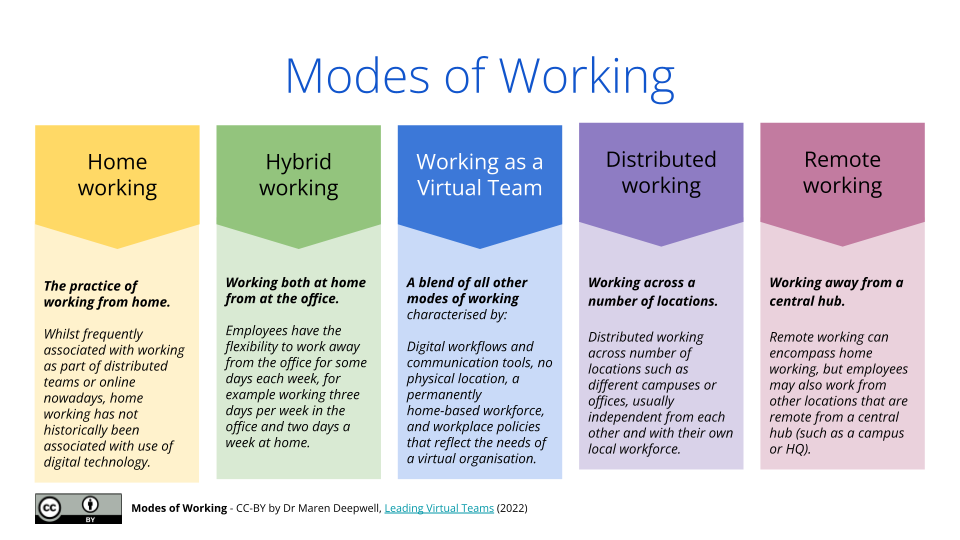
    Effectively reflecting on your practice is a key skill for leading virtual teams. For this topic, use these definitions of different Modes of Working to reflect on your practice. You can either join in the reflection as you listen to the podcast episode, which includes a dedicated section on this, or you can return to this once you have listened to the episode:

    • What term(s) best describe your mode of working?
    • How would you describe it to someone else?
    • To what degree do the policies in your organisation reflect this practice?
    • What may new colleagues not easily understand about the way you work? What else?
    • What might be difficult for new colleagues to get used to? Why?

    So what?” The purpose of the reflection is three-fold: first and foremost, it helps you develop your reflective skills. Try to notice how easy or difficult you find it to reflect in particular questions. Secondly, the prompts are designed to help you identify blind spots and open up new ways to think about the way you work. Thirdly, you can use these prompts to identify areas for action or making a change to the way you work.

    Image of the resource Modes of Working included in the section below.

    Explore tools and resources

    Here are some further tools and resources to explore if you’d like to take a deeper dive:

    Say hello #lvt23

    If you’d like to connect with me and other participants during the course, use the hashtag #lvt23 on MastodonInstagram and Twitter. I’ll be posting a few times each week during the course, and I’d love to hear from you. 

    Catching up?

    If you are just getting started with How to Lead Virtual Teams or catching up with topics you have missed, you can find all the information you need to get started on the catch up page.

  • #LVT23 How to Lead Virtual Teams: Part 1 -Course Orientation

    #LVT23 How to Lead Virtual Teams: Part 1 -Course Orientation

    Welcome to the course orientation 🙂

    If you are registered for this course, you will receive 2 emails from me each week, one on Fridays to introduce the topic and a second one on Thursdays with a round up of resources and a quick recap.

    Course overview

    Each course topic includes a podcast to listen to, prompts to help you reflect on your practice and inspiration to explore the topic further.  Here is an overview of the course and the dates on which each topic is released:

    >> Part 1: Orientation and a brief introduction to Leading Virtual Teams (21 April ’23)
    Part 2: How we work and onboard new colleagues (28 April ’23)
    Part 3: Setting shared expectations (5 May ’23)
    Part 4: Fostering a shared team culture (12 May ’23)
    Part 5: Leading team activities (19 May ’23)
    Part 6: Course reflection – Setting intentions for your practice (26 May ’23)

    Course companion book

    To get started, download the course companion book, Leading Virtual Teams. The book is free to download in different formats and we will use individual chapters from the book throughout the course.

    For each topic, individual chapters are sign-posted. The course podcasts include the key points for each topic, so there is no need to read each chapter unless you wish to take a deeper dive into a particular topic.

    Listen to the course podcast

    This course is podcast based and you can take part by simply listening each week as a new topic is released.

    This week’s episode:
    S02E12 – How to Lead Virtual Teams: Part 1 – Course Orientation

    In the first course podcast (29 min), I introduce the topics of the course and show you how to take part. For this orientation session, we’ll be focusing on the Introduction Chapter of Leading Virtual Teams.

    Don’t miss the next episode

    The podcast is called Leading Virtual Teams and you can find it on most podcast platforms including:

    You will receive a weekly email as new course episodes are released, and you can also subscribe to the podcast to make sure you don’t miss a course episode.

    Reflect on your intentions for the course

    Reflecting on what’s important to you is a key skill for leading virtual teams. This week, focus on setting an intention for what you want out of this course.

    There is no wrong way of doing this. You can choose to write your thoughts down or you might prefer to simply think about things. Get started with these prompts:

    • What do you most want from taking part in the course?
    • What practical constraints do you have?
    • How can best overcome or work within these constraints?
    • What would you like to change or learn more about?

    Not sure where to start? If you’d like to develop your approach to reflecting on your professional practice, then have a look at the dedicated activity in Chapter 2 of Leading Virtual Teams, which includes helpful hints and practical tips to get you started.

    Explore tools and resources

    As this is our orientation week, your main focus should be on finding your way around the course and the key course materials including the book and podcast. Here are some further tools and resources to explore if you’d like to take a deeper dive:

    Tool for reflection: Leading Virtual Teams – Wheel

    I have adapted this coaching tool to help leaders and managers reflect on their approach to leading virtual teams. The wheel contains eight sections, including one which is blank for you to add your own category. You can download this template, print it out and add your own scores or make a copy to edit. If you’d like to learn a bit more about how to use this tool, listen to a previous podcast episode that goes into more detail.

    Further reading:

    There is a wealth of information out there about how to lead virtual and hybrid teams and each takes a very different approach. These are two of the most popular books I’ve comes across:

    • J. O’Duinn, Distributed Teams, 2nd ed. (John O’Diunn, 2021).
    • Warzel, C and Petersen, A. Out of Office (Scrible, 2021)

    Connect #lvt23

    If you’d like to connect with me and other participants during the course, use the hashtag #lvt23 on MastodonInstagram and Twitter. I’ll be posting a few times each week during the course, and I’d love to hear from you.