It’s my second time to volunteer as a guest curator for the @femedtech Twitter account and in the past year, since my last time as a curator, much has changed.
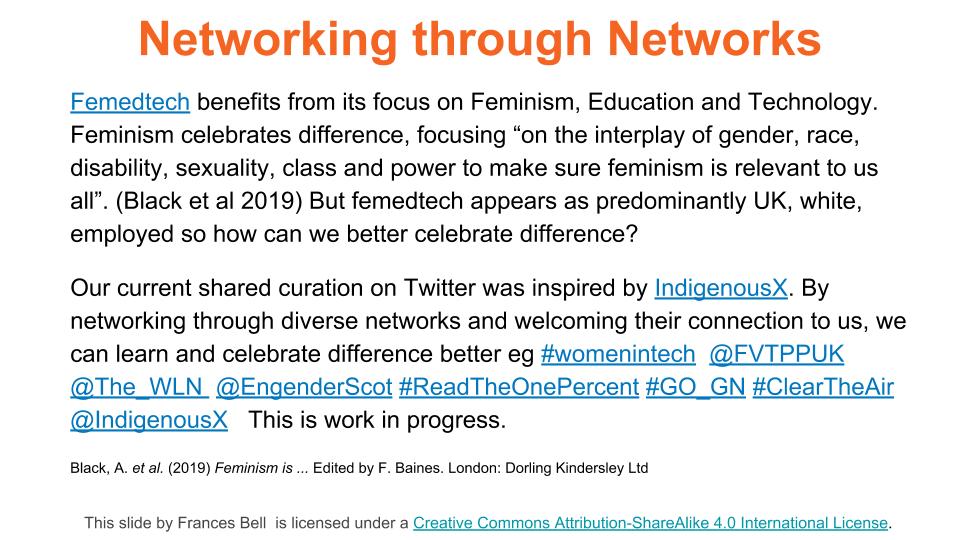
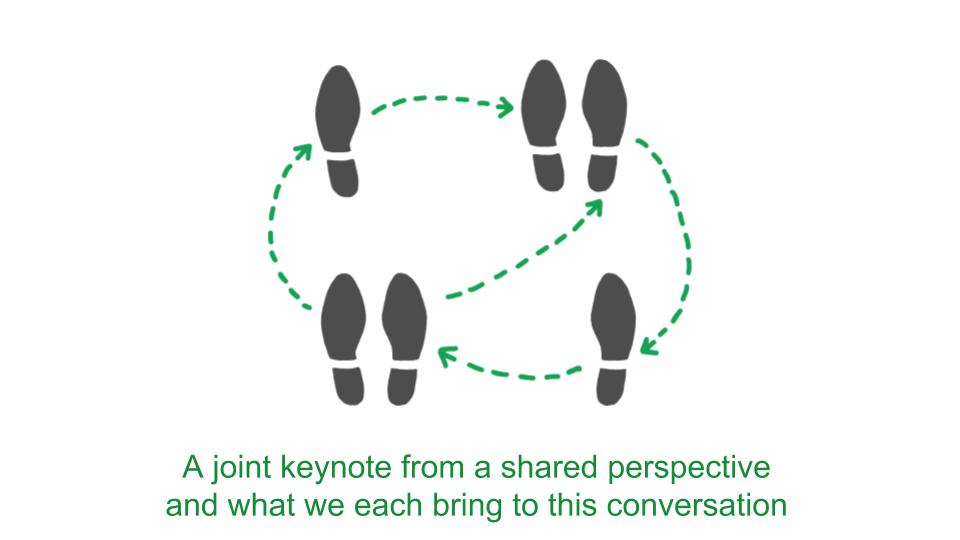
In 2018, I followed Helen Beetham, being only the second person to try out how to be a guest curator. At the time, the account had 122 followers, had tweeted about the same number of tweets and we were just in the process of writing some guidance for the activity, making it up as we went along and learning from the wonderful examples of networks around us. Frances Bell contributed the slide below to the community-sourced slides for International Women’s Day 2019.
So what is it like to be a guest curator now, that the following is ten times bigger and the network is growing rapidly, organising activities around events and interests?
I start each day by checking in with the account, checking first on the notifications and new followers. Following back those who are new and welcoming them is one of the key things I try to do each day. It’s fascinating to see who follows the account and often I come across individuals and accounts I also want to connect with in my personal capacity.
Then I look for new tweets that have been tagged with the hashtag #femedtech and like or retweet those. This can open up quite a few new rabbit holes down which my time disappears as I find a new book, artist or research that I want to learn more about. In contract to my own Twitter world, there is a much more varied and unexpected range of things being posted. Here are some examples from recent days:
You can see, there is a really varied range of things being posted, so I strongly recommend you follow the account yourself and join in.
Then, each day, I try and find and contribute something new, something from my own network or frame of reference, and which I can share to enrich the conversation or open it up to include new accounts. So this week I posted:
Looking for a creative challenge every day? Follow @ds106dc and the posts that happen each and every day
And I also work to communicate from what the network does in my day job, for example this week I had the opportunity to speak at the 13th Research and Innovation in Distance Education, and eLearning (RIDE) annual conference and I included a section on promoting equality in my talk, specifically focused on new analysis my colleague Martin Hawksey did of ALT’s Annual Survey focused on comparing gender perspectives, and his related post makes for interesting reading.
Being a guest curator for the #femedtech network really opens up new perspectives for me, it helps me get into the mindset of being a volunteer (and my day job relies heavily on the goodwill of volunteers, so that is particularly helpful for me) and it’s a powerful reminder that whilst we are making a lot of progress, there is always so much more to do to create a more equal and equitable society.
And on that note I’d like to mention a last opportunity to make your voice heard, to join in the conversation, which is a new open space for femedtech created in the run up to the OER19 conference. You can read all about it here and consider the following questions:
How do we balance privacy, openness and personal ethics?
How do we mediate our place in the open community, aspects of which might conflict with our personal ethics?
Is openness an act of conformance and / or defiance? And are there performative aspects to openness?
Do we feel pressured to be more open than we are comfortable with, or do our boundaries constrain us?
How do we manage sustainable spaces for exploring challenging issues around open?
Today for International Women’s Day Martin Hawksey and I joined an inspiring day organised by the University of the Highlands and Islands Women’s Network. We contributed a joint keynote on promoting equality in a distributed organisation.
— University of the Highlands and Islands (@ThinkUHI) March 8, 2019
The keynote focused on sharing our perspectives on promoting equality on three levels: promoting equality as a challenge for Learning Technology professionals, promoting equality as key value in our organisational culture and promoting equality as a personal commitment.
You can access the full slides deck, including crowd-sourced slides from the generous #femedtech community https://go.alt.ac.uk/IWD19altc and all slides are openly licenced.
Martin’s part of the talk focused on a new analysis of survey data from ALT’s Annual Survey, that highlighted some very interesting differences in how male and female professionals views differ and he’s written a blog post that includes all the graphs and links to the full data set.
For my part, I want to add some reflections of my own on key parts of what we spoke about:
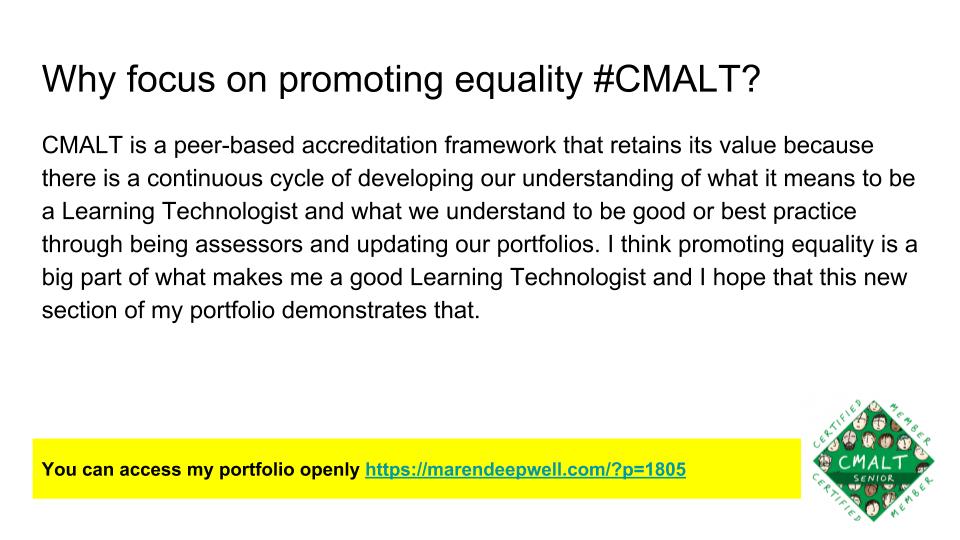
First, building on the perspective that Martin explored through the survey results, I shared parts of my professional development portfolio which has been accredited through ALT, making me a Senior CMALT Holder:
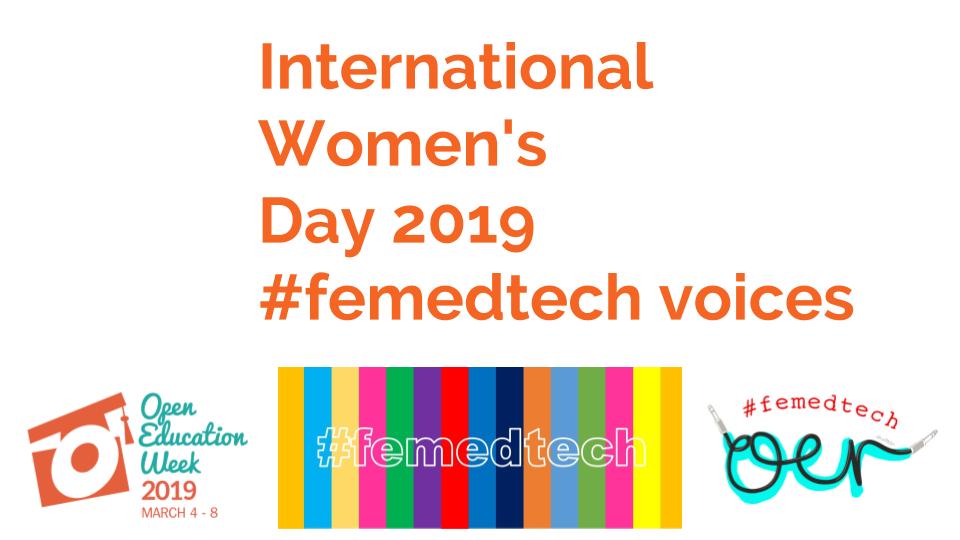
We heard much today about how important professional recognition and career progression is to fighting structural and organisational inequalities and in this context I felt there was an added significance to recognising different forms of promoting equality as not only a valid, but essential role of leaders at all levels, not ‘just’ specialist staff. One of the speakers today, Dr Susan Engstrand, reflected on how even small matters like keeping meetings running to time and chairing in a manner that encourages participation from everyone can make a significant difference and promote a positive culture change. It was inspiring to hear so many different voices, students included, from such a diverse university population as the communities that the University of the Highlands and Islands serves and the closing slides of our keynote added more voices from the #femedtech network to today’s discourse:
Especially as this year International Women’s Day happens during Open Education Week, it’s been a pleasure to receive contribution for this crowd-sourced slide deck, enabling volunteers within the network to help share ideas, perspectives, inspiration and practical resources. Thank you to everyone who has already contributed – and more contributions are always welcome.
As an extension of the monthly series of blog posts about leading a virtual organisation this keynote built on a recent post and podcast, focused on Martin’s and my own experiences. And so I felt it was appropriate and important that the talk followed a similar conversational format, giving our audience the opportunity to join into reflecting on our different points of view, contrasting experiences and also the similarities. It reminded me powerfully that meaningful progress can only be made if we don’t have the conversation about equality ‘just’ amongst women, or indeed any discourse about inequality of any other kind. It’s not a ‘women’s problem’ or an issue that only concerns those of us who identify as female. It’s an issue for everyone to be concerned with. In some contexts, we may make an economic argument, that mixed teams are more effective. In others there are legal, social and political realities to be confronted. But on a daily basis, there is also the difference we can each make, affecting change on a small scale, within our personal sphere of influence, as part of our families, our communities, our institutions, our networks. Thank you to everyone at the UHI International Women’s Day event for so many examples of enthusiastic, passionate and compassionate people doing just that. Every day.
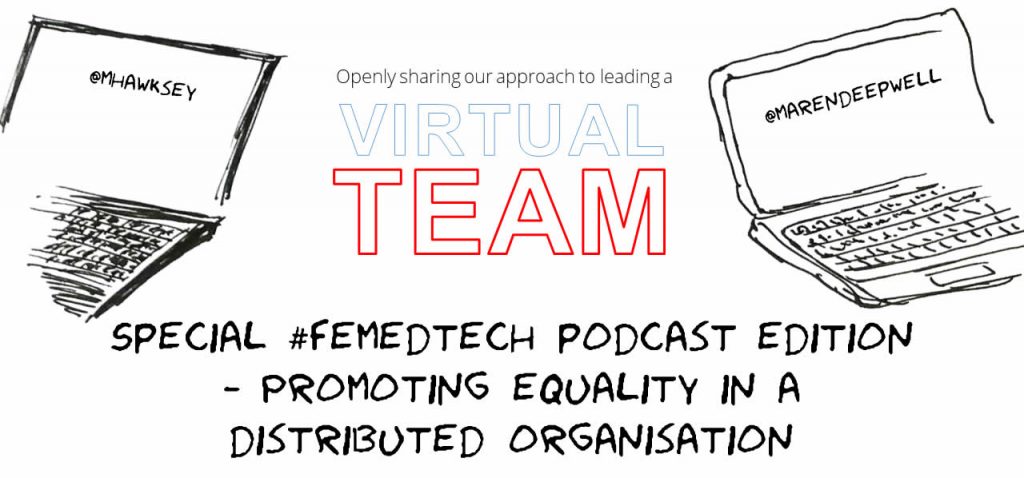
Hello and welcome to this month’s post on leading a virtual team. In this post (cross-posted here) the two of us, that is Martin Hawksey (@mhawksey) and Maren Deepwell (@marendeepwell), continue our series of openly sharing our approach to leadership.
If you are new here, you can catch up on earlier posts and podcasts or find out more about ALT, the organisation we work for as senior staff. We really appreciate comments & feedback and welcome questions or suggestions for future posts.
February
Maren: In the past year we’ve each volunteered as a guest curator for @femedtech (here’s a link to my post on that). Promoting greater equality in Learning Technology and in our distributed organisation in particular has become an important part of our professional practice. In 2017 I gave this talk at EdTech17 and since then I’ve included something about equality in most of my talks, following the example of others to use my voice to raise awareness.
As my turn to volunteer as a guest curator is coming up just after International Women’s Day on 8 March and we are contributing a joint keynote on promoting equality in a distributed organisation to a related event at the University of the Highlands and Islands, I’ve started to reflect on what I’ve learnt over the past year and come up with some ideas to discuss in this post and podcast: first, I’ve discovered lots of my own blind spots – issues and inequalities that I wasn’t aware of previously. The #femedtech network and also working in the Open Education community has helped with that (although there is a lot more to learn). Also, our work on policies for remote working has prompted me to question what I can do, what I can change, to help address any structural inequality within our organisation, by for example reviewing policies for flexible working and family leave. Another thought is that reading the narratives of others, recounting personal journeys, precarious work and family situations, career challenges, work life balance problems and so forth, made me reflect on how far outside of any comfort zone I usually work. And that is a sobering thought, particularly as I am in a position of relative privilege.
Martin: It’s interesting to consider equality and diversity as part of a distributed team. A number of the discussions I’ve seen around gender equality highlight the benefits of employers providing better opportunities for flexible working. Another factor to consider is the physical workplace can be very gender bias. The allocation/distribution of toilets is often mentioned, but I think there are lots of other environmental factors which are often overlooked. I don’t know whether virtual workplaces can be gender bias, perhaps you have thoughts on this, but it’s interesting that in a 2017 survey on Jobsite they reported that 76% of female tech professionals thought businesses offering remote working were more likely to retain top talent. Blind spots is one of the biggest challenges, not just within the workplace, but society as a whole. Before attitudes and approaches can be changed the issue first has to be acknowledged. In the case of gender I think a lot of guys don’t see a problem, or even if they do see it as a problem it is something that they shouldn’t be concerned about. As part of my curation period for @femedtech I came across the “ICTs’ for Feminist Movement Building – Activist Toolkit
A part of this Frances Bell highlighted the ‘Principles of Feminist Communication’ which is part of the toolkit. A principle that caught my eye was “we produce content in a democratic manner. Women take the lead. The process serves to build positive power”. In the case of @femedtech it is absolutely important that women lead this community, but for it to be successful it has to reach those who have their own blind spots. As such I was grateful for the opportunity to curate this community for a short period. As I explained to a friend the best equality and diversity training I had ever been on.
Maren: I agree. It’s an enormously valuable experience. Physical workspace is an interesting area when it comes to promoting equality and I’d include conference/meeting spaces in that. There are many aspects to this, even the seats you sit on: for example, I was on an all women panel once conducted on a high stage on bar stools. Not great when panelists are wearing skirts and the camera is located five feet below. Or dress codes for work, including it still being legal to stipulate women wear heels. And don’t get me started on the topic of pockets
Trying to fit new slightly bigger phone into new slightly smaller jeans and now I have #pocketrage
“Only 40 percent of women’s front pockets can completely fit one of the three leading smartphone brands.”
. Working closely with the tech sector a different kind of stereotype dominates, the genius young start up CEO or coder, mostly males who work all hours of the day. Having other responsibilities outside of work or not being able or willing to give up 100% of your time all of the time can easily be looked down on. If you open up your perspective to challenging discrimination based on age, disability, gender reassignment, race, religion or belief, sex, sexual orientation, marriage and civil partnership, and pregnancy and maternity then the challenges just keep getting bigger (ALT’s policy on equality & diversity underlines this). Which is why I feel so strongly that it’s also a matter of personal responsibility to help promote greater equality: everyone can make a difference within their personal practice, their immediate sphere of influence or even their own mindset. We can each educate ourselves, try and become more aware and raise others’ awareness. I am always inspired by projects such as the Feminist Internet, Women in Red, Uncommon Women and many others that do amazing things. On a related note, I saw a tweet the other day where Kelsey Merkley shared a childhood memory:
I was a wizard for Halloween – people told me girls couldn’t be Wizards. At 9 I gave no fucks about gender roles https://t.co/xOXGuX7xoI
It made me smile because my dream jobs growing up were bin man (because of riding at the back of the truck), hot dog vendor (love of ketchup), astronaut (amazing science teacher), judge (inspired by Captain Picard) and my fancy dress costume of choice was Poseidon (trident) and circus director (top hat). It never occurred to me that these weren’t ‘girly’ choices. Nowadays I buy books like Garth Nix’s Frogkisser for the younger readers in my life, so they can develop imaginations in which the White Wizard can be a teenage girl. And I indulge in books like those written by Ursula LeGuin, which have diverse lead characters and cultural contexts so that my own imagination grows in richness and diversity.
Martin: I’m hoping over the generations there is more equality. One issue we have is people just live to darn long so even if this is the case we still have a long time to wait. Just before our last Trustee meeting and knowing I had the prospect of a 4am start I decided to stay up and watch The Great British Sewing Bee. My interest in sewing is largely as a spectator, but I’m quite happy to put buttons back on, I also sewed on all of my daughter’s Brownie badges. People who know me well will recognise me as a maker and DIYer so perhaps not a surprise that I’m interested in this type of programme. When I was a kid I remember one year asking Santa for a sewing machine, I don’t recall it being a particularly positive reaction to that request and think I ended up with a bike instead. As someone with their own child I feel I’m more conscious of not imposing stereotypes. Some of my friends/family are teachers and when we have spoken about this in the past they say they feel there is greater openness and acceptance in areas like sexual orientation in that generation. Thinking about this post and how it relates to equality in the workplace one question I have is there a danger that remote working will be used to allow organisations to have a diverse workforce but also prevent people having full freedom of expression? An example I have in mind is a number of organisations, notably the education sector, now provide employees with the option of branded rainbow-coloured lanyards. This is a very visible support of the LGBT+ community, an act that would have far less public impact for a remote workforce. Do remote workers have the same degree of expression as office based staff?
Maren: That feels like a good jumping off point for the podcast we are recording for this post. There’s so much to unpack. Like many of the issues we discuss in this series this is a topic that touches on very personal, human questions and reaches all the way to formal HR policies, working with diverse stakeholders and keynote speakers and even our organisation’s strategy. I’ve also explored this in my Senior CMALT portfolio to show that this is a key element of my professional practice.
There’s a person on the image below who has green hair, and that’s intentional. Sure, it’s a small thing, but it’s important because of the thought process that went into it. It’s putting values, policies even, into practice in a playful and powerful way.
When I was a young teenager, I asked my parents for a (mechanical) typewriter for my birthday so that I could type my journal, plays and poetry – on coloured paper mostly. I didn’t have the internet.
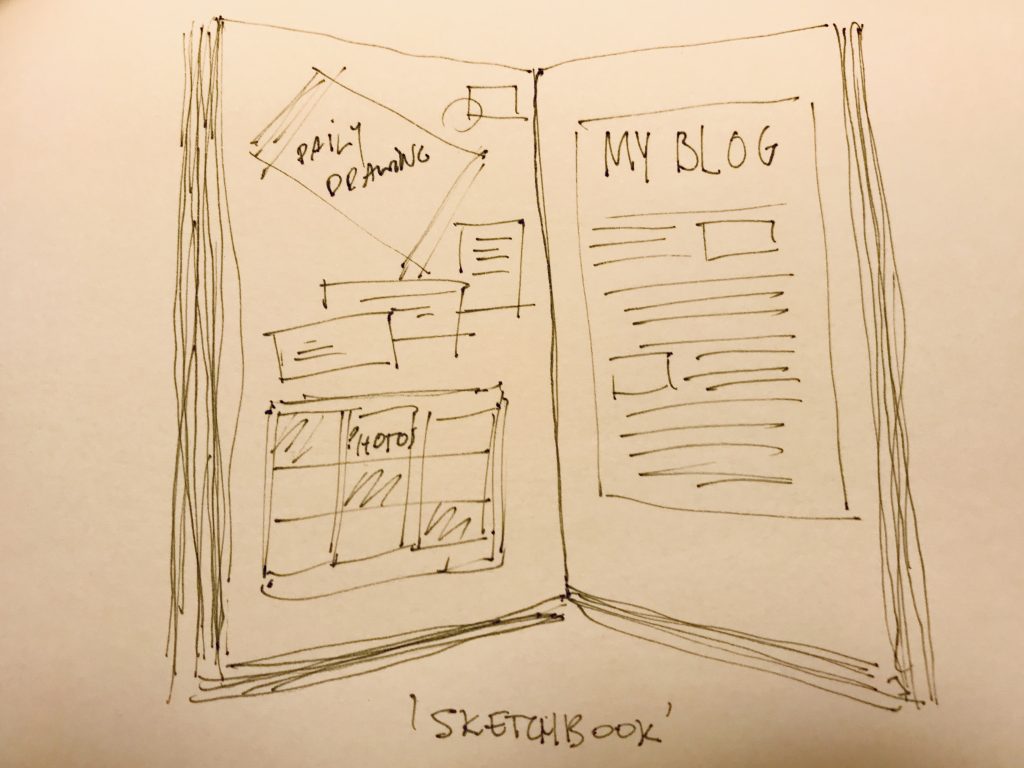
When I was an art student, my sketchbooks had pockets, windows, some smelled of strange colours or oils I had tried out, some trailed plaster dust or were covered with fabric. I also had a blog filled with all of these things (no longer accessible).
When I was writing my thesis I had binders full of flyers, photos, product samples, stories, interviews and even dried plants. I also had a blog: now the cemeteryscapes archives.
Now, I have a private blog, notebooks of daily drawings, archive boxes of things I collect for inspiration, thousands of images, cups filled with stickers and badges, many places where I write and reflect and thanks to Reclaim Hosting I have my own domain. This blog.
This is the tip of the iceberg of the messy, constant creative process that is the way I think and work. It includes images and drawings and slide decks and links to things and stories and conversations and my portfolio of professional practice. It also has many typos, personal anecdotes, moments of my life that I have chosen to share.
Sometimes I write on other platforms, for my organisation, for academic purposes, to promote things, to provide commentary, to inform, to share… but usually all things I do end up at least linked to from my archive, if not backed up on this site. All together it constitutes part of my ‘sketchbook’, part of my practice, the most open part of my practice. What’s important to me is that it forms part of my process, through which I am prompted to reflect, to work out ideas, to develop my thinking and that I have a record of that.
Having a record of my work is extremely useful when it comes to appraisal time, when I want to send a link to someone, when I need examples of things I have done. It also stops me from moving always forwards without looking back, without appreciating all that I have done, even if much of it is not polished, or finished or maybe even never sees the light of day. It includes mistakes and errors and things I’ve changed my mind about. I feel I have a measure of control, because it is my own platform.
Curiosity and creativity are messy. My work is, too. Much of it is not productive, it doesn’t lead anywhere, it’s not for public consumption, for others. It’s for me. When I have a good idea in the shower or when I’m out for a run, sometimes that idea ends of being part of my work in a way that surfaces, but most of it isn’t. That doesn’t make it less important. It’s one of the things I learnt to appreciate at art school. To appreciate that I can’t always tell what may be useful to know or keep or read. To value distraction and diversions and the unexpected. Blogging can be part of that.
You reading this now is a bonus.
In my view, open practice isn’t primarily for others. When I write on my own blog, I don’t write with an audience in mind unless I am writing for a specific event, i.e. a keynote transcript for example. I take an informed decision to publish, because I want to. I want to share my practice, provide insight into what I do and to add my voice to how professional practice is articulated. I want to be visible. But it’s not for others. If no one reads this, and plenty of my posts have only a handful of readers, that is fine with me. It doesn’t make it a less valuable part of my practice. I am in a position of privilege, yes. In addition, I have the resources and skills to host my own domain to be able to do this, blog in this way. But in one way or another, this kind of writing has been part of my life for three decades, from typing onto the coloured pieces of A4 paper, leftovers from my mother’s disused work folders, to scribbling into sketchbooks to years worth of post-it notes that accumulated during my research student years.
There is a famous quote by artist Rick Beerhorst about sketchbooks that describes well how I feel about blogging as part of my creative process: …”[Sketchbooks] help me stay free and, at the same time, help me get connected to the world around me in a deeper way”.
An inspirational hour with Lorna Campbell on blogging as academic practice, which Lorna kindly facilitated for me and my colleagues inspired this blog post and I am deeply grateful to Lorna and all who’s blog posts inspire me on a daily basis. Thank you.
It’s not long before International Women’s Day on 8 March and whilst the work of the #femedtech network is not all about women, but about greater equality for everyone, the day is a great opportunity for us to share the work we do, spread the message and reach new supporters.
Like many of you, I’m looking forward to sharing ideas, inspiration and some hard hitting facts when I talk about #femedtech and so I am looking for contributions to a shared slide deck – shared with everyone and free to use for you all.
Please contribute something if you can, make a slide or more than one, adding images, quotes, references, figures or ideas that may help us better share the work we do and the things we care about. All contributions should be suitable for CC-BY sharing and include attribution.
Given that it’s early in the year and a cold, dark morning in Nottingham, UK, I felt it would be useful to start this talk with a sunnier view of beach near Sligo, Ireland, a place to feel the sun and the sea on your skin, a place to take some time to reflect and breathe and take a break. Those aren’t things that I generally associate with social media, in particular in Higher Education. Social media often comes with a general sense of the superficial, showing just the best side of myself, trying not to avoid being vulnerable for social media can be a toxic space for many, particularly for women, for people of colour, for anyone whom the trolls choose to single out. So if you are already a place in your year where you feel your digital shadow is looming large, maybe it’s time for a digital detox https://datadetox.myshadow.org/en/detox . I came across this useful tool via Mozfest a few years ago and I found it helpful as a way to check in with my relationship to social media.
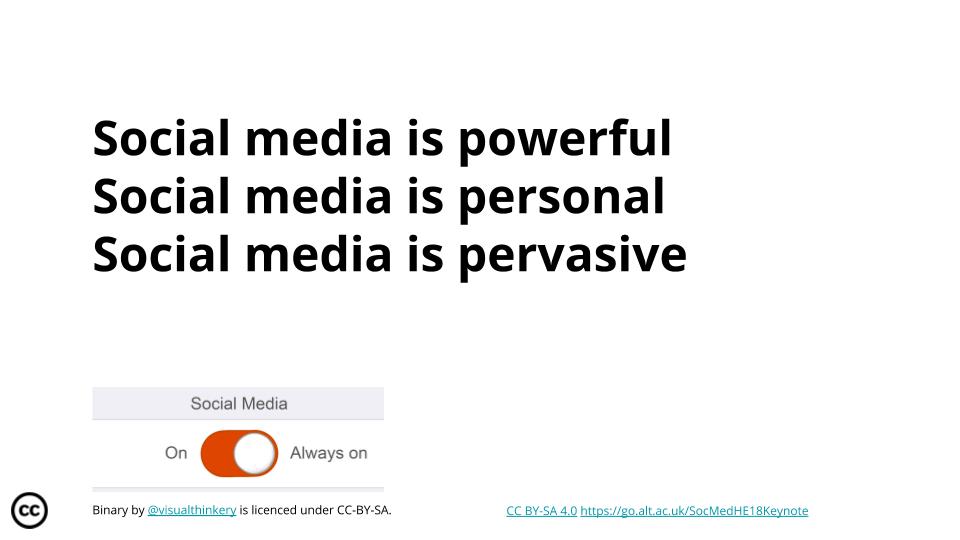
Slide: Social media is powerful. Social media is personal. Social media is pervasive.
It’s important to think about because social media is powerful, it’s personal and pervasive. It’s part of our personal lives and professional practice in education. It’s part of what our colleagues do, how our learners work and part of our social reality from citizenship and dating to job hunting and even death and remembrance. As human beings we rely on our social interactions no matter how they are conducted and in this age social media is part of how we live for an increasing proportion of the global population. Because it is important, we can’t leave it up to others. Because it’s important, social media needs us. Social media needs us to question, investigate, reflect on, engage with, challenge, shape, control, monitor, analyse, track, investigate, govern and take ownership. And that’s what I’ll explore in this talk in three hashtags:
How is social media changing professional practice? How does social media support openness in education? Social media for social good?
Slide: #altc – a perspective from Learning Technology
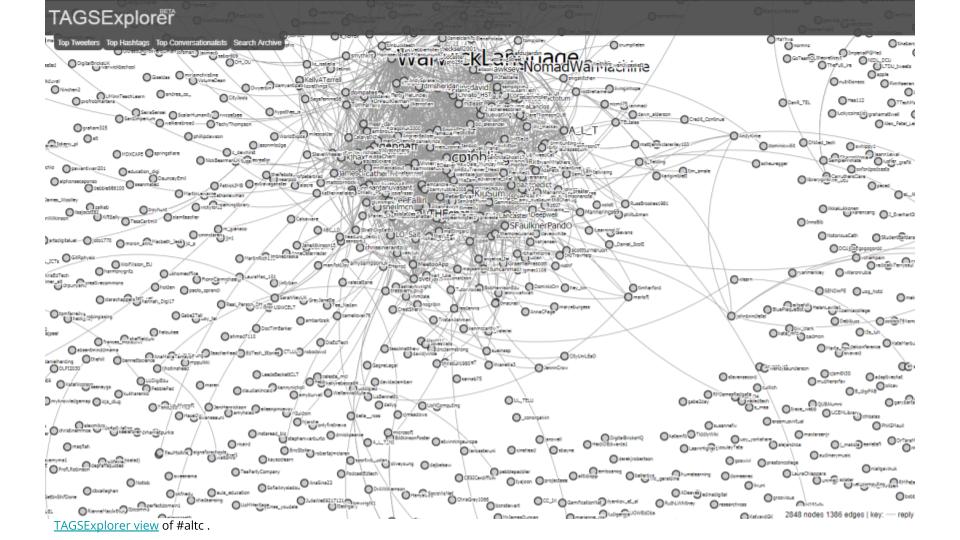
The first hashtag is #altc and it’s probably the biggest hashtag in my working life. To begin with the hashtag was used only during events, mainly ALT’s Annual Conference and it changed each year. Since 2014 however the hashtag has been used not just for the conference, but increasingly throughout the year. To begin with the “c” stood for “conference”. Now the hashtag has come to mean more than that thanks in large part to the vision of ALT’s Martin Hawksey, now the “c” stands for community, conference, create, collaborate, communicate and so forth. And it now generates more tweets in a single week during the Annual Conference than we previously recorded for an entire year. It’s developed far beyond the single use event hashtag it started out as and that reflects how the activities it supports have expanded also. As a membership body for Learning Technology professionals, ALT has become very active on Twitter and our network and the conversation is growing – you can see how this is visualised here on the TAGSExplorer view of #altc .
Slide: TAGSExplorer view of #altc
The community is now active throughout the year and the way that social media is used really varies and includes individuals actively using the network to share practice, ask questions and celebrate achievements. ALT as an organisation is powered by its Members many of whom volunteer for the Association and one of my favourite examples of using social media and the #altc hashtag last year was celebrating ALT’s 25th birthday. We wanted everyone to be able to celebrate whatever is important to them, to add their own voice and for the anniversary to reflect some of the diversity and breadth of the community we serve. On social media you could thus create your own celebration postcard, including your message and image, remixed under a Creative Commons licence using the Remixer developed by Bryan Mather/Visual Thinkery (go to https://remixer.visualthinkery.com/ and have a go at remixing yourself). It’s a small way for individuals to have a voice in ALT, be able to shape the organisation and reflects its values and aims to encourage participation and collaboration and openness.
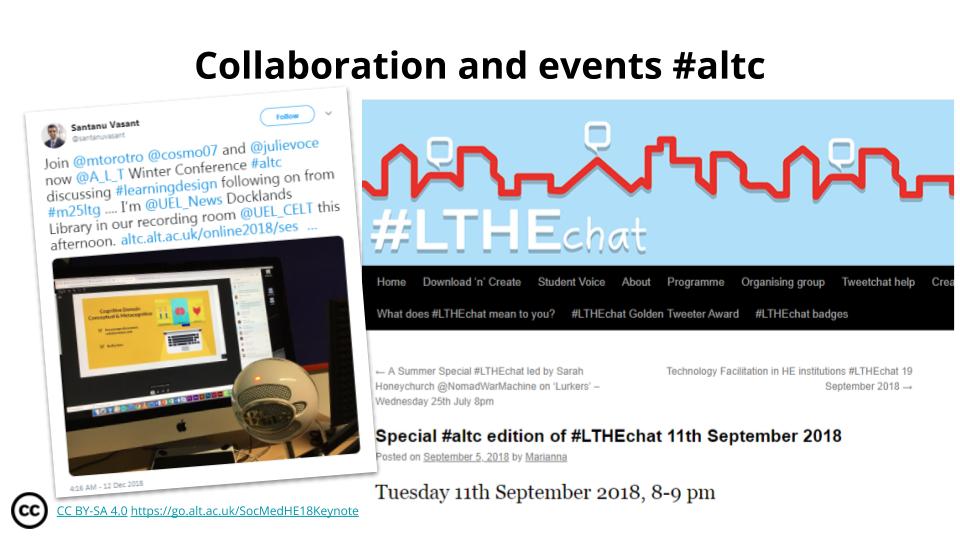
Slide: collaboration and events #altc
Beyond individuals we have leveraged the power of our hashtag to collaborate with others and to enable relationships between Member-led initiatives and the centrally supported network. That’s particularly important in Learning Technology as much of the work we do reaches across disciplines, sectors and often beyond the UK. This approach to social media isn’t about distributing marketing messages or one way communication. Our aim is to support and develop a positive online space, a social media channel that Members and the wider community can make us of and have ownership of, a space that supports our work in strengthening professional recognition and advocate for our Membership.
Our Members meanwhile have a strong open ethos and much of what we do is consequently openly accessible to the benefit of the wider community. Openness is so important in Learning Technology because the tech landscape develops at such a rapid pace that the most effective way to keep pace with it is in collaboration with others, by sharing resources, research and reflection. Like social media, openness is not unproblematic and like social media openness has great potential in education. And that brings us neatly to hashtag number two and also to my second question: How does social media support openness in education?
Slide: #open
I want to start by highlighting two examples, two policy developments in Higher Education, that I have worked on, firstly the Higher Education Funding Council for England Consultation on the second Research Excellence Framework and then also the Open Education and OER – A guide and call to action for policy makers. The first is particularly relevant because it provided an opportunity to argue the case for the role of social media in how impact is measured in Higher Education and the second as it highlights how Open Education and OER can expand inclusive and equitable access to education and lifelong learning, widen participation, and create new opportunities for the next generation of teachers and learners, preparing them to become fully engaged digital citizens.
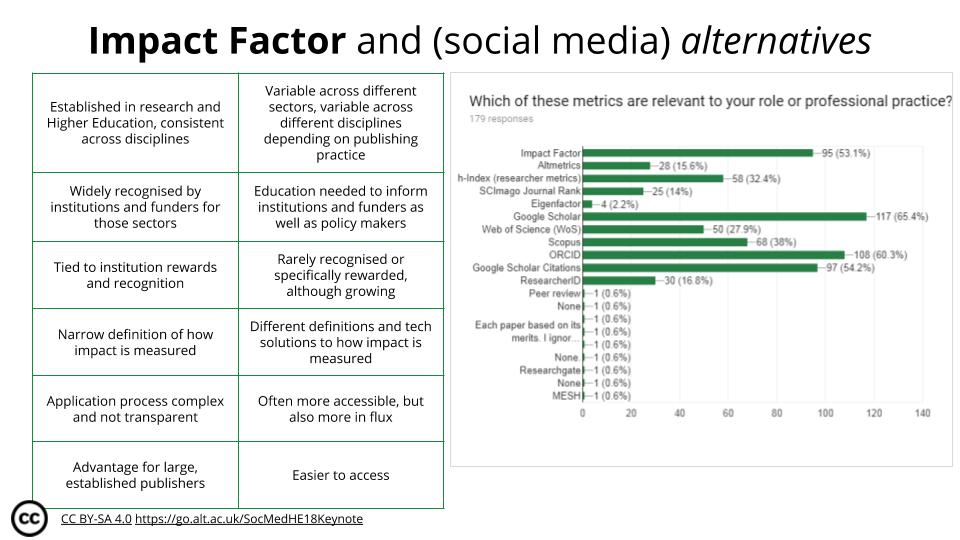
But are policy developments such as these making a difference in practice? Has policy changed much since 2014 when for example The Metric Tide by HEFCE was published (http://www.hefce.ac.uk/pubs/rereports/year/2015/metrictide/#alldownloads)? It’s aim was to “reduce emphasis on journal impact factors as a promotional tool, and only use them in the context of a variety of journal-based metrics that provide a richer view of performance. Publishers should also make available a range of article-level metrics to encourage a shift toward assessment based on the academic quality of an article rather than JIFs.”
Social media plays an important role in the alternatives to the traditional Impact Factor and is increasingly used not just by publishers and authors, but to recognise the important role of peer reviewers and support their recognition, too. Research in Learning Technology, the journal ALT publishes, is of special interest to me because I was part of its pioneering transition to become the first Gold Open Access journals published by a UK professional body. Since then I have had hands on involvement in two further transitions between publishers, leading to the journal now being independently published by ALT, financially supported by Members and edited by a group of volunteer Editors who lead peer review and author support.
It hasn’t been awarded an Impact Factor to date and we are actively investigating all alternatives, how their are used, how they are developing, what their longevity is and how sustainable they are. Open Access has seen the readership and reach of the journal increase from hundreds to hundreds of thousands. Social media supporting innovative ways of measuring impact may help its impact grow further. For now, openness helps ALT influence policy makers, increase the impact of research for public benefit, build a shared vision for the future of professionalisation in Learning Technology and grow our community of Members.
Slide: Impact Factor and (social media) alternatives
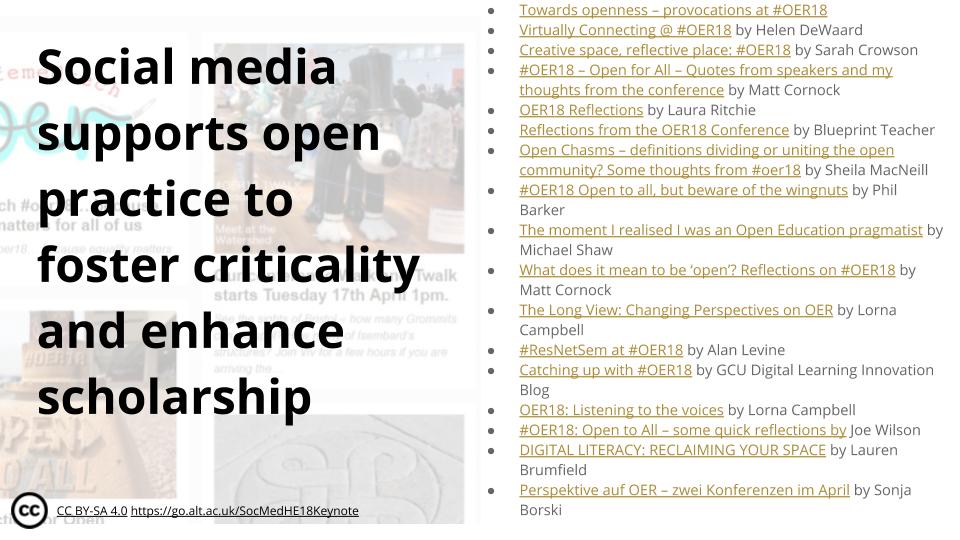
I now want to look beyond organisational boundaries to focus on individual professional practice and how social media supports open practice to foster criticality and enhance scholarship. In my experience there is no better example of this than the work that is happening around the #oer hashtags, no, conferences, and the way in which social media is used here to address some of the most difficult questions including how privileged participation in such events is, how we can find and support the voices of those we are not already hearing and how we can meet some of the global challenges that education faces through openness: access to education and equity.
It’s become somewhat of a social media tradition that the blog posts and tweets start long before an actual OER Conference, last year reaching such a large volume that there was more conversion online than anywhere else. It connected those who couldn’t attend in person (to some degree) and enabled a much richer discussion, more criticality and scholarship than before.
Slide: social media supports open practice to foster criticality and enhance scholarship
And as an open practitioner myself I am inspired, challenged, prompted to try and step up in my own work, to contribute something, to question how I could do things differently, better. And last year was very much a year of collaboration in the open for me, with many projects taking place on social media, including twitter chats and many blog posts.
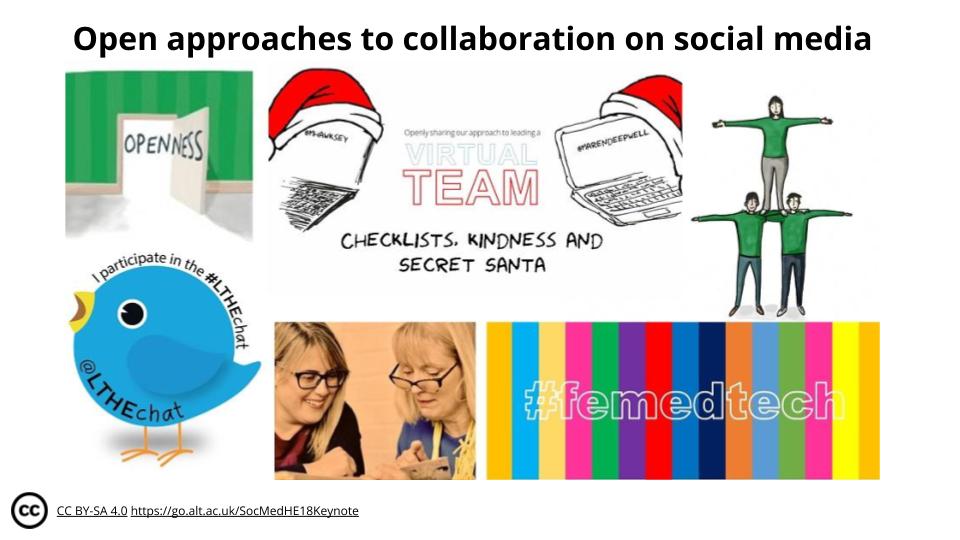
Slide: open approaches to collaboration on social media
I wanted to progress leadership as an open practice – which, incidentally, is one of the sections in my CMALT portfolio and something for which I get a lot of feedback and input on social media. But the collaboration which has prompted me to reflect the most on the pros and cons of open practice on social media is my work with Martin Hawksey on leading ALT through its transition to becoming a distributed organisation and establishing a new working culture as a virtual staff team. Our monthly series of posts has been at the heart of all my work last year, touching on everything from people management and well being at work to the technical challenges of remote working and the nuances of working in the open. Writing these posts whilst everything is actually happening, rather than sharing output from work that is in the past, felt far more scary than similar kinds of work I had done before. There is much of what I do day to day that I hadn’t managed to make part of my open practice before this collaboration – leadership, management… these are not the most straight forward topics to share (especially when you are everyone’s ‘boss’). There are a lot of pros for me in this kind of approach, but also some downsides: sharing work in this way puts you in a vulnerable position, for example if someone personally attacks you, if you are not performing well, when you make mistakes or when things go wrong. Social media can be a scary place when you are not sharing success. It’s always personal and there’s a limit to how well you can protect yourself once you are out there, in the open. But on the other hand, I want to be open about how to lead, how I work. I want to show that things do go wrong, that mistakes happen and how to work through them. It’s important to share questions and doubts. It’s part of my ethos, my approach to leading a team, to leading an organisation, and I want my presence on social media to reflect that. When I first became a CEO I found it really difficult to find role models on social media (and indeed in real life) and alongside all the people who have inspired me along the way, I want to try and help others find the right way of building their professional identity.
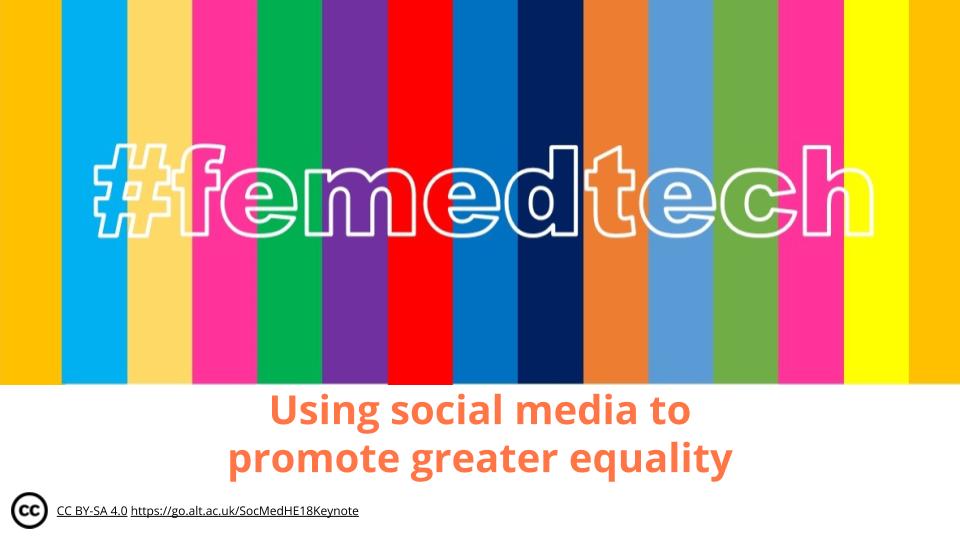
Slide: #femedtech – Using social media to promote greater equality
And on that point, thinking about identity, we arrive at the third and final hashtag and the last part of my talk: #femedtech. The challenge here is using social media for social good. And in terms of equality, and equality in Learning Technology in particular, we still have a long way to go. Equality is for everyone, it’s in everyone’s interest and it’s everyone’s look out. Femedtech is a growing network and I am a volunteer and supporter, giving my time and voice to help promote a cause I believe in.
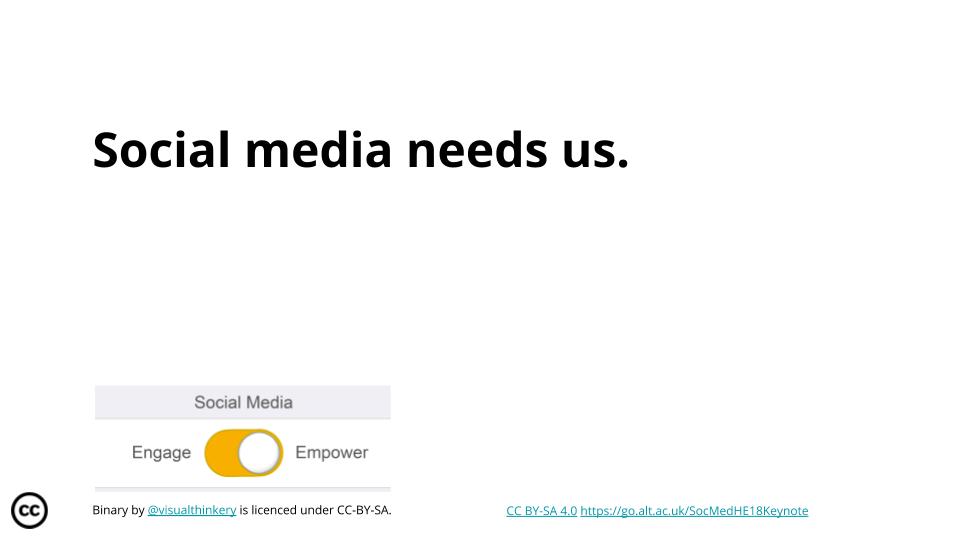
It’s only one example of how we can use social media to engage and empower in education and to make use of the digital, critical and technical skills we have to take some ownership of how we grow, support and chart the development of our network. And that is an important point to consider, because it is the skills and knowledge that we have that enable us to do that – the fact that we know quite a bit about social media, technical infrastructure and how data is generated and used. It’s our skills that enable and empower us to use the tools and platforms to enable and empower others – hopefully leading to greater equality along the way!
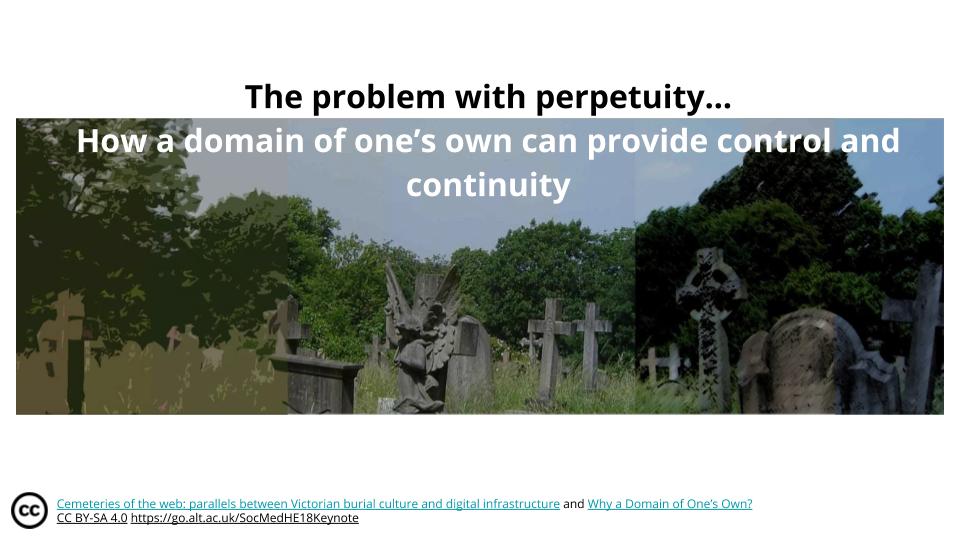
Slide: The problem with perpetuity… how a domain of one’s own can provide control and continuity
With that, we are not just going against the grain of the traditional power relationships that govern education and by extension Learning Technology. We are also going against what social media and online platforms in general wish us to do. They want our data, our attention, our engagement and in return they promise us much.
Now, I should pause here briefly, because the relationship between Victorian burial culture and digital infrastructure may not be immediately obvious, and I suggest if you are interested to read my blog post on the subject – but suffice to say that I have a PhD in cemeteries and with that comes a frame of reference that I find is very applicable indeed to thinking about our relationship with technology.
One commonality between Victorian burial culture and digital infrastructure, for example, is that a lot of digital infrastructure gives a promise of permanency in order to secure our engagement and content and Victorian entrepreneurs created urban cemeteries with the same promise. In the digital realm and in particular on social media your posts, pictures or updates remain in place while their are valuable to the platform, but can disappear or become inaccessible with little or no notice. The newly created burial space in Victorian cities would similarly be described as a place for eternity, not just safeguarding bodily remains, but securing status and remembrance for future generations. And like its digital counterpart, cemeteries, too, could disappear for building projects or urban development with gravestones stacked unceremoniously against a wall or used as paving material.
A domain of one’s own (alongside the aforementioned skills and knowledge) is key in my mind to a more empowered relationship to technology and social media. Post on your own domain, repost everywhere else – and when everywhere else stops their service, you still have your posts on your own domain. I am really inspired by the work Jim Groom has been doing in this area and I suggest you read his post on a related project.
The kind of relationship that I envisage us to have with technology and social media has a lot to contend with: we have questions about who controls the dominant discourse and how to foster diverse voices inside filter bubbles, we have a lot to work out around privacy and the right to be forgotten, the ownership of data and data literacy and the future of social media.
Slide: Social media needs us.
I hope that brings us to a point where we can explore these questions further, putting the emphasis not on the technology, but on human agency:
How can we use social media to enhance our professional practice? How can we use social media to support openness in education? How can we use social media for social good?
A big thank you to all whom I work with, who I have been inspired by and in particular the participants and organisers of the #SocMedHE18 conference for listening.