Tag: #femedtech

  • Blogging along #FemEdTechQuilt

    I am working on ideas in order to make, and that’s the key word here, a contribution (7 x 7 inches) to The Femedtech Quilt of Care and Justice in Open Education. Read all about what this is and more here. Read it, share it, get involved. This is important.

    I have never made anything for a quilt. I can hardly sew a button back on so that it stays on. I tried to learn how to knit, but although the women in my family are super craft capable as a whole, I am NOT. So despite my keen interest in the project and the warm invitation, support and encouragement I have had along the way (THANK YOU to you, you know who you are) I am feeling thoroughly intimidated.

    I have made and shared some drawings of early ideas:

    And now I am thinking about how I can actually make something. Something that would capture how much I care about the cause that this project is all about.

    Quilts are very special. I don’t know much about the history, but I am lucky enough to own some. And they are very precious to me. They make my daily life a warmer, safer, more caring place. And that I value very much. For naps, for early mornings, for sleeping in winter, for bad days, for dark days. The quilts I own have been in my family for nearly forty years and recently one of them had to have emergency repairs. I brought it to my mother and hoped that she could help. It was late autumn and felt reminiscent of taking teddy bears that had lost eyes or ears or even a leg to be cared for and put back together… only to magically reappear under the Christmas tree – whole again. It always disturbed me that in Star Trek even Captain Picard never had a proper duvet or quilt for sleeping under. Only strangely metallic fabric blankets that seemed at least to me never really comforting. A proper quilt is a source of great strength and comfort and not something I’d like to be without in the future.

    And a future without care would be very bleak indeed, and not just in Open Education.

    I can’t wait to see this quilt come into being come April. And carry all of our hopes for change and resistance with it from OER20. I am deeply grateful to all those who make it happen and most of all thanks to Frances Bell.

  • 2019 – It’s been a #femEdTech kind of year

    If you don’t think gender inequality (in Learning Technology) is an issue that concerns you, this post is especially for you. Welcome!

    For those readers who are already interested in this topic, welcome back. It’s been a #femEdTech kind of year 🙂

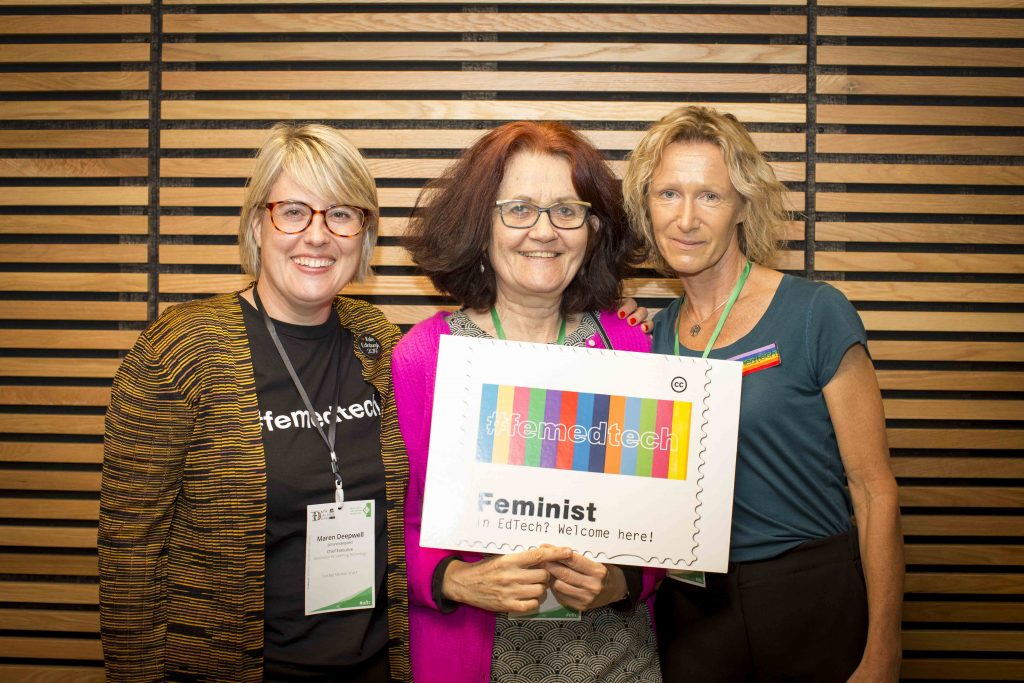
    Maren Deepwell, Laura Czerniewicz, Helen Beetham

    For the last few years I have been actively involved as a volunteer in community efforts to promote gender equality in Learning Technology but this year my day job as CEO of the Association for Learning Technology took on a decidedly more #femEdTech flavour. 

    Now, it’s important to acknowledge that gender inequality is certainly not the only issue we are facing in Learning Technology and that there are other forms of inequality and discrimination that we need to continue to address and challenge. 

    But nonetheless it remains an issue from the gender pay gap to the gender data gap, representation at conferences and on executive boards, in policy making, on social media and so forth. 

    As I am in a position of relative privilege I can often exert influence over who I work with, who gets invited and who has a voice in what I do. But as soon as I leave my sphere of influence I am back to being the token female speaker on the agenda, the only woman around the table, the woman who gets trolled. Sigh. Sometimes cry. Often shout! 

    In this post, I am going to share the key pieces of my work on equality in Learning Technology from 2019. I hope they will be useful to you to explore, share, reuse:

    My year started at with a talk that brought together the threads of community, openness and equality:
    Community, Openness, Equality: a keynote in three hashtags #SocMedHE18 (talkvideo): Social Media for Learning in Higher Education conference, 9 January 2019.

    Promoting equality in a distributed organisation, joint keynote with Martin Hawksey for International Women’s Day, University of the Highlands and Islands, 8 March 2019; this particular talk and the work we presented from the ALT Annual Survey provided a basis for other talks later this year, particular in relation to exploring a gender perspective of the professionalisation in Learning Technology, job roles and changes to this over the past 5 years:

    Who’s responsible for the future of open? #femedtech #oer19, contribution to #femedtech Open Space for OER19 conference; this is a short post I contributed to the #femedtech Open Space for the OER19 Conference in which I reflect on the importance of engagement:

    “… the only rule is to make use of your voice, to continue to engage and question, not to become indifferent or disengaged no matter how difficult that can seem at times. …It is, for me, a powerful reminder that we each have agency, and that taking part, contributing something that helps others understand our way of seeing the world, our perspective on open, our world view (as a women, as a feminist, as a contributor in my case) is a meaningful and important act.”

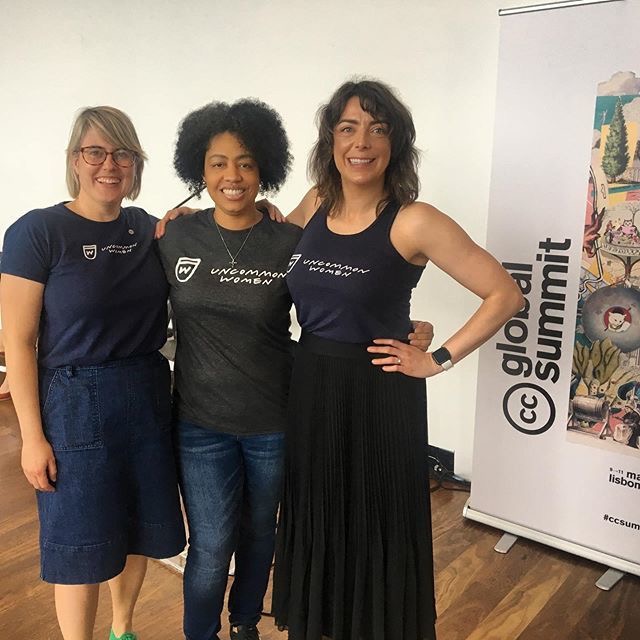
    UnCommon Women meet up at the Creative Commons Global Summit 2019

    And this certainly isn’t limited to the work we do here in the UK, or even the #femEdTech network, as there are many other communities and projects with similar aims.

    Continuing this thread and responding to the many requests for further information we received following the talk on International Women’s Day, we ran an online session to share more of the survey work: Webinar: Equality in Learning Technology: New insights from ALT’s Annual Survey,  with Martin Hawksey, 15 May 2019 and I was also invited to speak at a very interesting event on Technology and Education: opportunities and challenges for equality at the University of Sussex, 17 May 2019.

    The #femEdTech network is made up of activists all of whom ‘represent’ the network in their own contexts. But we, and who that ‘we’ is changes quite often, get regular requests to write about what we do and I volunteered to write this particular post: Building a Network for Curation – the #femedtech movement, blog post for WCET, 22 August 2019; the post gives a short summary of what the network is, what activities members engage in and examples of the types of things we have done in the past.

    A drawing that reads #femedtech and

    And there was a lot of talk of #femEdTech also with Terry on the podcast: Gettin’ Air with Terry Greene, 23 August 2019; which I really enjoyed. You can listen to the episode here.

    And that really set the tone for the remainder of the year, making the most of every opportunity to include something about equality in Learning Technology and contribute to the conversation including this post on HUMANITY OF DATA.. #ALTC on femedtech.net, 27 August 2019; and an article I wrote for the Educause Review on Learning Technology as a Professional Practice: Developing a Critical Perspective, Educause Review, 14 October 2019; and finally at Open for a cause: fostering participation in society and education, panel conversation with Lorna Campbell and Audrey Watters, Wikimedia Deutschland, 27 November 2019. This last event in particular presented a chance to speak about an exciting project that is coming up in 2020: The femedtech Quilt of Care and Justice in Open Education.

    I also want to reflect briefly on how to challenge the status quo and keep going… .

    Male only conference, event, panel? No!
    I no longer accept invitations to male only events or panels and I always ask to see the list of speakers/full agenda. Many organisers I respond to to ask about other female speakers seemingly have not thought about this. Full stop. In many cases the conversation leads to changes to the agenda to be more balanced and I have plenty of lists of speakers I can refer them to if they are looking for speakers on particular topics. This is an old problem, but I figure that I can be one less person to accept it and if more and more people join in then ‘manels’ will soon be a thing of the past. 

    Women’s issue? No!
    As you can see from the list above, this year I started to include something about gender equality in pretty much every talk I have given, regardless of context or audience. I reject the idea that gender equality as an issue should be confined to women’s networks or International Women’s Days etc. It’s everyone’s responsibility. It’s fundamental to the work we do in any sector. Eye rolling, sighing and other ‘oh, here she goes again’ reactions are common. Regardless of how many graphs I show or stats I include to provide a dispassionate, well-referenced and balanced argument, the uncomfortable truth is that gender equality requires change and disruption for every single one of us. 

    Vote = equality? No!
    I often come across the perception that gender inequality is no longer a thing. That at least in the UK the fact that women have the vote means that the problem has been sorted. Be content already. This is precisely why I include something to address this misconception in every talk. I’d also recommend reading up on the research (Invisible Women – exposing data bias in a world designed for men by Caroline Criado-Perez is a good place to start). 

    Allies – thank you!
    I am fortunately not high profile enough on social media to attract a lot of trolling, but keeping up this work year in, year out is hard enough given what I do have to contend with. Luckily I have allies, both men and women and those who identify differently, whom I am grateful for. Every time I hear their voices, see their actions, notice their efforts, I am glad that they are there. Some of them are very visible and others work behind the scenes, but all of them make a difference and they inspire me to do what I can to make change, too. Some moments of this year, like this VConnecting session at the ETUG 25th Anniversary Conference, have stayed with me:

    So, gender inequality in Learning Technology, we are coming to get you… from collecting data about pay, promotions and professional practice to calling out harassment, discrimination and ignorance on the web and in the physical world.

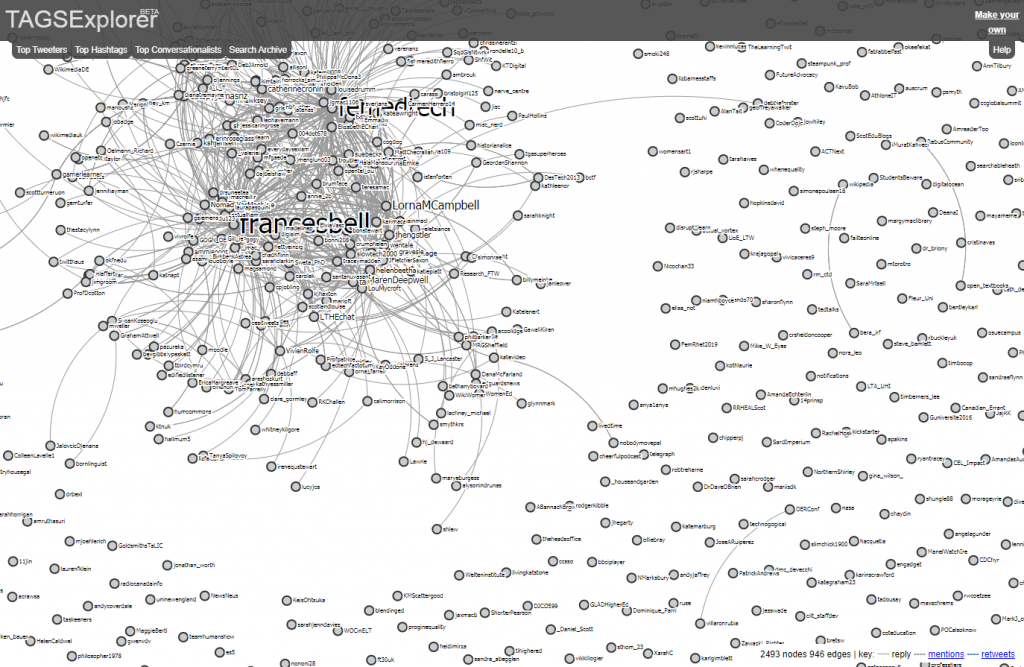
    And if it all gets too much, then there is always the #femEdTech hashtag to follow and the TAGSExplorer of wibbly wobbly equality conversations to watch as they grow and expand… here is to a very #femEdTech new year.

  • #ETUG Conference keynote, 21 June 2019

    This is a written version of my keynote for the ETUG conference in Kamloops, Canada, on the 21st June 2019. Thanks to the conference organisers you can now also watch the video of this talk.

    You are more than a data point. Weaving a tapestry of hope and humanity.

    It’s a real privilege for me to be here, to have been invited to contribute to ETUG’s 25th Anniversary Conference, and also to have the honour of taking part in National Indigenous Peoples Day.

    I’ve dreamt of coming to Canada and this part of Canada in particular ever since as a teenager I discovered the books of Douglas Coupland and the art of Emily Carr. So when I met Clint Lalonde at ALT’s 25th anniversary conference in Manchester in the UK last year, and I heard more about the work of ETUG and the community here followed by the invitation to come and give this keynote, I started writing straight away. Parts of this talk are many months in the making, whilst other things I am going to talk about this morning are fresh off the press – so new in one instance, that you are going to be the very first audience to see them.

    I have worked for ALT, the Association for Learning Technology, since 2008 and one of the reasons why I love what I do is that I have always been interested in how we, as human beings, relate to the world around us, and in particular how we relate to technology. For me, there is no better context than education and lifelong learning to explore how that relationship is evolving as digital technology becomes more pervasive in our lives.

    There is a lot that we do as the leading professional body for Learning Technologists in the UK and some of it may already be familiar to you and has much in common with the work ETUG does. But there isn’t time to cover everything in this brief introduction and so instead I want to highlight our values of openness, collaboration, participation and independence, with our 3,500+ Members at the heart of everything we do.

    The one question I often get asked about ALT, is what is Learning Technology or who is a Learning Technologist. Well… I’ve brought our definition along so you can see for yourself. I’m proud to be a Learning Technologist and one of my aims today is to unpack for you exactly what that means to me and who my professional self is… how my professional practice has been shaped by who I am. This element of my talk is a personal story, it’s part of my story and one example I will use to challenge the perception that the ‘march of the machines’ is moving us to a future in which we are all just data points, gadgets or messy human problems that need to be ‘solved’ by technology.

    On the one hand, my perspective is informed by research, practice and policy making from 25 years of the Association’s work with thousands of professionals in the UK and from across the globe … on the other hand it is my personal perspective. I want to share what the world of Learning Technology looks like from my point of view in order to get across why it is so important that we develop a more mature and reflective, a more critical perspective in our professional practice and how we might set about doing so in the age of automation and technological determinism.

    But let’s start at the beginning… and that goes back to Clint, who gave a wonderful talk last year that started with

    “…When I grow up, I want to be a Learning Technologist… (said no child ever)… .”

    Well, I certainly didn’t start out on a path straight to becoming a Learning Technologist either, although I think I always wanted to be someone who works at the intersection of technology, learning and society, someone who plays a role in negotiating our relationship with innovation. On my way to becoming who I am today, many different roles have played a part: Being a woman, an Anthropologist, a carer, an artist… and a Star Trek fan 😉

    As an Anthropologist I studied cemeteries, I learnt about the concept of being there, immersing yourself in the viewpoint of the other, to spend a year doing ethnographic fieldwork, walking in someone else’s shoes. Eating, drinking, breathing… being in the world that is not our habitual one, really learning what the world looks like through someone else’s eyes. In our own context, that someone else may be educators, researchers, librarians, students, IT Helpdesk – depending on where you yourself are situated. A Learning Technologist should be a bit of an Anthropologist at heart, always translating between sides that can’t see each other’s perspective, who don’t speak the same language, who don’t measure success in the same unit. A Learning Technologist works to bridge that gap, to translate one sides requirements into another’s user experience.

    As an Artist I value curiosity. I understand that there is a certain amount of messiness that’s essential to the creative process of solving problems. I learnt about how there’s always more to discover, how things are always in flux and how we (re)invent even the end of (art) history to write a fresh chapter on our human endeavours. The creative process reminds me of how important it is that we are human beings with human bodies and human senses that shape how we perceive and interact with the world. We can only perceive the world through human eyes even though technology has enabled us to look at the world differently for many hundreds of years, from chalk paintings to photography and video. Each technological advance brings with it a new perspective, new insights. As a Learning Technologist a big part of what I do is keeping pace with change and negotiating the role of human beings with society, with technology, with each other. We help shape who, what and how we teach the next generation.

    As a woman I learn each and every day about the limits of technology and the reality of privilege, prejudice and power. Whether it’s inherent algorithmic biases, gender data gaps in the datasets used to train AIs or mobile phones that aren’t designed to fit in my ‘smaller than the average man’s’ palms, all of these examples and countless others highlight how important it is to question how technology works, to interrogate what’s behind the dashboards and predictive models, the disruptive technology that is hailed as the next big thing.

    As a Learning Technologist I work to understand precisely these things so that I can provide expert advice to decision makers, ask vendors and developers the questions no one else might, to identify training and development needs for staff and students, to keep up to date with every new way in which technology challenges our values and our working practices from labour disputes to efficiency drives. Being a Learning Technologist is inherently political just as every technology has a political dimension.

    I am also a carer for my elderly parents and this role prompts me daily to reflect on the importance of care and kindness. To care for others tests the limits of what even the most advanced technology can do in the face of naked need for certainty, comfort and warmth. Caring for the young and the old is often hard. But it is an essential part of what being human is all about. The journey we are on from birth to death is not one we can undertake alone. We are social creatures. We live, we love each other. We connect, communicate and care for each other. No one wants to die surrounded only by machines. Being human is not a quest for perfection. It’s simply how we experience our life, the world, the universe.

    As a Learning Technologist I’m reminded of that every day. The business of learning and teaching and assessment would be so much easier if it involved one machine being taught by another machine with everything tidily captured in a data set for us to analyse and examine. Instead, we have a political, emotive, heavily contested definition of what education is, how we learn, what the purpose of it all is. Because we are all much more than a data point and that complexity is important to acknowledge. Our experience of the world, our way of learning and understanding the world is so much more than what can be captured in zeroes and ones. The ones and zeroes… in short, technology, is important, sure, but they should not define our lives or determine the shape of our education system.

    As a Star Trek fan I developed my enthusiasm for the wonders of technology. I discovered my love for artificial intelligence and … androids. So much of how we interact with technology now, like tablets and voice recognition and mobile phones were all born in my imagination shaped by the Starship Enterprise, and the ship’s smooth glass surfaces, the talking computers and the crew’s ingenious problem solving inspired a lifelong love for being hard working and solving puzzles. As a Learning Technologist I often feel like there’s a lot of Star Trek in my world and some of the tech advocacy I come across is certainly trying to sell me a vision of the future that’s close to what sci-fi of a few decades ago promised. But what has stayed with me more than the glitzy computers is the value of things like craft, creativity and ultimately humanity (or its alien equivalent) that was and still is at the heart of Gene Roddenberry’s vision.

    Being a Learning Technologist gives me the opportunity to think about some of today’s most urgent questions. My professional practice enables me to address some of the biggest issues we face. Technological innovation or disruption alone can’t help us articulate answers to such questions. As for example Audrey Watters wrote in her annual review The Stories We Were Told about Education Technology (2018) or as Martin Weller wrote in his blog series on 25 Years of Ed Tech “education is fundamentally a human enterprise” and as such we must situate our use of technology and our relationship with it in the theoretical, historical and critical frameworks from across disciplines. Just as I’ve shown by sharing how my own journey shapes my approach and practice, our own stories are particularly important in this context.

    Some might think that day to day activities like designing LMS modules, explaining how open licencenses work or training staff in the use of social media is far removed from these ‘big’ issues that I am talking about. That the majority of us work within systems, frameworks and institutions that leave little freedom for addressing such questions. But let me share some examples of what I mean: take the value of labour. Last year, a new institutional policy for lecture recording was being developed at the University of Edinburgh. Melissa Highton, Assistant Principal and Director of Learning, Teaching and Web Services (LTW)  at the University of Edinburgh, blogged openly about the process which started normally enough but then happened to coincide with industrial action at UK universities and suddenly the questions about the new policy went from pedagogical approaches, attendance levels and revision tools to such concerns as whether or not a university may use recorded lectures to “replace” teachers during strike action, enabling the institution to continue “delivering learning”. It is a huge credit to those involved that with input from all parties the process has resulted in a robust policy which was successfully adopted and now serves as a model not only for lecture recording policies in general, but also for openly sharing both the policy making and consultation approach and the resources created for wider benefit. It comes back to my earlier point, that Learning Technology is inherently political and that we need to be mindful of how our use of it shapes the value of labour.

    Another example is an initiative that was recently announced in the UK focused on student suicide prevent which included a project which aimed to: develop an “Early Alert Tool, led by Northumbria University, which will identify students at risk of mental health crisis by mining data sources, like social media.” This and other national efforts to scale up the use of learning and learner analytics ask serious questions of us: they require us to articulate how we can make ethical use of such technology, what approaches we want to see adopted by policy makers and how we can cooperate with each other and with industry to educate ourselves and our students. ALT consulted its membership and submitted a response to the UK’s All-Party Parliamentary Group on Data Analytics. Of course, this example only scratches the surface of the scary realms that some of the more sophisticated surveillance products in education are operating in. Martin Hawksey’s recent keynote on surveillance, which demonstrates some of what is possible with readily available tech and a few hours of coding, should be your next read if you’d like to learn more.

    Earlier this year, I took part in a panel discussion at the Royal Society in London on Human Transformation Remembering and Learning alongside Diana Laurillard and Diana made a point that really resonated with me: Diana reminded us of the enormous scale of the demand for education (at all levels) worldwide. Diana reflected on how many hundreds of thousands of teachers will be needed to provide education and training as more and more learners in the global South in particular gain access to education and come online. Technology properly and intelligently used, Diana argued eloquently, can help us scale up provision and broaden access for all learners, especially those who may otherwise not find access. But the teachers at the heart of that endeavour also need the requisite digital skill. Alongside the rest of the workforce, we in education face a huge challenge of continuously up-skilling literally everyone to keep pace with even the slowest pace of change and innovation. And that is another context in which we who work in Learning Technology face the sharp end of the adoption curve as we need to keep a step ahead not only of everyone, staff and students, who need the right skills, but also the decision makers, those who negotiate contracts with suppliers and take decisions about what technology will be used, so that we can advise them, help them ask the right question, provide an expert perspective situated within the learning context, rather than coming from the developer or sales executive.

    With only these three examples we have uncovered the huge range of situations and contexts in which we work… and I want to focus next on what skills and capabilities we need and how we can make sure we have strong recognition for what we do. ALT’s work reaches back nearly three decades and we have seen Learning Technology change from a specialism adopted by single individuals from different disciplines and backgrounds to growing into a career path that attracts more and more professionals and leads from junior positions all the way to the most senior ones. I fall somewhere in between as I, too, have come to this work from a different background as I have recounted earlier. But for the past 10 years I have been working at the heart of developing and enhancing professional recognition in the UK and that has given me a lot of insight into how things are developing and what we do next.

    ALT’s approach centres around these four core principles of professional practice: it starts with a commitment to communicate and disseminate best practice and also an empathy and willingness to learn from colleagues from different backgrounds and specialisms. It requires a commitment to keep up to date with new technologies and at the heart of it all is a commitment to exploring and understanding the interplay between technology and learning. Bryan Mathers worked with ALT Members of a period of months to create this visual thinkery so that we can share our approach more widely.

    Building on these four core principles is ALT’s accreditation scheme, CMALT. CMALT stands for Certified Member of ALT. It took me three failed attempts over five years to finally submit my own portfolio for peer review, so I can share a bit of my own experience with you and I can happily say that I find CMALT to be worthwhile and valuable not only as an important professional mark of distinction for my CV, but as an opportunity to continue my professional development as a peer assessor.

    If you haven’t come across CMALT before, here is a quick overview.

    CMALT as a framework has operated successfully for over 10 years… but what I want to share with you next is a bit of a sneak preview of what is launching next month in ‘BETA’ and officially at ALT’s own annual conference this year, in September. It’s taken input from many ALT Members, 4 pilots, many consultation sessions, webinars and wider consultation via ALT’s Annual Survey over the past 18 months… but now the new and expanded CMALT framework is ready.

    In addition to the existing CMALT accreditation, we have developed an expanded framework that provides two new pathways to accreditation: Associate CMALT and Senior CMALT.

    Here is how we distinguish between the different pathways and who we think they will be most relevant for: because we understand that there is a wide breadth of Learning Technology roles and our current baseline of portfolios includes many different job roles, we include differentiators such as years of experience, what the focus of a role may be, how big an impact a role may have and so on.

    I have been involved in the pilots both as an assessor and also as a candidate, as I have expanded and rewritten my own portfolio in order to test out Senior CMALT for myself. My portfolio, both the original and the expanded version are openly available via the CMALT portfolio register and also via my own blog. If you follow #CMALT on Twitter you can often find blog posts and shared portfolios and that sense of shared practice, of peer support and reflection is a big part of why I feel ownership over my portfolio in a sense that I haven’t felt with institutionally owned cpd activities. I host my CMALT portfolio on my own domain (with the help from the awesome folks at Reclaim Hosting) and it will develop as my professional practice does.

    The new and expanded framework however still requires the same three elements in each section. It sounds simple enough but actually many of us struggle to take credit for our work in the first person, many of us struggle to articulate sentences like “I did this…”. Similarly, reflecting on failures is such a valuable but difficult undertaking. Very few feel comfortable to include examples of things that went wrong in their portfolio although this is a perfectly valid way to proceed and I personally find it’s a shame that this record of our professional practice doesn’t often reflect the extent to which we need to take risks, experiment and allow things to fail in order to succeed.

    So, here is a quick preview of what the expanded framework looks like, starting with the four core competency areas required for everyone. This slide covers everything that Associate CMALT requires.

    For both CMALT and Senior CMALT, additional areas need to be covered, including a specialist area, which candidates can define themselves.

    Finally, for Senior CMALT we have designed a new part of the framework which focuses on an advanced area of practice that needs to address each one of the four core principles we looked at earlier. Personally, this is the part of writing my Senior CMALT portfolio that I enjoyed the most. I picked promoting equality in Learning Technology as my advanced area of practice and I then faced the challenge of having to relate that to how I keep up with new technology (actually, if you have read books like Invisible Women, you will know that the gender data gap makes a real difference to how technology is developed) or my commitment to disseminating best practice. It made me look at my work in a completely new and unexpected way.

    I mentioned earlier that CMALT is based on peer assessment and everyone who gains the accreditation is strongly encouraged to become an assessor in turn. I wasn’t sure how I would feel about being an assessor to start with, but working alongside some experienced Lead Assessors I found that it has become an important part of my professional development. It constantly challenges my understanding of practice and as the peer review gradually scales up year on year, it provides a robust and yet agile foundation for our understanding of how professional practical is developing, allowing us to map how things are changing. The CMALT framework has been mapped to a number of other competency frameworks and we are always looking for new frameworks to map to. Do get in touch if you would like to collaborate with us.

    “Why did we set out to expand the CMALT framework?” I hear you ask.

    Well, my answer is simple: “because more and more roles in education require Learning Technology expertise.”  Our existing framework has stood the test of time for over 10 years and continues to be at the heart of what we do, but we also know that the community we serve is growing, is diversifying and its needs are increasing.

    For example, more and more Members of ALT have senior, management or leadership roles and Senior CMALT will provide a valuable pathway for them as they seek to progress from CMALT or to provide a stand-alone accreditation appropriate to their role and requirements.

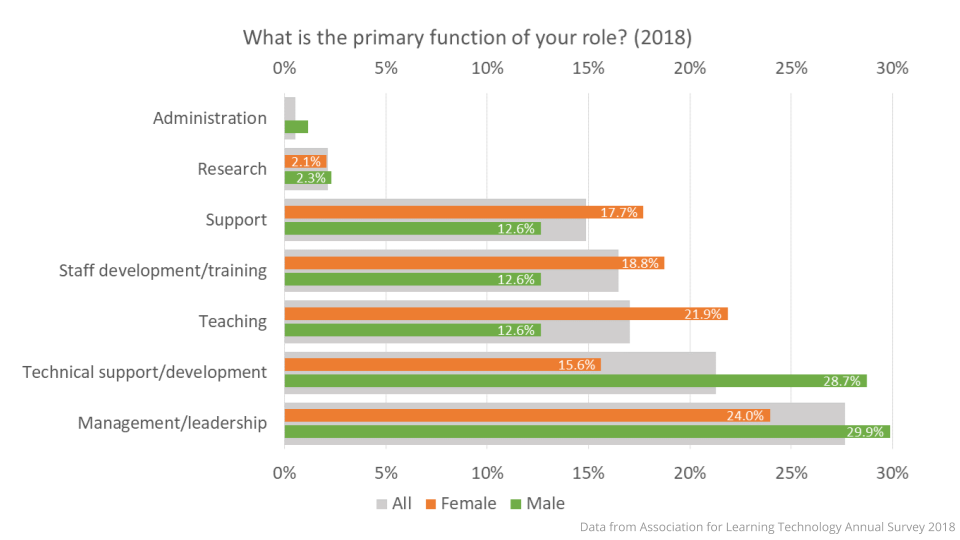
    The graph I have just shown you is from ALT’s Annual Survey and alongside the CMALT peer assessment process the survey generates open data, anonymised open data, which helps to map how professional practice is developing and which we publish annually both as a report and dataset, the work for which is led by Martin Hawksey. This year, for the first time, Martin used the data from the survey to provide a new analysis with a focus on gender, comparing responses from those who identity as male/female.

    As you can see from this graph, the gender balance in the responses to our survey is fairly even and we think this reflects our overall membership quite well.

    One example of this new analysis is a comparison of ranking enablers/drivers for the use of Learning Technology from the 2018 survey. We have picked out two examples: dedicated time and recognition for career development. You can explore further analysis and the survey data for yourself…. This brings me to my final point:

    Gender equality is an important issue and one that I am passionate about. I support efforts to improve gender equality in many ways and I want to recognise the work of so many others who give their time and energy to do the same, for example Feminist Internet, which includes a partnership with UAL Creative Computing Institute to design a feminist Alexa, the @femedtech network which for the OER19 conference set up a SPOLT open space to explore feminist perspectives on open educational practice, contributions to which are still welcome, the Women in Red who work to address the gender balance of English language Wikipedia bios of which only 17% are about women and the Uncommon Women project which aims to advocate, amplify and support women headed up by Kelsey Merkley.  Despite all the progress we have already made, we still have a long way to go when it comes to achieving gender equality.

    The bigger challenge of which this is only a small part however is how to make education more equitable for everyone.

    That brings us back to my own story, my own perspective and professional journey as a Learning Technologist, an Anthropologist, an Artist, Star Trek fan, a carer and a woman. Some of you may be familiar with the OER Conferences that we organise and with the wonderful work of Kate Bowles who gave one of the keynotes at OER19 this year entitled ‘A quilt of stars: time, work and open pedagogy’. Kate and many other speakers and participants created a strong narrative of hope, a thread of open practice that stitches us together, a tapestry, a patchwork, a weaving together. In her blog post about the conference, Kate described her reflections as “a scrap of practice that makes sense through the labour of others who take time to read it, think about it, share it, ask questions of it, extend it” and I feel her words eloquently highlight all the invisible work, the unbilled effort, that is so often crucial to making change happen, from grassroots activism to academic practice.

    And this message of hope and kindness very much inspired my own theme today. It reminds me that I am more than just a gadget, more than data point on someone’s dashboard.  We are all more than that and our professional practice is more than can be tracked in time spent, papers marked or support tickets answered. Our practice becomes fully realised when we adopt a more mature and reflective, a more critical perspective that is informed by our stories and recognises the importance of the labour of others. Communities such as ETUG and ALT are key to us collaborating and communicating in order to create a future for Learning Technology that is more open and equitable for all, to weave that tapestry of hope and humanity.

    And with that I am at the end of my talk and I want to thank you and end by wishing ETUG a happy birthday from everyone at @A_L_T . Thank you.
  • Discussing (gender) equality in technology and education at the University of Sussex

    Recently I was invited to take part in a seminar on ‘Technology and Education: opportunities and challenges for equality’ organised by the Technology Enhanced Learning Team at the University of Sussex. Here is what the seminar was about:

    Technology has always played a significant role in education – whether it was the fountain pen and printing press of the past or today’s mobile devices, online study and immersive technologies. It cannot be assumed, however, that technologies will offer equal opportunities to all or that there is equality in all the spaces where technology and education meet and interact. As new technologies are increasingly adopted within educational contexts, now is a great time to think about the challenges and opportunities for equality.

    For this TEL seminar we are thrilled to welcome Dr. Maren Deepwell (Chief Executive Officer of the Association for Learning Technologiesand our own Mary Krell (Senior Lecturer in Media & Film Studies) to speak about the opportunities and challenges they see for equality in the ways that technology and education come together.

    Dr. Tamsin Hinton-Smith (Senior Lecturer In Higher Education) will chair the seminar and join Maren and Mary for a panel discussion of the ideas raised and audience questions.

    The day was really interesting and you can watch the videos from the seminar, access the slides and find out more about the speakers and chair on the university website.

    My contribution focused on gender equality but our conversation was much wider, focused more holistically on all types of inclusion and diversity, what progress we have made and how much there is still left to do.

    I was really inspired by the creative, thoughtful and visionary Mary Krell, whose thoughts on the limitations of technology as well as its potential resonated with me and my own thinking around how technology isn’t always the best way to engage, enable or empower learners.

    Similarly, Tamsin Hinton-Smith spoke eloquently and passionately about teaching training and development with a focus on equality and from a feminist perspective, providing insight into what the university is already doing and where further work may be done.

    The TEL Team also has a podcast (definitely recommended listening) and I enjoyed taking part in recording a session, in particular as some of their regular questions really made me think: what’s your favourite keyboard shortcut (my answer here was CTRL + F and also CTRL+/ CTRL- to zoom in/out) and what app can’t you live without (for me, sadly, that would be text messages).

    #femedtech skateboard visual
    Soup up my deck by @visualthinkery is licenced under CC-BY-SA.
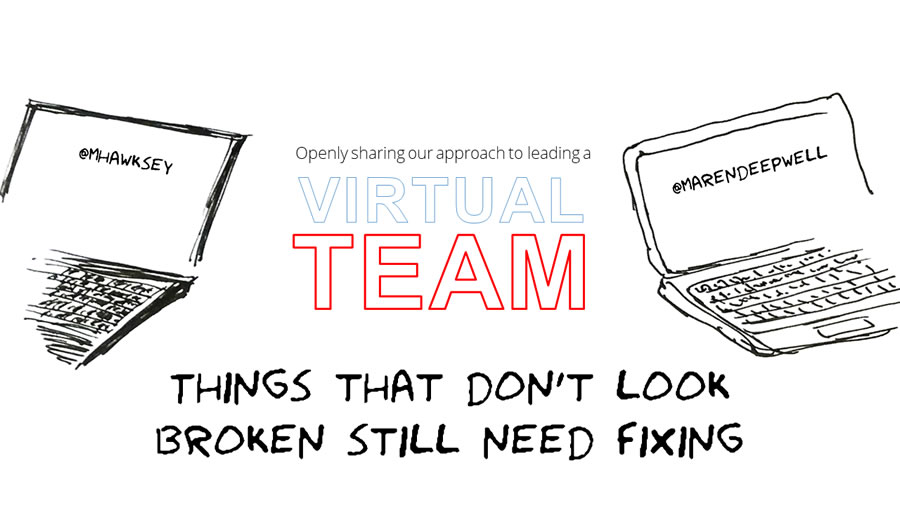
  • Virtual Teams: Things that don’t look broken still need fixing

    Things that don’t look broken still need fixing

    Hello and welcome to this month’s post on leading a virtual team. In this post (cross-posted here) the two of us, that is Martin Hawksey (@mhawksey) and Maren Deepwell (@marendeepwell), continue our series of openly sharing our approach to leadership.

    If you are new here, you can catch up on earlier posts and podcasts or find out more about ALT, the organisation we work for as senior staff. We really appreciate comments and feedback and welcome questions or suggestions for future posts.

    March

    Maren: this month I’m keen to pick up on a couple of things we started talking about in the last podcast, talk about all things open as we get ready for OER19 and also discuss a book you recommended, Invisible Women. It’s an awesome read full of interesting facts and laugh out loud moments (car manufacturers’ advice to lower my voice to help AIs understand my ‘atypical’ high female voice made me giggle it seemed so ludicrous) and there are many things that really chimed with me in the context of this series on open practice, starting with how important it is for women & men to each contribute their perspective to policy, research and practice equally. The joint keynote we wrote for International Women’s Day at UHI is a good example of this – neither one of us could have written the talk on their own.

    It’s the open collaboration, the dialogue, that produces deeper insights. Gender data gaps discussed in the book provide countless examples of where that kind of dialogue is lacking from workplace practices (biases in recruitment software) to disaster relief (male only committees designing shelters without cooking spaces). Another point the book prompted me to reflect on is how important transparency and openness are for promoting equality. There are countless examples of complex technologies, especially AIs, that are proprietary and don’t permit us to investigate potentially biases much less address them. The two overarching thoughts I took from the book are that firstly, in one way or another, women, and by extension anyone who doesn’t fit the ‘template’ is made to adjust in order to fit – even if changing the underlying policies/design/structures would have bigger benefits for all. And secondly, how we always prioritise something else, focus on the next crisis, instead of focusing on gender equality ‘because we see the rights of 50% of the population as a minority interest’.

    Martin: ‘Fit’ is an interesting topic. As part of our talk at UHI I thought I’d look at the findings of the ALT Annual Survey to see if there are any notable differences for survey responses based on gender. This was a very quick analysis so I can’t say if the results are statistically significant but it was interesting to see differences in areas such as enablers/drivers for the use of Learning Technology by male and female respondents. Fit, and in particular culture fit, features as a chapter in ‘The Open Organization Leaders Manual’, which you recently shared. In this Jen Kelchner’s writes about “Stop hiring for culture fit“. As part of this Kelchner argues that instead of cultural fit organisations should recruit for ‘alignment’:

    “Fit” implies that your organization seeks to indoctrinate new members into its specific way of life—to clone its vision of the ideal member in everyone who joins it. When we talk about “fit” we create the potential for exclusion. It prompts us to seek someone who already embodies the values and principles we think are best (then seek to “fit” them into a pre-existing spot in our organizations), and ignore others.

    Achieving “alignment,” however, is different. Alignment involves embracing diversity of thought and building inclusive, innovative, community-driven teams that are all oriented toward shared goals, even if they look and think differently from one another.

    ‘The Open Organization Leaders Manual’ uses five principles as part of it’s Open Organization Definition: transparency, inclusivity, adaptability, collaboration and community. In terms of transparency it’s highlighted that:

    In open organizations, transparency reigns. As much as possible (and advisable) under applicable laws, open organizations work to make their data and other materials easily accessible to both internal and external participants; they are open for any member to review them when necessary (see also inclusivity). Decisions are transparent to the extent that everyone affected by them understands the processes and arguments that led to them; they are open to assessment (see also collaboration). Work is transparent to the extent that anyone can monitor and assess a project’s progress throughout its development; it is open to observation and potential revision if necessary (see also adaptability).

    I feel to our members and the general public that our operations are very transparent (our joint posts being a case in point). In terms of our distributed team it feels like more effort is required to be transparent, as in “to the extent that anyone can monitor and assess a project’s progress throughout its development”, than if we were all physically in the same office. We’ve previously talked about the challenges of virtual operations and the removal of some of the affordances of being physically co-located. Even though we are over 12 months into our move to operating as a distributed team this feels like one of the areas where we have the most continued evolution in our systems and procedures. This is also an interesting time as our staff team will have a number of new faces and I’m interested to see how candidates align to ALT’s values.

    Maren: I like the concept of ‘alignment’ instead of ‘fit’ and it is a useful way of thinking during recruitment in particular. But whilst I found the open org manual really useful, its perspective comes from open source/software companies. In our context, in a small charity with a wide breadth of projects it’s harder to make the kind of internal ‘joined-up-ness’ work for everyone than when you are all focused on making a product shipping deadline. There’s a balance to be struck between enabling individuals to get on with their work and effective team communication. And it can be hard to determine how much information is actually useful and why. For instance, I’m finding it rewarding to develop and improve our internal processes for reporting, budgets and project overviews. It’s part of the ongoing effort you refer to helping us as a team work together even better. Like you, I have a lot of enthusiasm for an iterative approach to designing processes. That said, I’m also acutely aware that any change requires time and effort that would not be needed if we just kept doing things the same way. It’s a big ask (and one that requires a strong common understanding of the reasons behind it) to spend time and energy changing things when there’s so much to be getting with. Especially when things don’t look ‘broken’ but still need ‘fixing’ to avoid disaster in the long run it can be a hard argument to make. As well as requiring time and effort, changing internal processes can also temporarily rob us of the comfort and confidence that comes with familiarity. Which leads me to reflect on what alternative sources of comfort I turn to when uncertainty and change are a constant. One example of what I do is to look beyond a period or process of change, and thinking ahead to what things might look like 3 months into the future or a year ahead. And it can be useful to do that as a team as well to create a greater measure of the kind of transparency you speak about. Here’s one such approach, similar to a SWOT analysis, that I found interesting and maybe we can try something like this at our next team day in April.

    Martin: Your comment on things that “don’t look ‘broken’ but still need ‘fixing’” made me smile. I’ve some wooden decking at home that falls into that category thanks to some rot, but I get we are talking about something very different here. Having recently gone through my annual appraisal thinking ahead is still fresh in my mind. It’s interesting to reflect on personal goals and I can also see the benefit of exploring and articulating team goals. As often with these collaborative posts they are an opportunity for me to start googling for answers to questions that pop into my mind. Something I started wondering was the impact of churn as staff move on and new faces join virtual teams. I didn’t find anything in particular that talks about this and I suppose the stronger influencer in this instance is less on whether or not you are dealing with a virtual team but the size of the team you are dealing with. As part of my search Google Books did throw up ‘Leading Effective Virtual Teams: Overcoming Time and Distance to Achieve Exceptional Results’ by Nancy Settle-Murphy. As part of the uniques challenges of virtual teams Settle-Murphy highlights that “it’s harder for team members to tell whether they’re out of alignment about important issues … and once out of alignment, it takes virtual teams much longer to pull back together”. Settle-Murphy goes on to highlight one of the challenges for virtual team leaders is “ensuring that all share the same understanding of team goals”. The modified SWOT approach you mentioned looks like it should help with identifying goals, the issue I see is the timing as we’ve potentially got two new starters joining us after April. In a team of six, two new starters make a big impact and with a high percentage of the team changing it’s going to be interesting times but the timing is good as whilst not a lull it does mean we are not throwing our new starts straight into our Annual Conference.

    Maren: ever since I took on a leadership role I’ve waited for the right timing for all those things, for the mythical steady state, that blank slate from which to start planning and doing afresh, ideally with all aims clearly defined and understood by everyone. But leading organisations or teams, working with technology and with people is always messy. There’s always history, legacy, mess you inherit, missing pieces of the puzzle and my favourite – the unknown unknowns. Our work is always work in progress. That’s why when you have a moment when things work out, when you achieve something or can enjoy something, it’s worth pausing and revelling in the moment. Send a hug, share a smile, take a breath. And then take that next step towards the inevitable chaos that will no doubt put an end to that peaceful moment.

    More to read and listen to

  • Who’s responsible for the future of open? #femedtech #oer19

    This post is for the inclusive Open Space session coming up at OER19 in April. You can read all about the session here. It is posted on the FEMEDTECH OER19 OPEN SPACE. Here is a link directly to the post.

    I have chosen to focus on the question: “How do we manage sustainable spaces for exploring challenging issues around open?” and my response has also been inspired by a recent blog post by Martin Weller on ‘Learning the rules of predicting the future‘. In the post, which deserves extra credits for inspired use of Parks and Recreation gifs (note to self: up your GIF game), Martin sets out the following “rules” for predicting the future for education (I am quoting only very briefly here, so you should really read the whole post, as it makes for excellent reading):

    • The first rule to learn about change in higher education is that very little changes, while simultaneously everything changes.
    • A second rule is that technological change is rarely about the technology.
    • The third rule is to appreciate the historical amnesia in much of educational technology.
    • The fourth, and final rule I would suggest is that technology is not ethically or politically neutral.

    And that has inspired me to think about rules for making sustainable spaces, which links to the broader question of who takes responsibility and how to take responsibility for the future of open spaces of all shapes and sizes. It also relates to the question of permanency on the web and in technologically mediated social spaces in general (I have written about Cemeteries of the web: parallels between Victorian burial culture and digital infrastructure previously). So here goes:

    First, I would argue that in most cases planning for the long term, for sustainability in any sense, does not come into the development of new spaces, platforms or tools. So many sites and systems come and go, disappearing often with all the content we have created and without much notice or help for migration. Interoperability standards, transferable file formats and all that goes with it are rarely at the top of anyone’s priority list whilst iterative, agile approaches to development force users to move along regardless. When funding dries up or business models change repositories, community sites, communication platforms etc become unsupported, derelict collections of broken links and unanswered support requests. This is not only inconvenient, but has serious consequences: it makes it difficult to have a sustained critical debate as we constantly loose records of what we have already done; it puts the focus always on reinventing, re-establishing, re-designing new spaces and it promotes the kind of historical amnesia in much of educational technology that Martin Weller warns us about.

    Sustainable spaces for exploring the challenging issues around open also require us to address the question of who has ownership of those spaces, both in a practical sense, i.e. who owns the domain, who controls access, who pays the bills, as well as the social aspects such as who controls the conversation, who records it, who can participate and who ends it. Some of the hardest questions we must ask have strong political and ethical dimensions. If the organisation or entity that hosts or supports such a dialogue has a strong agenda, be that commercial, political or social, then we need to question how that impacts on the kind of discourse we can foster and also how this may impact on the sustainability of the project. Open means many things to many people and there is a whole range of motivations to get involved and try take ownership of spaces that support open communities.

    One of the things that’s really tricky about both open in education and technology in education is what Martin Weller describes as ‘very little changes, while simultaneously everything changes’. I find that is often to do with our goalposts constantly moving further ahead and at the same time the spectrum of individual and organisational practice spreading out. What I mean is that the range of challenges we ask technology to help us meet is huge – from basic infrastructure to educating millions across the globe. Similarly, when it comes to thinking about open, there is a vast array of situations to tackle. It all depends on the perspective you start from and it can be difficult to find common ground in a conversation that brings together many different contexts – this is exactly the reason why an open space like this one can help.

    I don’t seem to have come up with very clearly articulated rules, but rather characteristics and questions around the lack of long term planning, questioning ownership and motivation and the need to appreciate different perspectives from which what we find challenging about open can be explored. One very generic sounding conclusion to draw is that the only rule is to make use of your voice, to continue to engage and question, not to become indifferent or disengaged no matter how difficult that can seem at times. But it is, for me, a powerful reminder that we each have agency, and that taking part, contributing something that helps others understand our way of seeing the world, our perspective on open, our world view (as a women, as a feminist, as a contributor in my case) is a meaningful and important act.