Tag: coaching

  • How to make a milestone map

    How to make a milestone map

    Many of my clients are looking to make progress in their work or personal lives: to make a change, develop their career path or build personal habits. Many of us have goals like ‘progress in my career’ or ‘be happier’… but it can be hard to break down exactly what to do in order to achieve our aims and define what ‘success’ means to us. Here are five tips that will help you create a milestone map that works for you:

    Choose a format that works for you

    It’s hard enough to set out a milestone map without having to do battle with the interface. Maybe you are someone who thrives on learning all about a new productivity tool (hello, fellow Asana fans), and if that’s the case, then use that extra motivation to get you started in a shiny new template. If pen and paper seems more attractive, or post-it notes on a whiteboard get you thinking, then choose those. You can use pretty much any format you like. The key is that you need to pick something you can easily work in, add to over time and access, and something that will enable you to add a lot of information if you need to (when you break down goals like ‘develop my career’ into smaller, actionable tasks).

    If you have a work tool that you need to use for a performance review or appraisal, then ideally start somewhere else and late copy your finished thoughts into the required format. Give yourself space to think first and foremost.

    Pick your goal(s)

    Is this map going to help you plan out the next five years? Focus on finishing a book or a project? Is this a map to a career transition, a healthier you or a bucket list? Do you already know exactly what you are aiming for?

    • If you have a clear goal: then set out your parameters first. For example, if you are planing for a writing project, note all the specifics such as word count, deadlines and so forth. For example, if your goal is to: submit a paper to a major conference; this could be made more specific: Submit a 5,000 word research paper to a conference by July.
    • If you are searching for clear goals: often it can be hard to set out goals straight away. It’s helpful to think about broad categories to start focusing, e.g. ask yourself what timeframe you are planning for; what aspect of your life you want to think about, such as work, family, relationships, hobbies, self; consider what’s important to you and how this can be reflected in your plans. For inspiration, have a look at the Wheel of Life tool or List of 100 Dreams I have previously blogged about or start with a list of your values to help guide your thinking.

    Turn goals into milestones

    Once you have your blank page in front of you and picked your goal(s), it’s time to turn the goals into milestones. Earlier I used the example of a writing project, where the goal is to: Submit a 5,000 word research paper to a conference by July. For this kind of project, ask yourself questions like: who else is involved? How will they input? Are any parts of this time-sensitive? What is the end product? How do I get there? Or what is the first step? What is the next step?

    Group tasks that go together and define a milestone for each group. For example:

    • Write 500 word outline
    • Research initial references
    • Share with colleague for feedback
    • Milestone: Draft a full paper structure

    Then, consider how to move from your first milestone to the next.

    The same approach works for much bigger goals, such as working towards a promotion or leading an initiative. Whatever you choose to focus on can always be broken down into individual steps and milestones.

    Check your map

    Part of the magic of this kind of planning is that it really works, provided that the map is true to you. By that I mean that the map reflects what can you can reasonably achieve. If you usually write less than 500 words a month and your plan is to write 5,000 words a day, then you will very likely not achieve your goal.

    The trick is to dream big and allow yourself to set goals that are truly meaningful to you, which you then turn into achievable actions that fit within your life.

    Similar to prioritising your to do list, you can prioritise your milestone map. A long term goal might go on the back burner while you focus on a more urgent opportunity for example. A map is not a to do list, but a tool for you to make the changes you want to make happen.

    Ask why?

    I often come across milestone maps that are all about what people feel should be on them instead of goals that align with what’s truly important to us. So my final tip for when you have your map, is to check in with yourself about the why.

    Why is this goal on your list? Why is it important? Why do you want to spend the next three years working towards this?

    Milestone maps often bring out our inner need to conform to other people’s expectations. Maybe there is a specific deliverable you need to meet to get more funding for your project. Or maybe there is a hoop to jump through on the path to tenure. Whatever you are aiming for, remind yourself of why it’s important to you.

    Make your hybrid working milestone map

    I recently worked with the wonderful folk at Reclaim EdTech on a course all about hybrid working, and as part of the course I designed a roadmap for professional practice in hybrid working. If this is something you are interested in, drop me a line and I’d be happy to send you a template so you can make your own.
  • Tranquillity by Tuesday – follow up

    Recently I blogged about Laura Vanderkam’s Tranquillity by Tuesday: 9 Ways to Calm the Chaos and Make Time for What Matters. Now that I have finished the book, and tried out some of the rules for time management, here is a follow up sharing how things went:

    What did I try out and how did it go?

    The first ‘rule’ that I put to the test for me is Rule Two: Plan on Fridays. The basic idea is to plan for the week ahead on a Friday afternoon and the chapter goes into explaining why this is a helpful practice and how to do it. I already plan on a weekly basis, but it was still interesting to read more about why this is effective. Two things jumped out at me:

    Plan across three key categories: career (which I took to be short-hand for all types of work, paid and unpaid), relationships (which encompasses partners, family, friends, any we care for and spend time with, including pets) and self (this is the category that is easy to overlook).

    Plan on Fridays: there is a good section on why Friday afternoon is a good time to plan (provided you follow a Monday – Friday work or school schedule):

    1. there is little opportunity cost: for many of us, Friday afternoon is close to the weekend, it’s not a good time to start something new and this less busy time can be extra productive if used for planning;
    2. You can make Monday productive: start the week knowing what your day is going to bring and focusing on it;
    3. Upgrade your weekends: making more time to make plans for leisure or family time or self care rather than using the weekend for planning;
    4. Calm the ‘Sunday scaries’: meaning that going into the weekend with a clear plan for the following week helps you switch off and stop worrying about or planning for what’s ahead.

    This last reason resonates with me in particular, as I usually do planning on Sunday evenings and I have definitely found that to have downsides.

    Overall, I found this habit took some effort to embed in my week, partly because I don’t follow a regular Monday to Friday work schedule and partly because some of my planning is done with other’s.

    However, I did schedule a regular planning session into my work diary and home diary, and I made an effort to start planning on Thursdays and Fridays for the week ahead.

    The biggest improvement that I felt nearly immediately was that I worried a lot less over the weekend. I found it very helpful to have thought about the week ahead and have a plan in place.

    I also found it easier than I had expected to slip in some productive time into my usually quiet Friday afternoons. This was something I hadn’t been sure about, but I found it easier than expected.

    Upgrading my weekends hasn’t really happened yet, but I think that is largely because they already work very well… and as it happens I started a new yoga class on Saturday mornings at the same time as I started this new habit, which feels like good timing.

    Further inspiration from the book

    I really enjoyed this book and took a lot of inspiration from it. The two ideas that jumped out at me that feel particularly helpful to me are: first, the concept of a back-up slot and also the idea to include one little and one big adventure in plans for each week.

    Planning in some ‘adventures’ seems like a cheerful idea and looking for activities that I could do in one hour or less (little adventure) or half a day (big adventure) feels both challenging and achievable. It relates to the three categories I used to start planning my weeks (work, relationships, self) and I am going to try that idea out in the coming months.

    I also LOVE the concept of a back up slot for my diary. In the book Laura goes into different ways in which this can be helpful, from scheduling time slots for particular work tasks, for family time or even days of the week.

    In practice I have long had back up slots in my schedule, but I never thought of them as such, so revisiting this in the context of the book. I found it helpful to consider in what ways I could use this strategy and I found exercise a really good example of an activity that needs a back up slot as it is rare for me to be able to exercise as I plan each week as something always comes up. So an exercise back up slot will definitely be in my schedule from now on!

  • Creating space in a packed schedule

    It feels like it’s been a very busy week (month, year, decade…) and if your schedule is anything like mine, you probably don’t have enough time for being creative, taking breaks or anything else that injects a little bit of joy into the routine.

    There are many strategies for tackling this problem, and one approach I have been experimenting with is pairing habits.

    What’s pairing and how does it work?

    I first came across the concept in Gretchen Rubin’s Better Than Before and basically this strategy is about pairing a new habit you want to adopt, such as doing a short meditation session, with an established behaviour, such as getting up.

    There are two ways in which pairing can work: in positive ways (for example listening to an audiobook whilst walking the dog to create extra time for reading) and also in negative ways (buying too many snacks in the cinema).

    Finding focus

    I found for example that I associate standing at my desk with being responsive on chat and email. That focus on being available and the consequent constant interruptions made it very hard to focus on tasks that require space to think.

    Although I was still productive and got a lot done, I was putting off tasks that would need more focus and started on other things that I could fit around communicating.

    The solution was to pair tasks that need more focus with stepping away from my desk. Now I take my laptop with all email or DM apps closed to a table and write away from my inbox. When I sit down, even though I am physically less than 3 feet away from where I usually stand, I find it easier to focus on the task without distractions.

    Lunchtime reset

    Another example from my own experience is a negative pairing: I was good at taking lunch breaks but I was bad at actually resting. Instead, especially on days when I work from home, I started doing chores or life admin or watched things on my phone. I stopped working but I still kept going.

    Over time, I found that really exhausting and I was craving a break that would help me reset. The start of my day may be four hours of stressful meetings, so I wanted to find a way to help me break the negative pairing of lunch with getting things done.

    I identified things I wanted to stop (doing admin, chores, screen time) with things I wanted to do instead (go outside, play with the dogs, close my eyes for a few minutes).

    Initially, I found it hard to change my habits. I caught myself staring at my screen or sorting things out around the house. When I sat down to do something like a breathing exercise or a short meditation, I found myself thinking about work.

    Gradually however, I found ways to stick to and even enjoy my new lunchtime habit. I use a mindfulness app or other videos for 5-10 minutes and the guidance they provide helps me reset more easily. Weather permitting I have lunch outside, and my phone stays inside. I have stopped planning to complete chores during lunchtime instead making time outside of lunch.

    What could work for you?

    What habits are present in your life? Do you have any positive pairings that work for you or negative ones you’d like to change? How could pairing habits work for you?

    If you’d like to try this strategy for yourself, here are some questions to get you started:

    • What habits work well for you (at work, for your wellbeing, or another area of your life?)
    • Why do they work well?
    • Can you identify any pairings that you would like to change?
    • How would you like to change them?
    • What single change would have an immediate positive impact on you?

    Resources

  • Exploring Gretchen Rubin’s Four Tendencies

    I was curious to explore this particular framework, especially as I sometimes listen to the Gretchen Rubin podcasts.

    Four Tendencies described

    There is a dedicated book that makes for interesting reading, however to get started, here is how Gretchen Rubin explore the concept:

    By asking the one simple question, “How do I respond to expectations?” we gain exciting insight into ourselves. And when we know how other people respond to expectations, we understand them far more effectively, as well.

    We all face two kinds of expectations—outer expectations (meet work deadlines, answer a request from a friend) and inner expectations (keep a New Year’s resolution, start meditating). Our response to expectations determines our “Tendency”—that is, whether we fit into the category of Upholder, Questioner, Obliger, or Rebel.

    Knowing our Tendency can help us set up situations in the ways that make it more likely that we’ll achieve our aims. We can make better decisions, meet deadlines, meet our promises to ourselves, suffer less stress, and engage more deeply with others.

    https://quiz.gretchenrubin.com/?utm_source=website&utm_medium=homepage

    Taking the quiz and what I got from it

    Whilst you do need to provide an email address to complete the short quiz, it is free and has been taken by 3 million users. I always find myself choosing between options and feel a little that none of them really describe me particularly well, but it is not too long and the result feels authentic: My dominant tendency is to be an Upholder (“I do what others expect of me—and what I expect from myself.”) and that rings true to how I see myself.

    The report I receive is four pages long and I find it helpful to read through it. It mentions both upsides and challenges of this particular tendency when it comes to communication, work and daily habits.

    A new insight I take away from the quiz is that whilst there is a ‘relentlessness’ about this kind of person, which can be tiring for me and those around me (something I AM familiar with) there is also a suggestion that being good at keeping commitments to myself and a strong sense of self preservation helps protect me from burnout.

    There are quite a few books by Gretchen Rubin that I haven’t read, including the Happiness Project, and the one that appeals to me the most is about daily habits, called Better Than Before. So that is going on my reading list 🙂

    Explore for yourself

    If you’d like to explore the quiz for yourself, head to the online quiz page and get started.

  • Reflecting on different modes of working

    As part of my work on the Leading Virtual Teams book, I have been careful to define what is meant by terms describing different ways of working. It’s taken me a while to bring the various terms together, and to reflect on their meaning not just now, but also before the advent of digital technologies and more widely available, reliable, high speed internet connections.

    In my childhood days for example, selling Tupperware from your garage was a popular way for women to work from home alongside bringing up children, for example, and that didn’t involve Zoom calls or being online at all.

    Similarly, there are many industries in which distributed working (i.e. across a number of different geographical locations) or working remotely (away from a central location such as a campus or corporate HQ) has been commonplace well before we had the capacity to take much of our “office” with us in the form of a laptop or even mobile device.

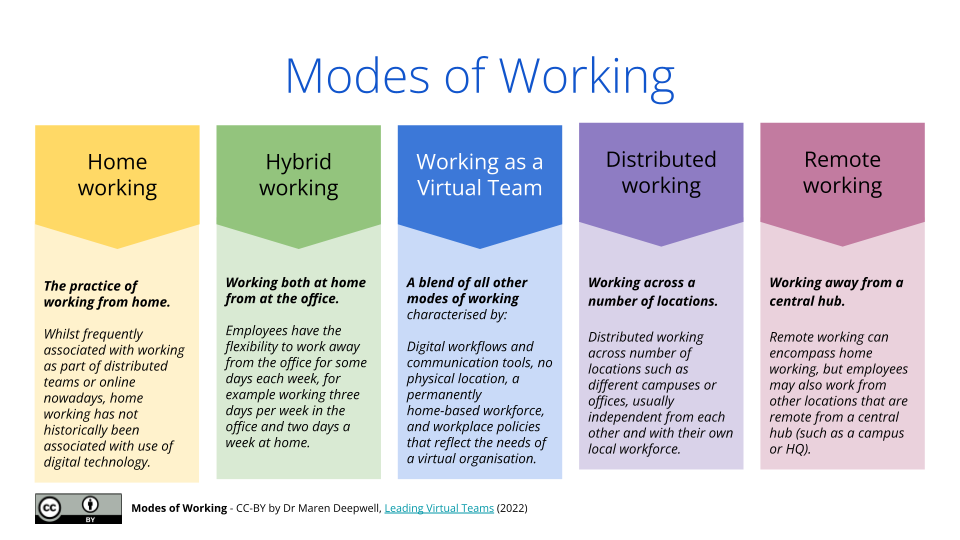
    Graphic showing an overview of different Modes of Working - CC-BY by Dr Maren Deepwell, Leading Virtual Teams (2022)

Home working: The practice of working from home.

Whilst frequently associated with working as part of distributed teams or online nowadays, home working has not historically been associated with use of digital technology. 

Hybrid working: Working both at home from at the office. 

Employees have the flexibility to work away from the office for some days each week, for example working three days per week in the office and two days a week at home. 

Working as a Virtual Team: A blend of all other modes of working characterised by:

Digital workflows and communication tools, no physical location, a permanently home-based workforce, and workplace policies that reflect the needs of a virtual organisation. 

Distributed working: Working across a number of locations. 

Distributed working across number of locations such as different campuses or offices, usually independent from each other and with their own local workforce.

Remote working: Working away from a central hub. 

Remote working can encompass home working, but employees may also work from other locations that are remote from a central hub (such as a campus or HQ).
    Graphic showing an overview of different Modes of Working – CC-BY by Dr Maren Deepwell, Leading Virtual Teams (2022)

    One of the key themes of the work I have been doing is reflecting on how the way we work impacts on us. More specifically, I am interested in how different modes of working impact on particular aspects of our lives such as physical and mental health, work/life balance or a sense of connectedness.

    Inspired by my coach training, in which our coach trainer recently asked us to practice with a coaching tool called Wheel of Life, I have adapted this coaching tool to explore different ways of working such as working from home, hybrid working,
    distributed or remote working and working in virtual teams and reflect on how the way you work impacts on you and your life.

    Here is one example focused on hybrid working:

    Example of a wheel adapted to reflect on hybrid working

    Each wheel contains eight sections, including one which is blank for you to add your own category. I have been experimenting with what categories to include based on the research I have undertaken, and the mix of what’s included changes for different modes of working.

    For hybrid working, you could reflect on and score:

    • Home working environment
    • Work/life balance
    • Physical and mental health
    • Care and family responsibilities
    • Socialising with colleagues
    • Commute
    • Office or campus work environment
    • and… a category of your choice

    Here is another example that I have completed for working as a virtual team:

    Example of a wheel with scores adapted to reflect on working in a virtual team

    In this example, I have added a lower score for “Virtual socialising with colleagues” and high scores for areas like “work/life balance” and “home working environment”.

    Try out this resource

    You can download this resource and use it or adapt it to better suit your particular needs.

    If you have any feedback or comments, I would love to hear from you. Contact me.

  • Walking into a coaching mindset

    In January I officially started my coach training in order to become an accredited coach, an ICF Associate Certified Coach, via Katie Linder’s Higher Ed Coach Training.

    We are now in Week 7 of the course and I am thoroughly enjoying it. I have learnt a lot in the first few weeks of the training, met some amazing people and started to develop a whole range of skills. It’s been a very motivating part of my practice and I find myself looking forward to each Saturday night’s session.

    Whilst the training is very comprehensive, the hours required fit well around my existing commitments, and I have been listening to readings on walks in the evening and at weekends.

    Along the way, I have set up a summary page about the work I am doing, and as my first pro-bono clients start coming on board, I have started to share coaching information and resources .

    Adopting a new mindset

    One of the things I have found the most interesting so far, is adopting a new mindset – a mindset that is focused very much on whomever I am working with. It’s fascinating to focus on not knowing the answers, but to be curious about what we might discover together.

    Curiosity is something I value highly and it’s an element of coaching that I find suits me very well. I like asking questions, and I always try to keep an open mind about what might be at the end of a thought process or a conversation, and the coach training helps me develop a new way of doing that.

    Initially I was expecting it to be challenging not to give advice or offer answers because that is often what my work requires of me day to day. But I haven’t found it to be a problem at all, quite the reverse. Focusing on my clients priorities has helped me adopt a new, a coaching mindset.

    Walking and coaching (literally)

    One idea I have had that is inspired by my previous experiences of walking line management meetings is to offer established clients I work with sessions that enable us to walk and talk. Here is what I have in mind:

    Walk with your coach

    Sometimes a video call is not the best environment to get us thinking, so for established clients I offer coaching sessions whilst we walk. Usually, this would be coaching via a phone call, but if you are based locally, we could also meet in person. Walking coaching sessions are particularly suited to think together about difficult situations or to reflect on a particular problem or idea.