
Category: VirtualTeamsBook

  • Virtual Teams Book: Trust & surveillance… extract from Chapter 3

    Virtual Teams Book: Trust & surveillance… extract from Chapter 3

    In July, I drafted the first chapter of my book about leading virtual teams. Head over here to learn more about the project.

    Progress since the last post

    Since my last post, I have been working on Chapter 3. This includes some of the most interesting sections relating to Learning Technology and Open Education, in particular a section on open approaches to leadership.

    The chapter was harder to write because I had a lot of things I wanted to refer to which would be covered in other parts of the book, which don’t exist yet. On the plus side, I have managed to get into a good routine with my writing, and I found a regular writing (half) day, which helps a lot.

    Posey, the puppy, will soon start to spend more time in my office, and I am looking forward to having her company as my writing buddy. Pictures to follow.

    For the next four weeks, I will be working on Chapter 2, on Building a virtual team spirit.

    As planned, I will be sharing extracts from work in progress (read the first extract below) and invite you to read along, reflect and share your thoughts. As part of the book writing process, I will also organise virtual drop in sessions which are open to all and free to attend and there is a regular newsletter with updates about the book and upcoming events or get in touch with me directly.

    Chapter overview: Leading a virtual team

    In what way is leading a virtual team different from leading a team that is geographically co-located?

    This chapter explores what leading a virtual team is like for managers and leaders. We will discuss the challenges of leadership that are specific to a distributed workforce and explore ideas for how to find your own virtual leadership style. 

    It’s worth taking a moment to reflect on your own journey to leading a virtual team. Consider for example, what your experience has been to date? Have you mostly managed people in co-located contexts, in offices or on campus? Have you previously managed staff who were home-based or had flexible working arrangements? What was a successful experience of working with a virtual team for you? 

    Many of us get to a position of having to manage a distributed workforce with little or no prior experience, particularly if your organisation has only recently introduced remote working or you work for a start-up company. 

    If you do have experience to draw on, consider how this shapes your expectations of managing your current team. Reflecting on your own experiences, are there things you would do differently in future or approaches you feel worked particularly well? 

    I want to take a reflective and open approach to exploring what leading people whom you may never meet in person is really like in the long term. This is important as part of being effective as a virtual team manager is to narrate and communicate what may be self-evident in an office setting. And in turn to inspire your colleagues to make a greater effort to communicate with you and each other. 

    Whilst many of the examples discussed in this chapter are drawn from my experiences in the charity and education sectors, they are more broadly applicable.

    Draft Chapter extract

    Below is an extract of the draft chapter. This is from the middle of the Chapter, ahead of the last section. Unfortunately the footnotes haven’t come across, so I will do my best to fix that for the next time.

    Trusting in yourself and others

    A common question about working remotely I get asked is how I manage staff without supervising their work in person. How can I trust things are being done without seeing it, without being there to check and so forth. My answer is that being part of a distributed team is a two way street. Staff need to want to work remotely, to adjust or learn how to do things in a way that works for them AND the organisation. Everyone needs to be willing to make the most of the opportunities that being part of a virtual organisation offers, you can’t do that for them.

    When you see people in person, you get a lot of clues as a manager about how things are going. You probably have opportunities to see people interact, chat with each other, or bend over a computer screen together to solve a problem. When you lead a distributed team, opportunities to gather such information are more limited, but they are still there. 

    Building trust as a virtual team is all about establishing a baseline of communication and behaviours that help everyone work better with each other. You can for example use a Code of Practice to set out our expectations of how things should be done. Many virtual teams have something like that, whether an actual document, ‘house-rules’ or a statement about what they believe in, how they like to work and what their expectations are of each other. 

    A Code of Practice could cover practical questions like what to do if you are sick, how to safely use two-factor authentication services for work and support for working remotely. It can also set out how the team works together, explain schedules for regular meetings, suggest ways to resolve conflicts and what you expect staff to do in terms of sharing calendars and regular communication. 

    One way of building trust in your staff is to observe their regular patterns of behaviour and to investigate if they deviate from that. For example, if you are used to hearing from someone regularly every Tuesday and they fail to report in, that’s a signal that you might need to investigate. Or if you are used to chatting with someone every morning on Slack, and they don’t turn up when they were meant to, that might be a sign that something is wrong. 

    Depending on the type of team you lead, you may not need to supervise people too closely and give them more freedom to do their work in their own time. I find the more freedom you want to give your team, the clearer you need to be about what your expectations are and when deadlines are happening. 

    It is interesting to reflect on the duty of care as an employer of home-workers beyond basic health & safety or display screen equipment although this is important. For example, if your workforce includes individuals who live alone, it is important to check that you have procedures in place for solo home-working. Make sure you have ways to monitor that staff are checking in regularly and/or that someone notices if you don’t hear from a colleague for a while.  In a large team especially it can be easy to miss that someone has gone silent. 

    Those silences mean more to experienced leaders of virtual teams, especially in small organisations. Over time, you develop a feel for the level of activity, chatter and interaction that makes up the daily tone of a virtual team and you can usually tell whether that tone is just right or off somehow. It could be something like too many jokes or none at all, or general silence when someone poses a question. It could be that new member of staff who hasn’t yet joined into the watercooler chat or the usual suspects whose voice drowns out all others. 

    The aim of getting attuned to your own team’s voice is to be alert for any changes in that tone that might cause you concern or require you to take action. 

    Another aspect of building trust is to get a better sense of each other’s home-working context. “One way to achieve this is to give each other tours of your workspaces. This allows colleagues to form mental images of one another when they’re later communicating by email, phone, or text message”.  Another way to achieve this could be to ask everyone to share a picture of their workspace, discussing the biggest upsides or downsides of their setup. Working from home exposes who we are much more to our work colleagues than coming to a shared space like an office. Our homes are not shared, corporate spaces, they are personal.  Each individual may feel comfortable with different levels of sharing that personal space with team mates. 

    A lot of the research on virtual teams initially was conducted on IT projects or software company teams as “the earliest virtual teams were formed to facilitate innovation among top experts around the world who didn’t have time to travel”. So it is important to be mindful that those contexts don’t necessarily reflect the diversity of today’s permanently distributed workforces. 

    As a manager, particularly if you manage an international workforce, you need to be aware that different cultural and social context might cause quite different behaviours and that can seemingly undermine the trust you are trying to establish. The tool being used can also make a difference here. Your video conferencing tool or choice may default to video on or off and that in itself can shape the expectations of the users. Research into the use of webcams in online learning is a useful touch point here, as it can help us explore why for example some students prefer to switch their camera off and some don’t mind it always being in and how this can be helpful in understanding employee behaviour. 

    These considerations from the classroom can provide a helpful starting point when thinking about camera policies in the workplace: 

    For instructors, rather than focus energy on how to manipulate students to turn cameras on, we can concentrate on presenting the course content in ways that students can relate to. Some things to consider are:

    • Lean in to the discomfort you may have about teaching online and examine it.
    • Consider critical equity issues regarding race, gender and class when establishing your camera policy.
    • Learn to trust in your students to be in charge of their own bodies, spaces and learning.
    • Find ways to develop your virtual presence to show students that you are invested in their success.
    • Offer alternative ways for students to demonstrate their engagement that don’t require cameras, such as using the chat function, organizing small group discussions and providing an online annotation tool for students to share their views.

    The work of teaching requires the development of mutually respectful, trusting and supportive relationships. Respect and trust must extend to understanding students’ needs for privacy and the safety from surveillance of their private lives. At the same time, as professional educators, we must attend to student learning and proficiency. But learning and proficiency do not necessarily go hand in hand with a camera turned on.

    There may be very practical reasons for you to require your colleagues to have cameras on for certain meetings or working together on particular projects, but it is unlikely to be necessary at all times, and giving this some thought and setting out strategies and expectations in advance, ideally in consultation with staff, will help set out policies that work in the long term. In my experience, building trust and maintaining this over time, is a balancing act between being flexible in order to accommodate the different contexts of a home-based workforce and a common way of communicating which all commit to. 

    What can feel hardest to deal with at a distance is trust breaking down. For example, you might feel someone is not pulling their weight and falling behind with their work. Or a member of staff is not being truthful about what they are doing. There are of course ways in which you can closely monitor your remote workforce. From monitoring keyboard strokes to having a camera always on, there are many ways in which you can track what your staff are doing. In my working context, it has never been desirable nor has it been necessary to supervise staff in such a way and in my view technology can’t be a substitute for building trust and engagement in your virtual team. 

    In the Age of Surveillance Capitalism surveillance of homeworkers on the rise. sava saheli singh’s film A Model Employee tells the story: “to keep her day job at a local restaurant, an aspiring DJ has to wear a tracking wristband. As it tracks her life outside of work, she tries to fool the system, but a new device upgrade means trouble”. Discussing surveillance practices in the workplace is a complex topic and beyond the scope of this book. In the context of fostering trust leading a distributed team, an important question to ask is whether as an employer or an employee, we are prepared to sacrifice the privacy of our homes in order to work from home. For me, the answer is no. 

    There are other ways to manage performance and keep communicating even in the most difficult situations and in the next part of this chapter, we’ll be looking at finding an approach that works.
  • Virtual Teams Book – First Chapter Done

    Virtual Teams Book – First Chapter Done

    Just over a month ago, this project to write a book about leading virtual teams got underway. If you missed the first post that explains what the book is about and the open approach I am taking, then head here to catch up.

    Progress since the last post

    Since my last post, I have outlined what the book is going to be about and each chapter within it. I have set out word limits for the book overall and each individual chapter and I have gone through the material I already have and I have assigned it to each chapter.

    Then, the task of writing the first chapter began. I picked Chapter 4: Pitfalls and problems of virtual teams to start with as this includes a section on the pandemic and crisis working, which is something I am thinking about a lot at the moment.

    I have dedicated one afternoon a week to focus on writing and doing bits and pieces for the book around that. I started writing over 5 weeks and took some time off to have a holiday, and the chapter changed a lot from zero to 12,000 words and is now 9,475 words long.

    It was really useful to start writing and I learnt a lot from drafting this first chapter. It still needs more references and the tone isn’t quite right, but having the first draft of the first chapter is a nice milestone.

    For the next four weeks, I will be working on Chapter 3, on leading a virtual team.

    As planned, I will be sharing extracts from work in progress (read the first extract below) and invite you to read along, reflect and share your thoughts. As part of the book writing process, I will also organise virtual drop in sessions which are open to all and free to attend and there is a regular newsletter with updates about the book and upcoming events or get in touch with me directly.

    Chapter overview: Pitfalls and problems of virtual teams

    Many unforeseen problems arise in a virtual team over the years. In contrast with managing a traditional, office-based workforce, there are a lot of factors at play that you have little or no control over when you manage people remotely, from moving house to problems with technical infrastructure. This chapter explores some of the difficult and dark times I experienced leading a virtual team and ways to cope with them. I also discuss ideas for establishing a positive life/work balance for remote workers and hopefully avoid many common problems from the outset. 

    One of the lessons I learnt about leading a virtual team is that many problems only arise over time. Something that isn’t an issue early on can become problematic a year down the line when you no longer benefit from things you have done when you were working together in person in the office. One example of this is the renewal of a contract last renewed when there was still a physical filing cabinet with the relevant papers in it next to your desk. In my case, it took literally a calendar year to sort out a complex mail forwarding arrangement that still gives me nightmares. Even in a relatively small organisation like the one I lead, certain processes only occur every 2-3 years or less frequently. I found that in particular governance, audit and quality assurance processes can become harder over time as the organisational memory of how things were done fades and you need to establish new ways of doing things remotely.

    Your portfolio of problems will change over time, and there are several other factors, such as staffing changes or establishing a new service for example, that can cause new issues to arise in the dynamics of a virtual team. Each onboarding process brings with it an unknown quantity of home-working related variables that over time impact on your team. Everyday challenges can seem easy to overcome at first, but the lived experience of spending every day at home and working can be difficult to anticipate. 

    It’s worth taking a moment to reflect on how many things shape life at home and by extension working from home and how much things can change abruptly and without warning. It may be a new pet, a sudden illness or redundancy that causes home life to change overnight. Or it may be external factors such as a building site or noisy neighbours. Managing a virtual team involves to some degree connecting with the reality of home life of your workforce and all that brings with it. 

    Whilst a lot of what I focus on in this chapter is about creating balance between life and work, about maintaining a degree of professional detachment and separation between home and work, there are limits to what can realistically be achieved. There will always be situations when not going out to work means that there is no escape from a difficult situation at home and this is one of the most challenging aspects of managing a remote workforce. 

    I have divided this chapter into three sections: first, I want to focus on everyday challenges that virtual teams experience. That includes negotiating the tension between working from home and doing housework, working from home in different time zones and seasons as well as wellbeing for home-workers. 

    The second part of the chapter is about managing crisis and change as a virtual team, such as moving house (which can be more impactful than anticipated) and how to communicate and build trust when things really go wrong. 

    The final part of the chapter is dedicated to reflecting on working in times of pandemic. Before 2020 none of us had experienced this scale of global health crisis as a virtual team and we learnt a lot from the experience which we tried to meet with grace and compassion. 

    Draft Chapter extract

    Below is an extract of the draft chapter. This is the third and last section of the chapter.

    Working as a virtual team in times of global crisis

    “Hello from month two of lockdown here in the UK. I initially started writing this post on 23 March 2020, but since then so much has happened that I stopped and now, a month later, I’ve started again. 

    I’ve been reading so much about the current crisis: at first there were emergency announcements and lockdown measures, then support and help for coping, then about the ‘new normal’ and now we’ve arrived at predictions for the future. 

    It is both incredibly busy and extremely boring. 

    I am not sure how I feel about the idea of ‘business as usual’. I can understand the desire for a sense of normality and keeping to a routine, but no one can really function normally just now, so I am starting to think about what measures we can take to lead our team through the coming months.. 

    My ideas include a 20% reduction in overall productivity (to give us as a team more flexibility around care commitments etc), setting priorities for each week and creating a clearer overview for us as a team (kind of like what you would do for a project, ie treat the crisis as a project) and to try and set aside small pockets of time for thinking about things, rather than just doing…”

    Reading the opening paragraphs of a blog post I published on 4 May 2020, and it takes me right back to those dark days. Obviously, the COVID-19 crisis had a much wider impact than I can comment on in the context of this book. The social, economic and political ramifications here in the UK and globally cannot yet be fully understood. The human cost, which continues to rise, is huge. Personally and professional we have all been affected. 

    In the context of working as a virtual team, the great pivot online introduced a great number of people to work from home and this is something I have discussed earlier, in the Introduction. 

    When the crisis hit, our team was already working from home, and in that respect we were safer than many others. Also, our organization was safer. We already had established processes for working from home and that was a huge plus. 

    However, no one had prepared for what was to come next, and I want to reflect on the practical as well as the leadership challenges of leading a team through such a crisis. 

    For me personally, the global pandemic coincided with a period of great personal upheaval including divorce and a move to a new city, which made this time one of the most challenging of my career as a CEO. 

    Practical measures

    To begin with, we took a lot of practical steps to support staff during this time of crisis. This included: 

    • Extra paid time off, extending Bank Holidays for example
    • Regular, individual check-ins with HR and support staff
    • Diverting funds usually spend on development like attending events to offer financial support for coaching, mentoring and counselling
    • Including wellbeing check-ins in weekly team meetings
    • Encouraging staff to share tips for wellbeing, for example links to online meditation sessions, helpful reading, recipes or entertainment

    At times of high stress, even two weeks can seem like a long time and a lot can change in how a team is feeling or coping. It’s challenging to share how everyone is when some of the things that are happening to everyone are very personal. 

    What I focus on is to find some balance between work being an escape, a bit of “normality” for everyone and work being a source of social interaction and support. These two things are not necessarily mutually exclusive, but they can sit uneasily alongside each other when for example one person wants to try and have a ‘normal day’ and someone else feels like sharing their personal or crisis news. 

    One of the most recognisable features of working from home during the pandemic is the video call, which “can be cognitively demanding keeping an eye on the chat as well as listening to what the presenter is saying and looking at their slides. ‘Why is video conferencing so exhausting?’, exploring factors like “non-verbal overload” and “constant gaze” as reasons video calls can be more tiring than meeting face-to-face. 

    As someone who does lots of online meetings back-to-back his is something I can relate to.  I am not a fan of back to back video meetings and I find there are alternatives:

    • having a phone call (often more personal), 
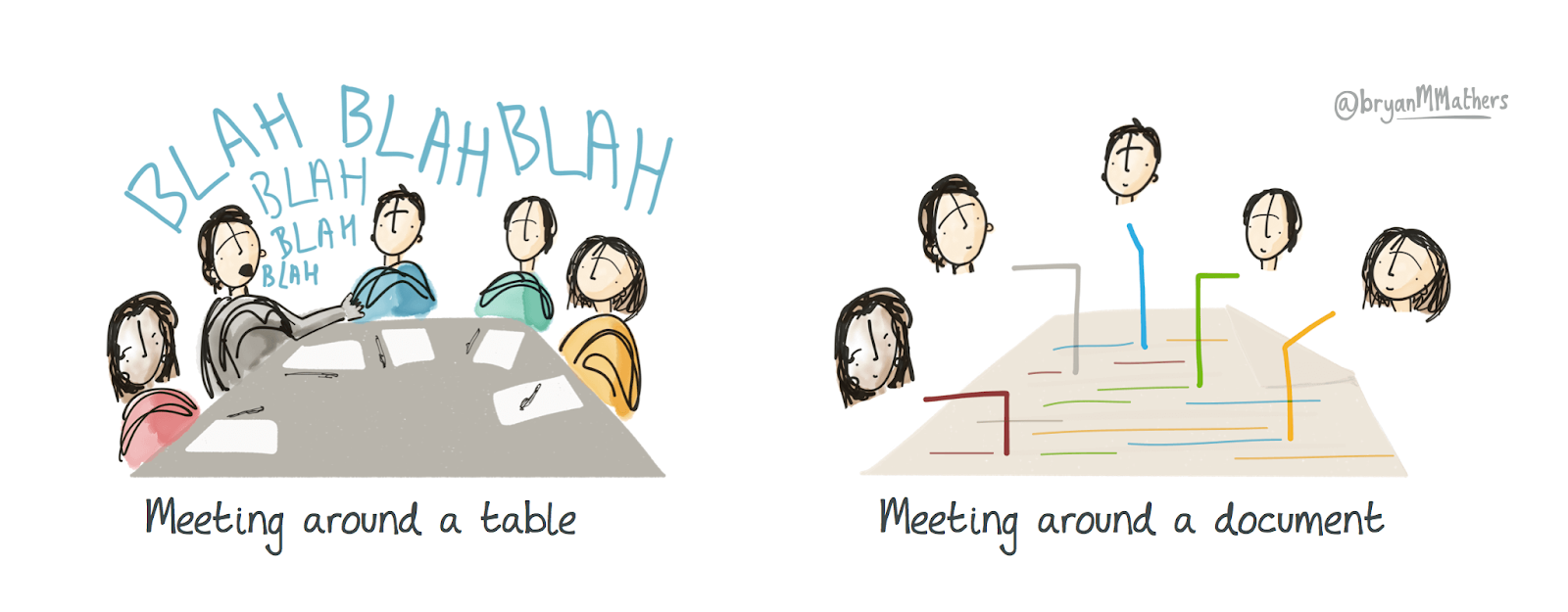
    • meeting around a document, 
    • or screen sharing something that everyone can focus on instead of video, 
    • or having an audio call maybe with video briefly at the start to wave hello. 

    If… nothing helps and you do have to have back to back meetings, as I often do, then what works for me is 

    • to have them standing up (I currently have a standing desk only), 
    • to keep each one to half an hour or less, 
    • to take regular breaks between meetings, 
    • and to check in with everyone participating at the start. 

    Meeting around a document by Visual Thinkery is licenced under CC-BY-ND

    Being one of many faces in a grid of video camera pictures is not a helpful way to visualise what having a productive meeting looks like. We don’t all just stare at each other in person. So having a visual focus other than those individual feeds, like an agenda document or a shared screen is key to getting things done for me. 

    We also explored using a virtual backdrop in video calls, like in a meeting or at a conference, and I am in two minds about it. Whilst I prefer seeing people in their context, I appreciate that many are not in environments they are comfortable sharing widely or wish to protect their privacy. 

    Strategies for crisis working

    As time went one and as we passed 100 days since the lockdown in the UK commenced, more strategies for working as a virtual team in times of crisis emerged .

    As well as focusing on our own team, I received requests every week from organisations who were considering adopting working as a virtual team as their ‘new normal’. Every few days I had calls with senior managers who are trying to decide whether they still need a physical office, managers whose employees want to have more flexibility, less commuting and more virtual collaboration. We talked through things like PO boxes, GDPR for home-workers, financial support and line management – but we also talked about the reasons for such a shift, how important it is to think through strategy and values underlying those moves to virtual teams. 

    Over time, my concern grew that there is a lot that was being left behind, particularly messy HR problems, access issues and long term implications of not meeting in person. For a lot of people I spoke to, endless Zoom meetings or Microsoft Teams was all they have to go on when they start to think about what their virtual work world will look like. 

    When I started thinking about what our team would look like online, I must say that tools for video conferencing were not even on my list! I was thinking about consulting employees, drafting what I wanted to be the most equitable changes to employment contracts and setting out a blended model of working together that saved some costs, but also budgeted for others such as team days in person, equipment, travel costs, home-working allowances and so forth.

    Even with an established distributed working culture the impact the crisis could be seen on our virtual team. Many went from having their own dedicated workspace in a calm home to suddenly discovering this had become a shared workspace with other members of the household. Sharing a workspace, an increase in video calls, homeschooling and childcare meant even established remote workers are also having to rediscover ways to make things work. 

    Whilst ALT is a distributed organisation there has always been a recognition of the importance of face-to-face time both one-to-one and through team away days. 100+ days of social distancing also meant we as an organisation missed our regular face-to-face team days. I found I really miss face-to-face away days and the opportunities to meet individuals in person. The longer the period that we do not meet up as a team the more I feel the impact of not having more informal catch ups. 

    Many of us were not able to easily find a quiet spot for a conversation in lock-down homes, and even when not surrounded by family, there is a lot going on within the home environment that can be distracting. All of which makes it more difficult to really focus on conversations, particularly in a Line Management context. 

    Fellow CEOs I talked to are finding they are similarly experiencing some deterioration in those important relationships. Some people find it easier to establish an equivalent level of trust and exchange than others.

    Ideas we have tried to create different kinds of spaces to interact in are:

    • Meeting around documents
    • Walk and talk conversations on the phone, whilst we go for a walk individually
    • Good old-fashioned phone calls
    • Virtual get togethers for social occasions such as birthdays

    In year one of us being a virtual team, we had a lot of change to cope with but enthusiasm was high. Year two was mostly about settling into being a virtual team and ironing out less straightforward issues. We strengthened policies for home working and collaboration that made our way of working more robust and sustainable. Year three started off with a new strategic vision to take us further, to build on what we had established and six months in we have a completely different business model and context to contend with. 

    What I am thinking about really is what year four should look like… . I read a lot about a desire not to return to the old ways, but I don’t really empathise because the way in which we work as an organisation had already departed from the traditional model well before the pandemic forced many into the great online pivot. Personally, I wouldn’t relish a professional life without face-to-face interaction with colleagues or Members. I miss it. 

    I have put in place a feedback form that I hope we can complete every few weeks or months to ask individuals about their personal preferences regarding travel, having meetings or catch ups face-to-face and also going to events – taking into account their personal circumstances and wellbeing. 

    The differences between colleagues who live in different parts of the UK, even in our small team, have really become clear to me in recent weeks, particularly as the lock-down in Wales, where I live, was last to lift. 

    Dealing with precarity outside beyond our control

    As life, in the UK at least, entered a new phase and restrictions were being eased, workers started to return to offices in greater numbers. Holidays at the end of a difficult year were on the horizon and in many ways things were starting to improve. We moved from crisis mode to post-pandemic living. And yet there was no let up in sight at work. For my team, work continued at full pace, and the strain of the last 18 months was showing. Everyone had their own particular challenges, their own struggles and personal circumstances that shaped their experience of this time. What we did have in common is less capacity to cope with stress, with things going wrong. 

    The continued impact of the pandemic, of self-isolation cases at school and at work, the lack of childcare, transitions and changes at work, as well as crowded family homes and all that we didn’t do the previous year catching up with us created a sense of continued precarity beyond our control. Many of us had been fully vaccinated by this time and grateful to be safer from a deadly virus, but we continued to have a lot to contend with in our own ways.

    Acknowledging things not being normal

    Through the loss of being able to run face to face events and also due to other factors, our organisation lost nearly half of its turnover in 2020. Like many charities, we struggled with that scale of loss and although our strategic response had a positive impact very quickly and helped us weather the most difficult period, we had to make savings and cuts wherever we could. A year on, I was pleased to see that month by month things were improving and new income generation strategies were starting to pay off. Yet we were still having to be extremely fastidious when it came to managing our resources. Some staff costs had to be cut in order to safeguard the future of the organisation and we were not yet in a position to relax those measures. 

    This was a singular context but it does translate into many situations when a team or an organisation is coping with a difficult period and it got me thinking about ways in which to provide support and acknowledge challenges. 

    Usually, I would have looked to structural changes first, to aim to provide more staffing resources, more support for existing staff or financial rewards and benefits. 

    In the context of post-pandemic recovery, my scope for those sorts of measures was extremely limited however and I had to think about other approaches.  Something that would go beyond the formal support already in place and which had been positively received.  One of the ideas we put into practice was a wellbeing day. A duvet day if you like.

    A day when you don’t have to come to work, you don’t have to use a day of holiday. You can take it whenever you need to and you can focus on rest, relaxation, whatever you feel might improve your wellbeing.

    I was glad when our Board approved this proposal and granted the extra day to all staff. The aim of this was partly to give everyone an extra day to breathe and also about acknowledging that things weren’t normal. That we still have a lot to cope with, a lot to contend with. Here are some of the ideas we came up with for how to use the day: 

    • Mentoring & cake: Sometimes an extra day off is just what you need to do some thinking. Get in touch with your mentor, coach or a friend and arrange a chat over a long walk. Take a step back from your daily grind and get some head space. Aim to end your chat somewhere with excellent cake.
    • Early run and pub lunch: Maybe a wellbeing day for you starts with a nice run (jog, walk) along the river or around the park, enjoying the feeling that everyone else has to go to work, but you don’t. Follow your feet, and breathe in the morning. Job done for today. At lunch, head to the pub for an early lunch (int optional) and revel in the luxury of not having an improvised sandwich for lunch.
    • Bed: This needs no explanation. Stay in bed. Enjoy.
    • Tidy and new pictures: Maybe you want to use your day to make your working space the best it can be. Have a tidy and clean and then get creative by putting up some new pictures. Extra points for making something yourself. Also extra points for dog/cat photos. The nice thing about this kind of day is that you get both unlimited tea AND a nicer desk when you do have to go back to work. 
  • Virtual Teams – The Book Project

    Virtual Teams – The Book Project

    Welcome to the first post in the Virtual Teams Book series. Read on or find out more about this project.

    An introduction: From learning online to working online

    More and more organisations are moving to working remotely. It’s becoming commonplace in sectors like education to work from home as part of geographically distributed teams. As the number of managers and leaders leading virtual teams is increasing, everyone is looking to learn how to effectively manage people and organisations once the established order of the office disappears.

    For many, this change has been accelerated by the global pandemic and 2020 has been a watershed year for new ways of working. Many took part in the great shift to virtual teams as part of managing a crisis and this had many consequences that impacted unevenly on different demographics. Even once offices and campuses started to re-open many organisations and individuals took the decision to adopt new ways of working.

    Many who had been working from home prior to 2020 found themselves in conversations with colleagues who were struggling to adjust to the consequences of lockdown and a global crisis whilst often working from their kitchen table, sofa or improvised desk. In the UK and elsewhere with the necessary infrastructure there was a rapid move to adopt video conferencing and online productivity tools and from there a new model of working emerged, characterised by screenshots of participants in an video call.

    At the time, there was a lot of interest in finding solutions to what was for many an unforeseen situation and one for which they didn’t really have a plan. ‘Self-help’ style manuals and tips on how to manage people at a distance, how to work remotely and how to monitor and supervise employees were published widely, for example:

    In a short space of time, coping with a crisis situation was turned into an opportunity to learn how to work remotely, often with little consideration of the wider impact on employees, organisations and the communities they serve.

    I will write in more depth about the consequences of this later on, as there are many interesting things to be learnt from what happened.

    For now, I want to focus on one particular outcome, which is that many organisations and individuals decided that they might prefer to continue to work away from the traditional office setting and to use the pandemic as a way to achieve a big change. This change was often motivated by a range of factors, from financial savings and continued concerns about the risk of infection and serious illness to a growing recognition of the strategic and practical advantages offering more flexible working may bring.

    These aren’t new insights, as there is already expertise to draw on, going back decades, including:

    Setting aside the practicalities for the moment, the opportunity the events of 2020 presented to us was a shift in thinking. Similar to the way in which learning online became suddenly central to people’s perception of education and training, so did working from home. In a short space of time the common perception of what was possible and effective with technology for both learning and work changed completely.

    And then, after this big shift in perspective, we started to think about the future, and what work (and also learning) should and could look like in the future.

    Let’s skip twenty years and jump ahead

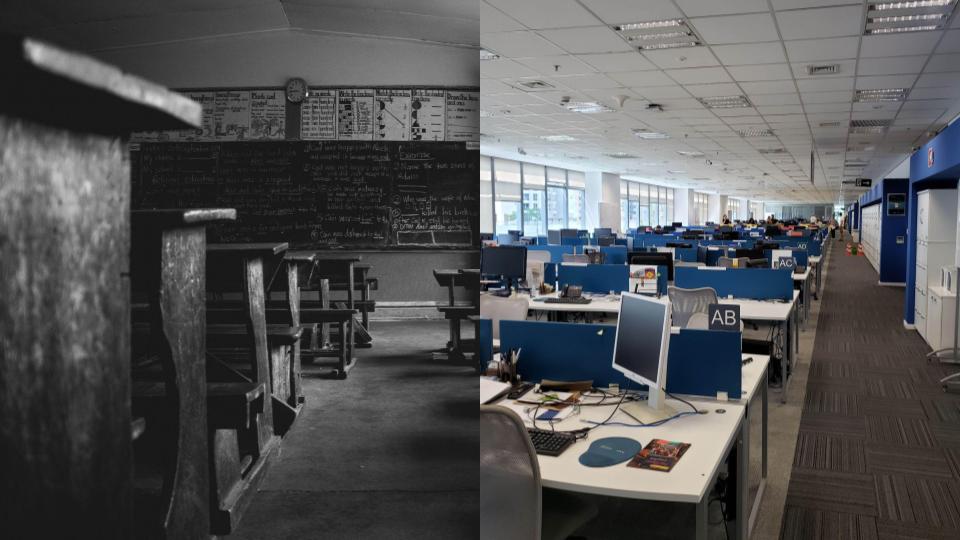
    Ever since I began to work in Learning Technology nearly twenty years ago, the narrative of using technology for learning, teaching and assessment has been that this is something new, a departure from the old-fashioned classrooms kitted out with wooden benches and blackboards and chalk.

    The overriding narrative has focused on the need to re-invent, modernise and otherwise revolutionise education, to make it fit for purpose, future proof and successful. This is one of the driving forces behind much of educational technology. Education in its traditional, old-fashioned model is broken, so the story goes, and EdTech can fix it.

    And yet, what we know from decades of research, practice and policy making in Learning Technology is that no, it isn’t cheaper.

    And yes, you still need teachers (not just machines or event intelligent machines).

    Also, students and staff at all levels need continual upskilling. And no, you can’t rely solely on vendors to measure what works and what doesn’t. You need expertise to make ethical, equitable decisions that take into account the rights and needs of all involved. And no, there isn’t an AI that can do that for you. There are always risks and things go wrong frequently. Using technology for learning, teaching and assessment isn’t a nice to have anymore, it isn’t new anymore and we need to reframe the narrative of a broken education system that technology can fix, to one in which lifelong blended learning is the norm.

    This may sound like an obvious point, but in my experience it really isn’t. Instead, in the past twenty years we have continued to focus on fixing education with technology. And now, technology is offering solutions to ‘fix’ the workplace. This is where lessons from Learning Technology can really teach us a lot about what’s ahead and what we can skip in order to jump right to a better new narrative.

    The tools we use to work from home are very similar if not the same as those we use in education and the same problems and questions arise in both contexts: a lack of trust, collaboration and communication.

    This is what the book I am working on is all about. Sharing lessons so you don’t have to discover them for yourself. In practice, I find that all the lessons we have learnt about EdTech can be translated into working as a virtual team. You need to focus on skills and support instead of savings. You need to find ways to build trust and manage crisis.

    Developing your approach to leading a virtual team or organisation

    Having led my team from being office based to working from home with in person elements to working entirely from home for 12+ months with no in person contact, I’ve had a lot of experience with the different options. And there is much to consider when designing your approach in a post-pandemic workplace.

    After months of working remotely, we have all learned that most tasks are accomplished and most meetings go just fine without the office.

    But that, the authors warn, doesn’t mean companies should suddenly abandon their workplaces. Going to the office, they argue, has never been just about work. And technology won’t make socializing less dependent on direct interpersonal contact anytime soon. In this article they describe the important social functions of an office: It’s where people build trust through personal interaction, learn the nuances of their job, and build and maintain organizational culture. And it’s through random in-person encounters between people from different functions and cultures that many of the most innovative business ideas are born. The authors conclude by showing how design, technology, and management practices can be used to make tomorrow’s offices more effective as social, learning, and innovation spaces.

    https://hbr.org/2021/03/designing-the-hybrid-office

    One function of in person contact is that of social interaction (outside of formal meetings) to foster relationships, social bonds and cooperation – the ‘office as a social anchor’. In person interaction, it argues, helps built commitment and support for each other and the organisation. One of the examples cited is the ‘The WELL (Whole Earth ’Lectronic Link), which started in 1985, is one of the oldest virtual communities in existence’. 35 years later, we have A LOT MORE technology and connectivity to help us establish and grow our virtual teams and communities – but what many of the teams and organisations who only moved online in 2020 don’t have, are the shared experiences of meeting up, sharing life events, supporting each other longer term.

    Even in my team, having worked mostly remotely for 3-4 years now, sharing those events over time, has had a big impact already. It takes times for enough birthdays, weddings, births and so forth to happen in order to share them and for that shared experience to strengthen team and organisational culture and belonging.

    In my experience the onboarding or induction process, is one of the biggest challenges of leading a virtual team.

    Classically, this on-the-job learning takes place through apprenticeship. New employees learn the correct and proper way to behave—“how things are done around here”—from directly observing those around them, especially their mentors.

    Technology can certainly be used to facilitate this sort of learning, but without question an office makes the process a lot easier.

    Here are examples of approaches to help provide as many opportunities as possible for the kind of learning that’s described in the article.

    • As a team, spend time working synchronously with a new member of staff, enabling them to observe how you use tools and systems and explore what you do day to day;
    • Provide a comprehensive induction checklist, with links to processes and procedures, which you work through together;
    • Start the induction process before the first day, to ensure that a new colleague knows what to expect and how to prepare, including undertaking a home-working risk assessment;
    • Provide an induction focusing on the ‘why’ and bigger picture context of what the organisation does, rather than the ‘how’.

    As well as onboarding new members of staff, creating informal opportunities for interaction is a big challenge. It can take a significant amount of time, effort and imagination to create time for ‘unstructured collaboration’ to happen, and initially I spent a lot of my management time experimenting with different approaches to make this happen in my team, including setting up a ‘watercooler chat’, having unstructured ‘show & tell’ elements in weekly team meetings and so forth.

    Since then I’ve come to the conclusion that all of these efforts contribute something, but by far the most effective is to lead by example. Even as a senior leader, you have to make the effort to have open conversations, exploring ideas and questions, sharing thinking in progress, so that you create not only space but also time for the kind of unstructured collaboration you want to happen.

    It’s an important skill for senior leaders in particular to cultivate. The result is less presentation and more collaboration – fewer meetings where no one speaks up and everyone has their cameras turned off and more days on which everyone contributes and ideas spark.

    You can learn to cultivate that kind of approach to leading virtual teams, and it takes a high level of focus on your own skills in communicating and collaborating online. You need to put yourself intentionally in a position in which you would naturally be in an office – sitting at your desk with work in progress, staring out of the window whilst thinking about a difficult problem.

    Head to the project page to find out more or subscribe to news about the book.