Category: VirtualTeamsBook

  • Virtual Teams Book – Monthly News, January 2022

    Virtual Teams Book – Monthly News, January 2022

    Writing Retreat ahead

    At the end of last year I completed the first draft of the book and I am really pleased that despite everything that was going on last year, I managed to reach that important milestone. Along the way I made some changes to the structure of the book and now that the draft is complete, I can also see overarching themes emerging.

    My plan was to continue editing the draft chapters over the holidays, but when I finally reached the end of the working year and having had my booster jab, I decided to take a complete break instead. It was much needed and I am glad to have had some proper time off.

    My plan is to still fit in some editing this month before heading on a week long writing retreat at the end of January.

    Talks and events

    This month I am speaking at fewer events as many of the planned conferences have been moved to later in the year. In many ways this is a blessing as it gives me more time to focus on writing. At the end of December I looked back at the talks and articles I published in 2021 – and that were more than I expected.

    One key focus for 2022 is going to be continuing work on the Framework for Ethical Learning Technology and I am looking forward to taking part in the THE Digital Universities Week and Ahead by Bett to share process and new developments.

    Join our monthly radio meet up on DS106radio talking about the journey from learning online to working in distributed teams on Tuesday, 11th January 2022 at 19:30 GMT on DS106 Radio – chat with me or submit song requests #DS106radio.

    Coaching update

    I have had excellent coaching on my journey to becoming a CEO. My own experience has given me an understanding of how powerful the right coach can be and how valuable for developing your approach to being a leader.

    In order to become an accredited coach, an ICF Associate Certified Coach, I am taking part in Katie Linder’s Higher Ed Coach Training. I’ll be blogging every month sharing my experiences and how this relates to leading virtual teams.

    Writing buddy update

    Posey celebrated her 1st birthday this month, so she gets featured 🙂

  • VIRTUAL TEAMS BOOK: … EXTRACT FROM The Introduction

    VIRTUAL TEAMS BOOK: … EXTRACT FROM The Introduction

    Progress since the last post

    Since my last post, I have been working on the Introduction to the book and that has been very helpful. It’s prompted me to write an overview of how all the chapters hang together and it’s help me get a clearer sense of the overall structure.

    Apart from the conclusion, I have now drafted all chapters. I have decided to incorporate what was going to be a chapter on addressing inequality and inequity in remote work into each chapter as those questions came up again and again.

    So now that I have a clearer sense of the shape of the book, I want to make a plan for revising and improving the drafts that I have completed so far, building up to a week long writing retreat in late January.

    Remote working radio:

    It’s time to start what will hopefully turn into a monthly radio meet up on DS106radio talking about the journey from learning online to working in distributed teams. The first one of these will happen today:

    • Date: Wednesday, 1st December 2021
    • Time: 19:30 GMT
    • Where: DS106 Radio
    • Hashtag: Chat with me or submit song requests #DS106radio

    See you on the airwaves.

    Chapter: Introduction

    Below is an extract from the draft introduction chapter:

    In 2017 I embarked on a journey of organisational transformation as the CEO of an independent charity, as we took our organisation from a traditional, office-based model of operations to a fully virtual, distributed team. In comparison to many businesses who were forced to adopt home-working in response to the global pandemic, we made the transition for strategic reasons over the period of a year. Instead of sending staff home with a laptop one day and starting home-working the next, we went through formal consultation periods and implemented the transition gradually, providing support and training at every stage. As a result we made a very successful transition and started to focus on how to evolve our approach to working as a virtual team beyond practical considerations from the outset. 

    When I set out to create a new vision for what working for our virtual organisation would be like I came across a lot of practical advice about infrastructure and business processes and I also read a lot of management books that seemed intent on helping leaders and managers to translate traditional power structures from the office to the virtual workplace with a strong emphasis on productivity, cost-savings and employee surveillance. None of what I came across helped to answer my questions. 

    What I was looking for was authentic insight into what it’s like to manage people remotely and to lead an organisation from home, and to do it well. And by doing it well I mean not only meeting budget targets and KPIs but to balance business needs with employee happiness and wellbeing. I was looking to find creative and fun ways to work with people you may never meet in person and to build meaningful working relationships.  I was looking for ethical ways to work online that respect employee privacy and build trust between the organisation and its staff. In short, I was looking for the opposite of the ‘office-deficit’ model. 

    This is why I wrote this book. It’s the book I wish I had when I was setting out on my journey to lead a virtual team. I hope it will provide a source of inspiration and a prompt for reflection to my readers and will be of practical help with managing hybrid, blended and fully distributed teams and organisations.

    If you’d like to keep in touch with book progress:

    • Subscribe to my newsletter;
    • Join today’s monthly radio meet up on DS106radio;
    • If you’d like to invite me to speak or write, get in touch with me directly.
  • Remote working radio

    Remote working radio

    In recent months I have been blogging about writing a book about leading virtual teams and I have shared my progress in blog posts and extracts from draft chapters.

    This month I am writing on the introduction for the book and once I have that completed, then I’ll be close to having a draft of the complete book, which is pretty exciting.

    And that means it’s time to start what will hopefully turn into a monthly radio meet up on DS106radio talking about the journey from learning online to working in distributed teams.

    The first one of these will happen next week:

    • Date: Wednesday, 24th November 2021
    • Time: 19:00 GMT
    • Where: DS106 Radio
    • Hashtag: Chat with me or submit song requests #DS106radio

    See you on the airwaves.

  • Virtual Teams Book: Setting out as a Virtual Team… extract from Chapter 1

    Virtual Teams Book: Setting out as a Virtual Team… extract from Chapter 1

    Progress since the last post

    Since my last post, I have been working on Chapter 1 which is all about setting out as a Virtual Team. It’s been very rewarding to work on this chapter as it include a first hand account of the key milestones I experienced leading a team from the office to working remotely and I enjoyed re-reading some of the posts one month, six months and a year into the process. It was useful to reflect on how much the reality a few years later meets with the expectations I had at the beginning and what has changed.

    Next, I will be working on Chapter 5, which will explore equity and equality for virtual teams. I have left writing this chapter till last, particular because it requires the most research and also because I wanted to be able to reflect on issues that arise in the other chapters. Now that Chapters 1-4 are complete, I have my key issues to address in this chapter ready.

    I have completed drafts for four of the six chapters now, and I am on track to complete my draft of the whole book before the end of the year.

    As planned, I will be sharing extracts from work in progress (read this month’s extract below) and invite you to read along, reflect and share your thoughts.

    • Subscribe to my newsletter;
    • Look out for details of the virtual drop in sessions starting in November;
    • If you’d like to invite me to speak or write, get in touch with me directly.

    Chapter overview: Setting out as a Virtual Team

    This chapter is divided into two parts. The first part covers practical considerations for setting up virtual teams, including how to involve staff in the process, recruitment and selection for virtual teams and practical considerations such as choosing the right tools and platforms for the job, GDPR compliance and up-skilling staff.  

    The second part of the chapter contains a first hand account of an organisational transformation process I led to give practical examples of what can happen during a journey from office-based to blended or fully virtual team. 

    Draft Chapter extract

    Below is an extract from the first part of the chapter, focused on recruitment and selection.

    Distributed organisations offer a different value proposition to staff. Whilst there are downsides, too, the advantages of working from home and the flexibility that brings with it are significant: 

    Not everyone’s commute is that brutal, but companies and organizations can enable a more diverse and healthier workforce if they allow people to work remotely, at least some of the time.

    For instance, consider how difficult it is for a blind person, or someone who is confined to a wheelchair, to commute into an office every day by taking a bus for an hour each way. The commute itself is stressful and exhausting. Will that individual also be able to give their best to the work if they are already tired from just the commute?

    Or consider parents of young children who need to remain within a 10-minute drive to their children’s schools in case of emergency. If remote work is allowed, you gain access to a whole other talent pool of potentially highly-skilled employees. 

    https://www.informationweek.com/team-building-and-staffing/create-an-all-star-tech-team-welcome-remote-workers

    Once you have made the jump and offer flexible or fully home-working, recruitment needs to reflect that and enable you to find the best candidates in the larger number of applicants. Here are some practical examples of how to adjust the selection process for remote working: 

    Set out expectations clearly

    Ensure that role descriptions and adverts set out clearly that you offer in terms of flexible/home-working. Be as specific as you can about what you provide (e.g. equipment, financial support etc) and what prospective staff will need to have in place (such as a dedicated work space). If you have policies that are specific to home-working, refer to these and spell out precisely what your expectations are. Particularly in the post-pandemic workplace many people’s experiences of home-working may have been during a time of crisis, and won’t necessarily reflect what a ‘normal’ approach looks like long term. Include details such as ‘we expect all staff to be in the office on Wednesdays for a team meeting’ or ‘our normal working hours are between 9.00am and 5.00pm’ to help prospective candidates get a sense of how flexible your approach is. 

    Review your internal processes

    It can be difficult to find comprehensive guidance for recruitment processes that happen online and in most contexts your existing policies and training should continue to apply. That said, it is important to review what everyone participating in the recruitment process needs to be able to do in order to fully participate: if panel members struggle with the meeting software or reviewers don’t understand how your online score sheet works, then the recruitment process is going to suffer. It may seem like an obvious point to make, but even experienced managers need time to gain confidence undertaking fully online recruitment. Ideally, test your process by role playing / user testing all elements beforehand, so that you can put yourself into the shoes of a candidate and gain a sense of what their experience will be. 

    If your organisation uses a particular tool or platform for all meetings try to use the same platform during the recruitment process. Similarly, try to use as many of your familiar workflows when designing the practical elements of the interview. It the absence of a physical environment the candidates will get a much better sense of the organisation if the interviews happen on the same platform that they will be using day to day. In a sense, it’s the virtual equivalent of seeing your office or visiting campus. 

    Include remote-working questions

    It can be very helpful to include questions specifically about home working in the interview. It can help you learn more about each candidate and establish a rapport about some of the challenges you can encounter. For example you could ask something like: ‘Have you had any experience working from home previously?’ and ‘Can you expand on the main challenges you’ve encountered and/or perceive?’. 

    You might be surprised how considered responses to such questions can be, highlighting issues like isolation and maintaining boundaries between work and personal life. 

    It can also help establish whether candidates have experience working remotely in a solo capacity, e.g. running their own business or working as a consultant, and working remotely as part of a distributed team. Whilst there are many transferable experiences there are some important differences, such as the volume of communication required, having to be available for team members and meetings more frequently and having a shared sense of starting/ending a day. Often individuals who have worked remotely only in a solo capacity underestimate the extent to which this makes a difference and the interview can help establish a common understanding of what the organisational working culture is day to day. 

    Homeworking long term

    If you are offering home working full-time or some days of the week on a permanent basis, it is worth reflecting how this can impact on staff as things change either in the workplace or at home. For example, the tools you use as an organisation may change significantly over a period of five years and require constant upskilling. Virtual working often relies on tools that are frequently updated, impacting on workflows and requiring changes to procedures. Whilst this is true of everyone in the workplace to different degrees, the impact of such changes can be felt more keenly as a home-worker, for example if you start you week by logging in and suddenly your usual Monday morning catch up meeting won’t let you join or if you can’t reach work in domestic emergency because of software updates. Being reliant on tools and platforms that are updated according to Silicon Valley release schedules can cause havoc for even the most techy of staff and requires everyone to be adaptable to a larger degree than a traditional office setting where support can be provided at your desk or in your building. 

    Committing to working from home long-term can seem an easy decision initially, but can become challenging during periods of change at home, such as a house move, changes in family life or relationships as well as physical and mental health. What seemed a good fit initially may turn out to be a nightmare a year on. Any and all information that you can provide for candidates to help them reflect on the realities of working remotely in the long term is valuable and increases the chances of finding the best candidate. 

    Virtual Interviews

    In many cases the interview is the deciding factor in the recruitment process and if you are recruiting for a virtual team you will hopefully have experience in organising meetings online. For virtual interviews, preparing ahead of time is key. Common pitfalls include using a platform that is only available to individuals within your organisation, failing to ensure your interview is fully accessible and lack of appropriate support for panel members. Plan in time for the candidate to set up and test things before the formal interview starts and allow time for things to go wrong. First impressions in virtual interviews happen both ways and candidates have likely prepared very carefully so it is worth being very explicit with everyone taking part in the recruitment process how to represent themselves and the organisation. 

    As with the other elements of the recruitment process, established HR guidance will apply, but in addition, ask yourself what went wrong in bad meetings and interviews you have attended. Everyone has experiences of chairs not seeing their hand up, technical difficulties not being resolved, cameras being switched off when they should have been on and so forth. Even for experienced staff, checklists can be really helpful for virtual interviews and ensure that candidates have a better and fairer experience. 

    If you find yourself interviewing someone in a suit, sitting in front of a perfect office backdrop and never breaking eye contact whilst giving you textbook answers and at the other end you are hoping to have an informal conversation from your kitchen table with your cat walking across the screen then you are experiencing a class virtual interview fail. Interviewing online robs you and the candidate of many common assumptions about what’s expected and how to behave, so be as explicit as you can both in the way you communicate and what information you provide ahead of time. For example, if formal workwear is commonly worn in your organisation, make candidates aware of that. Similarly, if it is not usual for staff to use digital backgrounds and if it is acceptable to see each other’s (family) life in the background, you can make that clear as well. Consider carefully how you can eliminate as many factors that could distract you from the purpose of the interview as possible. You don’t want to focus on someone’s unusual virtual backdrop or their unexpectedly formal attire instead of the key questions around the job. 

    Experienced managers pick up a lot of clues when meeting candidates in person and that can help you take action to calm nerves and make candidates feel welcome. Online, the clues are still there, but it can be a lot harder to get beyond someone feeling nervous once you have had a technology fail or sound drops. Chairs should be prepared to start the interview in a manner that helps settle everyone and also pause proceedings if unexpected difficulties occur. In a later chapter we will specifically explore equality and equity in the context of working remotely and these considerations are particularly important in the context of recruitment starting with the connectivity and equipment required to apply to the tools and software required to take part in the interview process. A tool or platform that the organisation has a licence for and which is thus easily available to all staff may not be accessible to prospective candidates for example. 

    The tension between technology and human beings becomes apparent in other chapters of this book and in this section I have intentionally focused on recruitment processes that are conducted largely by human beings using technology as tools for recruitment instead of recruitment undertaken by machines. I have chosen to do so as this book is focused on knowledge workers and professionals who work in education contexts and automated selection processes are not predominant as yet, at least in my experience. 

    No doubt certain types of recruitment are becoming ever more determined by automated processes and artificial intelligence, and scenario based virtual interviews and skills texts can provide a useful addition to recruitment processes. Someone who comes across brilliantly in a prepared written application, virtual test or on email may not be able to communicate well in real time or on screen. So if the role you are recruiting for relies on communication and collaboration in a virtual team, it’s important to put human interaction at the centre of the selection process and ensure that the candidate you are appointing has the required skills for the role. 

    The set up for home-working is a huge factor in the long term physical and mental health of your workforce and it can feel much more outside of your control than an office would. 

    If appropriate you can include this kind of guidance in the information for prospective staff as well as in annual/regular processes for all staff. Ensure that it is a compulsory part of everyone’s practice to review and document their workstation and that you have a way to monitor this and address any issues that arise. 

    Many new or temporary home-workers start out working with their laptop on the sofa or at the kitchen table and then report back and neck pain or wrist problems. 

    The set up of the workspace should be an important part of the induction process and not left to chance as it’s your opportunity to get things right from the outset and avoid problems and illness further down the line. 

  • Job satisfaction for virtual teams

    At the moment I am writing on Chapter 1 of the Leading Virtual Teams Book, and this chapter covers recruitment and selection as well as starting out as a virtual team and making the move from office-based to virtual.

    One of the things I have been thinking about as I am writing, is what makes it rewarding to work in a virtual team and how those of us who are permanently home-based measure success.

    This Liz and Mollie visual promoted me to try and make my own pie charts of how we might measure job satisfaction and success at different stages of a career journey. The chart includes salary, job title and liking what you do which I have included in mine below also. Instead of free time I have include life/work balance and I have included wellbeing instead of physical and mental health.

    Chart 1: Measuring success as a home worker. 
The pie chart has five equal slices labelled Salary, Job title, life/work balance, Liking what you do and Wellbeing, each covering 20%.
    Chart 1: Measuring success as a home worker.
    The pie chart has five equal slices labelled Salary, Job title, life/work balance, Liking what you do and Wellbeing, each covering 20%.

    To begin with, I have assigned each aspect an equal value. Whilst recruiting for virtual teams over the past few years, I have encountered a lot of different versions of this equation: for example, for some the job title and liking what you do slices of the pie are smaller, and the emphasis is on life/work balance and salary.

    Chart 2: Measuring success as a home worker with an emphasis on life/work balance. 
The pie chart has five slices labelled Salary (20%), Job title (5%), life/work balance (50%), Liking what you do (5%) and Wellbeing (20%).
    Chart 2: Measuring success as a home worker with an emphasis on life/work balance.
    The pie chart has five slices labelled Salary (20%), Job title (5%), life/work balance (50%), Liking what you do (5%) and Wellbeing (20%).

    This measure is often motivated by the benefits of working from home making commitments outside of work easier to manage, for example caring for family or research. In this case, the benefits the job delivers in terms of flexibility and income outweigh the nature of the work or the position. In this context the ability to work from home is often essential to enabling the individual to work at all, and that can be a big opportunity for virtual teams who are recruiting from a larger pool of talent.

    Chart 3: Measuring success as a home worker with an emphasis on liking what you do/job title. 
The pie chart has five slices labelled Salary (10%), Job title (20%), life/work balance (10%), Liking what you do (50%) and Wellbeing (10%).
    Chart 3: Measuring success as a home worker with an emphasis on liking what you do/job title.
    The pie chart has five slices labelled Salary (10%), Job title (20%), life/work balance (10%), Liking what you do (50%) and Wellbeing (10%).

    Often, working as part of a Virtual Team can offer opportunities to individuals to do a job they love that isn’t available locally. This is one of the best aspects of recruiting for Virtual Teams, as it can significantly increase the commitment to roles and organisations, performance and job satisfaction. This kind of value system is often found in individuals in highly specialised or creative roles or jobs in particular industries.

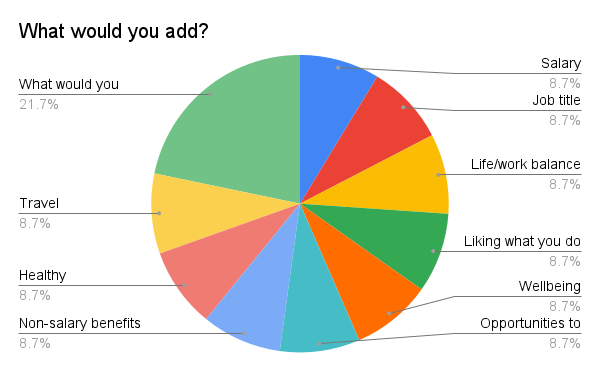
    What would you add?

    There are different slices you could add to this pie, for example opportunities for professional development and learning. Good non-salary benefits or working on a healthy organisational culture. You could add opportunities to travel and having fun.

    In addition, what importance we accord to each slice of the pie will change over the course of a career and due to other circumstances. A job that is a good fit at the start, may not be a good fit a few years down the line and working from home may not be a good fit when life changes happen.

    A quiet office away from the kids or a workplace that gets you out of the house and meeting people is not easily added to the value proposition for working in a virtual team.

    Large or resource rich organisations may be able to offer a blend of working from home and working in the office that increases the spectrum of what you can add to the range of value added. But a blended approach doesn’t necessarily always deliver the best of both worlds, but can result in many people sitting in Zoom meetings in the same building, without any of the benefits of sharing the space with co-workers.

    Chart 4: Measuring success as a home worker - what would you add? . 
The pie chart has ten slices labelled Salary , Job title , life/work balance, Liking what you do, Wellbeing, Opportunities to learn, non-salary benefits, healthy organisational culture, travel and fun and the biggest slice is labelled: "What would you add?" .
    Chart 4: Measuring success as a home worker – what would you add? .
    The pie chart has ten slices labelled Salary , Job title , life/work balance, Liking what you do, Wellbeing, Opportunities to learn, non-salary benefits, healthy organisational culture, travel and fun and the biggest slice is labelled: “What would you add?” .

    If you are interested in reading more, head to the Leading Virtual Teams Book page where I share extracts from individual chapters in monthly blog posts.

  • Virtual Teams Book: Building a virtual team spirit… extract from Chapter 2

    Virtual Teams Book: Building a virtual team spirit… extract from Chapter 2

    Progress since the last post

    Since my last post, I have been working on Chapter 2. It was great to work in this chapter as it includes a lot of practical strategies and case studies, which were fun to revisit.

    Next, I will be working on Chapter 1, Setting out as a virtual team.

    I have completed drafts for three of the six chapters now, and I am a total of 29,000 words into the process, which means I am halfway to a complete draft.

    As planned, I will be sharing extracts from work in progress (read this month’s extract below) and invite you to read along, reflect and share your thoughts. As part of the book writing process, I will also organise virtual drop in sessions which are open to all and free to attend and there is a regular newsletter with updates about the book and upcoming events or get in touch with me directly.

    Chapter overview: Building a virtual team spirit

    This chapter focuses on ways to engage a virtual staff, managing people who may never meet in person and finding ways to create a proper team spirit. Some of the examples in this chapter include show & tell sessions, team days and activities as well as physical items such as team merchandise, treats and presents. 

    Before we look at practical approaches, let’s consider some of the key questions that determine what team building activities will be the most effective in your context: what shapes the way a virtual team works? How do you find the right balance between online and in person activities? What do you want your team to feel like on a day to day basis? 

    It can be liberating to consider these questions outside of practical constraints. The way your team works, how often you can meet or what sort of activities you can make happen may be determined by constraints outside of your control, such as internal policies for example. That said, it is still worth getting a feel for what you hope the culture of your team can be and then work with the practicalities involved.

    Draft Chapter extract

    Below is an extract of the draft chapter.

    Team Meeting Ice-breakers

    In this case study, every weekly team meeting starts with a short ice-breaker activity. The chairing of the meetings is rotated, so that every member of the team takes a turn chairing the meeting. It is the responsibility of the chair to include an ice-breaker activity on the agenda. 

    In a team of ten or less, rotating the meetings can be a great way for bringing their own personality and style to the proceedings. What follows are examples of the kind of ice breaker activities we designed as a team: 

    • Animal corner: For this activity the team was asked to share your four-legged friends if you have one, or any animal that makes you smile! . 
    • Favourite recipe: Here the team shared what has been your favourite recipe discovered during lockdown, through which we discovered Freezer Vegan Breakfast Burritos and Ottolenghi’s Feta and oregano fries! 
    • Musical Mayhem: share a link to whatever song or piece of music that makes you feel alive! This ended up with a very eclectic mix of songs and also gave a sense of what made the team tick, covering tracks from the Bee Gees to N-trance. 
    • Movie recommendations: sharing box set or movie recommendations including links to reviews, personal reviews and ideas for further watching. 
    • Hogwarts House: the team took a free online quiz to find out which house each of us belong to (our team includes someone from every house…). 
    • Emoji Weather check-in: sharing what the weather’s like in emoji works well during heat waves or cold snaps. The team compared who was in the coldest place.
    • Air punch: share a thought or memory that you go to for virtual air punches. There were a very interesting range of responses to this, which like “Hogwarts House” stimulated some nice conversations. 
    • Pictionary Jam: where we had a round of Pictionary each drawing on a Jamboard. Plenty of other whiteboard tools are available to try this out and if a Pictionary game isn’t handy there is a website for that.

    Whilst every individual brings their own ideas to these activities, they all only take 5-10 minutes to complete, are easy to do and are very casual. 

    Planning your own virtual ice breakers? Start with these questions:
    Do you have any practical limitations or requirements?
    What, if anything, do you want to avoid?
    What examples can you share with your team to get started?
    Is there a particular time limit?