Category: Tech

  • Reviewing my tech stack III: Openness in Practice

    Reviewing my tech stack III: Openness in Practice

    As promised, here’s an update on how things are going when it comes to using technology. If you have missed the first two posts, have a look at me taking stock of the tools and platforms I currently use:

    One of the things I have taken as read so far is all things open, and what values inform my considerations when it comes to technology. When I think about work, it’s important to me that what matters to me shapes what I do and how I work.

    What matters to me?

    I love running my own business that reflects my values and generates a living, too. Having worked in the not for profit sector and with small businesses all my life, I have learnt how to harness the power of one to make a difference. That said, it’s hard to articulate sometimes how that works in practice, specifically in my work context, how do I put my values into action. Here are some examples that came to mind:

    • my books and publications are open access and free to all, including this blog, where I have been publishing my thinking for nearly 20 years;
    • professional, ethical practice is key to my coaching and my courses. That is why I am an ACC-level certified coach and a member of the International Coaching Federation and I continue to develop my practice and critical thinking around coaching and leadership;
    • I offer 10% pro bono places for both my 1:1 coaching and courses, enabling folk to get the coaching they need or try it for the first time, absolutely free;
    • My work is hybrid by design with digital wellbeing in mind, and I offer blended, hybrid and full online coaching and courses.

    So, my technology choices should ideally align with my values around openness, ethical practice, good value for money, digital wellbeing and meticulous informality, which sums up my approach as a whole.

    Video Conferencing

    Now, my current tool, Zoom, doesn’t align well with most of these principles, but it does have the upside of being a familiar platform for many. That in itself helps me during coaches and courses as it enables my clients to focus on the work we are doing rather than the platform that facilitates it. That is valuable.

    Current platform: Zoom

    Cost: £15.59 per month
    Pro: Personal meeting room, easy scheduling, familiar to most, no log-in required, reliable recordings
    Cons: AI integration is on the increase, concerns about business model/data privacy, expensive

    My current contenders for alternative tools are: Google Meet (easy for me, but not always a good option for folk because of log-in issues), and Whereby.

    Alternative option 1: Google Meet

    I’m very familiar with Google Meet and I have used it for years in previous roles.

    Cost: included in my Google Workspace subscription and includes a free option, too
    Pro: Integration with my calendar, easy scheduling, very robust, reliable recordings
    Cons: AI integration is on the increase (but I have more control over it as a Workspace admin), sign in from other orgs/or no Google account can be glitchy

    My sense is that trying this option with individual clients and personal meetings would be low risk, and could help establish whether this could scale up for me.

    Alternative option 2: Whereby

    I’m also quite familiar with Whereby and I have used it for years in across various organisations.

    Cost: $8.99/month or $89.99 annually for the professional option
    Pro: Personal meeting room, custom branding/background, no log-in required, reliable recordings
    Cons: none that I can find as yet.

    This feels like a really good alternative to Zoom for my purposes, and has in practice proven to be very reliable and easy to access for all. I also like the fact that this is a smaller platform dedicated to this purpose, rather than a complete workspace solution.

    There are of course other options I considered, including Streamyard, but for my specific context these two options feel like the best fit.


    Image: Photo by Carl Heyerdahl on Unsplash

  • Reviewing my tech stack II: Socials

    Reviewing my tech stack II: Socials

    I recently embarked on reviewing my tech stack (read the first part) and as soon as I published the post, I realised the socials weren’t really covered and yet form a big part of my communications tech stack. So in this post, part II if you like, I’m going to focus on my social tech stack.

    Now, I won’t be mentioning Twitter as I haven’t been active on there for a few years now, ever since I deleted my account. That won’t change. Enough said.

    Professional social channels – Share, like, follow

    I have some cross-over between personal and professional channels, but I try to avoid it wherever possible. It helps me stay offline more and helps folk reach me for work stuff via channels I am responsive to.

    BlueSky

    At the moment, BlueSky is my favourite social network, and probably where I interact the most with folk. Thanks to a lot of stirling work from folk in the education and edtech spaces creating lots of starter packs, I found finding folk I want to follow (apologies for the unintentional tongue twister) really easy. I love the vibe and the interactions, and I post a lot of updates there. Account: @marendeepwell.bsky.social

    Instagram

    A lot of my work ends up being quite visual, and I love sharing it via images. Instagram is a platform I started using more over the past few years, and I find it really helpful to connect with coaching folk. Account: @marendeepwell

    I should mention that I actively NEVER browse Instagram, and don’t use most of its features. I don’t produce video for it, and I don’t use or watch reels. My mute button is always on, so for me this is a quiet, static platform. I am not sure if it’s the luddite in me or simply my age, but I don’t crave more video in my life, hence Instagram stays mostly images and I don’t use TikTok. I did try it, and deleted it again after a day, which reflect my personal preferences as to how I like to engage with my online world.

    LinkedIn

    I have a love/hate relationship with LinkedIn, and its user experience baffles me. I really dislike its automated emails, have switched off pretty much all notifications, and struggle with the general tone of much of the discourse, but it IS extremely useful to me and the largest network I have on any social network nowadays. Account

    Mastodon

    I use Mastodon mainly for keeping in touch and connecting with edtech/open ed folk, and I really appreciate the federated space it offers. Having learnt at least a little about what it takes to run these servers and keep them alive, I especially appreciate Mastodon, but the downside is that its activity level (at least for me, and in the way I can engage) is quite limited. Account: @marendeepwell

    Threads

    Threads is probably my least active federated social media app, and I don’t particularly enjoy using it. Many folk I interact with on Instagram don’t seem active on here. No strong feelings, but I don’t use it much. Next.

    Podcast and Newsletter – Share, like, subscribe

    In part I, I mentioned the podcast and newsletter already, but I wanted to revisit them here as a way to keep in touch and connect with folk.

    Personal social channels – Family & friends

    These are really only used for people I actually know in person.

    Messaging Apps: Threema, WhatsApp, DMs

    Confession time: I am not a big fan of group DM chats. I join none unless I really need to and I am currently in less than 3. Unlike many people I don’t live in WhatsApp. I delete messages and conversations regularly and I switch off whatever I can in terms of notifications, live status and so forth.

    Also, I text in full sentences. With punctuation. And I am an old fashioned emoji user 🙂 . I don’t type with more than 2 fingers on my phone, mostly just one 😉

    I have a few friends with whom I use specific apps/methods of communication that keep us in regular contact and I deeply value. But mostly it’s just sending letters by post.

    Facebook

    Would prefer to leave. But can’t easily do so. But considering it. Sporadic usage. Sometimes useful.

    Instagram

    My personal account is private and very small (around 50 folk). It’s where I share pictures of my dog Posey, pizza and my day to day home life. It’s the most unedited of my social media accounts. For better or for worse.


    Image: Photo by Carl Heyerdahl on Unsplash

  • Reviewing my tech stack: Part 1

    Reviewing my tech stack: Part 1

    As I get back to working and blogging after a nice break, my focus is on getting my digital domain on order. Since starting my own business I have added all sorts of services, subscriptions and platforms to my tech stack, and as my work has evolved, so have the tools I use.

    My aim for this review is twofold: first up, I want to make sure I am not paying for services or subscriptions I don’t actually make good use of, and secondly I want to make sure that the technology I do use is, wherever possible, aligned to my values. I should probably thank Zoom’s “we are an AI-first company” announcement for prompting me to find an alternative video call platform, ideally one that put humans before technology.

    I am blogging about this as I go along, so let’s see what happens. In the interest of transparency, I have added some current costs as well as my “status” and a personal “overall” evaluation. This is not meant to be anything more than my personal view.

    To make it easier, I have come up with three headings to group tools together:

    Organisational infrastructure

    Tools and platforms that help me run by business day to day.

    Google Workspace

    My business, small as it may be, still needs an organisational infrastructure, and after trying out various alternatives I have settled on Google Workspace to provide that. It’s a tool I have used for over 15 years, and it does exactly what I need it to, reliably and cleanly.

    Google Workspace provides my email, file storage and video call capabilities for informal calls and meetings. It’s where I work and live day to day.

    Cost: £6.00 per user per month
    Status: Here to stay
    Overall: Excellent

    Asana

    I use Asana to plan out by business objectives, and to schedule recurring tasks and actions from completing my tax return to logging CPD coaching hours. I used Asana in my CEO role and I use it also with other teams at the moment, and it has great utility in those context. For me personally, my little Asana instance of one user is a dream as I have been able to customise it exactly to my preferences and I use it pretty much only to plan out annual cycles of work or larger projects.

    Cost: free (at the level I am using it)
    Status: Here to stay
    Overall: Excellent

    Stripe

    Having tried pretty much every payment processor out there at some point, I had no great hopes for trying out Stripe. Fortunately I was wrong. For my (low volume) purposes, Stripe offers all round excellent functionality. It’s a standard fee structure, and I found it a pleasant surprise that most people seem to get on with paying invoices happily and quickly without support.

    Cost: transaction fees depending on turnover
    Status: Here to stay
    Overall: Excellent

    Domains, blog and newsletter

    This warrants its own category because it’s so important.

    Reclaim Hosting

    My primary domain, https://marendeepwell.com/ , is where my WordPress blog lives, and it’s been safely and happily looked after by Reclaim Hosting for over a decade. I am a big fan of this independent hosting company for many reasons, including their excellent service, personable support and fair pricing.

    I have been a Shared Hosting client for a long time and was also converted to Reclaim Cloud as my needs grew. I also have several domains which I manage here.

    Cost: Shared Hosting $60 per year + top level domains. Reclaim Cloud costs depending on usage.
    Status: #4life
    Overall: Excellent

    My blog and domain on Reclaim include my newsletter and mapping of my domain to my Google Workspace email account.

    Newsletter, MailPoet and Mailgun

    Since I started my newsletter, I tried out various WordPress plug-ins and also MailChimp and its equivalents. Eventually I settled on the Newsletter plug-in, and Mailgun to manage the actual sending of the emails.

    More recently, I started experimenting with MailPoet as an alternative and I am as yet undecided which one I will go with. MailPoet seems attractive as it has a nice design interface, and its integration with WordPress feels more light touch than the recently updated Newsletter plug-in, which is trying to integrate the blog and newsletter more closely (which I am not keen on).

    Cost: Mostly free.
    Status: in transition
    Overall: could be better

    Course/coaching delivery

    A lot of my consultancy work takes place within organisations who have their own tech infrastructure set ups, from security and sign-ins to file storage and video conferencing tools. Like many others in similar roles, I manage multiple profiles for platforms like Teams or Google or Slack. When it comes to delivering coaching and courses independently however, I try to find balance between form, function and feasibility.

    Zoom

    This is the platform I use nearly everyday and which I like the least. Despite the fact that it is reliable and easy to use, this is a platform I dislike and would like to find an alternative to. Ideally something more light-weight and less objectionable. For my purposes, I really *just* need a video call platform that offers recordings, and nothing more.

    My current contenders are: Google Meet (easy for me, but not always a good option for folk because of log-in issues), and Whereby.

    Cost: £15.59 per month
    Status: moving away from
    Overall: dislike

    Squarespace Courses

    In 2024 I started offering coaching courses, and tried out a whole host of platforms, starting with WordPress, dedicated course platforms and so on. This platform offers the functionality I need in terms of managed access, offering a fully accessible course design, it’s mobile friendly and relatively easy to learn (for me). As I produce my own course resources and (audio) content, this was the only platform I tried out that work for short-term development like courses and still resulted in a professional finish.

    Cost: £100.51 for 12 months (course module)
    Status: Working well
    Overall: Like the finish

    Moo

    Moo is a printing service that I love and I have used for many years. I use it to produce printed materials for my coaching, workshops and courses. It’s especially good if you need small quantities and lots of different versions of the same content.

    Cost: depending on product
    Status: Here to stay
    Overall: Excellent

    Personal productivity and communications

    This is a catch all category for everything else I use.

    • Canva: I have a love/hate relationship with Canva, and am always looking for alternatives. However I do find it exceedingly useful, especially when it comes to producing coaching materials and printed designs. After being offered the opportunity to pay 300% more per month earlier this year, it’s pricing has remained at £10.99 per month for me, for now.
    • Buffer: a tool which can schedule posts across various social media platforms. I do use (the free) version, but not enough.
    • Calendly: another tool which I use currently in the free version, but which I make limited use of.
    • Fission and AudioHijack: audio recording, streaming and editing, Excellent tools I bought licences for very happily and which I couldn’t do without.
    • Spotify for Podcasters: a podcasting platform experiment that stuck. Would like to move away from, but not a priority.

    In part 2, I’ll report back on what has changed and how I got on.


    Image: Photo by Carl Heyerdahl on Unsplash

  • … we did it again.

    … we did it again.

    A few years ago the OERxDomains21 Conference, a conference of firsts in 2021, fired up the world of online conferencing against the dark backdrop of the pandemic. It was an amazing event, and, as I wrote at the time:

    …it’s been a career highlight for me, to lead my team on a rollercoaster ride which ended in an event we are all proud of. WE WILL DO IT AGAIN.

    I wrote that in April 2021 and as it turns out, WE DID IT AGAIN. This week in fact as another event, another conference of firsts, rocked the radio: DS106RadioSummerCamp.

    When I pitched the idea to Jim and the team at Reclaim, I tried to go all in:

    Imagine summer camp, on the radio, connecting with friends old and new as you tell stories around the campfire, reflecting on the year that’s been and learning a whole lot along the way. 

    At the time, I had no idea whether it would be possible for us to pull this off at all and indeed whether anyone would turn up in the middle of August for a week of radio on DS106Radio… and how we would somehow pull this all together into a coherent schedule for folk to follow.

    Making it open

    One of the things we all agreed one from the outset is that the event would be completely free and open to all, and that all the resources would similarly open and easy to access, download and share again. We get open and we do open, and to round it off you ALSO have broadcasts and documentation of how it works behind the scenes from how to create the podcast recordings to how to host your very own radio station. Reclaim rocks open!

    Making it more inclusive and accessible

    The other thing we wanted to make happen was to make the event more accessible. Radio has some limitations from the outset, and so we started to experiment with recordings and transcripts as a way to help folk access the event in different formats and across time zones. Thanks to a phenomenal response to our open call, we had a lot of speakers and guest DJs join us on air over the course of the week.

    Making it fun

    My favourite thing about the Summer Camp was that is was FUN. Having fun on the internet, with friends, it was amazing. The schedule looked incredible once it all came together… and the reality lived up to the hype. There were so many creative sessions making the most of the medium. Kudos to everyone who gave this a go! We salute you.

    Making it golden

    It’s no coincidence that both of these events were made possible with the incredible team at Reclaim. There is so much gold dust sprinkled around in this space where experimenting is the order of the day and curiosity is prized so highly! That’s what makes it possible to make events like this happen… and to give us the golden moments that we remember in years to come.

    We did it again.

  • Personal reporting in Asana

    In my last post, I reflected on the benefits of a monthly newsletter as a tool for reflection and monitoring progress. For example, I shared how looking at my blog posts for the month gives me a chance to think about aspects of my work I have enjoyed and want to do more of, things I’d prefer to spend less time on, what I want to focus on in the coming month and what is going on the back burner or stopping all together.

    This kind of approach, focusing on what to stop/start or do more/less of is generally helpful, but I find it particularly effective when I review what I have been working on and can use specific examples. Now, in my CEO role, my team and I have started to use Asana last year to support collaboration and reporting across the organisation. I found it extremely useful from the start, but transferring all of my personal to do lists and productivity habits into a new platform has taken some time. As I became more confident in the platform, I found new ways to manage my workload and to review my own progress.

    One example of this, is that I have started to use Asana more for my weekly work planning, and I wanted to share some tips about how I do that:

    1. Reporting

    The reporting menu in Asana comes with a “My first dashboard” set up, and I have used this to set up a personal view of tasks by going into each one of the charts and adding a filter that selects only me as an assignee of the tasks being reported on. This way, I can see all of my tasks at a glance.

    It’s the first time in my career that I can analyse my workload at this level of detail, and it’s fascinating to compare my own sense of how things are going and what I am spending time on with what the dashboard view captures. It’s a useful exercise for me to consider what’s not being captured and why.

    Most of the time, I find leadership related activities are absent from the reporting. Although I have both shared and private plans that capture most of what I do “think about staffing problem” or “ruminate on difficult email response” type tasks are not always easy to quantify.

    2. Unscheduled tasks

    One of the key priorities for us as a team in order to make the most of Asana, is to ensure ALL tasks we add have a deadline and are assigned to someone. I get a lot of tasks assigned to me, and using the reporting feature helps me identify the proportion of tasks that are currently without a due date and thus falling off my radar. 

    I love the discipline and accountability a tool like Asana brings with it, particularly as it helps you capture what you are doing wrong (planning work without giving it a deadline or a lead) as well as what you are doing right. It’s fascinating for me to reflect on why this is happening in certain areas of the work we are doing, as it often points to a lack of communication or clarity elsewhere, which in turn helps me understand what I communicate effectively and what I need to do better to get across.

    3. My Tasks

    In Asana the Board view of My Tasks is starting to feel more helpful to me. I have set up a “To do this week” section, which I add tasks to at the start of my week. That helps me get a sense of whether my workload is reasonable or not. 

    I have also set up a CPD section for myself, in which I dump all CPD related stuff. I then have a recurring monthly task that reminds me to review this section. I intend to use this section as a short-cut to complete my CPD list during my next appraisal. 

    Here is a glimpse at my personal dashboard:  

    Screenshot of the dashboard showing graphs of completed and incomplete tasks in different ways.
  • Putting the data detox kit to the test

    Putting the data detox kit to the test

    Like everyone else I have been spending a LOT more time online this year out of necessity. The more time I spend online, the stronger my desire to control and limit the data I produce, at least for personal interactions…

    So, I am putting the Data Detox Kit to the test… you can, too, see https://datadetoxkit.org/en/home .

    Step 1 (for me): Control your smartphone data to increase your online privacy

    My first task is to rename my phone… i.e to change the device name. Done!

    Next up, CLEAR YOUR LOCATION FOOTPRINTS… I already have all the recommended settings enabled and don’t allow any apps on my phone to access location services without asking, so that’s an easy step for me.

    Now, reviewing apps I never use. “Getting rid of those random apps on your phone that you never use can be a powerful way to detox your digital self.”

    Let’s see… the first app I delete is for train tickets and timetables. I haven’t used it since March. Also, Skype for Business can go. I am not sure that still exists. That’s it – I am not a heavy app user. There is an “app cleanse” option for those who are.

    Step 2: I head to “Renovate my social media profile”

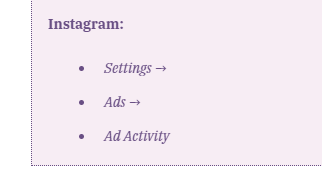
    First, I try out some of the suggestions to get a sense of how much my social media knows about me. I head to Instagram first:

    The results are not surprising for me: I like tights, running leggings, beds!… When I explore my Ad Topic Preferences, I can pick to see more or fewer adds related to… alcohol, parenting and pets. Err… .

    Profile pics. OK. The guidance explains:

    Do you use the same profile picture across various accounts online? Reverse image searches like TinEye or Google Image Search (1) can help people easily connect the dots about the services you use.

    https://datadetoxkit.org/en/privacy/profile/

    I used to have the same profile pic for everything. Recently I moved to the same pic for work related accounts (Twitter, LinkedIn, Work email) and different pics for everything else (Facebook, Instagram, messenger apps).

    One suggestion that resonates with me is “get off the app and onto the browser”.

    That is a good idea. I no longer have Twitter or LinkedIn on my phone. Instead I use a browser on my computer mostly during work hours.

    I still use facebook via an app however, and I am considering that at the moment. I head to the suggested ad settings and check what’s happening with my data.

    I already have wholly private accounts and only share information with Friends, but even that group can seem too large at times.

    So… with that in mind, I do a bit of a clean up.

    Step 3: Personal social media clean up

    In order to do any of that, I need to reset my facebook password. Useful to be reminded how I haven’t done that in a while.

    I delete an old Twitter account, which is easy enough.

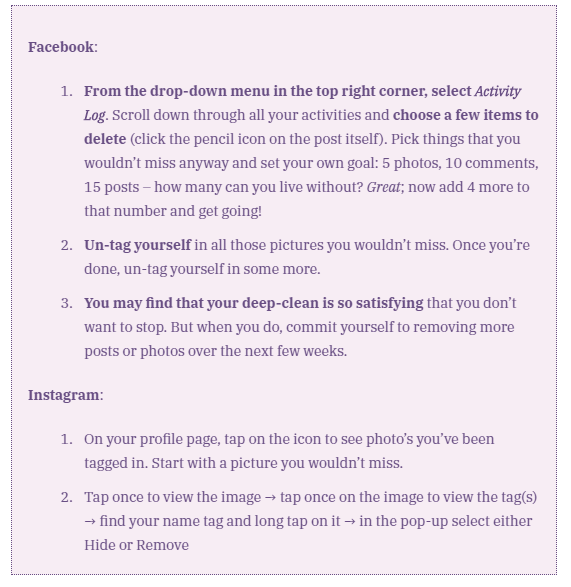
    Deleting Instagram accounts proves much harder! There is useful guidance but I don’t find it straight forward to follow. In the end, I delete all of my Instagram accounts. Making a fresh start might be a good idea. Separate accounts for separate things. No more joined up-ness.

    I don’t wish to keep my data from Instagram, as I have all the images I ever posted, but here is a guide to deleting accounts whilst keeping your data.

    One last thing I do is the clear my browser history and website data on my phone’s browser (the work one is usually pretty clear as I do a monthly clean up of that).