Category: open practice

  • 23 things & coding… new open course adventures

    Recently I have been writing about setting up a new CPD log using Google Apps for Education. After a couple of busy weeks (at ALT’s Annual Conference) I have been searching for a new open course to try for this autumn. I really enjoyed my experience taking part in the Digital Scholar course and now I am ready for a new adventure.

    So, first up and already underway, I have registered for the 23 Things course from the University of Edinburgh. Recommended by a colleague on Twitter I found the course a really inspiring proposition.

    While there are quite a few familiar topics, I hope it’ll be a good opportunity to keep up to date with current practice and find new tips and ideas. I might also see if any of my colleagues might join in and utilise the course to help us provide some internal CPD. One aspect of the course I am already finding really useful is the community blog.

    Another new course I have signed up for gets underway next month and is run on FutureLearn for the Open University: Learn to Code for Data Analysis. More of a challenge given what little I know about this but it’s definitely an area I am keen to develop in. In addition to what looks like a great course tutor team and content, the course also runs on a platform that I have worked with myself and I am keen to experience another course as a participant. Judging from the hundreds of enthusiastic posts in the welcome forum, I am certainly not the only participants who is looking forward to the course getting underway and not the only novice either.

  • CMALT CPD Log: tracking professional development using Google Apps

    Since gaining my CMALT accreditation in February, I have been struck by how much of a difference it has made to me (and I am not just saying that because I work for its awarding body…). As well as providing useful evidence for my work day to day, it’s made me take a more focused and considered approach to my Learning Technology work. Part of it is developing a habit to reflect, about learning to pause and take stock before moving on to the next thing. I’ve also started being a peer assessor for other candidate’s portfolios and that has been an interesting process in itself, making me feel more connected with other professionals working in the same discipline.

    As the portfolio has to be updated every 3 years (as explained here) I’ve been considering how I am going to track my own activities. Three years is a long time and I think I would dread having to compile everything in 2019. So, like other CMALT Holders before me, I have tried to devise an approach to help me keep everything in one place and link easily into my portfolio that I built using Google Apps for Education.
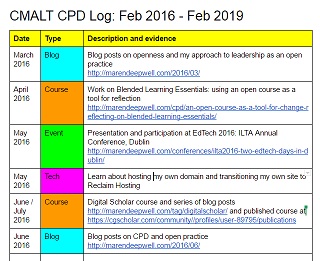
    CMALT_Log

    Main aims: keep a running log of CPD activities, make it as easy as possible to log these, keep the format linked to my portfolio so that I can transfer content at the review stage and keep evidence.

    First steps: I set up a Google sheet and a form initially, but found that I didn’t like it because typing longer text into each cell didn’t work for me and the form felt too impersonal. I wanted to give myself the flexibility to add reflection and expand the format whenever I want. So I started a new Google doc instead, with a table, free text sections and an appendix section with guidance from the ALT website. I also set up a folder for additional evidence to be stored.

    Collect evidence or risk loosing it: it became quickly apparent that a lot of evidence I was logging is contained in my blog. As I now host that on my own domain (thanks, Reclaim Hosting 🙂 I feel that this works even in the long term. However one course I participated in this summer has published my work only behind a log in. So I took screenshots of the key information and stored them in the folder in case I loose access in the long run. Certainly the process of logging the evidence was the reason why I did this – otherwise I don’t think I would have.

    Where’s my CPD heading? As well as aiding reflection and encouraging me to keep my work properly backed up colour-coding different categories of CPD (e.g. events, blog, course… etc) made it very clear what I have been focusing on and areas in which I could do more.

    Tags, categories, images… couldn’t I do all of this in a more elegant way? I am sure I could. There are apps out there that would certainly make it look and feel a lot more glossy. If you have found a way that works for you, I’d love to see how it works. For me, sticking with the same format as my portfolio works for now.

  • My last week as a #DigitalScholar?

    PeerTomorrow is the last live session of the Digital Scholar course. In this post I will share my experience of week 4 and look back briefly at the course overall. So, last week was all about the peer review process and reviewing each others’ course outlines. At the end of the week, we each received the feedback provided by our peers and mine was definitely useful. Some comments were very factual, pointing out a typo or missing information, while others made me think about how a particular section of my proposal could be re-framed or re-ordered to make it clearer. What I found particularly useful:

    I know what I am talking about, but will my audience… : I think that is a key benefit from being part of a course with such a diverse group of participants. At least one of my reviewers was completely unfamiliar with what the course I was proposing was about and their comments made me want to improve my outline to make it easier to understand.

    Where, what, when… : I have a tendency to repeat things when I write and using 100 words where 20 will do. Some of the feedback prompted me to be more strict about where information was included and where it could be omitted. The Scholar interface and the course rubric also helped with that.

    No one knows who you are… : I rarely get blind feedback on work that I produce and as I have a senior position it can be hard for others to give me critical feedback. Even if you try and take a very collaborative approach, those kind of barriers make a difference. So I appreciated my “blind” feedback in particular because it was rather blunt.

    Is this the end of my #DigitalScholar journey?
    While this week is the last week of the course I am not sure I am ready to leave things behind. I am looking forward to tomorrow’s live learning moment, a meet up which has established itself quickly in my weekly routine as something I look forward to. I’ve also made some good connections with other participants and I hope they will continue to develop beyond the course end date. In terms of the work I did during the course, developing the course outline has been a really interesting undertaking. I think I have a good idea for how to develop it further in a work context, applying some of the ideas to my day job – and I also have come to realise that I have some other ideas, the bread crumb style course I mentioned in a previous post, that I might explore in my own time. Both have helped inspire me to engage directly  with open course design and delivery for the first time since my work on the ocTEL course finished.

    If you would like to read more, you can find all my previous posts about the course: starting with the first one looking ahead at the course, followed by the week 1 post about meeting the community and joining in, then my post for week 2 which focused on my process of designing the course outline and imaging another and also my post for week 3, which was about the peer review process.

  • Peer review as a #DigitalScholar: week 3

    This week our task on the #DigitalScholar course was all about per review. From creators of our own course outlines we turned into reviewers for our peers and provide feedback on a number of theirs.

    In contrast to reviewing short abstracts for conference proposals or fully thought out research papers, reviewing course outlines is a different experience for me. For example, after only a week or two of developing, quite a big proportion of what I have reviewed (and produced myself) is work in progress and thus often a lot more interesting. My peers are taking a more risks trying to put together an innovative course. I like reviewing work in progress as it exposes more of the thought processes – my own and my peers’.

    Also, it’s been fascinating to see the range of different proposals and topics. The discourse on online courses I am most familiar with is based in Higher Education, primarily in the UK and the US, and the course outlines I have seen are targeted at participants all around the world, including in a number of developing countries. The audiences that have been identified are quite different from the ‘typical’ MOOC participant I so often read about. In contrast the course outlines are all about helping communities not connected to formal education provision.

    I read an opinion piece in the future of universities today, from Times Higher Education, and one of the views presented was that technology has found a home in universities, but that nothing has really changed. This kind of perspective is common because it reflects our consistent need to learn, to assess, to prepare new generations for a broad range of professional futures. Learning Technology may change the way we do things or enhance them, but the fundamental processes remain unchanged, the article argues. On the other hand, the DigitalScholar course highlights the scale at which for example the availability of online courses, such as the ones we are designing, are changing things. Identifying a need that an online course can meet is a first step to making use of Learning Technology that really acts as a “game changer” – providing training, CPD or supporting crisis management.

    So, thanks to Reda and the course team for another inspiring and engaging week of the course. I am already looking forward to next week.


  • #DigitalScholar week 2: course structure v a trail of breadcrumbs

    CuriosityI’ve been working on my course outline as part of the #DigitalScholar course I’m participating in. The deadline is on Friday and I have been catching up on the guidance and help provided to get my submission ready. The topic of my course is using reflection as a CPD tool in Learning Technology.

    As I mentioned previously, the course is run on Scholar, a new platform for me, and I feel we are gradually making friends. The ‘creator’ tool we are using took some getting used to – but it soon becomes easy to use. I’ve still drafted most of the text in a Google doc in the first instance, but translating the draft into the creator interface was straight forward and I really like the fact that you are creating content in a format which can then be used in different ways, basically working in something like a publishing interface meets back-end content management. Anyway, one of the most useful pieces of guidance provided by the course team is a rubric which sets out what sections you need to include in the outline for your future online course, what kinds of things to consider, what potential participants might need to know and so forth. It’s very helpful as well as thought provoking – in particular when it comes to thinking about possible business models for future courses. My experience on courses like ocTEL for example, was all about delivering an open course without any financial contribution from participants. The #DigitalScholar process makes you reflect on that and what sustainable alternatives might look like. It’s useful and valuable to be challenged to think about this during the initial course design phase I think.

    But… yes, there is a but. I think the more I work on my course outline, the more I think about course activities, learning outcomes, accreditation or peer-review or indeed the underlying business model, the more I realise that the kind of course I’d really like to design would be quite different. Only by trying to create something new within a given structure, using the platform provided, have I started to realise what it is that I am actually curious about. It’s still a bit blurry, but some elements are starting to become clear. Here is what I have so far (and keep in mind that this is professional/personal development for me, so I am focused and what I am interested in rather than what I need to deliver at work):

    Minimal content. A little like various “thoughts for the day” or “image of the day” creative approaches already happening. Maybe via email or Twitter – but no learning objects as such, mostly just a prompt. Or a trail of breadcrumbs to follow.

    One way to curate contributions. That’s probably inspired by what we did with ocTEL, creating a way to use hashtags to collate contributions from across different platforms so that participants can stay within their native environments. It would probably be much harder to balance out the bias of any chosen platform in practice than I imagine, but this is all in my head anyway.

    No video. Just words. This is where the story element I am after comes in. Like reading a story, participants should be able to imagine things for themselves rather than being shown.

    Any pace. I think my ideal course would have no set pace, no fixed end date. A little like my experience of participating in Dave Cormier’s #rhizo15 course, there would be a no constraints.

    Reflect. The main focus of the course would be on reflection. Whether you do that in your head, draw it, write it down or share it wouldn’t matter. Reflection is a personal undertaking and the course wouldn’t need to measure that. It would be up to people participating to decide whether they reflect or how well it worked for them.

    Hmmmm. All in all I am not sure what I am thinking about is a course at all. Maybe it’s more an activity others could join in with.

    So, that’s my progress report from week 2 of the #DigitalScholar course. Thus far I have made a lot of useful connections, met a new platform, participated in a couple of inspiring online meetings, created a draft course outline and – well, come up with a completely different idea as well. Well worth it, I think!
  • My first week as a #DigitalScholar: the adventure begins

    IMG_3158It’s been a busy week taking part in the new Digital Scholar course and in this second post I’ll share my initial impressions and experience over the past few days. This online course is run on the Scholar platform, which I am new to.

    Saying hello: One of the really fun aspects of the first week on the course has been getting to know the other participants. It’s been great to see greetings from a global group of participants from a pletora of different backgrounds, professions and sectors. I’ve been enjoying hearing about what others’ are aiming to get out of the course and what they are looking to achieve.

    Finding my way around: that’s been more of a challenge given that I am new to the platform, the course structure etc. The course team provides a lot of guidance, including video tutorials and overviews/lists of things to do. Some aspects of the Scholar platform haven’t felt intuitive to me – e.g. the process of adding others’ as peers – but all in all I have found what I am looking for.

    Noise or nice: Like other courses of this kind I have participated in, there is A LOT of activity in the first few days. Figuring out what to concentrate on and what to filter out is a key learning process. For me, adjusting email settings and finding ways of checking on updates without getting lost in hundreds of personal messages has been a learning curve. I’ve tried the Slack channels as well, although at the moment I haven’t found a use for it yet. I have tried to participate in the conversation #DigitalScholar on Twitter instead. I am not sure to what extent I am going to engage with the informal networking instead of the formal peer review process – I suspect it’ll depend on how much time I have.

    Independence: One aspect of the course I really like is that it allows you to be fairly independent in how you organise and approach your work. There is a strong emphasis on figuring out how to make this work for yourself and that helps increase my engagement. I also enjoy having a new online space in which to start creating a project. There are key deadlines to work towards, so that helps keep me focused and paced through the week.

    Up next: I have just over a week to finish the outline of the online course I am using as my course project. It’s a course about using reflection for CPD in Learning Technology (yes, for some of you that may sound familiar from my CMALT portfolio…;) .