Category: open practice

  • #OpenEducationWk: Openness for eternity?

    oeweek
    Open Education Week 

    It’s #OpenEducationWk and I’ve been inspired by activities and blog posts from across the community, including a special edition of the #LTHEchat (helpful intro here) and a number of webinars organised by the ALT Open Education Special Interest Group (including a preview today of the OER16 Open Culture conference coming up in April). Seeing so much commitment to and enthusiasm for scaling up open practice and resources has been a joy – but it’s also made me think about sustainability in the long term.

    Many of us have plenty of problem solving to do right here, right now – and planning for the long term is not often a top priority. When it comes to creating open educational resources or sharing open practice it can be hard enough to do in the first place without thinking about how sustainable a particular piece of work might be when someone comes across it in 10 or 20 years. One of the immediate benefits of sharing something can be the feedback from colleagues, the conversation and knowledge exchange it stimulates and the connections we build through them. So our networks grows bigger and stronger and become more sustainable.

    But what about our resources we share? What about them in the long run? In Learning Technology in particular many are fond of big sweeping statements (see Audrey Watter’s Hack Education project for an eye opening reality check) that make it sound as if a project or initiative solves a particular problem once and for all (and for everyone). Hyperbole along the lines of “no more textbooks – EVER” or “the END of the universities” makes it sound like we operate only a stone’s throw away from #edtech nirvana over the horizon. But without the right meta data, without considering interoperability, without updating and re-sharing things much of what we create remains useless to others. Enabling others to find and make sense of resources or assess their usefulness in their context is challenging while looking for what you need often leads to broken links, missing licences, taxonomies that only make sense to those who designed them and repositories that have long since fallen into dis-use.

    maxresdefault
    Image source

    Institutional structures, if they support openness, can help with some of these issues while we have access to them. But when jobs change, people move on or institutions evolve these internal structures can become inaccessible.  Like the huge aircraft boneyards that become material metaphors of the age of air travel, our open landscape has its own spaces where all the dead OERs reside. When the lifespan of open resources is so limited the investment they represent also has limited benefit. Particularly when it comes to publicly funded resources there is a lot more we could do to ensure that what funding there is has an impact beyond its immediate beneficiaries.

    This is why policy is so important. The work Creative Commons are leading in the US for instance (here is further info about their #GoOpen campaign) or the work of the Open Education Consortium help create robust ways to enabling open practice, create and share open resources at scale – to ensure sustainability in the long term. When institutions embrace openness, like the University of Edinburgh has done recently by adopting a new OER policy, they bring us a step closer to making openness sustainable in the long term.

    Which brings me make to where I started: openness for eternity? How can we make it work in the long term? Make sharing openly sustainable, scale-able and useful? From the global movement via national and institutional policies to individual practice it is a formidable undertaking. Weeks like this, #OpenEducationWk, show that we are making progress.


  • Google Apps for Education (#GAFE) as a #CMALT portfolio tool

    Recently I was accredited as a Certified Member of ALT (find out more here) and the key component of the scheme is a peer-reviewed portfolio. You can build your portfolio in almost any format provided that it is accessible to assessors and follows the required structure.

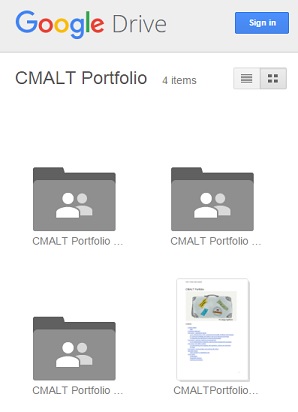
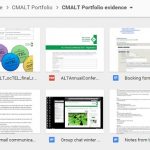
    CMALT folder
    My portfolio in Google Drive

    I chose to build mine using Google Apps for Education (GAFE) and here I’d like to reflect briefly on the experience:

    Why use GAFE? My main reasons were that it is free to use, I am already familiar with the tools available, there is storage and authoring tools all on one place and most importantly it works long terms as I will retain access to the files or at least be able to download them easily if needed. A further advantage for me was the ability to organise all the different types of content including supplementary evidence and images into different folders and make them easily accessible to the assessors.

    What did I use? I focused my portfolio around a Google Doc. I decided early on that I wanted to illustrate my portfolio and the format I was after was linear  – I wanted to build a narrative. I included screenshots, images and links and where appropriate filed these into folders on Google Drive. I also used a Google Sheet to help collect a lot of the evidence in the early stages, mainly to have a record of the various locations and links. I think that may be something I keep using as an ongoing record of my CPD activities.

    What does this look like long term? Now that I have achieved CMALT the portfolio will have to be reviewed every 3 years. In that time period I’ll likely accumulate a lot of evidence of my professional development and my intention is to log it in a Google sheet, link to it where appropriate, and build up my folders of visual evidence as I go along. Then, when the time comes to review and update the main document or add to it, I should be able to draw on the information I already have. It’ll also make it easier to reflect on what I have done.

    Any drawbacks? From my perspective there was no functionality that was missing and the auto-save and offline working capabilities made it fuss-free for me. Because you can share content without requiring others to have an account but you are still able to limit access I found GAFE was a useful tool indeed. Another plus was that I could share early drafts for comment and others could add to and comment on specific paragraphs.

    CMALT 2

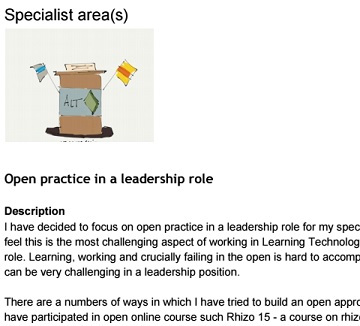
    Open practice? If you are curious to have a look or indeed find inspiration for your own CMALT portfolio you can access my portfolio folder via this link https://goo.gl/44I4Bd . I have added a Creative Commons Licence so that you can access it and re-use for example the images I have included. The specialist area I have written about in my portfolio is open practice in a leadership role. Sharing my portfolio openly is part of the work I do and I am grateful for all the encouragement and feedback I have had from my colleagues throughout this process.

  • Feedback, milestones, reflection: appraisal in a leadership position

    This is the time of year for reviewing personal and professional development, for reflecting on achievements and set goals for the following year. In short, it’s time for my annual appraisal process.

    This will be my fourth in a leadership position and each year the process has evolved depending on the needs of the organisation and myself. What we have found works consistently:

    • 360 degree feedback: that includes everyone who reports to me, those whom I report to, colleagues whom I work with and external reviewers;
    • Clear assessment of goals set and progress made, milestones reached and key deliverables – in my case that encompasses most of what the organisation does or doesn’t do as my role carries overall responsibility for strategy and operations. This is where individual appraisals for others feed into my own which is really helpful;
    • Reflection on personal and professional development, often in relationship to what we had planned 12 and 6 months ago, but also anything else that has developed in response to changes in circumstance;
    • Written feedback and face to face conversation. My appraisal process is a blended process which involves a distributed group of individuals and culminates in a face to face meeting, led by the current Chair of the organisation I serve which changes annually.

    Variations from year to year:

    • Emphasis on performance, support, development… depends on the context and provides some flexibility in a process which can at times become a long list of colour coded milestones;
    • Openness also varies. Some years have been very open and I have shared many parts of my appraisal feedback with colleagues, while some years are more personal and less easy to share;
    • Scale and perspective, from the proverbial helicopter view to the detailed analysis of a specific situation. That again seems to change from year to year.

    As I am compiling this year’s appraisal documents I find that now in its fourth year I have more expectations, a clearer idea of what I’d like to get out of the process. And one of my aims for this year is to use the process as a way to continue my open practice. In my experience colleagues in leadership roles can find it difficult to get effective feedback and appraisals. For some, it becomes about performance management and if there are no concerns, then it’s just a formality. Others focus on providing feedback and thus get little in return. Some colleagues feel that at a certain level of seniority you should be able to do without, to reflect sufficiently on your own. And to some degree I agree with all of these perspectives. But there are some reasons why I really value taking a more in depth approach to my own appraisal:

    • Giving constructive negative feedback takes time and focus. I value honest praise but I feel it’s important to give opportunities for negative feedback, too;
    • Ongoing reflection is an essential part of my practice, but when a period of time is particularly busy I can still loose perspective. Being forced to take a step back and collect a whole year together in one place gives me an annual perspective that opens up new vistas;
    • Having a deadline makes me do things like (finally) submitting my CMALT portfolio, write a submission or review an article;
    • Writing my appraisal is a chance to not only set achievable goals, but to dream up new visions of the future and what that may hold.

    All in all I think you can see why I feel this is such a valuable process. Particularly in a leadership role I think it’s a privilege to hear from others what they feel you could do better, how you might achieve more.

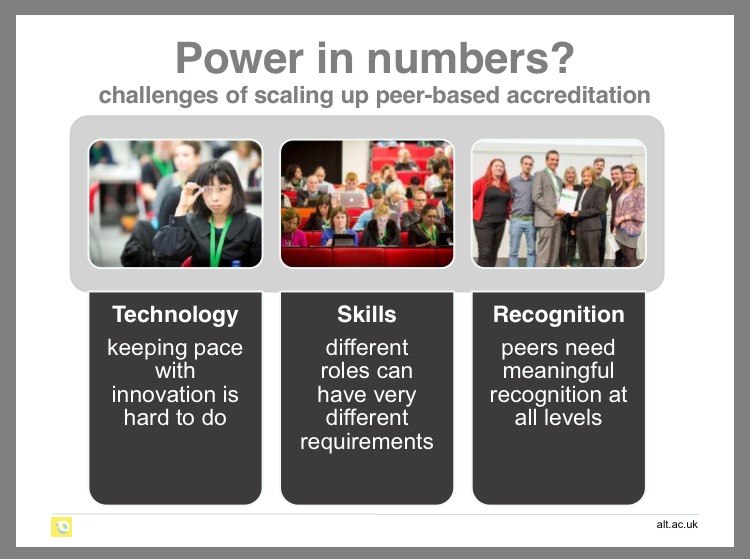
  • Peer based accreditation for agile professionalisation in Learning Technology

    Snapshots from my presentation as part of a panel at OEB15, 3 December 2015 in Berlin. You can also download the entire presentation (CC-BY) OEB15_MarenDeepwell_2015 (1).

    FullSizeRender (5) FullSizeRender (4) FullSizeRender (3) FullSizeRender (2) FullSizeRender (1) FullSizeRender


  • Sharing my #CMALT portfolio: reflecting on the why and how

    Open I’ve been working in my #CMALT portfolio. Given that I haven’t yet submitted it for assessment (it’s not quite finished) you might rightly think that a blog post about sharing it is a little premature. Of course you are right – and I won’t actually share it until it has been assessed and (hopefully!) passed sometime in the future. But my intention to share it openly has definitely shaped how I have approached things and to me it’s interesting to reflect on the why and how of that process.

    The main reason why I want to share my portfolio is that reading others’ portfolios has been a really valuable part of making my own. I have found it interesting to see how others have build theirs, from the technology used to reflections shared. At times, I have been humbled by what others have achieved (often single-handed) and often I have felt empathy with individuals whom I don’t know, but who were struggling with the same things I have. In what is largely solitary undertaking the portfolios of others have provided inspiration and motivation.

    Creative CommonsBut sharing what is essentially a personal artifact incorporating examples of work and reflection has not been entirely straight forward. My chosen format, Google docs, makes sharing easy. I can even set up a shared folder for additional evidence and control who has access. Licencing, too, I have considered. The most restrictive Creative Commons licence seems like it might work for this purpose. Some of the examples/evidence in the portfolio is already licensed under Creative Commons so that aligns well. I should be able to produce backups, copies for updating and different formats of the portfolio quite easily and that is an important consideration for me – I wanted to make it as easy as possible for me to actually do work on it initially and subsequently keep it updated.

    But what about the actual content, what I describe and reflect on – in particular working with other people? What about reflecting on failures?  In most instances I have opted for not mentioning individuals by name, using role titles or generic terms instead. This is particularly important I feel when talking about colleagues in the team I lead. While it hasn’t always been easy, the consideration that what I am writing could potentially be read by anyone has contributed to making my work more balanced. But there has also been tension between accurately describing what I do and respecting the privacy of those I work with. Now that the portfolio is nearly finished I have shared with my staff team for feedback. This way everyone who is referred to has the opportunity to read what I have written and comment on it.

    A further consideration has been including things that don’t work, things that have gone wrong. Given that this is a portfolio meant to demonstrate professional experience and skills, you are more likely to include examples of things that have worked. But for me there is value in reflecting on things that could have gone better, what I could have done differently. Including that in a publicly-shared document however deserves consideration.

    From the outset, the intention of sharing my portfolio has shaped how I have approached my portfolio. It’s been particularly valuable as it has encouraged me to reflect on the guiding principles of the #CMALT framework in my work – one of which is empathy with and willingness to learn from others. In that spirit, I hope that my portfolio can one day be useful to others in similar ways.

  • Drawing my way through my #cmalt portfolio

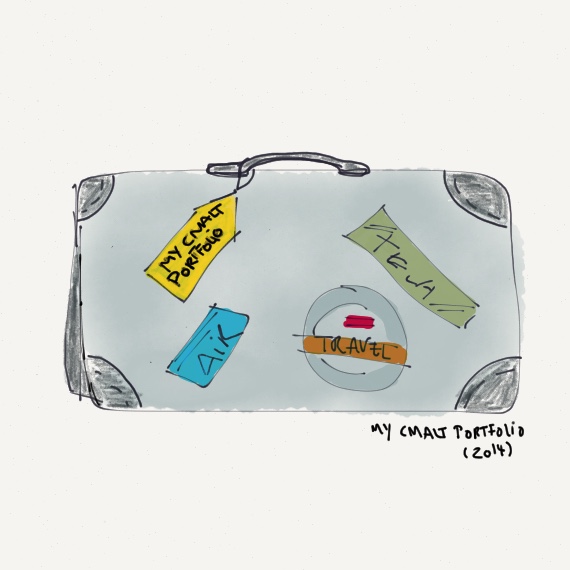
    IMG_1010Compiling my portfolio for submission for CMALT,  ALT’s peer-based accreditation scheme, has been a long term project. Originally I started in 2011, but I didn’t complete it. Now I am close to finishing and planning to submit my portfolio (finally). As part of the process, I have made drawings for each section of the portfolio, usually one per section. The first few drawings I made close to a year ago, but I am still adding new ones. Some are illustrations based on CMALT criteria or headings, others are from my work and blog posts. Most of the drawings start life with pen and paper, but many end up being re-drawn on the paper app on an iPad and later edited again with more apps to add text, adjust colours and so forth. This kind of professional development definitely doesn’t require you to get your colour pencils out and start drawing things, so why? Here are my thoughts:

    IMG_1014First, drawing is something that’s been a key part of my practice, of the way I think, long before I started working in Learning Technology and I still find it an invaluable part of my work today. Whether it’s designing open badges or trying to figure out a complex network of use-cases, I often find drawing things down helps with problem solving and communication.

    Second, drawings are a good way for me to express different parts of my vision, my personality. I like using them as part of my approach because they can be more eloquent than words and allow me to contribute something more. When I contributed #rhizo15 earlier this year, I found that drawings were a great tool for participating either together with text posts or as stand alone posts. There is something about using colour and images that really connects wit the way I think about things. In the case of my #cmalt portfolio, adding drawings helped to make it feel more like me, help me focus on what I wanted to communicate about my work.

    FullSizeRenderFinally, and importantly in this context, drawing takes time and focus. For me it is an excellent way to reflect and reflecting on your practice is a key part of the #cmalt framework. I often started a section with a drawing and by the time it was finished, I would be ready to start writing, having laid out the ideas in my head. The reflection is probably the most rewarding part of the process for me.

    It’s not really about the drawing in itself, more about the process as a way of giving myself time and space to really think about things, figure out how I feel about something and sometimes, it ends up surprising me with unexpected ideas. That’s the best part for me.