Category: open practice

  • My #OER17: many voices taking action

    My #OER17: many voices taking action

    What a week it’s been #OER17… As I wasn’t able to catch that many sessions while running the event, I am enjoying reading, watching and catching up with everything. And there is a lot out there – photos, drawings, presentations, videos, recorded live streams and an ever growing number of blog posts. Thank you for sharing!

    Before the conference I had three hopes:

    First, learn & listen about how Learning Technology can support openness. I am thinking here about technology used for learning, teaching and assessment in any context (ALT’s definition is useful here) not the more specific ‘educational technologies’ like VLEs or e-portfolios.  The huge potential of technology for all kinds of openness is evident – but what this conference made me think about is how critical it is for staff and students to gain sufficient understanding of the tools, platforms or networks to make informed use of them. That would include understanding what data about them is collected and how it is used, what footprints they may leave and for how long and so forth. Providing support for developing this kind of fluency can be difficult, in particular when in many institutions the concept of openness is contested. I came away with many questions and a sense that there is much to tackle once I get back to my desk…

    Image of a Virtually Connecting Session
    Photo of Lisa Taner, Lucy-Crompton-Reid & Maren Deepwell at a Virtually Connecting session at OER17 taken by Martin Weller

    My second hope for OER17 was to make time for people and conversations. That was probably the most enjoyable aspect of my days, and like many other participants I was delighted to be able to connect in person with many individuals from my social networks. One of the highlights was joining a Virtually Connecting session with Lisa Taner and Lucy Crompton-Reid, facilitated by Martin Weller – and I am grateful to Maha Bali for inviting me. You can now watch it on YouTube . Meeting participants from different continents and having a conversation that bridges the physical divide was a great way of seeing things through someone else’s eyes. The social events before and during the conference were another good time for catching up and I was impressed by the bowling, ping pong and karaoke going on all around.

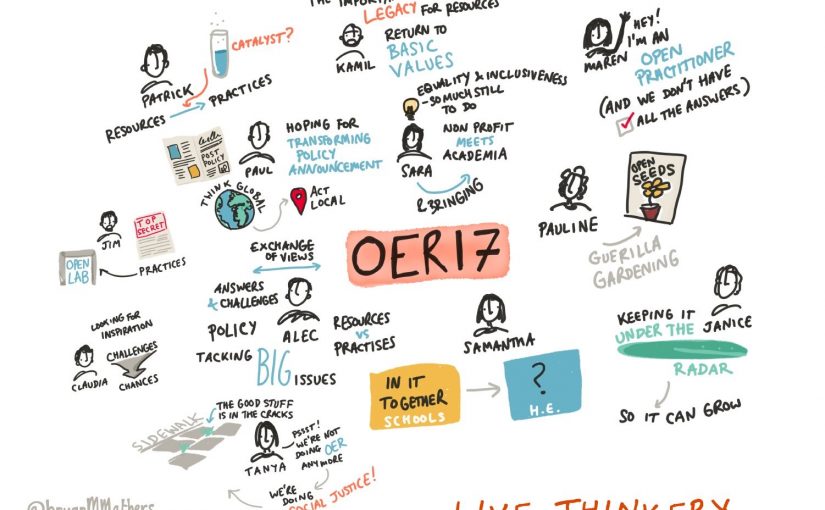
    Together with Bryan Mathers I ran a workshop and Bryan has kindly shared all the content from the presentation and the featured image above, the ‘Live Thinkery’ I helped facilitate. The workshop was called “from Voice to Visual” (prezi is here) and we were looking at the creative journey of the ALT visual strategy. If you haven’t already, visit Bryan’s page dedicated to OER17 and find all of his visual thoughts, all licenced CC-BY – thank you, Bryan!

    CC resist by @bryanMMathers
    CC resist by @bryanMMathers at http://visualthinkery.com/project/oer17/

    Conferences and communities like this are special to me, so my third hope was to enjoy the two days (and not ‘just’ do the day job). With so many inspiring and engaging sessions in the programme it is hard to pick out any specific ones. What brought it all together was the plenary panel. The recording of this session and the content created during the session are life affirming and I particularly enjoyed the Storify #OER17 #IWill shared by Catherine Cronin. Asking everyone to share their intention, their hope for making change and taking action was a powerful reminder of how much individual action matters, how much each of us matters. My experience of OER17 was a testament to that.

  • Celebrating the birthday of my own ‘domain of one’s own’

    Celebrating the birthday of my own ‘domain of one’s own’

    Fittingly after a week at the OER17: The Politics of Open conference, I am celebrating the birthday of my own ‘domain of one’s own’. I’d like to say thank you to Jim Groom and all the folk at Reclaim Hosting for their support – you are awesome!

  • Time to be… open #OER17

    Time to be… open #OER17

    We’re getting ready for the OER17: The Politics of Open conference this week. As one of the organisers of the event my main focus has to be on making sure everything runs as well as it can – but it’s also an opportunity for me to spend a few days with a community who shape the future of open education around the globe. And this year the conference has a stellar line up across 2 days with sessions set to challenge the politics of openness from the personal to the national.

    Image of ALT laptop stickers
    Stickers featured in the workshop

    There already is a plethora of blog posts by practitioners reflecting on and setting out their thoughts, hopes and inspirations. It makes for inspiring reading and personally I can’t wait to see some of these conversations play out at the event. I might have to write a follow up blog post (with a particular focus on a workshop I will be running jointly with Bryan Mathers called ‘From Voice to Visual – the making of an open strategy’ ). For now, here is what I’ve got in mind for my own #OER17, beyond the running of it:

    First, I’ll be looking out for new opportunities for Learning Technology to scale up, support and strengthen Open Educational practice. Technology isn’t always the answer, but I often think it can do more for openness.

    Second, I’ll be making time to have conversations. This year I am prioritising people over the programme… so if you are at the event in person or joining into one of the streamed sessions (or my first venture into Virtually Connecting thanks to Maha Bali!) come and say hello.

    Third on my list for this week is to enjoy OER17. That might seem like an obvious one, but it’s worth remembering. Over the past 12 months I have seen volunteers and colleagues pull together an event that has grown in participation, influence and voice. It’s going to be an amazing opportunity for everyone to come together and hopefully translate into practice and policy what they experience this week – taking action for open education.

  • Reflecting on what’s important… randomly

    Reflecting on what’s important… randomly

    I miss having a rhizomatic course to participate in. This kind of post of professional and personal reflection feels like it would have been appropriate for that kind of sharing space. In the absence of a course however, this is ‘just’ a rather random post.

    I’ve recently thought a lot about what’s important. Three very different things,  a work project, a TV programme and a new network, have come together in my head and it’s an interesting place to think.

    First, I’ve spent the past few months working on a new strategy for the member organisation I work for and that involved a lot of listening, observing and trying to understand what matters to the individuals and organisations we serve. The strategy ended up being shaped by shared values, an articulation of what’s important to the community.

    Second, I’ve also been watching an excellent new documentary series on design (Abstract on Netflix). It explores different types of design from illustration to interior design and it uses the tools of digital film making to enhance the story telling. I love seeing the world through the eyes of people who shape it as they ask what is important and why.

    Third, I’ve helped promote an emerging network (see http://femedte.ch/about/) which is focused on providing support and collaboration for a community of like minded individuals. The values that are being articulated as this network forms again focus on what’s important: equality for example.

    In each instance people make an effort to engage, they spend time and effort, because of something that is important to them. That is true whether it’s a designer who wants to change the way we feel about being at home, a professional who wants to develop in their career or someone who wants to make their voice heard promoting women in education and technology.

    It is hopeful, encouraging, to see people look at the world and take a positive action to change it for the better. Taking some personal responsibility for making a change within a personal or professional sphere requires effort and decisiveness. And the visions of what the future could look like in my three examples are positive. I’d like to see more equality in education and technology. I’d also like to see designers make homes, public spaces and products that I inhabit or use more green, more holistic, more humane. And I’d like to see the values articulated in the strategy I’ve worked on put into practice on a bigger scale. Amidst the sea of chaotic bleakness that news and social media can seem like at times, it’s important to reflect on what we care about and that we can contribute to making it happen.

  • Equality, empowerment, accreditation and beyond. My fantasy conference proposals… #altc

    Equality, empowerment, accreditation and beyond. My fantasy conference proposals… #altc

    Every year around this time when I encourage my peers to submit proposals to the ALT Annual Conference, I reflect on the fact that as one of the organisers I can’t submit a proposal myself. And given that as a Learning Technologist this is one of the key events in my diary each year, I have often thought about what I would submit if I wasn’t affiliated with ALT. So here are some of my fantasy proposals, ideas in the making, that I won’t be submitting (again) this year. If you have your own ideas then your chance to submit your 250/500 word proposal is still open until 20th (or soon to be 27th) March. Take your chance & make your voice heard.

    Poster, Theme: Wildcard: Poster showing how peer accreditation for Learning Technologist works based on the CMALT framework, which is mapped to a number of other accreditation pathways including the UKPSF, the Jisc Digital Capabilities Framework and Blended Learning Essentials. CC licenced so that the model can be adopted by participants in their own contexts.

    Lightening Talk, Theme: Empowerment in learning Technology: Empowered #edtech governance. A fast paced, visual take on how to work collaboratively with decision makers to build new strategies, using work with cross-sector stake holders as examples. Would include a 1 page “recipe” handout to take away and try out in your own organisation.

    Presentation, Theme: Learning Spaces: this presentation would be led by three apprentices/interns whom I have worked with in the past year and they would take participants on a tour of their learning spaces, both physical and virtual. The tour guides would explain how spaces are used and lived in, why and for what purpose. We would reflect on issues like privacy and agency in different spaces and importantly what happens in the spaces and time periods between things, i.e. between institutions, between life stages, between qualifications. We’d question how Learning Technology can provide continuity for life long learning both online and in person.

    Panel, Theme: Empowerment in Learning Technology: Working in Learning technology one of the things I am passionate about is equality. Particularly for those working as open practitioners there are so many ways in which inequality and discrimination can impact on our ability to achieve our aims. This panel would bring together 5 exceptional practitioners to share their own strategies for empowered practice in Learning Technology and to reflect critically on how their approaches are challenged. We’d invite participants to contribute their own tips and tools in advance and during the discussion, ending up in a series of posts providing practical information that would be useful to both learners and professionals.

    Workshop, Theme: Wildcard: Learning Technology: top 10 complete failures. This is one of the sessions I’d like to go to but somehow it doesn’t seem to make it onto any conference programme. Presumably because no institution pays for their staff to go and share the details of how they lost money or worse when Learning Technology failed. And indeed because no one wishes to have this particular reference added to their CV. Still, other conferences now include specific sessions where we explore what happens when things go wrong. What happens when projects don’t deliver, students don’t use the tools or academics simply don’t co-operate. The list of forgotten, crumbling Learning Technologies is long. This workshop then would include the brave colleagues I have known and worked with over the years who would be prepared to share their perspectives so that we don’t have to make the same mistakes over and over again. Participants would be contributing their own stories. Ideally one or two policy makers and industry experts would be contributing, too.

    You probably have your own ideas as to what sessions you’d like to go and see at the conference. Submit them… .

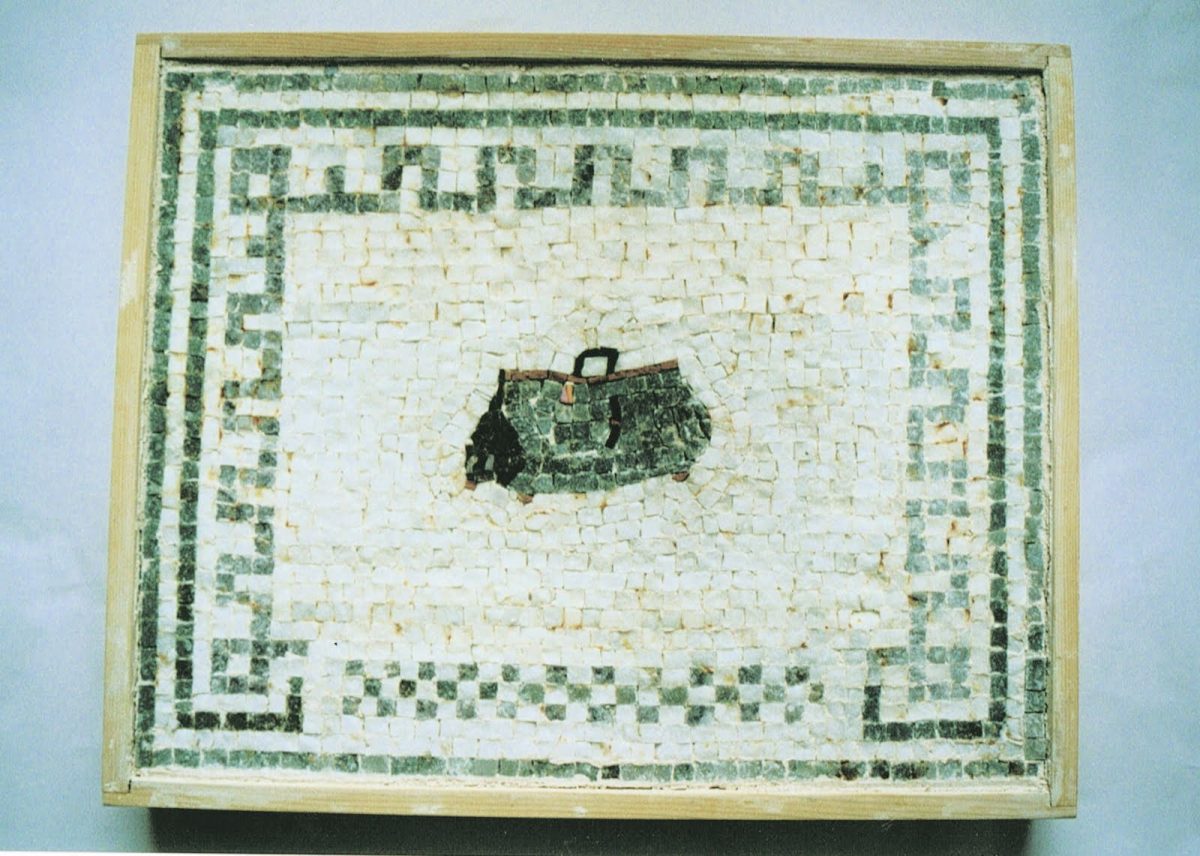
  • From marble to MOOCs… snapshots from my path to Learning Technology

    From marble to MOOCs… snapshots from my path to Learning Technology

    I’ve been continuing my project of uploading a LOT of images to Google Photos and some of these are scans or photos of drawings and artworks I made (Google isn’t great at recognising what the drawings depict but I am not entirely sure whether this is due to my inexpert drawing or insufficiently sophisticated algorithms). Before I started working in Learning Technology and before I did my PhD in Anthropology I trained and practiced as a sculptor – and drawing is a big part of making things. Learning how to draw and sketch shaped how I think and solve problems. Whether in Art or Anthropology or Learning Technology my professional practice has many threads that run through the last two decades. I’ve always been interested in time, change and how we as human beings shape the world around us.

    There’s a slideshow of a selection of images in the archive of this blog.