Category: Learning Technology

  • From Record Store to ReclaimPress.

    From Record Store to ReclaimPress.

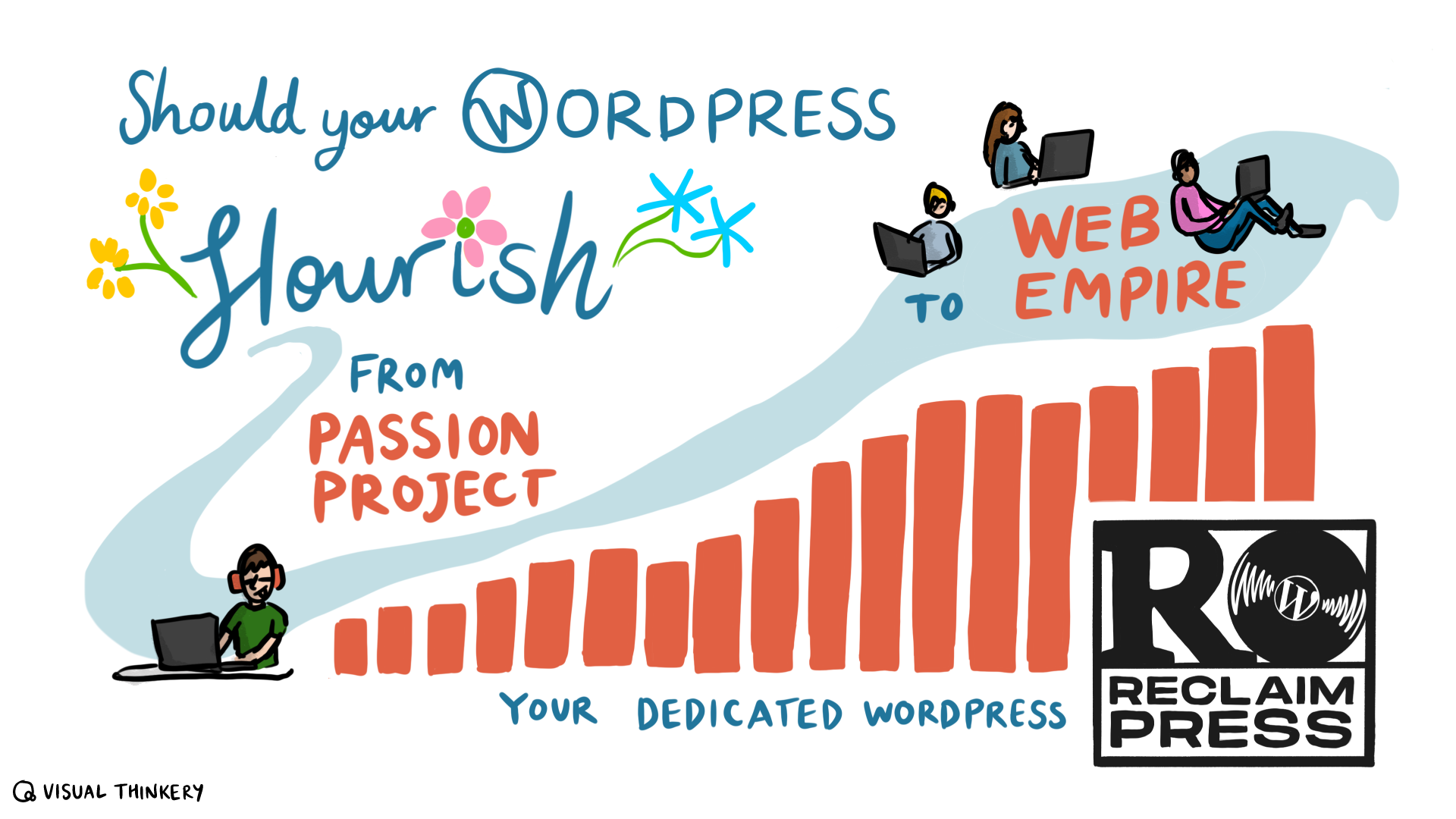
    I feel very lucky to continue my work with the awesome team at Reclaim into summer, and this month I have bagged myself one of the best pieces of work going: a conversation with Bryan Mathers all about that unique vinyl aesthetic and the brand new venture that is ReclaimPress.

    Over the last 10-12 years I have had the privilege of collaborating on many projects with Bryan, and I deeply appreciate his listening skills, his creativity and his grit. He recently ran the London Marathon and showed once again that once you put your mind to something, a lot indeed can be achieved.

    Every one of our conversations helps me reflect and leaves me inspired. So, yes, when there’s an opportunity to talk about how Reclaim’s aesthetic has developed from the early days of record stores and vinyl covers to the newly minted ReclaimPress, I jumped at the chance.

    I’ve already blogged about it on the Reclaim Blog, but I didn’t want to miss the chance to also shout here about our upcoming Reclaim TV session:

    Join us on Friday, May 17th at 3pm GMT / 10am ET for a very special conversation, a peek behind the scenes of the creative process behind the stunning visuals… and a chance to join the beta programme for ReclaimPress, too. Watch the stream over at Reclaim TV, or catch the recording later on archive.reclaim.tv or our YouTube channel as we go from passion project to web empire… . See you there!

  • Leading Virtual Teams Revisited – with Martin Hawksey

    Leading Virtual Teams Revisited – with Martin Hawksey

    This week we are going back to the origins of Leading Virtual Teams! Join us, Maren Deepwell and Martin Hawksey, in this joint blog post and special podcast episode:

    Maren: Hi Martin! Been a while since we last blogged about leading virtual teams and hybrid working. So… I have lots of questions to get us started: tell us a bit about what your current work set up is like, and what you are particularly interested in when it comes to all things virtual/hybrid working. 

    Also, I am curious to hear how you think things have changed since the dark days of lockdown working. I have been doing some research into the data around home-working and evolving policies here in the UK (for example this 2023 report and the flexible working bill and this WIRED article provides a helpful insight into what’s not being tackled). What’s your take on the evolving picture of hybrid working?

    Martin: Hi Maren, thanks for having me back! For just over the last year I’ve been working for a UK based Google Partner. We have offices in Manchester, Edinburgh and Utrecht, but the focus is very much on remote working. Even in a post pandemic world I see many businesses still trying to find the right fit around hybrid culture. One of the key challenges I see is how to replicate the benefits of being co-located when employees are hundreds of miles apart. For now let’s put these benefits in the broad bucket of ‘watercooler moments’, ad-hoc opportunities for social interaction as well as work discussions. Seemingly effortless and tricky to measure the benefit. It’s something I remember us talking a lot about and I know you’ve shared a number of approaches and strategies which can help. Where I work a recent internal ‘pulse’ survey has highlighted a desire for increased opportunities to work collaboratively. The business is exploring various approaches, including one of the skeuomorphic virtual office spaces, Kumospace. This pilot highlighted there could be real benefits in restructuring the way teams work, a virtual focal point with awareness mechanisms like location, icons, and camera status making it easier to immediately speak to someone if they are available. The challenge was the price point. It was interesting to read the surveys you highlighted which include data on the overall economic benefit of hybrid working. Whilst we had many anecdotal examples of conversations that unblocked issues or identified business opportunities it is hard to put a value on them. The other challenge was there was low engagement across the business in the pilot space. So while we could see benefits for our team, but possible to justify for the business. Does this example resonate with what you’ve seen? Do you get a sense that organisations are still trying to work out how to make hybrid working work?

    Maren: It’s clear that businesses are still on a learning curve when it comes to hybrid working long-term. In the media, there is a lot of debate on whether or not there’ll be a big return to the office, but I think recruitment and retention without a flexible offering will be so challenging, that organisations won’t have a choice. There are a lot of parallels between the use of technology in education and training, and the use of technology in the workplace. Similar to how student expectations have shifted when it comes to digital, so have employee expectations, too. Organisations who don’t offer flexibility or effective hybrid working won’t be able to recruit or retain the diverse talent they need without entrenching structural inequalities further, for example disadvantage employees with care responsibilities. A few years ago we talked about the effort it takes to create and sustain employee engagement online, and your experience with the skeuomorphic virtual office space really chimes with me. Anecdotally it feels like ‘everyone’ wants more connection and collaboration, but at the same time they’d like that sense of connectedness to be maintained by others, so that they can dip in and out as they wish. Even something as simple as internal chat channels require a lot of effort to maintain. If you are using something like Slack or Mattermost to coordinate customer support tickets, then every support ticket becomes a reason to engage (and the value proposition is clear). However if you are in a water cooler or social space there is usually no external prompt to engage and someone usually has to take responsibility for kick-starting engagement by posting something. What are your thoughts on this?

    Martin: The term ‘effort’ resonates with me. Internally in our department we’ve switched to using an all day Google Meet with breakouts for individual teams. In a recent conversation with a colleague about using this space effectively we talked about how it takes effort to join the virtual office, similar to the effort it would take to get to a physical office. I would also agree it requires someone taking responsibility for the use of virtual spaces. I would go even further and say it requires leadership. Similar to having an office manager it needs someone to take responsibility for monitoring and supporting the online office. Something I remember us discussing previously was effort in terms of cognitive load. Part of this is the brain doing overtime trying to analyze micro movements in facial expressions. Looking towards the future I think this could get a lot easier with the next generation video conferencing hardware. I recently had the pleasure to have a short demonstration of Google’s Starline immersive conferencing solution. This combines technology that can scan a face in 3D, and present this to the viewer maintaining a depth of field without the need of special glasses or headsets. The result is incredibly impressive. It was only a brief experience so I can’t talk to the long term effects. Two things I did learn was that maintaining a realistic 1:1 scale was important, so it’s unlikely we’ll see this technology on smaller screens. The other detail was for this solution they are focusing on capturing and displaying detail in the face. For example, when the person on the call held up an apple there was a strong 3D effect, but I could see some fragmentation in the detail between the apple and the person’s fingers. Still lots of unknowns with this type of technology including whether it will ever be affordable for the masses, but interesting times!

    Maren: It’s really interesting to look out how technology might shape things in the future and what sort of skills and capabilities folk may need to develop to effectively deploy more advanced solutions. One thing I have been thinking about a lot recently, and also a topic I covered in the hybrid working course I ran recently, is increasing productivity whilst stepping away from the screen. There are a lot of reasons why we are glued to our screens, but the longer I work in a hybrid or fully remote setting the more I realise that I need to design my days to be a lot less desk based in order to be at my most productive. From getting more movement in and giving my eyes a break, to finding new ways to connect and communicate without staring at a screen I am interested in how we can mix things up a little more. 

    Listen to the full conversation in the podcast 🙂

    Enjoyed this post? Get my free monthly newsletter directly to your inbox.
  • Fresh listens: Podcast Season 3

    Fresh listens: Podcast Season 3

    I’m really excited to have Season 3 of the Leading Virtual Teams Podcast finally underway. It’s a new season in every sense… and that is why I am kicking off with ‘new pencil case’ moments in episode 1:

    This episode celebrates the start of September, and the new season or start of term for many of us. I have recently tried out a ⁠new gratitude journal⁠ share ideas for how to find bright spots in a busy time of year. I also give you a preview of what’s in store for season 3 and the upcoming run of the ⁠Leading Virtual Teams course⁠ in October.

    Today the second episode of this season gets released and this one is all about coaching.

    The questions I get asked most often by new clients or those considering giving coaching a go, are… ‘What is a coaching session like?’, ‘What should I expect from the first session?’, ‘How should I prepare?’ and also ‘How can I make the most of it?’.

    In this episode, I bring together answers and examples to give you a sense of coaching with me, to explain what’s involved and what to expect.

    Listen to the podcast

    Each episode includes tools, resources and strategies for different aspects of hybrid working, and links to blog posts and further reading. On this page, you can find links to the all episodes and further resources in the show notes.

    The podcast is available on different podcast platforms and I hope you enjoy the show. As always, share your ideas and feedback in the comments, or on social media. If you have a specific questions or comment, contact me . I look forward to hearing from you.

    Enjoyed this post? Get my free monthly newsletter directly to your inbox.

  • Wakelet from #LTHEchat 254: Hybrid working: new frontiers in professional practice

    It was a great pleasure to return as a guest to the wonderful #LTHEchat for a conversation all about hybrid working.

    For #LTHEChat 254 we shifted our focus from learning to work. We discussed ways in which learning and teaching practices can inspire a more sustainable and equitable hybrid workplace. If you haven’t yet seen it, read the original post on the #LTHEchat site.

    I was very curious to hear different perspectives and see where this conversation would leads us, and it was a very fast paced, lively discussion on the evening. I found it hard to do more than read, and like or retweet during the live conversation, and I also wanted to give as much room as possible for everyone to express their views and share their experiences, instead of dominating the conversation.

    It’s been such a pleasure to work together with the amazing people who organise and support this important community activity, and I am so grateful for their support and guidance before, during and after the chat.

    The chat in action

    Here are the questions we explored:

    Q1: What is your experience of hybrid working? #LTHEchat
    Q2: How has hybrid working made a positive impact in your institution? #LTHEchat
    Q3: What can we learn from hybrid learning to develop effective hybrid working? #LTHEchat
    Q4: What role should staff play in the hybrid learning/working skills development of students?   #LTHEchat
    Q5: What do you see as the biggest challenge for the future of hybrid working #LTHEchat
    Q6: Share one hybrid working tip that you would recommend to others (and why). #LTHEchat

    LTHEchat 254

    There was a lot of rich conversation and I am still reflecting and delving back into various exchanges, which I hope to write about more in due course. For now, here are a few moments that jumped out at me on the day:

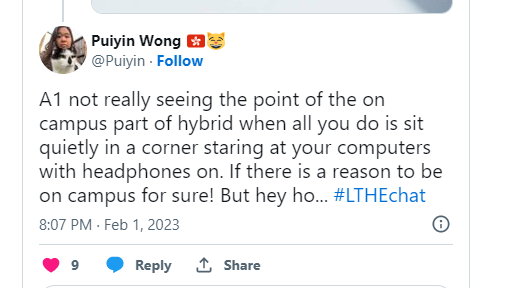
    Screenshot of a tweet from the chat

    It was inspiring to see how many different answers everyone had in response to “What is your experience of hybrid working”. It’s easy to loose sense of how different contexts impact on our ways of working, both personal and institutional, and this opener to the chat provided a vivid reminder of the broad range of hybrid working models that are happening across this community.

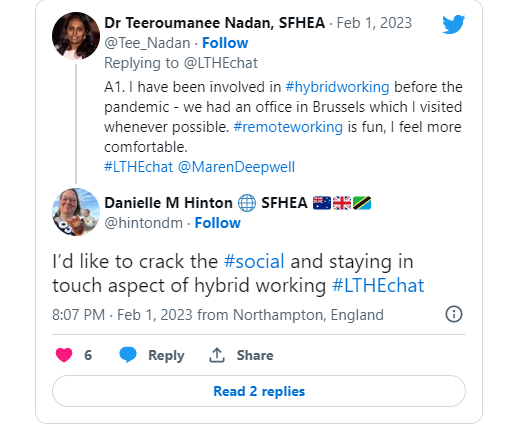
    Screenshot of tweet

    Another aspect of hybrid working that came across strongly was the enduring importance of social connection. This is something many contributors mentioned in a number of ways, regardless of whether they had long term experience of working in remote and distributed team or whether they were relatively new to it.

    The LTHE chat to me always feels like a valuable opportunity to connect with folk in and of itself, but this topic brought this to the forefront of my mind more than usual. It was amazing to glimpse a little of what folk feel is the reality of their home office life, office days and travel.

    Screenshot of tweet

    A lot of posts sounded very positive about hybrid work, with many contributors feeling more productive and seeing many upsides to the increased flexibility. But we also spoke about a lot of challenges: from equipment and connectivity to the lack of leadership, appropriate policies and lack of trust.

    There is so much more to dive into.. have a look at the chat for yourself.

    Explore the Wakelet

    You can now explore the whole conversation on the Wakelet: https://wakelet.com/wake/hx_8tyRERoRoSUhq-AFyj

  • #LTHEchat 254: Hybrid working: new frontiers in professional practice. Led by @MarenDeepwell

    Image of a team leader doing a team review with his team virtually.

    Image of a team leader doing a team review with his team virtually. (Source: iStock)

    I am really looking forward to returning as a guest to the wonderful #LTHEchat for a conversation all about hybrid working. I’m curious to hear different perspectives and see where this conversation leads us. Below is a re-post of the original post on the #LTHEchat site:

    For #LTHEChat 254 we are going to shift our focus from learning to work. We will explore ways in which learning and teaching practices can inspire a more sustainable and equitable hybrid workplace.

    Digital technologies enable remote and hybrid working in new and more connected ways, but it is by no means a new practice. Many industries have depended on home working over the centuries. In the UK we are at the beginning of a new era of widespread homeworking, prompting urgent questions about the rights of hybrid workers, working conditions, and how new working practices may increase inequality. Some workers may now have more flexibility working from home, but the pressures of competing demands such as caring for children or other family members whilst earning an income remain constant. Other issues such as the increasing digital surveillance of employees and privacy concerns around hybrid working practices further highlight the need for a careful and considered approach to setting out policies for the future of working remotely.  

    One indicator of the changes in how we work is new laws and policies that seek to formally express how the relationship between employers and their digitally connected and increasingly distributed workforce is changing.  For example, in the UK we have not yet seen an introduction of a code that would give employees a legal right to disconnect, whilst other countries, including France (2016), Italy (2017), Spain (2018), and Portugal (2021) have introduced such policies over the past five years and others including Ireland are working towards doing so. 

    We invite you to share your experiences of hybrid working and critically reflect on some of the downsides alongside the positives. What do we gain when we move beyond simply translating office-based practices and envisage a truly hybrid way of working? How can we help create welcoming and warm hybrid places to work that help sustain well-being and work/life balance? How can we empower ourselves and others in making hybrid working an equitable and engaging reality that benefits the organisation and the individual alike? 

    We are at a watershed moment for remote working in the sense that we have an opportunity to set out a vision for what is ahead that is informed by lessons from the past, as well as, the shift in perspective that the pandemic has brought about. 

    In 2017, I set out to find creative and fun ways to work and build meaningful relationships in the virtual workplace. The resulting Open Access book, Leading Virtual Teams, brings together case studies and practical advice to build on. This LTHEchat #254 offers an opportunity for a conversation about current practices and how things are changing. 

    Join us to share your own inspiration, questions, and prompts for reflection. From recruitment and induction to establishing effective and sustainable ways of working in the hybrid workplace we will explore the highs and lows of what it means to work in hybrid organisations in the long term. 

  • Mission Mastodon: Get involved in a new server experiment

    Mission Mastodon: Get involved in a new server experiment

    Yesterday saw the start of a new server experiment on Mastodon. Over the next three months ALT Members are invited to join in an exploration of this social space, and learn more about how to use it for personal and professional use along the way.

    We are excited to partner with Reclaim Hosting to offer 3 fun, informative sessions focused on Mastodon. The sessions are open to all and free to attend so you should have no issues accessing them here. The sessions will offer interested parties valuable insight into how the federated social media software Mastodon works, with everything from joining a server, to helping them find their way around, as well as providing a peek behind the scenes of the moderating and hosting process. We need you to join the sessions, participate and report back:

    • Session 1: Mission briefing: 19 January 2023 at 16:00 GMT (WatchRecording)
    • Session 2: Verifying your progress: 23 February 2023 at 16:00 GMT (Watch Live)
    • Session 3: 30 days until self-destruct: 23 March 2023 at 16:00 GMT (Watch Live)

    For any of the above sessions you can join the Reclaim Discord server to join the chat during the live broadcasts: https://reclaimed.tech/discord .

    If you’d like to register and get reminders about each session, head over to the ALT website and register now.

    Why are we doing this?

    The server we set up will act as a platform for our communities to explore and get to know Mastodon. The server will be temporary, but depending on what we learn along the way, we will decide how to proceed. So, whether you are completely new to the fediverse, or looking for other edtech folk to connect with, join us to explore and learn together.

    ALT and Reclaim EdTech are already active on Mastodon, and many in our communities are, too. We are looking to learn more about how we can support folk in this space, how community servers might function, how they could be moderated and what the costs involved might be, too.

    This is an opportunity to learn more about being active on Mastodon as well as learning about setting up, hosting and moderating servers for communities like ours and complement what we can learn from already established communities and servers with hands-on experience. 

    Join the server

    Curious? This is your opportunity to join our Mastodon server and get involved. Watch the recording of the first session and join in with the experiment. Everyone welcome!

    Reposted from the ALTC Blog.