One of my fellow coaches, Helen, a wonderful executive coach for Headteachers, recently shared online that her word of the year for 2026 is ‘analogue’ and that was music to my ears. As regular readers know, I’m a big fan of all things analogue, and the post prompted me to re-read The Revenge of Analogue by David Sax. Although the book was published ten years ago, and some of the research it mentions has been superseded, it’s central argument holds fast and the industry case studies of how industries were revived not for nostalgic reasons, but for business reasons are even more relevant today.
As in my previous post about using a Done List as an antidote for that pervasive sense of always having to get even more done, I’m blending my long days of digital productivity and working online with analogue activities, to make space for strategic thinking, reflection and planning. One of the questions I get asked the most on training days however is just how to carve out the time and actually create some offline head space when the pace of digital productivity feels simply relentless?
One strategy I find very effective is to add an analogue work bag to your toolkit.
From analogue to analogue (work) bag
If you haven’t come across the term, a so called “analogue bag” is a bag or basket filled with everything needed to engage in analogue activities and stay offline (I came across an interesting article recently that explains this phenomenon further). In the context of being at home and avoiding loosing valuable hours of attention to (doom)scrolling, you might fill your bag or basket with things like craft supplies, knitting needles and yarn, pen and paper, a journal, books or puzzles. In short, whatever supplies you find engaging and stimulating to engage in analogue activities.
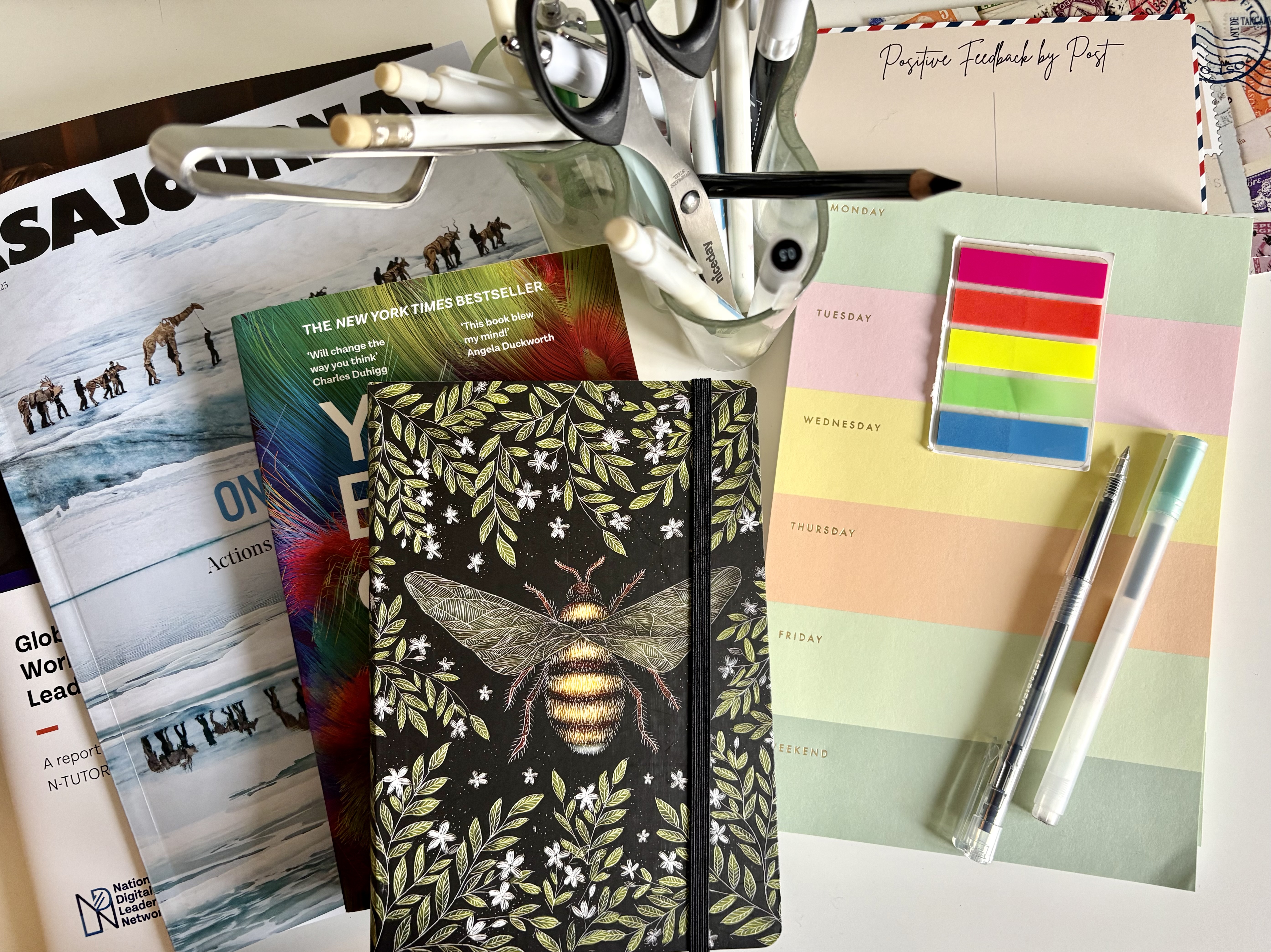
In order to translate this approach into a work context, all you need to do is to swap the contents of the bag or basket. Here is what that might look like:
pen and paper for making notes
post-it notes for reminders and planning
coloured pens/whiteboard markers if you have a bigger surface available
a planner or diary for longer-term perspectives
printed trade or research journals to catch up on what’s new
a book, such as a technical manual, non-fiction or a biography for inspiration
You’ll likely already have such things around your work space. The purpose of the bag (or basket, desk drawer, dedicated shelf or similar) is to make sure all of these are easily available to you, rather than lost in a forgotten drawer somewhere. Use the bag to offer inspiration and practical ways to get started with planning, reflecting, strategising or research as soon as you step away from the screen.
January is usually a time for planning for the year ahead. Whether at work or at home, there’s a whole year of goals yet to achieve stretched out in front of us, and I find that can be a little bit overwhelming. Whilst I am a fan of planning ahead, with so much to do, and only a finite amount of time and energy to do it with, I find I need an antidote to the madness of January’s resolutions and good intentions. In short, I am looking for a source of fresh inspiration and motivation.
I first came across the concept of a “Done List”, in this article by Oliver Burkeman: What if you’re already on top of things? . I’m a fan of his thinking on productivity, and this sense that often we start the day (or year) with a sense of what he calls productivity debt, which he describes as “this vague sense that I’m falling behind, and need to claw my way back up to some minimum standard of output. It’s as if I need to justify my existence, by staying “on top of things”, in order to stave off some ill-defined catastrophe that might otherwise come crashing down upon my head.”
The other aspect of a “Done List”, a list of things already accomplished, which only grows as the days pass, is that it helps you notice what you achieve before moving on to the next thing. I came across this interesting article which goes more into it: Forget To-Do Lists. You Really Need a ‘Got Done’ List in Wired. So, for me, keeping a Done List has become a great strategy for bringing a little more joy into the start of the year, and also helps foster more reflective and creative thinking, and that in turn often helps me get the more important things done more easily.
How to…
If you’d like to give this a go for yourself, just use whichever tool you usually use for making a to do list, whether that’s a notepad, a digital document or dedicated app.
Some productivity apps automatically disappear a completed task, which is helpful when you have a lot of different priorities to juggle, but it also means that you don’t get to see everything that’s been ticked off the list already. So in order to try this approach, you’ll need to make sure that everything already accomplished remains on the list and legible, instead of getting struck through or hidden away. Instead of having a list that looks something like this: Things I have accomplished!, you are looking to create a list more like this:
Things I have accomplished!
Started a DONE list
Made a folder in which I keep positive feedback
Filed CPD certificates
Made a list of how I volunteer as a reviewer, mentor or conference committee member
You can start with things you have done today, things completed this week or even keep a running list of things that are DONE throughout the year. In the podcast episode about this tool I share more examples of how I have used the tool, why I find it valuable and how it inspires my leadership practice.
If imposter syndrome or low confidence insert themselves and you worry that you may not have anything worth adding to your list, then try this strategy: instead of thinking about what might qualify as good enough to add to the list, add everything you have done today or this week. This list is just for you, after all, and no one else needs to see what you add.
Once you start listing activities, just keep going and make a list as long as you can, adding everyday things you have done. Even things that don’t feel like an accomplishment take energy and time to do, and thus they can be added to the list.
I made a fun discovery today: It’s now been over ten years since I started this list of things I have done. Wow! I had no idea it had been that long, and seeing those entries from 2013 made me pause and reflect on the habit of keeping the list, a decade in the making.
Why did I start tracking progress in this way?
My archive page is a lot like a personal vault. If you scroll all the way to the bottom of the page you’ll see that at the start I added some entries a bit like you would on a CV. I added dates of degrees I completed and images of things like my doctoral thesis from 2008:
Initially, I added these things as I was moving blogs, and I didn’t want to loose track of what I was up to. I was just in the finishing years of my graduate studies, and started working full-time and I had no real idea of what was going to happen next.
For a while, in the first few years of working at ALT, I didn’t really keep a record of anything until I started blogging publicly again in 2010 on WordPress, rather than my old Google Blogger sites. But then from 2013 onwards I started keeping a running list of projects I completed, conference papers, media stuff and so on.
Looking back to 2013, this entry makes me smile: June: Radio 4, Today Programme . Not particularly helpful for anyone other than myself, but it does bring back the morning I spent nervously sitting next to a very intimidating John Humphreys in the BBC radio studios in London. Similarly, in 2014 I went to the European Parliament in Brussels… noted in a similarly cryptic entry, but equally memorable for me. And although the 2015 link to an appearance on Parliament TV still works, many of the older links have rotted.
As we progress through the years the list of things I recorded each year becomes both longer and more comprehensive, particularly as I started to add links to blog posts on my own domain that contain a lot more information about a specific event or project. 2020’s entry is a bit shorter, but it looks remarkably ‘normal’ given everything that happened that year.
What do I use it for?
So, how is this useful?
Well, the practice of making the list and adding new entries to it is useful to me in itself. I could probably use a tool to compile this kind of information for me, but there’s great value for me in the act of processing what I have done and reflecting on it as I make the list.
For example, adding new items to the 2024 section of the list earlier today made me realise just how busy a year I have had so far, and we are only three weeks into it:
Workshop: Leading Hybrid Teams. Senior Leadership Team Away Day, University of Edinburgh, January 2024;
Article: Are you returning to the office, five days a week? Exploring the future of hybrid working. Learning Magazine, January 2024
So on a regular basis, as I publish something or a new project gets scheduled or completed, I will update the list, add links and date each entry. Wherever possible I try to capture what I am doing in a blog post as I add it to the list, so that I don’t have to rely on external websites to retain the information.
Then, on a monthly basis as I compile my newsletter, I refer back to the list, and cross-check what else I may want to mention. This is super helpful for me and makes compiling the newsletter pretty easy.
I also use the list as an archive in case someone asks me what talks I have recently given or what papers I have published on a particular topic and I make use of it for reviewing my progress or performance.
It’s a kind of super power when it comes to things like annual appraisals or planning career development. It doesn’t take me long to answer the questions like ‘What have you done in the past year ?’ or make a list of articles I have published. That is magnified if I want to write end of year reviews or reflections.
It’s important to me to keep learning and developing and over the years keeping this archive up to date has become a natural process of my workflow, just as blogging or journalling have become part of my practice.
Tips for starting your own archive
If you are keen to start your own list, get started with literally anything. You could add a workshop you have run or an event you attended, or even books you’ve read. You could add projects you have been involved with or led, or papers you have published.
The key is not to worry whether something is worthy of being included, and to simply include everything. I find once you start making a list of everything, things quickly amount to more than expected.
Over time, as you practice keeping the list, the satisfaction of adding to it will become a good motivator for keeping going but initially it can be difficult to find the courage to get started.
You might prefer to keep your list private, which is completely fine. The reason I have mine on my blog is that I am comfortable working here and I use my blog every few days. It’s a convenient place for me to refer back to or to send people to, but I don’t think the page that shows my archive gets a lot of visitors.
For me however it is priceless, and it reminds me when I have low days how much I have achieved over the years. Maybe your list will do the same for you.
One consideration for me is that I want to do what I can to keep the data safe. That is why I don’t rely on a platform like LinkedIn to keep this information. In an ideal world I might update the information somewhere like that, a network where folk who consider working with me might more easily get an idea of what I have accomplished. However, although that would be useful, I don’t trust that the information will still be there in 10 years or that it won’t suddenly get reformatted or repurposed as platforms change. Thus, I keep it here on my own domain first and foremost, and I update everywhere else when I feel it’s necessary.
So, good luck if you are just getting started and kudos to you if you are already on your way to keeping that precious list of everything you’ve done.
This academic year I am looking forward to working with many new clients, most of whom are new to coaching. The questions I get asked most often by new clients or those considering giving coaching a go, are… ‘What is a coaching session like?’, ‘What should I expect from the first session?’, ‘How should I prepare?’ and also ‘How can I make the most of it?’.
In this post, I have brought together answers and examples to give you a sense of coaching with me, to explain what’s involved and what to expect. This way, you can hopefully find at least a starting point and we can discuss other questions you have when we meet.
When is coaching a good fit?
The question most of my new clients ask to begin with, is whether coaching is right for them. Most often, we discuss this in our initial conversation, which gives them a chance to meet me, discuss what brings them to coaching and what they are hoping to achieve as well as how I can help. Coaching can bring many benefits, and it’s a really powerful tool for self discovery, productivity, professional development and much more, but it isn’t the right fit for everyone or every situation.
Coaching might be a good fit if you are:
Looking for a safe or creative space to focus on an important decision or period of change;
Feeling stuck and struggle with productivity or specific tasks;
Ready to plan for the next stage in your career or further ahead to the next 5 years;
Looking for someone to think (or draw) with to find solutions to problems.
Coaching offers a range of tools, resources and strategies in a creative, safe space that is focused on your needs. With a background in art and design, I build creativity into all aspects of my coaching practice. We might use sketch notes, visual conversations and other creative approaches as part of coaching sessions, and to help tackle any problems you bring to the session.
What to expect
If you are new to coaching, you might well ask how coaching is different from mentoring, therapy or hiring a consultant. Coaching certainly has aspects in common with all three, but is also distinct from them as a professional practice. In contrast to mentoring, which usually includes passing on context-specific know-how or experience, I coach clients from a range of disciplines or backgrounds. For example, I might coach a mid-career science researcher who is stepping up into a senior role even though I don’t have a background in science.
Similarly, coaching has commonalities with therapy in that it entails you getting know yourself better and engage in reflection. However, distinct from therapy, coaching is usually focused on the present or future plans, instead of looking back to understand how, for instance, childhood experiences have shaped you.
Coaching, particularly for groups and teams, can also be similar to having an expert act as an external consultant, advising your team, and indeed this is something I also do. However, as a coach, I work with teams and organisations to help them find solutions and ways forward, rather than presenting solutions to my clients.
My coaching approach is specifically designed for professionals working in the third sector, education and learning technology, with a focus on leadership and career development, as well as managing change and creative problem solving. I offer support tailored to you, creating a flexible and memorable coaching engagement that enables you to develop into the kind of leader you want to be in your community, team, project or organisation.
How to prepare
Choose a quiet and private space for your coaching session, and make sure you are comfortable and able to focus on the conversation. I usually use Zoom to facilitate our online coaching sessions, and I also offer to meet in person for a coaching day.
During a typical coaching session, we will be setting an agenda together, defining what the session will focus on and session objectives. We will use powerful questions to reflect and explore the topic, and I might recommend specific activities and resources to help you work towards your aim such as planning tools, milestones maps and tools to help you identify your values. I’ll make sure we regularly check in on session objectives and ensure you leave each session ready to take next steps.
Sometimes a video call is not the best environment to get us thinking, so for established clients I offer coaching sessions whilst we walk. Usually, this would be coaching via a phone call, but if you are based locally, we could also meet in person. Walking coaching sessions are particularly suited to think together about difficult situations or to reflect on a particular problem or idea.
Why I love coaching
I had wonderful mentors and coaches on my journey to becoming a CEO and in the 11 years in an executive leadership role in the non-profit sector. Coaching helped me through difficult periods of transition and supported me in taking difficult decisions under pressure. My own experience has helped me appreciate just how powerful coaching can be and how valuable it is for developing all aspects of your professional practice and values as an emerging leader or an established one.
What’s most rewarding for me about coaching is working with clients who are facing great challenges. I really enjoy working together to reflect, set new goals and find out what the next step might be. I am always curious to hear about where you want to go next and help you get there no matter whether that’s getting out of bed tomorrow morning or a new job.
One tool I have been trying out with clients is writing a personal mission or vision statement (in one sentence), which is harder than it sounds. I tried it out for myself, and it prompted interesting reflections for me. If you’d like to have a go yourself, start with your goal and values and try to express these in one sentence. Let me know how you get on 🙂
What qualifies me to be a coach?
I bring a lot of professional and leadership experience to coaching, and as a coach I adhere to the ethical and professional standards of the the International Coaching Federation (ICF). The ICF defines coaching as ‘partnering with clients in a thought-provoking and creative process that inspires them to maximise their personal and professional potential. The process of coaching often unlocks previously untapped sources of imagination, productivity and leadership’. With close to 100 hours of ICF standard coaching experience and having completed all mandatory training I am in the process of becoming an ICF Associate Certified Coach.
Enjoyed this post? Get my free monthly newsletter directly to your inbox.
I’ve put together three ideas to try out whether you are having a busy summer or taking a break. So if you are looking for some inspiration and ideas to recharge for the next academic year, have a go:
Tips for a week of complete rest
It’s taken me a long time to be able to step away from all types of work all together, and for me, having a complete week off is a big achievement.. as well as a reflection of how busy I have recently been. I took some practical steps to ensure that I had a complete break, and I wanted to share some tips that worked for me:
I completed a holiday handover, with my amazing colleagues and deputy, and then logged off all work systems completely on my last day at work;
No laptops came on holiday, and all computers at home where switched off when work ended;
I deleted all work-related apps from my phone or switched notifications off completely, included direct messaging, emails, and task management apps;
I logged out of/deleted all social media apps, like Twitter and LinkedIn, that I only use in a professional context;
calendar notifications were switched off or paused
A simply note to make a list of anything that I thought of, which were work related and which I wanted to pick up upon my return;
I intentionally packed books, audiobooks and other entertainment that would help me focus on things other than work.
Many of my clients are looking to make progress in their work or personal lives: to make a change, develop their career path or build personal habits. Many of us have goals like ‘progress in my career’ or ‘be happier’… but it can be hard to break down exactly what to do in order to achieve our aims and define what ‘success’ means to us. In this post I share practical steps to help you put your goals on paper and break them down into achievable chunks, including:
I am always on the look out for new tools or resources for coaching, and I want to share this one I came across in a blog post by Laura Vanderkam: It’s called a ‘List of 100 Dreams’. If this is a new concept, then head over to Laura’s blog to read more about the original exercise from Career coach Caroline Ceniza-Levine and how Laura has used this exercise as part of her work on productivity and time management. The ‘List of 100 Dreams’ is exactly that: a long list of things you wish to do, have or devote time to. In essence, it’s a very long bucket list.
I felt this was a lot of fun to try out, so if you are curious to learn more and try this for yourself, here’s how to get started.
Many of my clients are looking to make progress in their work or personal lives: to make a change, develop their career path or build personal habits. Many of us have goals like ‘progress in my career’ or ‘be happier’… but it can be hard to break down exactly what to do in order to achieve our aims and define what ‘success’ means to us. Here are five tips that will help you create a milestone map that works for you:
Choose a format that works for you
It’s hard enough to set out a milestone map without having to do battle with the interface. Maybe you are someone who thrives on learning all about a new productivity tool (hello, fellow Asana fans), and if that’s the case, then use that extra motivation to get you started in a shiny new template. If pen and paper seems more attractive, or post-it notes on a whiteboard get you thinking, then choose those. You can use pretty much any format you like. The key is that you need to pick something you can easily work in, add to over time and access, and something that will enable you to add a lot of information if you need to (when you break down goals like ‘develop my career’ into smaller, actionable tasks).
If you have a work tool that you need to use for a performance review or appraisal, then ideally start somewhere else and late copy your finished thoughts into the required format. Give yourself space to think first and foremost.
Pick your goal(s)
Is this map going to help you plan out the next five years? Focus on finishing a book or a project? Is this a map to a career transition, a healthier you or a bucket list? Do you already know exactly what you are aiming for?
If you have a clear goal: then set out your parameters first. For example, if you are planing for a writing project, note all the specifics such as word count, deadlines and so forth. For example, if your goal is to: submit a paper to a major conference; this could be made more specific: Submit a 5,000 word research paper to a conference by July.
If you are searching for clear goals: often it can be hard to set out goals straight away. It’s helpful to think about broad categories to start focusing, e.g. ask yourself what timeframe you are planning for; what aspect of your life you want to think about, such as work, family, relationships, hobbies, self; consider what’s important to you and how this can be reflected in your plans. For inspiration, have a look at the Wheel of Life tool or List of 100 Dreams I have previously blogged about or start with a list of your values to help guide your thinking.
Turn goals into milestones
Once you have your blank page in front of you and picked your goal(s), it’s time to turn the goals into milestones. Earlier I used the example of a writing project, where the goal is to: Submit a 5,000 word research paper to a conference by July. For this kind of project, ask yourself questions like: who else is involved? How will they input? Are any parts of this time-sensitive? What is the end product? How do I get there? Or what is the first step? What is the next step?
Group tasks that go together and define a milestone for each group. For example:
Write 500 word outline
Research initial references
Share with colleague for feedback
Milestone: Draft a full paper structure
Then, consider how to move from your first milestone to the next.
The same approach works for much bigger goals, such as working towards a promotion or leading an initiative. Whatever you choose to focus on can always be broken down into individual steps and milestones.
Check your map
Part of the magic of this kind of planning is that it really works, provided that the map is true to you. By that I mean that the map reflects what can you can reasonably achieve. If you usually write less than 500 words a month and your plan is to write 5,000 words a day, then you will very likely not achieve your goal.
The trick is to dream big and allow yourself to set goals that are truly meaningful to you, which you then turn into achievable actions that fit within your life.
Similar to prioritising your to do list, you can prioritise your milestone map. A long term goal might go on the back burner while you focus on a more urgent opportunity for example. A map is not a to do list, but a tool for you to make the changes you want to make happen.
Ask why?
I often come across milestone maps that are all about what people feel should be on them instead of goals that align with what’s truly important to us. So my final tip for when you have your map, is to check in with yourself about the why.
Why is this goal on your list? Why is it important? Why do you want to spend the next three years working towards this?
Milestone maps often bring out our inner need to conform to other people’s expectations. Maybe there is a specific deliverable you need to meet to get more funding for your project. Or maybe there is a hoop to jump through on the path to tenure. Whatever you are aiming for, remind yourself of why it’s important to you.
Make your hybrid working milestone map
I recently worked with the wonderful folk at Reclaim EdTech on a course all about hybrid working, and as part of the course I designed a roadmap for professional practice in hybrid working. If this is something you are interested in, drop me a line and I’d be happy to send you a template so you can make your own.