Category: Coaching Resources

  • Tranquillity by Tuesday – follow up

    Recently I blogged about Laura Vanderkam’s Tranquillity by Tuesday: 9 Ways to Calm the Chaos and Make Time for What Matters. Now that I have finished the book, and tried out some of the rules for time management, here is a follow up sharing how things went:

    What did I try out and how did it go?

    The first ‘rule’ that I put to the test for me is Rule Two: Plan on Fridays. The basic idea is to plan for the week ahead on a Friday afternoon and the chapter goes into explaining why this is a helpful practice and how to do it. I already plan on a weekly basis, but it was still interesting to read more about why this is effective. Two things jumped out at me:

    Plan across three key categories: career (which I took to be short-hand for all types of work, paid and unpaid), relationships (which encompasses partners, family, friends, any we care for and spend time with, including pets) and self (this is the category that is easy to overlook).

    Plan on Fridays: there is a good section on why Friday afternoon is a good time to plan (provided you follow a Monday – Friday work or school schedule):

    1. there is little opportunity cost: for many of us, Friday afternoon is close to the weekend, it’s not a good time to start something new and this less busy time can be extra productive if used for planning;
    2. You can make Monday productive: start the week knowing what your day is going to bring and focusing on it;
    3. Upgrade your weekends: making more time to make plans for leisure or family time or self care rather than using the weekend for planning;
    4. Calm the ‘Sunday scaries’: meaning that going into the weekend with a clear plan for the following week helps you switch off and stop worrying about or planning for what’s ahead.

    This last reason resonates with me in particular, as I usually do planning on Sunday evenings and I have definitely found that to have downsides.

    Overall, I found this habit took some effort to embed in my week, partly because I don’t follow a regular Monday to Friday work schedule and partly because some of my planning is done with other’s.

    However, I did schedule a regular planning session into my work diary and home diary, and I made an effort to start planning on Thursdays and Fridays for the week ahead.

    The biggest improvement that I felt nearly immediately was that I worried a lot less over the weekend. I found it very helpful to have thought about the week ahead and have a plan in place.

    I also found it easier than I had expected to slip in some productive time into my usually quiet Friday afternoons. This was something I hadn’t been sure about, but I found it easier than expected.

    Upgrading my weekends hasn’t really happened yet, but I think that is largely because they already work very well… and as it happens I started a new yoga class on Saturday mornings at the same time as I started this new habit, which feels like good timing.

    Further inspiration from the book

    I really enjoyed this book and took a lot of inspiration from it. The two ideas that jumped out at me that feel particularly helpful to me are: first, the concept of a back-up slot and also the idea to include one little and one big adventure in plans for each week.

    Planning in some ‘adventures’ seems like a cheerful idea and looking for activities that I could do in one hour or less (little adventure) or half a day (big adventure) feels both challenging and achievable. It relates to the three categories I used to start planning my weeks (work, relationships, self) and I am going to try that idea out in the coming months.

    I also LOVE the concept of a back up slot for my diary. In the book Laura goes into different ways in which this can be helpful, from scheduling time slots for particular work tasks, for family time or even days of the week.

    In practice I have long had back up slots in my schedule, but I never thought of them as such, so revisiting this in the context of the book. I found it helpful to consider in what ways I could use this strategy and I found exercise a really good example of an activity that needs a back up slot as it is rare for me to be able to exercise as I plan each week as something always comes up. So an exercise back up slot will definitely be in my schedule from now on!
  • Coaching tool: List of 100 Dreams

    I am always on the look out for new tools or resources for coaching, and I want to share this one I recently came across in a blog post by Laura Vanderkam: It’s called a ‘List of 100 Dreams’. If this is a new concept, then head over to Laura’s blog to read more about the original exercise from Career coach Caroline Ceniza-Levine and how Laura has used this exercise as part of her work on productivity and time management.

    What is it?

    The ‘List of 100 Dreams’ is exactly that: a long list of things you wish to do, have or devote time to. In essence, it’s a very long bucket list. Laura explains it thus:

    These could be travel goals, career goals, personal goals, or just general things that would be fun to do or possess. While plenty of people start a bucket list at some point, the upside of aiming for 100 Dreams is that it’s kind of…tough. Getting to 100 often requires coming back to the list several times. And while the first third or so tend to be big, longterm dreams (go to New Zealand!) by the last third it might be items like visiting a state park an hour away, writing a white paper on a topic that fascinates you, or owning a nice pair of pajamas. We’re talking fairly doable dreams.

    https://lauravanderkam.com/2018/10/welcome-to-list-of-100-dreams-week/

    Why try it?

    What I liked about the idea of making a really long list, is that it would help me identify new things I might want to do, rather than simply revisit the familiar dreams or goals which have been on my mental list for a long time. I found it helpful to challenge myself to dream, rather than to simply plan or prioritise.

    It feels fun to sit down and spend time thinking “what do I want to do?… What else?… and which other 78 things?”. I had not challenged myself before to try and come up with 100 things like this, and it was enjoyable and surprisingly difficult.

    How to use it?

    If starting with a blank page seems daunting (and to me it definitely did), then you could give yourself different headings under which to write your dreams: for example, you could use: work, people, self. Or, you could consider dreams for now, soon and later.

    Writing this as a stream of consciousness exercise for which you try to keep writing without pause could work, too.

    Or, add to the list over the period of a week.

    The key for me was to give myself permission to add anything that came into my mind, no matter how big or small or unachievable or insignificant. If something silly came up, that went on the list, too.

    A hybrid working adaptation: List of 100 Hybrid Working Dreams

    This tool can be used in lots of different contexts: you can use it for your life as a whole or focus on your career, and you could also use it to set out a vision for your organisation or team.

    It’s not often that we find time to sit down and focus solely on what possibilities there are when it comes to how we work, rather than what we achieve, and this tool can help make that space.

    Some prompts you could focus on are:

    • what are your dreams for your workspace?
    • what do you wish for in terms of working with others?
    • What would you like your daily routine to be like?
    • What changes, big or small, would you like to make in your team?
    • How would you like your organisation to change?
    • What do you wish to have in place to make work better?

    If you want to try out this tool, choose your favourite way to write or make notes, whatever you find easiest, and start writing down whatever comes into your mind. Don’t self-edit. Don’t judge.

    Give yourself space to think of 100 things (and, as Laura suggested, if that’s easy, then simply up the number and go for 200, 500 or even 1000 dreams to write down).

  • Lunch break ideas for hybrid workers

    At this time of year, it’s easy to focus on ever busy work schedules instead of activities that help with balance. Here in Cardiff the weather is dreary and grey, and not particularly inspiring even in the lightest hours of the day. Leaving my desk and screens in favour for a proper break feels much easier on sunny days.

    When I came across a book called Gone for Lunch: 52 Things to do in your lunch break (by Laura Archer), in the library recently it felt like a great opportunity to find some inspiration.

    Here’re my 10 favourite ideas for lunch break activities, inspired by the book but specifically adapted to the needs of hybrid workers. The ideas in the book are divided into for sections: activities you can do while sitting, being active, inside and outside.

    As most of us hybrid workers probably spend enough time sitting inside already, most of the activities on my list involve being active and/or outdoors, but there are two exceptions and I’ll start with those:

    1 Take a nap

    This is also in the book, and there are some useful tips here: aim to nap for between 10-30 minutes, don’t forget to set an alarm, and make sure you nap before 4pm and no later, to avoid disturbing your sleep in the night.

    One of the nicest upsides of working from home is that there usually are much better places to nap than in an office or on campus, and, in my case, the presence of willing pets who are just as keen to cuddle up for half an hour as I am.

    2 Meditate

    The book includes tips of trying desk yoga or to focus on ‘wish, pray, hope’ , so inspired by that, I am going to include meditation as a lunch break idea. There are plenty of apps out there like Calm or Insight Timer that offer free recordings, breathing exercises and timers to help engage in mindfulness and meditation.

    Personally, I find coming to a complete stop and resting in stillness for a few minutes is a powerful way to reset for the rest of the day, no matter how or where I do it.

    3 Green spaces

    I really like the idea of visiting green spaces. The book suggests that “spending as little as 40 seconds looking out over green space can boost concentration” and goes on to explore other benefits for our physical and mental wellbeing of spending time in nature.

    Depending on where you live and how much green space there is around you, looking at some maps of your local area will help you discover new green spaces close by, and help find new routes that you do not usually take.

    4 Local Café

    Adopted from the idea to visit local markets included in the book, you can visit (independent) local cafes which are close enough to where you live. Many of us find remote working from home can become quite lonely over time, and visiting local cafes or delis for an hour can help us reconnect with people and offer a change of environment.

    5 Listen to a podcast

    As a big podcast fan, I enjoyed reading the suggestions in the book for listening to podcasts during lunch breaks: start with short podcasts to find out what you like, look for podcast recommendations on blogs or sites you usually use, rather than charts within podcast apps to get more personal recommendations and make use of the broad range of subjects on offer to engage with different interests.

    One problem I encountered unwittingly with podcasts at lunchtime, is that I gravitated towards ones related to work. Listen to podcasts became more like professional development or catching up with things I hadn’t had time to read or listen to during work, which was productive, yes, but didn’t provide the break that I need at lunch to recharge. If you are looking to disconnect from work and really relax, choose a podcast with a relaxing topic unrelated to work.

    6 Take a photograph

    As an avid taker of photographs, the idea to take a “take a carefully considered photograph” really chimed with me. The idea is to really focus on the colour, form, shape and composition of the photograph, and to take time over it. Practical tips include turning on gridlines, focusing on a single subject, using reflection and so forth.

    This is an interesting activity as it’s completely flexible and can happen indoors and outdoors at any time. One I am going to try out for sure.

    7 Local Wildlife

    Another suggestion is to explore local wildlife, which could include taking part in activities like an online national butterfly count or bird watch, anywhere from gardening containers on a balcony, a nearby park or field.

    8 Play with a pet or care for a plant

    The most ‘local’ of animals for me are our dogs, and one of my favourite things to do during my lunch break is to play with the dogs in the garden. Hiding small treats for them to sniffle for or playing with their favourite toys and really focusing on them is a brilliant way to relax, and gives me a great sense of connection.

    Given that I am also devoted to my plants, another way to take a proper break from my screen is to care for my plants. Regular watering, dead heading flower pots… whatever it is on any given day really helps me to stay away from my screens for a while.

    9 Go for a wander

    This one probably doesn’t need much explanation, and can easily combine with several of the other activities… walk while listening to a podcast, walk a dog, wander in a green space, explore your local area and so forth.

    Or… for a complete change try a mindful walk. Really focus on the activity itself and avoid distracting yourself from what your senses tell you about your environment. Breathe easy and follow your feet.

    10 Visit a Cemetery

    My favourite moment reading the book was when I spotted “visit a cemetery” in the list of activities. Clearly, this is my favourite given that I spent years as an anthropology student in graveyards. For me, any opportunity to visit a cemetery is welcome.. so if you, too, like a bit of an explore through such spaces, then find your nearest one and enjoy your lunch break.

  • Tranquillity by Tuesday

    I’ve really enjoyed reading Laura Vanderkam’s Tranquillity by Tuesday: 9 Ways to Calm the Chaos and Make Time for What Matters. From an anthropological perspective, it’s interesting to read a book rooted in the experiences of a group of people putting the productivity and time management ideas into practice and I especially enjoyed reading why things did and didn’t work for particular individuals. I found it helpful to read about their experiences alongside the expert guidance provided, as it helped me think through how and why certain things might work for me or my coaching clients.

    Being on a journey of trying to work less hard and find more balance made this book appeal to me more with a central focus on calm and wellbeing alongside more traditional productivity techniques. The first ‘rule’ that I put to the test for me is Rule Two: Plan on Fridays.

    The basic idea is to plan for the week ahead on a Friday afternoon and the chapter goes into explaining why this is a helpful practice and how to do it. I already plan on a weekly basis, but it was still interesting to read more about why this is effective. Two things jumped out at me:

    Plan across three key categories: career (which I took to be short-hand for all types of work, paid and unpaid), relationships (which encompasses partners, family, friends, any we care for and spend time with, including pets) and self (this is the category that is easy to overlook).

    Plan on Fridays: there is a good section on why Friday afternoon is a good time to plan (provided you follow a Monday – Friday work or school schedule):

    1. there is little opportunity cost: for many of us, Friday afternoon is close to the weekend, it’s not a good time to start something new and this less busy time can be extra productive if used for planning;
    2. You can make Monday productive: start the week knowing what your day is going to bring and focusing on it;
    3. Upgrade your weekends: making more time to make plans for leisure or family time or self care rather than using the weekend for planning;
    4. Calm the ‘Sunday scaries’: meaning that going into the weekend with a clear plan for the following week helps you switch off and stop worrying about or planning for what’s ahead.

    This last reason resonates with me in particular, as I usually do planning on Sunday evenings and I have definitely found that to have downsides.

    So, that’s the strategy I am planning to adopt from Tranquillity by Tuesday, and if you are interested in exploring more, I’d definitely recommend this as a very well written, interesting read which comes with a lot of resources which are free to download on the book’s website 🙂

  • Changing habits with a Pie Chart Diary

    Recently I have been working with a number of clients who are finding hybrid working habits hard to change. Busy days blend into each other, and at the end of a week or even a month, routine tasks like answering emails or attending meetings have taken up all the time and other priorities or more creative work have had to take a back seat.

    I have struggled with this for years. Changing habits to make more time for writing, research or simply finding a moment to hear yourself think can be a challenge. Particularly when your working days are punctuated by the ping of notifications, endless emails or mandatory meetings, finding what some call the right cadence, a balance between busy work and creative tasks merits our attention.

    Setting abstract targets like “make more time for…” or “be more research-focused” can feel unachievable. So where do you start? One place to start is to get a new perspective on how you spend your time, so that you can pick a good moment to change your habits.

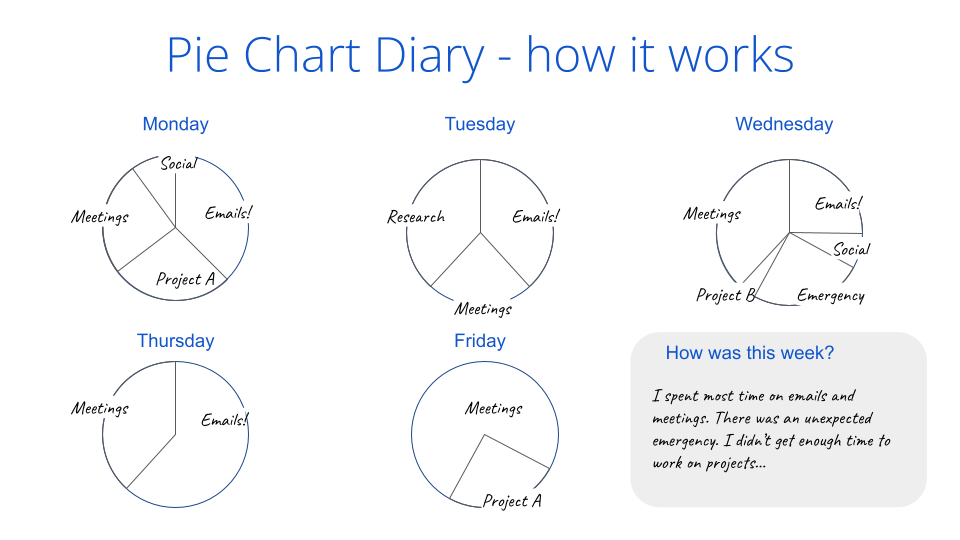
    For me, a bit of a spreadsheet nerd, I decided to track my time manually. I spend 2-3 minutes at the end of each day making a pie chart of what I had done that day. I continued to do this every day, always just before leaving my desk, and over the period of a month or two, I learnt some things about how I work:

    • I found that Tuesday, for example, were days when I never achieved my goals because they are dominated by meetings.
    • Wednesday mornings and Friday mornings were most productive for me.
    • I generally found time for things once I had a firm deadline.

    Here is an example of the Pie Chart Diary tool and how it can be used:

    Use it over a period of a few weeks or months, and reflect on:

    What do you spend most/least time on?
    What days of the week are you more likely to you achieve your goals?
    What is missing from your days?
    What could you change most easily to find better balance
    or to meet your goals?

    You can download this template if you’d like to try it out for yourself. Depending on your preference, you may want to print the template and write on it or simply use a blank piece of paper to make your charts. Or, if you prefer, use a spreadsheet or similar to track your categories and how you spend your time.

    The important part is to take a moment at the end of each day, and honestly reflect on what you actually did during the day. If there is something that takes up time, distracts you or interrupts you, consider adding it to your chart.

    When my dog was a puppy, my pie chart diary would have definitely included a “puppy” category as it took a lot of time out of my day to look after her.

    Look out for a podcast episode exploring the pie chart diary. As always, I’m curious to hear from you, what tools you use to track your days and what you learn along the way.

  • Hacks for Hybrid Working starts on October 24

    I am very excited to spot the announcement for Hacks for Hybrid Working, a new flex course starting on October 24th, in the September edition of the Reclaim Roundup which links through to Lauren’s preview post of the course.

    For many of us in Higher Ed, hybrid working is here to stay. So whether you’d like to create a better work/life balance juggling being on campus with working from home, or you are looking to move from crisis mode to a way of working that is more sustainable, healthful or simply a little more joyful, this course is for you. Join us to explore hacks to create a better hybrid workplace for everyone.

    For me, this is the ideal project closely related to Leading Virtual Teams, which is due to be published next month. I appreciate the opportunity to collaborate with Lauren and the amazing folk at Reclaim outside of my day job and to have the opportunity to share some of the know-how gathered on how to make hybrid working work for you.

    The cherry on top is that this course is free for anyone to attend and participate, so if you are keen to learn more, register here to receive event information.

    What’s the course about?

    Lauren explains in her post:

    We’ll be meeting over the course of 4 weeks beginning late October through November to unpack hybrid working and all that it entails. These sessions will be a continuation of our OER22 presentation, Building Connections with Virtual Teams, as well as our radio broadcasts that I’ve outlined in my post, Working Habits, Self Evals, and Finding Connection. I’m really looking forward to diving further into personal working habits that take shape in virtual/hybrid settings, evaluating our relationships with digital tools, and building out a Hybrid Working Roadmap.

    Here’s our topic list:

    • Week 1: Hybrid Working Unpacked
    • Week 2: Digital Tools in the Virtual Workplace
    • Week 3: Exploring Hybrid Working Hacks
    • Week 4: Complete your Hybrid Working Roadmap

    There is so much fun in store, including a special radio session and a SPLOT site alongside the course materials and tools we’ll be trying out.

    How can you take part?

    Sessions will premier on watch.reclaimed.tech/hybrid-working when the time comes, and we’ll also be chatting in the #hybrid-working discord channel! Also, make sure you check reclaimed.tech for weekly blog posts with supplemental resources, quick links, a SPLOT or two, and even some homework.

    When: October 24 – November 18
    Weekly video sessions each Mondays at 11am ET
    Live Q&A/discussion time on Fridays at 11am ET

    We are really looking forward to seeing you there 🙂