This is the time of year for reviewing personal and professional development, for reflecting on achievements and set goals for the following year. In short, it’s time for my annual appraisal process.
This will be my fourth in a leadership position and each year the process has evolved depending on the needs of the organisation and myself. What we have found works consistently:
- 360 degree feedback: that includes everyone who reports to me, those whom I report to, colleagues whom I work with and external reviewers;
- Clear assessment of goals set and progress made, milestones reached and key deliverables – in my case that encompasses most of what the organisation does or doesn’t do as my role carries overall responsibility for strategy and operations. This is where individual appraisals for others feed into my own which is really helpful;
- Reflection on personal and professional development, often in relationship to what we had planned 12 and 6 months ago, but also anything else that has developed in response to changes in circumstance;
- Written feedback and face to face conversation. My appraisal process is a blended process which involves a distributed group of individuals and culminates in a face to face meeting, led by the current Chair of the organisation I serve which changes annually.
Variations from year to year:
- Emphasis on performance, support, development… depends on the context and provides some flexibility in a process which can at times become a long list of colour coded milestones;
- Openness also varies. Some years have been very open and I have shared many parts of my appraisal feedback with colleagues, while some years are more personal and less easy to share;
- Scale and perspective, from the proverbial helicopter view to the detailed analysis of a specific situation. That again seems to change from year to year.
As I am compiling this year’s appraisal documents I find that now in its fourth year I have more expectations, a clearer idea of what I’d like to get out of the process. And one of my aims for this year is to use the process as a way to continue my open practice. In my experience colleagues in leadership roles can find it difficult to get effective feedback and appraisals. For some, it becomes about performance management and if there are no concerns, then it’s just a formality. Others focus on providing feedback and thus get little in return. Some colleagues feel that at a certain level of seniority you should be able to do without, to reflect sufficiently on your own. And to some degree I agree with all of these perspectives. But there are some reasons why I really value taking a more in depth approach to my own appraisal:
- Giving constructive negative feedback takes time and focus. I value honest praise but I feel it’s important to give opportunities for negative feedback, too;
- Ongoing reflection is an essential part of my practice, but when a period of time is particularly busy I can still loose perspective. Being forced to take a step back and collect a whole year together in one place gives me an annual perspective that opens up new vistas;
- Having a deadline makes me do things like (finally) submitting my CMALT portfolio, write a submission or review an article;
- Writing my appraisal is a chance to not only set achievable goals, but to dream up new visions of the future and what that may hold.
All in all I think you can see why I feel this is such a valuable process. Particularly in a leadership role I think it’s a privilege to hear from others what they feel you could do better, how you might achieve more.

 What I found particularly interesting in both talks were the connections between the wider issues facing us and technology used for learning and teaching. For example the importance of young people gaining the skills to become good digital citizens, to be empowered in their relationship with technology and the internet – and to be able to engage with wider issues (political, social or economic) effectively by using technology. While these skills are needed to make effective use of Learning Technology it was interesting to reflect on how many other areas of life now require digital literacy and skills.
 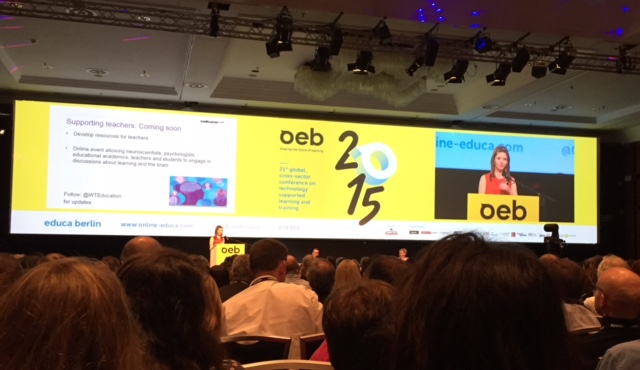 Meanwhile the focus on neuroscience and advance in trying to understand how our brains work was a sobering reminder of how little we know as yet as well as opening up a new perspective on the huge potential of research currently being undertaken. Some of the examples of ‘myth busting’ in the session were particularly revealing, e.g. many in the audience were surprised to find out that while personal preferences could certainly be observed, research could not demonstrate that different ways of delivering learning made a difference. This stood in contrast to a teen-led discussion the afternoon before where young people clearly expressed their own preferences e.g. that they felt they learnt better when using a mobile phone or video than making notes on paper in the classroom. One common thread for me however was a strong sense of trying to give people, both learners and teachers, more control, more power. In the face of rapid change and innovation there can be a sense of powerlessness, of loss of perspective – and much of the conference reminded me that skills, knowledge exchange and transparency can make a big difference in creating empowered use of Learning Technology.
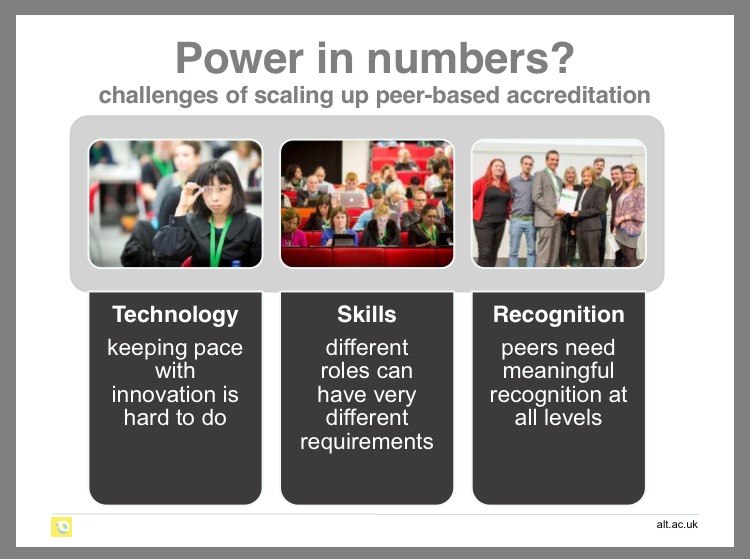
  The panel I contributed to for example had a focus on peer-based accreditation and assessment. If you’d like to have a look at my presentation, you can see some snapshots and download it (CC-BY)
  With an event as large and varied as this, it’d be easy to write many different posts focused on entirely different sessions from world class research to thought provoking debates. Personally I have taken a lot of inspiration away and in particular a fresh perspective on the enduring question about Learning Technology and its impact. We keep asking whether it really makes a difference, whether it has a positive impact on learning outcomes, test scores or learner success? What events like this help me see is that as our world changes, as everything from our economic structures to social behaviours is shaped in part by the technologies we also use in the classroom, Learning Technology and its critical, reflective and above all empowered use becomes ever more crucial to all lifelong learners.