Last month I wrote a post about feeling frustrated with a sense of never achieving enough:
I am embarking on a month of celebrating daily success: every day I am going to note a success and I am going to share it publicly to help hold myself accountable.
It doesn’t matter to me how big or small a thing it is, from getting out of bed to finding five minute of peace to have a cup of tea, finishing a report or responding to a difficult email. It all counts.
The kind of successes I want to celebrate and remind myself about are things that matter in my life day in, day out. I am not looking to mark achievement of the organisation I run or evaluate my performance. I have other places and processes for that. This is really about finding some balance in my own perspective.
To start with, I am going to share a success from each of the past few days, back to the start of the month, and after that I’ll post each day and share what happens.
https://marendeepwell.com/?p=3466
Did it work?
I posted a list of anything that mattered to me, something I felt was important or achieved from the 1st until the 31st July. I posted nearly every day, mostly on Twitter and Instagram and I really appreciated comments from people who shared their own small successes with me (thank you!).
What I shared falls into a couple of categories: work (7), personal wellbeing (8), work/life balance (7), family (6).
Most helpful for me was to gain a sense of achieving what’s important to me on any given day, and reflecting on what that was. As I mentioned in my original post, one aim for this exercise was not to be too focused on formal achievement at work, and instead to take a more wholistic view of my days.
Sharing a success each day felt quite cheerful, and often my daily calendar reminder prompted me to see my day in a different light.
I also found it fun to see what others were sharing or read the comments and DMs.
My list of successes
1st July: I went to the beach
2nd July: I completed stage 2 of coach training
3rd July: I ate well
4th July: I cleared my inbox after a week off
5th July: I blogged
6th July: I sorted out a lot of family admin
7th July: I published this post
8th July: Today’s success is to get work, pro-bono work, family support and life admin all to a place where the weekend can begin… with a long walk.
9th July: today’s success is resting & spending the day largely offline
10th July: picked a new colour to paint my home office
11th July: got a lot done despite the hot weather
12th July: Progressed three big governance projects
13th July: reported the successful outcomes of a project that started in Feb ‘21
14th July: today’s success is to get to work 45 min late… after waking up to domestic & canine chaos.
15th July: had a lovely lunch with a friend
16th July: processed my week with a largely offline day
17th July: signs of growth on the office plants
18th July: –
19th July: got a deckchair in my office
20th July: I did A LOT of work
21st July: cleared the decks at work ahead of a week of family care & support
This month I am making the final edits, before sending the book to the publisher for copy editing in mid August.
I have also been working on the cover and thinking about what resources and activities I want to work on ahead of the book launch later this year.
As summer is the busiest time for me at work, progress is slow going just now, and I am making the most of the warm weather to spend time away from the screen.
Recent blog posts
I have been blogging more recently and shared an update about a recent team chat & bake, that would make a great addition to the team activities in the book.
One of the things we really enjoyed about the activity was to spend some time together as a team without having to focus on a particular deliverable. It felt more like a social activity and we also enjoyed sharing jokes about how we were getting on with the recipe. It worked great to all make the same recipe as we could compare our experiences and tastes.
We are deep in preparation for our Annual Conference in September, our AGM and upcoming Trustee elections, while the awards judging and CMALT summer assessments are underway as well. This is the busiest time of year for our Association and my report to you includes important information for you as Members and our wider community.
A special mention to begin with, to celebrate the launch of Digital Learning in Higher Education, for which ALT hosted the preview webinar and which includes a chapter based on findings from our Annual Survey.
Enhancing our Governance
The Board of Trustees has completed a year long review of our governance arrangements in order to ensure that our practice reflects the Charity Governance Code, which was updated at the end of 2020. The Board started planning for the review in February 2021 which concluded in June 2022. All Trustees and staff took part in the assessment process, reviewing examples of our current practice against recommended standards, and agreeing actions for each area of our governance. The Board found that overall our current practice conforms to the updated code and reflects recommended best practice. The Board identified a number of operational actions and two wider areas in which to enhance our governance, specifically in relation to Board Effectiveness and Equality, Diversity and Inclusion, with a number of actions being implemented.
Trustees and staff welcomed the opportunity to review our governance and the outcome of the review process has highlighted ALT’s strong and robust governance overall. This was especially important during the difficult times of the pandemic which posed great risks for us as an independent, small charity. Our focus now is on implementing the actions the Board has agreed and to communicate the outcomes of the review and our progress to Members and to all our stakeholders. We will share initial findings with Members at the upcoming Annual General Meeting (AGM) in September, and subsequently report at least annually, usually at the AGM on our progress and what actions we are taking next.
Trustee Elections and AGM 2022
Our 2022 Annual General Meeting, will be held in person and online at ALT Annual Conference, 7 September 2022, Manchester UK. All Members are encouraged to attend and the AGM is also open to guests and observers. The Agenda for the AGM will be issued at least two weeks prior to the meeting. All papers for the AGM and related information will be published online.
We also issued a call for nominations for two Trustees to serve an initial three year term to be elected by Members. In response to the call we received nine nominations (each nominated by two Members), which is the largest number of nominations received in the past ten years and a great testament to the strong commitment our Members have to getting involved in ALT. Our elections will be conducted online by the Electoral Reform Services and the result will be communicated to members at the AGM. All eligible members will be sent an email with instructions on how to use the secure Internet ballot site. All elections and appointments of Trustees are undertaken in line with ALT’s aims and values, and our policies for Equality, Diversity and Inclusion.
We encourage all eligible Members to make their voice heardand use their vote.
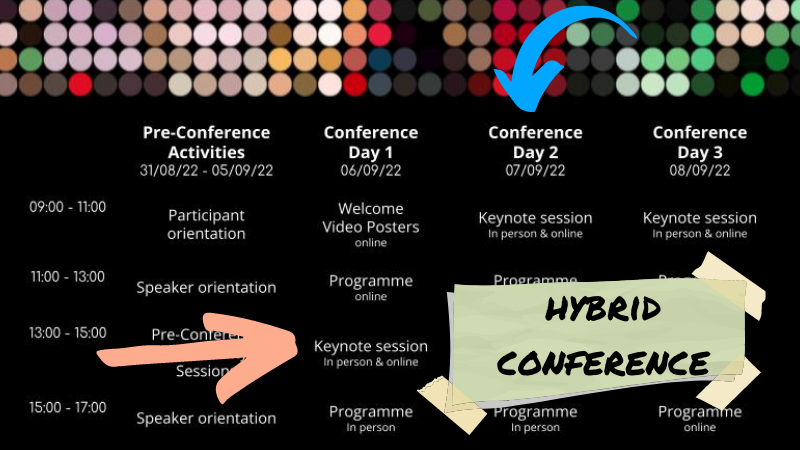
Work in progress: Screenshot of the draft programme for the conference.
Annual Conference 2022
I am very much looking forward to seeing our flagship event in a new hybrid format for the first time. We recently published a look behind the scenes and shared our thinking behind the format. We are putting our values into practice and Members at the heart of the conference, so in this spirit the event will be chaired collaboratively by the Trustees, who work closely with the Conference Committee. Every Annual Conference we have organised since 1993 has been led by Co-Chairs and their Conference Committee and we invite you to learn more about the important the work they do.
It has been heartening to see both long-standing and new Member organisations step up to support the event, as sponsors and exhibitors. We are also working in partnership with the Ufi – Voctech Trust to deliver the AmplifyFE strand of the conference; and with Jisc, on the inaugural Award for Digital Transformation. Our collaboration with ITN Productions which is now in its second year, was recently short-listed for the Best Collaboration – Association Excellence Award.
Meeting Members and sharing what’s in store for autumn
Earlier this month I attended the annual meetings of the ALT Scotland, ALT Wales and ALT Northern Ireland Members’ Groups. It was a privilege and pleasure for me to meet so many Members, both in person and online, and to get a better sense of what everyone is focused on.
It was especially enjoyable to be able to join Members gathering at the University of Cardiff, which is local to me, and join in some of the social activities.
It was fabulous to see how much creativity and organisation went into each day and seeing Members support each other in participation in the face of the continued impact of COVID-19 and train strikes.
Working with our Members is always inspiring, and I am grateful to serve such an active and impactful community, and hope to see and connect with many of you come September!
Setting out on a month of celebrating daily successes.
I am a (lapsed) 80s goth and a lifelong fan of The Cure. They were my favourite bands in the early 90s and I am going to see them live twice later this year (covid permitting).
One of the songs by the band is called Never Enough, and recently a sense of never enough-ness has crept into my mind.
‘However hard I try… it’s never enough..’ is what Robert Smith sings and whilst the song may be about excess of one kind or another, for me it’s the sense of frustration that resonates.
Whatever I do, there is always more… however hard I work, there’s always the next set of challenges… and no matter how much I achieve the goalposts keep moving out of sight. Working in the EdTech sector post pandemic, even in a privileged role like the one I have, does not often feel like a good place to be (and I salute the bloggers who try to articulate this sense of… WTF in all its nuances).
I don’t want to detract from saying what needs to be said, and of the impact the past few years have had. Personally and professionally so many are dealing with so much.
For me, in my own microcosm of getting out of bed each morning and running a small charity, of steering an unsteady ship over a choppy sea (that’s a metaphor for you, Martin), I am getting more and more frustrated with my own sense of fear or failure.
So, to cheer myself up (and to exploit some of my new found coaching skills in an experiment of self-coaching) I am embarking on a month of celebrating daily success: every day I am going to note a success and I am going to share it publicly to help hold myself accountable.
It doesn’t matter to me how big or small a thing it is, from getting out of bed to finding five minute of peace to have a cup of tea, finishing a report or responding to a difficult email. It all counts.
The kind of successes I want to celebrate and remind myself about are things that matter in my life day in, day out. I am not looking to mark achievement of the organisation I run or evaluate my performance. I have other places and processes for that. This is really about finding some balance in my own perspective.
To start with, I am going to share a success from each of the past few days, back to the start of the month, and after that I’ll post each day and share what happens.
If the idea appeals to you, you are warmly welcome to share your own successes, however large or small, on Twitter and Instagram.
Whilst I have been focusing on editing the book on Leading Virtual Teams, I have blogged a little less about what we have actually been up to as a Virtual Team… So this is a post about a great activity we have recently done: Team chat & bake.
A mail box from Positive Bakes, including all the ingredients for the team bake.
We chose a mail order baking kit for vegan & gluten free lemon cakes, which should be made easily and quickly within an hour which we set aside.
As a team we considered whether we wanted to have video chat whilst baking or use text chat, and we all voted to use text chat only, so we posted messages and shared pictures as we went along.
Photo of baking in progress… just mixing the dough for the lemon cakes.
One of the things we really enjoyed about the activity was to spend some time together as a team without having to focus on a particular deliverable. It felt more like a social activity and we also enjoyed sharing jokes about how we were getting on with the recipe. It worked great to all make the same recipe as we could compare our experiences and tastes.
Picture of baking in progress… lemon cakes fresh out of the oven.
The cost of the activity for us as a team was around £20 a person, and it took around an hour for us to bake the cakes… and start eating them. We scheduled the activity to take place before lunch, enabling us to move from the baking activity to lunch which worked well.
Photo of the final baked product – lemon cakes decorated with raspberry sprinkles.
What worked especially well for this activity was the chat element, which allowed us all to engage as much or as little as we felt comfortable with. Combining hanging out virtually with making (and eating) some practically is a great combination to engage Virtual Teams – bringing a more tangible dimension to a distributed activity.
Preparations are in full swing for ALT’s Annual Conference this September, and we are working hard to design a hybrid conference programme that reflects our values and the needs of our Members.
In the past we have openly shared ALT’s expertise designing and delivering innovative online events, and during the early days of the pandemic we published resources about running events online. This blog post continues this practice, sharing our thinking for hybrid conferences.
Our approach to hybrid
The question we started with was what a ‘hybrid conference’ means for us. We have over a decade of experience running wholly online conferences as well as in person conferences with an online element, such as live streaming keynotes for example.
For our approach to hybrid conferences, we wanted to ensure that we make the most of a return to in person session formats, enabling participants to engage in discussion and collaboration without the constraints of being live streamed or having to interact with participants online in every session.
At the same time, we want to continue to offer Members the opportunity to participate and contribute online, and to connect with everyone who is at the event.
Whilst the majority of events we run are openly accessible as a membership service, our two large conferences a year have to cover their costs and contribute to our income as an independent charity. Fees for this year may be the lowest in five years for our Annual Conference, but we are well aware of the squeeze on budgets and inequalities in income. Alongside our scholarship programme, online participation offers a lower financial barrier to participate.
We work also within the operational constraints of what we can make possible in the venue we work with, with the limited financial resources we have and also what expertise we have to deliver the event.
It’s important to us that the way the event is run and organised reflects the Association and its values, and that makes us reluctant to give external organisations control over how the event is delivered or indeed who keynotes. Whilst we value the support from our sponsors and partners enormously, we have also set clear limits of what we offer in return for that support and that, too, shapes how we organise events.
Earlier this year, we had a fantastic opportunity to run our first hybrid conference, OER22, and learn from that experience. Building on the lesson learnt, we designed our conference programme to:
Start and finish online, bringing everyone participating together;
Deliver all keynote sessions online and in person, with in person speakers where possible;
Design the programme to accommodate most UK travel to and from the event on conference days;
Find a balance between online and in person programming that is reflected in the fee structure;
Account for staffing for simultaneous online and in person delivery.
An unknown quantity: Submissions and Peer Review
Our Conference Call for Proposals opened for submissions after we had to start designing the programme, and the largest unknown quantity was that we had no sense of how many submissions we would get, how many would be for online and how many for in person, and what percentage would make it through the Peer Review process.
With OER22 we started to ask participants to choose a format (including whether they wanted to present in person and online) at the time of submission, and this worked well, with only 1% of authors requested to change this subsequently.
We thus used the same approach for submissions for the Annual Conference, asking authors to choose what format they wanted to present in from the outset.
The Call for Proposals opened on 6 May and we sent out the initial decisions to authors on 23 June. Those weeks can feel like a long time in which to wait to see the shape of your conference programme. Here is what we hoped for an what happened:
No of submissions: We aimed for receiving 100 – 150 submissions. We received 132!
Online/in person split: We planned for 35% online / 65% in person. We received 29% submission for online, 71% for in person sessions.
Acceptance rate: the initial acceptance rate is ~70% after round 1 of the review process. Depending on how many authors submit revisions and how many of those are accepted, this may increase. Overall these rates are in line with previous years.
We won’t know all papers that will feature in the programme, until all accepted authors have registered and all outstanding revisions have been submitted later this month.
(Incidentally, if you are an author in need of help or you have questions, contact helpdesk@alt.ac.uk ).
Programme design
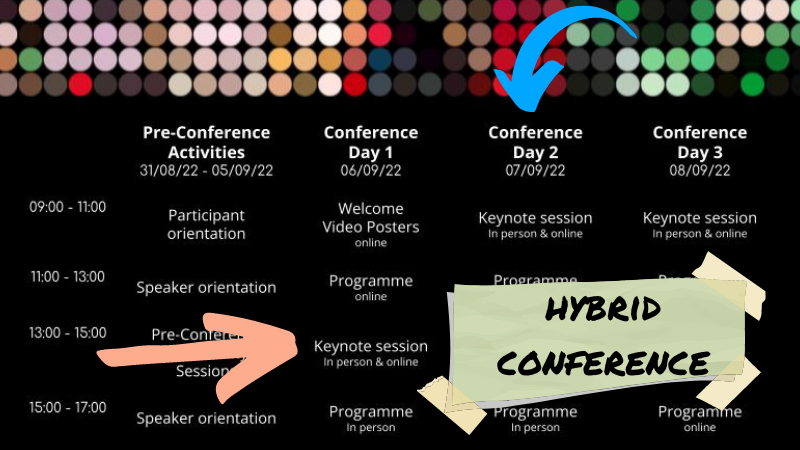
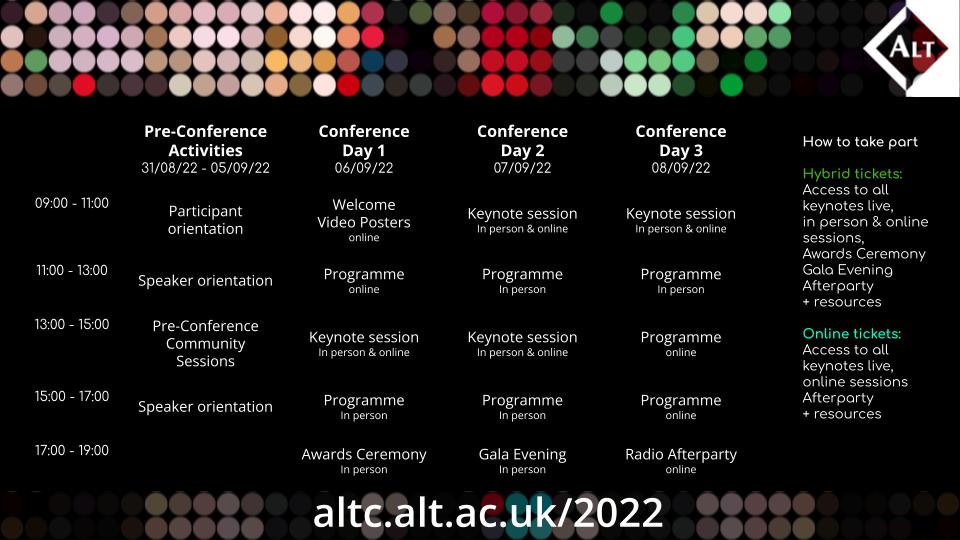
Work in progress: Screenshot of the draft programme for the conference.
Now that we have a better idea of the submissions for the conference, we can start to work on the actual programme, scheduling sessions and working out conflicts in scheduling.
Pre-Conference activities
We will run pre-conference activities 31st August to 5th September and these will be open to all and free to attend. This is an important point, as these activities include sessions run by our Special Interest Groups and Members Groups. During this time we also run participant orientation sessions online, helping to onboard everyone on the conference platform and starting the conversation in our social space.
Twice daily speaker orientation sessions will help prepare speakers to present either online or in person and pick up logistical questions about session formats and session chairing.
6th September – Conference Day 1
The morning of day 1 will be online with an online welcome and live sessions including video posters. In the afternoon, the programme will be in-person. Keynotes will be live-streamed to online participants. In the evening, we will hold the 2022 Learning Technologist of the Year Awards.
7th September – Conference Day 2
Day 2 will be in-person and in parallel we will stream pre-recorded sessions with live online discussion. Keynotes will be live-streamed to online participants as well. In the evening, we will celebrate the launch of Digital Transformation, our collaboration with ITN Productions as part of our conference gala.
8th September – Conference Day 3
The morning of day 1 will be in-person, again with sessions online as well. In the afternoon, the programme will move to online only. Keynotes will be live-streamed to online participants. In the evening, the conference after party will be online and hopefully see the return of #altc radio on the airwaves.
What’s next…?
Designing the hybrid events programme is only one of many steps on the road to #altc22, and we’ll continue to share our practice as we go along. We hope you will join us in September!