As we head into summer, I have been taking a break from work and headed to the Welsh coast for a well earned break. I am continuing my work with a number of clients over the summer, but having just completed my current coach training I will also have time to focus on other aspects of my practice including catching up on a whole host of books I am hoping to read.
Whatever your plans for the coming months, I hope you find some rest ahead of the new academic year and enjoy the warmer weather.
Blog posts and resources
This month I am sharing a blog post reflecting on different frameworks to think with. Not necessarily to adopt them whole, but because they usually offer me small nuggets of inspiration. It’s helped me find new ways to explore traits, motivations or fears and also where to turn if you can’t find a framework that feels right for you: Read Nuggets of inspiration: how we work and what works for us .You can find free coaching resources via my website and this time I have two new posts to share: try out a resource to help you reflect on different modes of working, whether from home, hybrid or in the office and exploring Gretchen Rubin’s Four Tendencies and find out about what type of accountability works best for you:
For existing clients who feel like you are just getting started or want to continue our work together I offer a discounted package of six sessions for £210 which includes six one hour sessions, a coaching plan, resources and accountability check-ins. Although I currently have no slots for new pro-bono clients, I do have a wait-list for new pro-bono clients looking to start coaching with me in autumn.
Over the past year I have started to enter awards, and I realised that it can be a helpful process to get a new perspective on one’s progress and gain some much needed professional recognition along the way.
This post is all about ALT’s Awards, which I can’t enter, but I hope that you will. The Awards celebrate achievement in the field of Learning Technology and are peer-reviewed by a panel of ALT Members from across sectors, chaired by the President of ALT.
Now, if you are someone who is ready to put your name forward, move right along and complete the entry form.
There are five categories to choose from, so hopefully you’ll find one that fits:
ALT Award for Individuals
ALT Award for Institutions and Teams
ALT Award for Leadership in Digital Education
ALT Award for Digital Transformation in partnership with Jisc
ALT Award for Case Studies of Ethical EdTech
The awards are open to all and free to enter and you don’t have to be a Member of ALT to be eligible. The Awards Ceremony is free to attend for all Finalists.
The Awards page has the full particulars of the criteria for each award, and the judging criteria are informed by the CMALT principles: A commitment to exploring and understanding the interplay between technology and learning; a commitment to keep up to date with new technologies; a commitment to communicate and disseminate effective practice and empathy with and willingness to learn from colleagues from different backgrounds and specialism. All entries should demonstrate alignment with the Framework for Ethical Learning Technology (FELT) and specifically FELT four core principles: Awareness, Professionalism, Care & Community and Values.
The entry form requires you to complete one main field:
Describe your entry, including why you should win this year, the impact of your work within or beyond your institution, how it was developed and what others could learn from your work.
and there is an option to include links to supporting evidence, resources or similar.
Why not enter?
Plenty of people I meet wouldn’t consider putting themselves, their project or their team forward for an Award. My question to you is: Why not?
If you don’t win or get short-listed, no-one will know. You will still have a useful summary that highlights what you have achieved that you can use for appraisals or dissemination, and you might have an opportunity to see your own achievements in a new light.
What you do is probably more worth sharing than you think. Plus, after two years of fire fighting and crisis support, I bet there is a LOT you will have achieved for your learners, your academics, your colleagues, your institutions, the wider community and the sector you work in.
And… there is always the option of nominating someone else. An unsung hero or a overlooked innovator.
Tips for entering
I have previously shared tips for entering, and these are some of the most popular ones:
What I/we do isn’t special…
Quite a few winners of the Awards over the years have either been nominated by someone else or started their opening sentence along these lines. Most of the time individuals or teams who do exceptional things don’t take the time to reflect or celebrate. They move on to the next thing quickly and modestly. This is one of the things the Awards are useful for – to reflect and acknowledge your achievements and those of others. If you aren’t sure whether what you do is ‘special’ enough to enter ask a colleague for their views. And if you know someone who should be recognised – nominate them.
Show what impact you’ve made
Quite often entries don’t include a lot of detail of what difference the work has made – how you have changed things. If you find it hard to find good ways of showing that maybe ask colleagues, learners or peers for comments or feedback. You could also include metrics of social media or open online interactions, such as how many readers a blog has.
What are the judges looking for?
Each year the judging panel includes at least two previous winners of the Awards. That means entries will be reviewed by at least individuals who have been in your position before. Other members of the panel come from across sectors including HE, FE, work-based learning and industry. So no matter where you work or what you do, there should always be someone on the panel who understands your perspective.
Interviews make me nervous…
Part of the selection process is that all short-listed entries are invited to a virtual interview. This is a friendly and collegiate day. If you are invited for an interview, you will be able to prepare in advance and the interview itself usually quite informal and about half an hour long.
So give it a thought and before 4 July 2022, complete the entry form.
Today I was delighted to take part in the launch of a new book:
Book cover image
Digital Learning in Higher Education
COVID-19 and Beyond
Edited by Matt Smith, Interim Head of Primary Education,University of Wolverhampton and John Traxler, Professor of Digital Learning, Education Observatory, University of Wolverhampton, UK and UNESCO Chair
Mapping the uncertain landscape of education in the wake of the COVID-19 pandemic, Digital Learning in Higher Education examines how Higher Education (HE) institutions have moved to widespread digital learning in an effort to maintain the educational experience. The book navigates the possibilities that lie ahead, using reflections from HE practitioners and other academic professionals to explore the beginnings of a new and brighter future for HE.
My contribution
I worked with Rachel Crookes and Matt Smith to co-author the chapter on Further non-teaching perspectives on aspects of the higher education sector impacted by COVID-19, based in findings from the ALT Annual Survey:
“ALT’s Annual Survey has run each year since 2014, with a number of the core questions remaining unchanged. We think it provides a unique insight into how learning technology is used across sectors as well as identifying emerging trends in current and future practice. Explore key findings from this year’s survey:
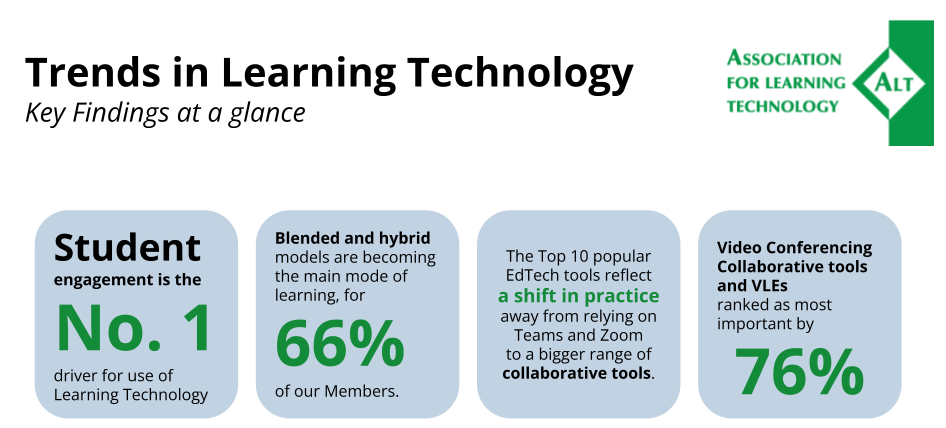
Trends in Learning Technology
This report focuses on how the Learning Technology landscape is changing through a focus on tools and technologies and also professional practice. Our findings provide insight into how blended and hybrid models are becoming the main mode of learning, for 66% of our Members and that student engagement continues to be the number one drive behind the adoption of learning technology.
This report explores one of the key questions we ask in the survey: how are institutions investing in Technology-Enhanced Learning? We continue to see an increase in investment of over 30% overall, although smaller than the previous year, when 45% of Members reported an increase in their budgets. From 2020 to 2021, investment in permanent posts has increased from 32% to 54%, and for fixed term posts from 34% to 50%, emphasizing the continued and growing demands for Learning Technology professionals in the long term.”
After a decade in which we survived cancer, Brexit and a global pandemic, my family is preparing for a seismic shift: my parents are returning to the shores of Europe to be near my sister, and I will remain in the UK, where my home has been since I immigrated in 1997.
The demands of age, which increase year on year, will be more easily met in their new home on the banks of the Rhein, and as a family we are all relieved to have found a strategy that removes at least some of the risks we have struggled with in recent years.
The endless stream of paperwork required for this move across Brexit borders is a stark reminder that even in this digital age bureaucracy requires original signatures, contracts completed in triplicate and proof upon proof of a life lived regardless of years lost to cancer and COVID. Good luck to those who have to obtain written proof of regular hygienist visits at the dentist for the past ten years.
When I separated from my ex husband and moved to Cardiff in 2020, my possessions were stuck in lockdown limbo for months, and I spent a lot of time missing small objects I hadn’t deemed important enough to pack into the first car load. Now, my parents are likewise trying to decide what to take, what to leave behind and what they can’t do without whilst their household is shipped across borders (where import duty will need to be paid).
My parents are both creative, and that creativity and desire to make things, fix thing and improve things is something we share as a family. In my dad’s case it is rooted deeply being an engineer, a life working with tools. My mother’s creativity is in working with numbers and also in paper crafts. My sister’s creative genius extends to whole houses, interior design and fabrics. My own shows up in all aspects of my life, as I have inherited something from each of them.
Something my dad gave to me during this move is a kind of mechanical leaver which comes with a key that enables you to shift weights up to ten tonnes. It’s an incredible bit of engineering, and a beautiful material metaphor.
It’s no longer an object of use for my dad, whose engineering projects are now smaller and lighter, but it is an object that represents his quiet strength and determination perfectly. Just as the homemade Christmas cards, and lovingly made gifts that my mum gave me represent her generosity of spirit and desire to do good for others.
This move marks a new chapter for our family, a new beginning in what will be a post-Brexit, post-pandemic world, and sometimes it feels like we need to shift a small mountain in order to get there. So it is a good thing indeed that we have this powerful reminder, that you can move great things, if only you apply your strength in the right way.
I have translated this post into German below, for my mother, and avid reader of my blog. “Hallo, Mami!”.
Ein Werkzeug des Lebens
Nach einem Jahrzehnt in dem wir Krebs, Brexit und eine globale Epidemie überlebt haben, bereitet sich unsere Family auf den nächsten, großen Schritt vor: meine Eltern übersiedeln wieder in Europäischen Gefilde, um näher bei meiner Schwester zu sein, und ich bleibe weiterhin in Großbritannien, wo ich seit 1997 zu Hause bin.
Den Ansprüchen des Älterwerden’s werden wir in ihrem neuen Heim am Ufer von Rhein’s eher gerecht werden können, und unsere Familie ist erleichtert, zumindest manche der Risiken, mit denen wir in den letzten Jahren gehadert haben, hinter uns zu lassen.
Der endlose Papierkram den man braucht um einen Umzug über Brexit Grenzen hinweg zu vollbringen, ist enorm. Es ist auch ein Zeichen, wie viel Wert Behörden, selbst in diesem digitalen Alter, darauf legen, alles im Original zu erhalten. Unterschriften bruacht man auf dreifach ausgeführten Verträgen zusammen mit vielfachen Belegen, die man trotz all den Unterbrechungen wegen Krebs und Coronavirus erbringen muss. Viel Glück an alle, die von einem englischen Zahnarzt einen schriftlichen Beweis dafür brauchen, dass sie alle sechs Monate beim Zahnarzt waren.
Als ich mich Anfang des Jahres 2020 von meinem Ex-Ehemann getrennt hab, und nach Cardiff gezogen bin, sind viele meiner persönlichen Dinge monatelang während des Lockdowns stecken geblieben. Und ich habe sehnsüchtig auf Dinge gewartet, die mir nicht wichtig genug erschienen um sie auf der ersten Fahrt nach Cardiff mit ins Auto zu packen. Diesen Sommer sortieren nun meine Eltern ihren Hausrat danach, was sofort mit muss, und was per Spedition geliefert werden kann (inklusive Zoll und Importsteuer) und auch, was man nicht mehr braucht.
Meine Eltern sind beide kreativ, und Kreativität und eine Gabe Dinge zu verbessern und neu zu gestalten ist etwas, was wir alle, als Familie, gemeinsam haben. Für meinen Vater diese Kapazität hängt mit Jahrzehnten als Ingenieur zusammen, eine erfolgreiche Karriere mit Werkzeug in der Hand. Bei meiner Mutter kommt die Kreativität von ihrer Arbeit mit Nummern und Zahlen, und auch mit Papier und beim Basteln. Das kreative Genie meiner Schwester kann sich auf ganze Häuser beziehen, durch Innenarchitektur und Design. Als jüngste habe ich etwas von allen geerbt, und meine Kreativität prägt alle Bereiche meines Lebens.
Ein Werkzeug das mein Vater mir während dieses Umzugs gegeben hat, ist dieses Objekt: es ist ein Mechanismus der sehr schwere Gewichte, bis zu zehn Tonnen, anheben kann. Es ist eine unglaubliche Ingenieur-Maschine und auch eine materielle Metapher.
Obwohl dieses Objekt an sich für meinen Vater nicht mehr nützlich ist, da seine Ingenieur Projekte in Zukunft etwas kleiner und leichter ausfallen werden, ist es weiterhin ein Symbol seiner ruhigen Kraft und Zuverlässigkeit. In einem ähnlichen Sinne sind die handgemachten Weihnachtskarten und liebevoll verpackten Geschenke die meine Mutter mir gegeben hat, Symbole Ihrer Großzügigkeit und ihrer Gabe, anderen eine Freude zu machen.
Mit dem bevorstehenden Umzug fangen wir, als Familie, ein neues Kapitel an. Ein Kapitel das sich hoffentlich ohne Brexit und weitere Epidemien überstehen lässt; und manchmal fühlen wir uns, als müssten wir einen riesigen Berg vor uns her Schieben, um dort hin zu kommen. Und deshalb ist es gut, dass wir dieses Werkzeug haben, dass uns daran erinnert, das man sehr viel erreichen kann, so lange man seine Kraft auch richtig einsetzt.
This is my quarterly update as CEO of ALT on our progress as we move further into the year. We now provide access to expertise to a much wider community of digital practitioners. We work hard to champion professional recognition for a growing range of Learning Technology roles and we inform and support institution leaders engaging with digital education. Our strategy needs to reflect this growing remit.
Informed by the findings from our Annual Survey, our Board of Trustees and I have worked together to set strategic goals to move us firmly into this (post) pandemic landscape towards our Annual Conference and AGM in Manchester in early September.
One of the strategic priorities we have identified is to develop a new hybrid CPD and events programme, which will launch in autumn and set out a schedule of webinars, workshops and events running online and in person.
We are also looking to develop our professional recognition activities, including refreshing the ALT Awards and pathways to CMALT, details of which we hope to share with Members soon.
We launched a new collaboration to tell the stories from our community with ITN Productions: Digital Transformation. Building on the success of last year’s programme, this year’s film will explore the potential of digital technology in education and industry and its impact on approaches to learning.
News about this year’s AGM and Trustee elections will be published alongside the Call for Nominations for Honorary Life Membership in May. Look out for information about how to stand for election and how to vote.
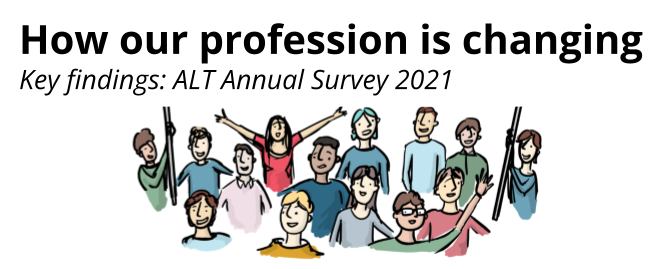
How our profession is changing
This second report from our Annual Survey explores one of the key questions we ask in the survey: how are institutions investing in Technology-Enhanced Learning? We continue to see an increase in investment of over 30% overall, although smaller than the previous year, when 45% of Members reported an increase in their budgets. From 2020 to 2021, investment in permanent posts has increased from 32% to 54%, and for fixed term posts from 34% to 50%, emphasizing the continued and growing demands for Learning Technology professionals in the long term.
ALT’s Annual Survey has run each year since 2014, with a number of the core questions remaining unchanged. We think it provides a unique insight into how learning technology is used across sectors as well as identifying emerging trends in current and future practice.
You can also read more about the report from ALT’s Chair, Helen O’Sullivan, and myself in this #altc blog post.
Celebrating the launch of the AmplifyFE Community Space in partnership with Ufi VocTech Trust
AmplifyFE is a partnership project which works to connect and amplify communities of practice for digital learning, teaching and assessment. The AmplifyFE Community Space works across the whole Further Education and Training sector in its widest terms engaging with vocational educators and those who support them.
The aim of this space is to:
Provide a place for vocational educators to share and learn from each other, increasing their access to learning technology expertise, digital pedagogy and professional development opportunities
Champion the use of accessible, inclusive learning technology to help those adult learners most impacted by the digital divide so that more people in the UK have improved access to vocational skills
Engage with FE groups and communities of practice and researchers in vocational learning to share best practice
Work across the whole Further Education and Training sector in its widest terms engaging with vocational educators and those who support them in FE Colleges, Adult and Community Learning (ACL), work-based and independent learning providers, prison learning, ESOL communities, ‘HE in FE’ providers, the whole, diverse sector.
To amplify the voice of professionals in strategic developments across the sector, led by organisations including ALT and Ufi.
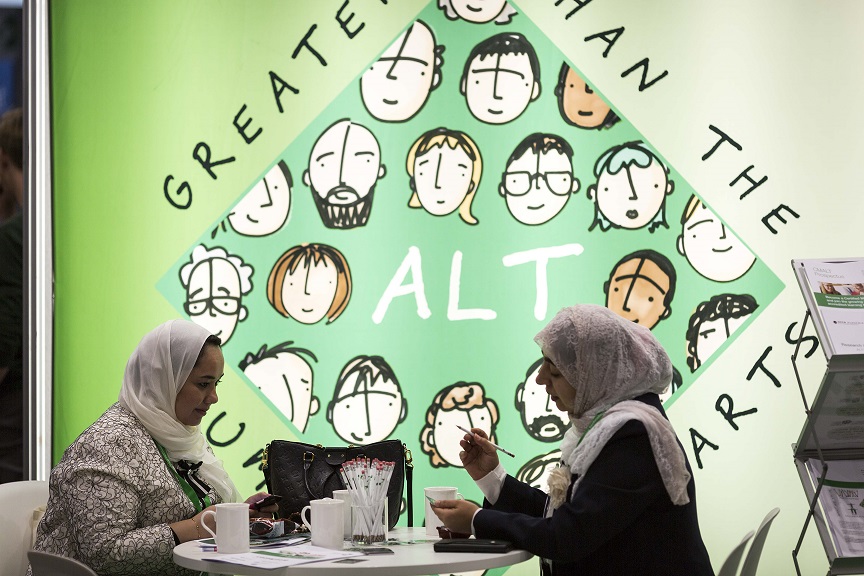
Picture by Chris Bull for Association For Learning Technology 11/9/18 ALTC 2018 day one. www.chrisbullphotographer.com
Preparing for our Annual Conference and AGM 2022
For the return of the Annual Conference to Manchester, 6-8 September 2022, we will bring together different critical perspectives from across our community that will examine the challenges ahead and question the shape of things to come. We are putting our values into practice and Members at the heart of the conference, so in this spirit the event will be chaired collaboratively by the Trustees of ALT.
Conference themes
Digital transformation beyond the crisis: what is your vision for learning, teaching and assessment? This theme is focused on how we are transforming education and training through digital practices in a post-pandemic world.
Co-creation with learners: this theme explores how to use digital technology in partnership with learners to design sustainable approaches that work for everyone. How can we co-create student engagement and enjoyment and make the learning experience more open, inclusive and equitable?
Emerging leadership for a new strategic vision: we are seeing a growth in more strategic responsibilities in roles with a focus on digital education and training. This theme is dedicated to the work and vision of both emerging and established leaders in both institutional and community roles seeking to share their expertise and learn from like-minded colleagues in a dedicated leadership strand of this year’s event.
Developing Digital Fluency: there has been a big shift in the digital skills and capabilities that we need to develop and recognise in both students and staff: from digital citizenship to critical data literacy and ethical considerations, what does it mean to develop digital fluency?
AmplifyFE: this conference strand is dedicated to proposals from the FE and Vocational Education sector, and we encourage submissions that share expertise around digital tools and technologies, skills development and collaboration (not competition).
Creativity wildcard: if your work doesn’t fit into the traditional research or practice themes, then this theme enables you to submit research, practice or policy proposals from any sector including Further Education, schools, vocational learning and training, lifelong learning and work-based learning.
We have been sharing the framework with the sector at a number of conferences and events this spring, including the THE Digital Universities Week and Ahead by Bett. ALT’s Framework for Ethical Learning Technology (FELT) is designed to support individuals, organisations and industry in the ethical use of learning technology across sectors. The following resources, including the FELT Reflective Self-Assessment are available to Members:
Work on the book is making good progress at the moment. I am focusing on working through edits and responding to feedback from reviewers.
Meanwhile I am also working with the publisher on the format, layout and cover. As Leading Virtual Teams will be published online under an open licence, we want to make it as accessible as possible.
This month I am also planning ahead for the summer, setting out deadlines for the final stages of the editing process before the book gets sent for copy editing. Summer is my busiest time at work as we have our flagship conference in early September and there is always a lot happening in the run up to that. So work on the book may be a little slower for the next period.
Remote Working Radio Season 1
As I have been working on my book Leading Virtual Teams, I have been talking about working remotely on DS106 Radio on the Remote Working Radio Show. What started out as a lot of music and a bit of chat from me and sharing updated on the book has grown into an hour of chat with special guests, exploring how we work from home, what challenges we encounter and tips for developing your own practice.
The show is taking a break over the summer, so here are the recordings from season 1 for you to catch up with and enjoy. A huge thank you to my guests who joined me on air and shared their insights. We will be back on air in the autumn for season 2.