Today feels like a milestone day. The clock’s have changed here in the UK, it’s the last day of the first quarter of the year… spring is underway (if still a lot wetter than I’d like) and I am freshly returned from an inspiring week in Cork at the OER24 Conference. It’s also been six months now since I started working in my new ventures, over a year since my departure from ALT was announced… and I feel like I have landed in a new place.
From now on, I will still share updates on how I am doing, but maybe not as frequently. Things will continue to evolve no doubt, and that is both exciting and expected as I build this chapter of my life. I have a sense of having begun, to have arrived, here, in the new place. Tomorrow is Monday, and my plan for the day is to spend a lot of time thinking, planning and plotting, fitting in a run and a dog walk, as well as some much needed tidying of my domains, both domestic and digital.
So to wrap up this season’s podcasting and to celebrate this milestone, I have recorded a special episode, sharing some of the highlights of the past six months and also some things I am especially looking forward to. Happy listening 🙂
I am still in Cork, Ireland, as I write this post, feeling both tired and elated after a wonderful week at the OER24 Conference. My first time attending the conference as a delegate was a great experience, and I thoroughly enjoyed it!
The Co-Chairs, Dr Gearóid Ó Súilleabháin and Dr Tom Farrelly from the host institution Munster Technological University (MTU). led a fantastic effort together with ALT’s team headed up by Kerry Pinny, and the Conference Committee and MTU teams did everything to make the event such as success. Big kudos to all involved!
In the best tradition of the conference, you can explore:
as well as a host of slides, resources and images posted with the hashtag #OER24.
My OER24 highlights
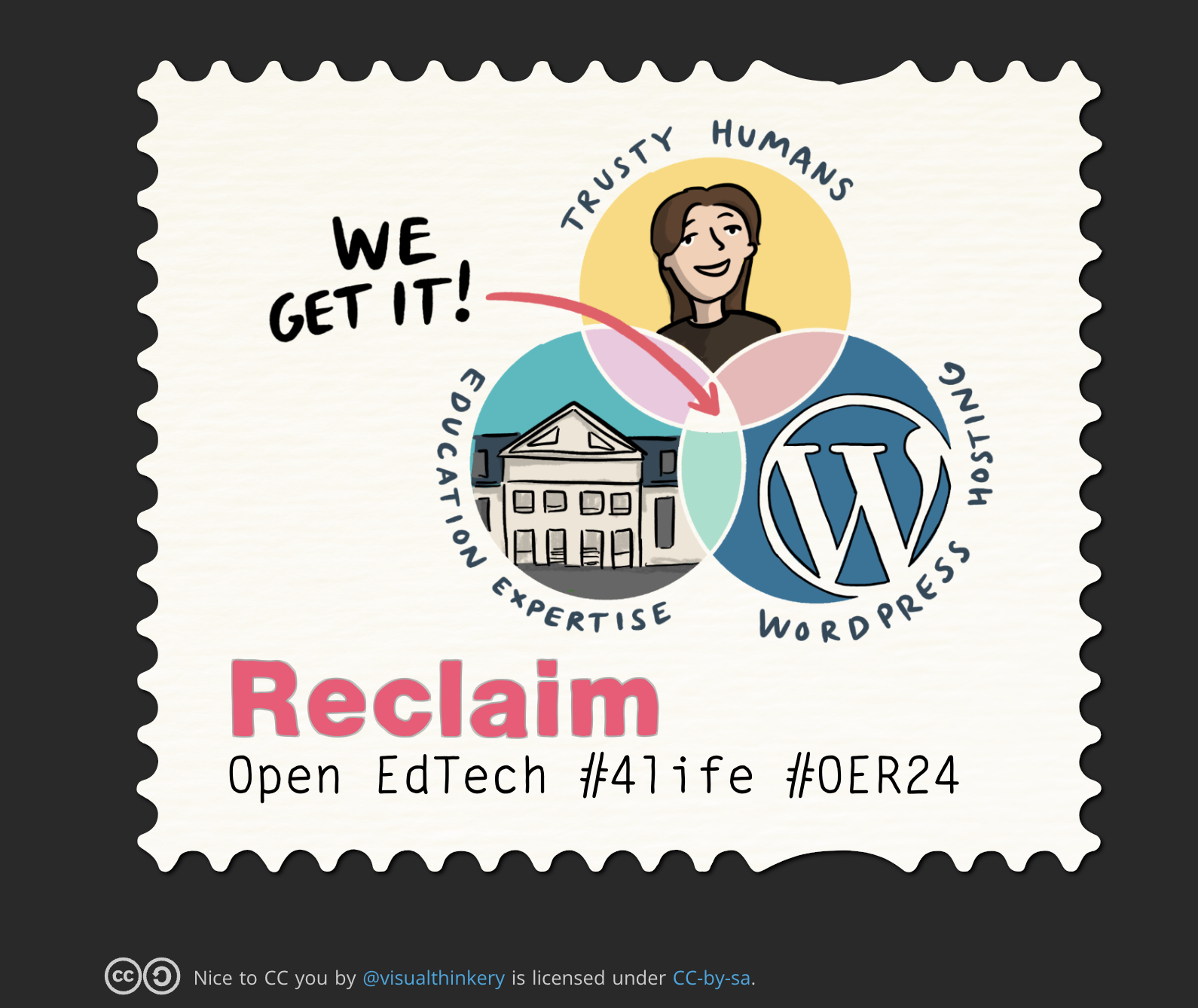
Together with my colleague Meredith (Fierro) Huffman from Reclaim Hosting I did a short talk on Reclaiming #Edtech4life in Open Education. I blogged a preview of this a few weeks before the event, and Meredith blogged our talk complete with slides and a link to the full video version we recorded together with Jim Groom on her blog.
We had the best fun with this talk and it prompted los of questions and inspiring conversations, which is always the best bit of being able to hang out at conferences in person.
During Open Education Week earlier this month and in the run up to OER24 I got to take part in a number of virtual conversations (blog summary) and one of the best parts of this week that I was able to connect (and hug!) with so many colleagues in person, many for the first time since before 2020. That weeks like this are once more possible made my heart swell.
There were also many absent friends, who weren’t able to join the gathering, and this is where being in a conference full of people not afraid to jump onto the airwaves or the interweb and start an impromptu live broadcast of hallway chats really helps! One of the voices we missed amongst the chorus at OER24 was Jim Groom, who still managed to permeate many conversations and moments of people shouting “4life” from the back seats.
Jim published a wonderful blog post celebrating our visual anthology of Reclaim’s first decade with a tribute to That Mathers Aesthetic! … Needless to say that that aesthetic shone through the whole event, not least in the funny and stunning artwork Bryan created for it.
I hope my first time taking part as a delegate won’t be my last, as this year’s OER Conference has confirmed for me what I long knew to be true: this is my favourite conference, and it has been for a decade.
It’s small enough to allow for a sense of community and conversations, it’s big enough to always attract new voices and viewpoints, it’s special enough to inspire each year’s hosts to go yet another extra mile… and it’s important enough for an Association like ALT to put it’s weight behind it, year after year.
Most importantly, it’s loved enough to bring out the very best in everyone who takes part.
P.P.S. (A personal post script)
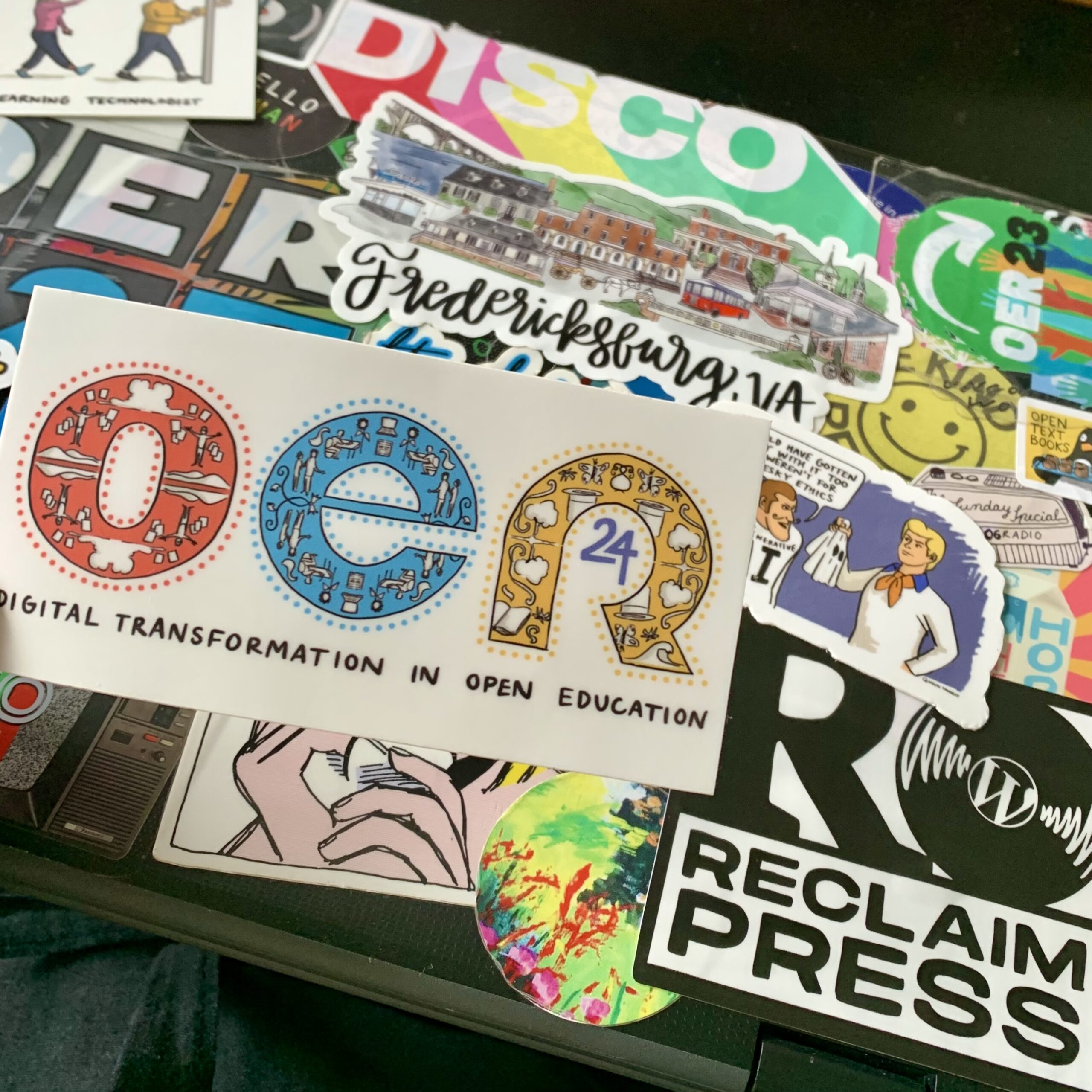
I leave Cork with much inspiration, a bag filled with small tokens of joy and friendship (thank you!) and a whole collection of stickers, as well as references, resources, ideas and a phone full of photos of smiling, hugging people.
In these (post) pandemic times I feel that opportunities for saying thank you, for recognising contributions and for celebrating big milestones are all too fleeting, few and far between. We are quick to move on to the next thing, to focus on the biggest challenges ahead. All the keynotes at OER24 reminded us of the bigger picture, the power of open to help us meet the moment, as Catherine Cronin and Laura Czerniewicz expressed this so beautifully.
So in the spirit of taking a moment to celebrate, I also leave with the memory of Rajiv Jhangiani helping us mark Martin Weller’s 30 years in edtech and his long service in both the conference and the wider community and it was a privilege to be able to experience that together with so many with whom Martin has worked and shared friendships with. Thank you OER24.
Enjoyed this post? Subscribe to my free monthly newsletter:
I am REALLY looking forward to OER24 this year, not least of all because I get to share the stage with Martin as we present out (first ever) short talk on podcasts and radio. If you are curious what we’ll be talking about, you are in the right place:
Read a short summary of our talk
How do you share open practice and foster innovation in Open Education in the age of social media fragmentation? What supports and amplifies peer-learning and knowledge exchange between Open Education practitioners as social media platforms like X become increasingly hostile spaces?
This presentation examines how the changes in social media impact open practice and highlights alternative media of radio and podcasts as a way to share practice and explore ideas.
Podcasts have grown in popularity over the past decade, with many easy to use tools for their production and consumption. In 2022 50 percent of respondents in the US aged 12 to 34 years old had listened to a podcast within the preceding month and 79 percent of U.S. consumers aged 12 years or above are aware of podcasting, up by more than 30 percent from a decade ago. Their use in education is expanding, with Shamburg (2021) reporting that educators have used them to discuss topics in a more informal way.
They thus provide an ideal medium for exploring open practice and experimenting with ideas, formats and topics. Internet radio is not a new medium in open and distance education, and during the pandemic saw a resurgence as educators took to the airwaves on grassroots stations such as DS106 Radio. In this session the speakers will explore their experience of using these two forms of media to develop their own professional practice and explore ways of connecting with audiences beyond spaces such as X and share lessons learnt.
Listen to the preview
Join us as we discuss our presentation at OER24, a conference all about Open Education, 27-28 March 2024, Cork, Ireland. Listen to the preview podcast with Special guest: Martin Weller
It’s been 18 months since I first launched my podcast, and this academic year I have stepped up the pace with a new episode every week. 65 episodes later… I still enjoy the process of making the podcast and it’s been very, very useful for my professional practice. It’s also a (for me still relatively) new way to sharing my work and I have tried to find the right tone in this medium, tried to find my podcast voice.
In this post, I bring together things I have learnt along the way, and also ideas for what I’d like to try out next:
Getting started: Looking back at the first year on the podcast, the pattern of putting out episodes is erratic. Sometimes I published 5 episodes a month, other times it was only one. They all come out on different days, and the format and duration vary, from below 10 minutes to above 40. Season 1, which doesn’t have episode numbers, has 10 episodes. Season 2 has 21 and currently Season 3 is at 30+. It’s a bit of a mess… However, what matters to me is that I did it. I continued to record and release episodes, trying out different topics and formats, with guests and without. I now feel that I have a podcast, and I have made it part of my professional practice.
Choosing what to talk about: Just looking at the titles of various episodes gives you a clear indication that there are a whole range of topics I talk about. Here are some examples from across the three seasons:
25 hacks to make hybrid work 1% more comfortable
A party without a cake is just a meeting…
Career transition reflection – 3 months in
Some episodes are focused on coaching, and include more factual/how-to content whilst others are about leadership in hybrid workplaces and others again are updates on my work, celebrating milestones, reflective practice, radio… . The list goes on. What’s useful for me is that the podcast has become a reflection of my practice and leadership. That’s what I am interested in exploring, and it’s been helpful to acknowledge that as I find my voice.
Listening to other people’s podcasts provided all sorts of inspiration and I tried out different things with various episodes to feel out what might work for me. Importantly, it needs to be a topic I am interested in, and it needs to be useful to me. My podcast is a passion project, not something I get paid to do. It’s an element of my open practice and as such it’s useful to others (I hope) but it’s primary user is me.
An audience of one? In the early days of the podcast, it certainly was (an audience of one). I remember how excited I got when someone who could not be family & friends listened! It still makes me happy to hear that someone found an episode interesting or useful and yet I haven’t put a lot of effort into promoting the podcast. The platforms on which the podcast is registered offer all sorts of tools and resources to help you build your marketing campaign and expand your audience, which I must admit I have largely ignored up to now.
It’s an intentional choice on my part to keep the podcast a space to play and experiment with. Just like my blog, I want the podcast to be part of my domain, a page in my sketchbook if you like. I don’t want to monetise it even if I could. I am not interested in it becoming the next big podcast on hybrid working even if that opportunity arose. I want it to sit in the margins. A working, thinking space instead of a polished production.
With an organically growing audience, episodes now attract 30-50 listens on average.
Experiments in podcasting: Since I started the podcast, I have experimented with various projects: I used the podcast to record audio versions of key sections of my book Leading Virtual Teams; I have run two CPD courses using my podcast as the main platform to deliver course content and I have used the podcast to share career transition updates as I started my free-lance venture. It’s certainly been a bit of a mixed bag of approaches and that has resulted in me learning a lot along the way.
I appreciate that it may be frustrating to folks who are looking for regular episodes week in week out on a similar range of topics, and with a similar take on the format and I am sorry if experimenting with various aspects of the show makes it less enjoyable or less useful at times. For me, these experiments have been incredibly useful and rewarding, giving me space to try out ideas and new approaches on the journey to finding my podcast voice.
Things I learnt along the way:
Getting comfortable with recording conversations and structuring content
Recording intros and outros
Writing show notes and providing links to resources
Transcripts and automatic transcription
Registering a podcast on different platforms
The power of replay: Whilst many people dislike listening to their own voice, and I am not a huge fan of mine either, I do listen back to my own podcast episodes. I find it incredibly useful to replay my thoughts to help me refine my reflections and also to review how my thinking has changed. Just as listening back to a recording of me coaching with my coach trainer helps me identify ways in which I can improve as a coach and also identify what I am doing well and why it works; listening back to podcast episodes is extremely helpful for my professional development.
It’s also a bit nostalgic, particularly in the more personal/reflective episodes. Here I am, celebrating milestones and sharing tips for this and that whilst around me domestic chaos or work problems reign. There are episodes when I clearly had a cold and episodes when I can hear my dog Posey in the background wagging her tail or chewing on something noisy.
A note on the technology: I don’t have much know-how to share when it comes to podcasting tools and platforms. I have a wonderful mic that I can’t connect to my current computer, I use a browser-based, free tool to record my episodes which is just about to go out of service… and I live in a noisy environment where proper recording quality is harder to achieve than I’d like. In short, my set up is makeshift. When I sit down at my desk in the morning between meetings to record an episode, I am afraid there are no ambitions to have a recording set up beyond headphones.
I am fortunate to know many people in the Open Education community with brilliant podcasts and radio shows, many of whom have professional experience in this industry, much better placed to advise on anything technical and I salute them. I learn much from their example, even if that is not always evident in the audio quality of what I produce… .
Where next? I am very excited about continuing my podcasting adventures and I have ideas I want to try out come summer, and a break in my ‘regular’ schedule. I also need to learn how to record my episodes on a new platform, and I am definitely working on getting the good mic connected. Most of all, and regardless of any practical considerations, I am determined not to loose this space for open practice that I have opened up for myself. It’s another experiment in open leadership that has become important to me, and that in itself is a huge reward.
It’s not all about podcasting… there’s a newsletter you can subscribe to as well… (that’s another blog post).
When I was a research student I came across David Abram’s The Spell of the Sensuous: Perception and Language in a More-than-Human World, an ecological philosophy book. At the time, I was deeply interested in phenomenology, and as part of my research in Anthropology I was learning much about how human beings relate to and experience the world. Specifically how we relate to the world through our senses as embodied beings.
From the articles and blog posts on his website, it looks like David Abram’s thinking has evolved much since then, and he is now a visiting Senior Visiting Scholar in Ecology and Natural Philosophy at Harvard University. Lots of fascinting things to dig into if you’re interested in these topics. Meanwhile my interest in this topic has also evolved, from thinking about human beings and the material world and landscape to human beings in the workplace, specifically in the increasingly hybrid workplace.
Which brings me to considering what happens to our senses when we work in a hybrid or fully remote setting for long periods. How does our embodied experience of work change as we spend more time in front of screens, alone in our studies or on kitchen chairs? And also, how does our perception of work shift as our senses of sight, smell, touch, taste and hearing adjust to hybrid working?
I am curious to start exploring some aspects of this and how our embodied experience of hybrid working may influence of sense of wellbeing.
Sight
The sense I read the most about in the context of hybrid working, digital wellness and technology is sight. Given the amount of time spent in front of screens, scrolling, staring and not blinking, implementing screen time limits or wearing blue-light-blocking glasses to alleviate eyestrain is becoming more common. Mobile phones now offer a different light mode closer to bedtime and monitor screen time in order to alert us when levels increase, and smart watches can remind you to move a little every hour. Other tips include taking a break from the screen, going outside to adjust to daylight, look into the distance or look at something green/natural to help your eyes relax and recover. The traditional 5-10 minutes of screen breaks every hour is part of every Display Screen Equipment safety training I have come across.
Hybrid working typically provides fewer distractions and more reliance on online interaction for communication and collaboration, making it less likely that regular screen breaks are taken. Even when we step away from the screen, notifications and messages on mobile devices usually stay switched on, making it more likely that we end up with more screen time.
Hybrid working has also led to more hybrid and online meetings. Depending on the role you work in, you probably find meeting free hours have become more rare and back-to-back video calls more common. Zoom fatigue impact us beyond our sense of sight alone, this article in Medial News Today summarises how “headaches, migraines, eye irritation and pain, blurred and double vision, excessive tearing and blinking are the most common and immediately visible physical symptoms of Zoom fatigue”.
This week, how many times have you taken a 5-10 minute break every hour? For me, I would estimate I take a short break for each hour less than half of the time. On busy days maybe 10-20% of the time, but generally somewhere around 30-40% of the time.
Healthy habit: step away from the screen
If you are looking to improve your digital wellness by taking more regular screen breaks, here are some tips to get started:
What is your starting point? To begin with, reflect on how regularly you step away from the screen for a short break at the moment. If you are spending 8 hours a day in back-to-back video calls, then even one or two breaks a day might seem like a stretch. If you are already taking a break at lunch or making tea mid-morning, building in a few extra breaks might feel more achievable. Be honest with yourself about where you are starting from so that you can set yourself an achievable goal.
Easy does it. No matter where you are starting from, find the least busy time of your working day or week. It might be Friday afternoon or Monday evening. It might be the hour after lunch when there’re fewer meetings. Whenever it is, focus on that time first and plan in an extra break. You can use your calendar, phone reminders, post-it notes or whatever else will help you remember to take a break. Then, when the time comes, step away from your screen and do something that is not screen related for 5 minutes. I often go downstairs to get some water, water my plants or make a hot drink. If the weather is nice I might step outside. It doesn’t matter what you do. As you get up and start to move, notice how you feel. Are you stiff? Is there any part of you (or all parts…) that feel tense? Get back to work after 5-10 minutes.
Make it a habit: you might decide to set yourself a goal to take an extra break every day or a number of breaks a week to begin with. Observe any physical symptoms of taking regular breaks away from the screen or how your mood changes. If you have a busy day or a busy week and you end up forgetting to step away from the screen or you don’t have time, just get back to it when you can. The overall aim is to get into the habit of having breaks, and even one additional break is better than none.
Share your habit: one of the best ways to make this habit stick is to share and normalise stepping away from the screen. If you use direct messages or chat at work, post a quick update like “Just stepping away from the screen for a break” or “Back online in 10 minutes. Taking a screen break”. It’s a powerful way to promote digital wellbeing in any workplace, and if you happen to lead people or projects, your example can help others, too.
In the next post in this series I’ll be focusing on a different aspect of embodied hybrid working and share a new healthy habit to try out.
Enjoyed this post? Subscribe to my free monthly newsletter:
This week is Open Education Week and I am super excited to join in the fun, celebrating all things open in education. If you want to catch me live, I am joining a whole host of special guests on air hosted by the one and only Alan Levine on Wednesday:
P.S. It was a lot of fun to join Alan online, and here is a screenshot of a moment that made me smile: all of us talking about online, digital, AI and so forth, surrounded by books.
Open practice is central to all the work I do and for the past ten years my interest in and commitment to open has only increased. So it’s been a special pleasure to take part in a series of conversations in the run up to this week:
Building Community with guest Martin Hawksey!, Reclaim TV, 9th February 2024 was the first of these. I was lucky to join my Reclaim colleagues Amanda and Taylor and our special guest Martin Hawksey, who for me is both a friend and long-term collaborator. Community building is really at the heart of open practice for me, and we chatted about how to engage with people, how to reach new communities and networks, the impact of the pandemic and the changes in the social media landscape. Martin has more experience in this space than most, having built, curated and supported communities from the local to the global scale over the past fifteen years or more. There is little he isn’t expert in when it comes to making technology serve communities, and in this session he shares some of his reflections as well as tips 🙂
Building on that conversation, Reclaim & OER #4Ever, with Meredith Huffman, Reclaim TV, 16 February 2024 took the community building one step further as we previewed a talk we are planning for OER24. The theme of the talk is putting community together with capabilities and CPD, sharing approaches for gaining skills and expertise in open educational technology. Plus, we share a lot of fun memories of what we got up to at open education conferences over the years.. (friendly warning: shoe tweets are mentioned in this episode). I love how Meredith explains how building on hosting and infrastructure the community piece can help empower staff to have a better relationship with tools and technology which benefits not only the institution, but students as well. I can’t wait for OER24!
For me the conversation that brought all the elements together was Using Open Source tools as key infrastructure, with Anne-Marie Scott, Reclaim TV, 1 March 2024. This is the one where we talk big picture, global policy and institutional change. I love listening to Anne-Marie share her rich, reflective perspective and admire her ability to explain even the most complex dynamic in open source and open tech with such clarity, that you always leave inspired and empowered in equal measure.
And to add another piece of blogging goodness, I have shared a bit more over on the Reclaim blog.
Don’t want to miss what I am up to? Get a free, monthly summary to your inbox: