As I am half way through the year, I am taking a look back at what I have blogged so far, and in the best tradition of the form, to blog about blogging once again. And, if you missed one of these, now is a good time to catch up and bookmark posts for future reading.
Blogging in numbers
2024 has been a good year for blogging (it’s always a good year for blogging!). I published 35 blog posts in the first six months of the year, slightly fewer than last year (43), but still an average of six per month. March was the month with the most posts (thanks to lots of things to say about open education) and June was the month with the fewest (thanks to a deeply relaxing two weeks away and offline).
I regularly offer dedicated workshops and short courses for leaders and managers who manage people or projects in hybrid or fully remote settings. Over the past two years I have run several of these and each cohort has been a wonderful experience.
Although much of my work now is focused on helping other organisations design and build similar offerings for their own staff, I love the freedom that running my own courses offers – both in terms of the content and the design and delivery of the course. My own offerings give me a lot of scope to innovate and to try entirely new ways of engaging participants.
This time, there are a couple of things I want to try and add to the course design following feedback from previous cohorts: the course will offer more opportunities to get feedback and dialogue on a weekly basis so that we can discussed specific challenges and individual contexts in more depth.
I’d also like to experiment with adding some of the coaching resources and approaches that my individual coaching clients find most useful and offering more accountability and check-ins to help course participants stay on track and get the most out of the course.
As before, there’ll be a whole pack of practical tools and inspiring reading to take away as well as the course podcasts to support professional development beyond the end of the course and at your own pace.
I am really excited to get work underway on this new venture, and if you are curious to learn more, read the preview below and check out my previous courses, which are openly available.
NEW Autumn 2024
Healthy Hybrid Working for Managers and Leaders
When it comes to hybrid working, managers and leaders have a different experience to the wider workforce and different needs, too. From running effective hybrid team meetings, keeping oversight of progress and managing performance there are a whole range of challenges for hybrid people and project management.
If it’s part of your role to translate newfound hybrid flexibility into effective collaboration between colleagues, establish communication channels that engage a hybrid team with diverse capabilities and preferences and balancing work with other commitments, then this course is for you.
Over four weeks we will take a deep dive into what it takes to manage happy hybrid teams in a way that reflects your values, and create healthy habits to balance the demands of a leadership role even when work/life boundaries are blurred.
Start date: Monday, 7 October 2024 Duration: 4 weeks
This month I am taking a proper break from work for the first time since I started working on a self-employed basis full-time. I love running my own micro-business, but when it comes to taking holidays it’s not yet working for me. I find myself fretting about work and checking emails or committing to things because of my clients’ schedules and as a result taking a complete break from work hasn’t happened so far. Now that a long-awaited break is upon me, I want to finally get that complete break and I am preparing for two weeks without work, two weeks filled with the joy of not working.
I love my work, and I have years of practice when it comes to staying connected and working too much, so I need to make an extra effort to achieve the kind of break I dream about. In case you are looking for inspiration for your own break, here are some steps I am taking this week:
Start to wind down early: I had my calendar blocked out for a while now, but about two weeks ago I started to actively manage my schedule to protect my time off. There are 0 meetings or other commitments this time, a kind of zero tolerance policy for work meetings, calls or check-ins. Between my coaching clients, projects and upcoming talks etc I have a lot of different folk I communicate with every month, and I have tried to schedule everything so that everything that needs to happen this month happens before I go offline.
Get things off the list: I do have work things that can’t just wait whilst I am away, and wherever possible I have planned ahead and completed work ahead of schedule, so that everyone else can get on with things whilst I am away. This has meant a very busy couple of weeks for me, but it’s felt good to get things done. It also means that I feel less guilty for taking time off.
Stack up analogue activities: for me, a proper break means that I spend A LOT less time online. I won’t be scheduling any social media posts for when I am away, and I will set my out of office on my accounts before I leave. To replace a lot of my digital activity, I have a whole stack of library books to read, pens and paper to get creative and a new camera to play with. For the actual trip, I have a travel guide, yes, an actual guide book, and plenty of yoga planned, too. The less time I can spend in the company of my phone, the better. It’s always a bit of a bump for me when I let go of the pace of being online, but after a few days of doing things differently, I usually find a new cadence for my days.
The permission principle: inspired by the writing of Elizabeth Gilbert and her idea to give yourself a permission slip in order to be more creative, to experiment, explore or even fail, I, too, am a big believer in giving myself permission to enjoy not working. It sounds obvious but it remains a powerful principle. Giving yourself permission to enjoy the time away from responsibility makes it much easier to sit with yourself outside of work.
Material markers of freedom: like many people who work from home regularly or permanently I have a whole host of work-related things in my space. When I prepare for a time off work, I try to clean and remove everything, packing away the office and replacing it with things that remind me that I am off work. My desk becomes a drawing table or a new home for plants. My office chair gets covered in a beach towel. Instead of notebooks and pens, I have records and cups of coffee. Even my digital desktop changes. I change my desktop background to a holiday one. I remove all my work accounts and apps from my phone or hide them effectively enough for me not to be tempted to check in.
Logging off: Finally, when everything has been done and I am ready, I log off. And then I immediately start a list where I can dump anything that comes into my head that I have forgotten, need to follow up on or that worries me. I always, always, remember something I didn’t do. And because I don’t want to go back and have to start the whole process of separating myself from work over again, I add it to my list instead. in 99.9% of cases, whatever I have urgently remembered or worried about has become irrelevant by the time I get back to work.
So, thats me done for June. See you next month.
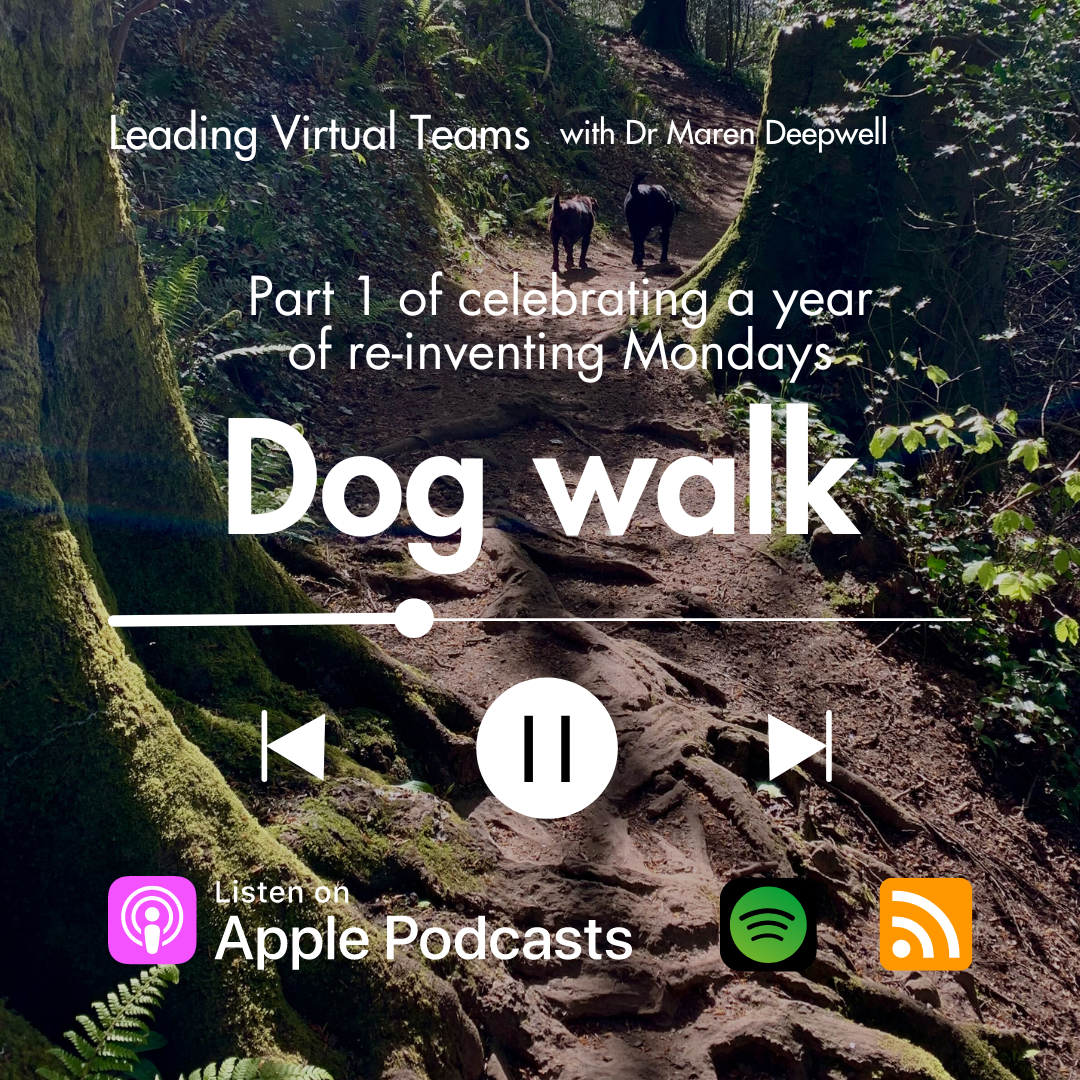
P.S. When I got back from my break, I recorded this podcast episode, reporting back on how well these tips worked. Enjoy!
Image credit: CC-BY me, taken in West Wales
Keep in touch – subscribe to my free monthly newsletter
This past academic year I have worked on a number of different projects all connected by the theme digital wellbeing. This post brings these different strands of work together and offers some key take aways.
Now, before we jump in it’s worth being clear what we mean by the term ‘digital wellbeing’:
In the wider context of digital health it can mean using technology, applications, websites or online services to help us manage our health and wellbeing.
In the workplace, and specifically in an increasingly hybrid workplace, we often use the term digital wellbeing or digital wellness to describe how the use of digital technologies impacts our physical, mental or emotional health and wellbeing, for example screen fatigue or stress caused by digital overwhelm and constantly being connected.
It’s interesting that in one context technology is seen as a solution to managing health and wellbeing and in the other we have to manage technology to improve our health and wellbeing. In my work the second meaning of digital wellbeing is most relevant, as I work with individuals and organisations who are seeking to increase their awareness of and control over their relationship with digital technology in a work context.
What is the challenge?
The biggest challenge is having common ground to discuss what’s beneficial and what is having a negative impact when we think about technology and wellbeing in the workplace. It depends on a lot of different factors from the job you have, where and how you work, how you use technology outside of work, where and with whom you live and so on. An introverted researcher with a dedicated home office who lives alone is going to have a very different baseline from a member of support staff who is always on call and who has small children at home.
Professional development in digital wellbeing is thus not a ‘one size fits all’ teaching scenario. Although some advice will be helpful and relevant to most, it’s largely a case of cultivating a sense of awareness, of curiosity to begin with. In my experience an inquiry based approach seems best suited to address the topic and in many of the resources and course designs I feature resources and tools to help participants analyse and reflect on what aspects of hybrid working most impact on their digital wellbeing and why. The aim overall is to increase awareness and offer tools to start noticing what is working and what isn’t.
Common factors
Once you get to a point at which reflection is happening, some common factors emerge:
A desire to take more regular breaks or indeed an awareness that one should doesn’t easily translate into action. In very few workplaces is it seen as normalised to take regular screen breaks;
Senior managers are generally seen as unaware of the issues and hybrid working often makes people in power perceived as more distant, less accountable. The few exceptions I have worked with, i.e. senior leaders who do take an active interested, reap the rewards from and with their teams;
Desk/workspace set up are usually less than ideal. Space, equipment, improvements like a sit/stand desk, are often wished for, less often realised;
Everyone appreciates more time at home and/or with their family, but that doesn’t lead to less time working. Work/life balance feels more under pressure for homeworkers with a busy home life, especially with young children or care responsibilities;
The office, campus or HQ is perceived as problematic, either because it is too empty or because space has been reallocated and is now shared. Flexible/hot desking doesn’t seem to work for most;
Putting your phone away during screen breaks or lunch time is something most won’t attempt;
In every group I have worked with there are some who would return to the office tomorrow, and do not wish to ever use Teams or Zoom again. There are an equal number of folk who would never countenance the prospect of returning to the office, and most see working from home 2-3 days a week as the norm. Mondays and Fridays especially.
Teaching things like taking a break from sitting in front of your screen is hard to do in a format that requires yet more screen time, and I made an effort to experiment with different modalities including blended, audio only and asynchronous approaches. Making space to be silent, to pay attention to only one thing or only one window on the screen is key, and yet it’s very hard to achieve. Digital desktops are as unique as their users, and most have dozens or tabs, files or windows open whilst engaging with digital wellbeing activities online.
The wellbeing piece needs more expertise
In my work from coaching and teaching to leadership development the wellbeing part of digital wellbeing has always been an area I felt I need more expertise in. The literature on digital wellness and digital wellbeing, at least in the context I work on, is very often focused on the digital part of the equation, not the human being. Nearly all of the tips shared by participants in different context where related to technology and included wearing glasses that protect from blue light to using timer apps to remind you to take a break. Dedicated meditation mindfulness apps such as Calm, Headspace or Insight Timer have extensive and well produced content for wellbeing at work, but often such support doesn’t reach those harder to convince.
What’s needed is more practical expertise on how our bodies work (at work) and how we can increase digital wellbeing in practical ways. That’s the direction in which I am keen to develop my work next, and I am looking forward to sharing more details of an upcoming collaboration that will do precisely that in the coming months.
Listen to the podcast episode:
My projects in Digital Wellbeing, academic year 2023/24
The first project was my free course Healthy Habits for Hybrid Working, which I ran in October and November last year. The course was designed to share practical tips that you can use to find ways to make hybrid working really work for you (or you team or organisation) in the long term and covered the following topics:
The work of the course then evolved into a series of resources, coaching tools and podcast episodes over a period of months, which included running dedicated workshops for teams and leaders.
One of the most popular of these is an adapted coaching tool called the Hybrid Working Wheel, which many of my clients started using, and I organised a holiday ‘reflect-along’ session over the holidays which was a lot of fun!
Teaching digital wellbeing and hybrid working as a short-course at the University of Oxford’s IT Learning Centre was one of my favourite projects of the year, and I worked with a growing cohort of faculty and staff over two terms.
This course was specifically designed to enable participants to:
Reflect on how your current habits are impacting on your digital wellbeing
Identify your hybrid working skills strengths and areas for development
Understand the long term impact of hybrid working on digital wellbeing
Develop a sense of how to foster digital wellbeing
This week I am giving a short talk about podcasting at the University of Oxford. The talk is called 5 ways to get started with podcasting, and explores 5 ways to develop your own professional practice in podcasting and explore ways of connecting with audiences beyond social media.
I recently shared that as part of my work with Reclaim Hosting, I had the privilege to talk with Bryan Mathers and Meredith Huffman about the story behind ReclaimPress and as a result there’s a case study all about ReclaimPress on Reclaim the blog, that is definitely worth having a look at (I wrote it, so I might be a little biased, but hearing from Bryan and getting a healthy dose of his creative genius paired with Jim’s vision is always worth it!).
ReclaimPress is running a beta program, and I was invited to take part in it, enabling me to test drive this newest offering. Now, full disclosure here, I have been a (very happy) customer of Reclaim Hosting’s Shared Hosting package since May 2016, when my WordPress site and domain moved over to what seemed to me the best independent hosting company around. Having met Jim for the first time at OER16 in April 2016, you can see that my first impression of Reclaim’s work up close and personal had a lasting effect… .
In 2016 I had already been blogging for quite a few years, from my earliest days on Blogspot or Blogger (or what that service was called to begin with?), then on a Google site or three, and then on WordPress.com. Trawling through my archive, it looks like I started blogging prior to starting my PhD in 2004/5, from which point on my blogging took on a more serious form and from 2009-11 I wrote a blog dedicated to my postgraduate research, the archived copy of which still exists at https://cemeteryscapes.blogspot.com/ . Twenty years or so of blogging means that I have blogged for nearly half of my life (it’s my birthday this month, so the passage of time has been on my mind).
Over the past decade however, from 2013 onwards, blogging has become a lot more important to me. On my archive page you can still see posts back that long https://marendeepwell.com/?page_id=45 and the drop down menu of posts on the sidebar goes back to 2010, and my blog currently has around 530 posts and 43 pages.
All of this wasn’t really on my mind when I got the invite to join the beta program for ReclaimPress. I was simply excited to try something new, experience for myself a service that the team I work with on a free-lance basis had put in many months of effort developing and fine-tuning. I was excited to give it a spin and experience the faster service for myself alongside a small group who are also part of the beta program (you can sign up, too).
And then, just as Taylor, who heads up ReclaimPress, checked in with me about moving the blog, the fear of the whole testing process suddenly hit home. My blog, which I mostly take for granted, and which, thanks to the super solid shared hosting experience I have had ever since 2016 I never really had to worry about, ever, suddenly became my most precious of domains.
It never occurred to me that anything could go wrong, until things moved. Eeek. And that is despite the fact that Taylor did absolutely everything to walk me through the process step by step, checking in at every stage, and handholding me so that I basically just had to sit back and relax. Nothing was lost, everything looked great (and fast) at every step. And yet… it suddenly dawned on me that if this site is really quite so important to me, why haven’t I invested more to make sure it stays safe and sound and well maintained and backed up and so on…!?
When Bryan, Meredith and I talked on Reclaim TV about Bryan’s experience, he mentioned that he had some sites that couldn’t go down, sites he wanted well looked after without having to navigate a fully blown enterprise level admin process like Reclaim Cloud. And I thought to myself, well, Bryan runs his business on the web, he does have sites that can never go down… totally understandable. I only have a blog, with a ‘select’ readership. It wouldn’t matter to me if it went down… OR WOULD IT?
Turns out, when it comes to this precious blog, I am completely petrified of anything happening to it and now that it has moved to a new home I am very much relieved. It is testament to the excellent support and outstanding performance of the shared hosting that Reclaim provides that I didn’t run into any disasters over the past eight years. It ‘just’ worked, seamlessly, year on year. And whenever I did have a question about how to configure something, help was kindly and always on hand.
I probably should have thought a little more about moving my blog before it happened, but I needn’t have worried. As you can see, normal service was never interrupted, and my site, and all of its history, lives on more happily than before on a service that can grow if my blogging ambitions get bigger. With a new book around the corner, and a couple of other projects in the pipeline, you never know quite how big those dreams will get. It’s reassuring to me that ReclaimPress can offer my blog a forever home. Full stop.
What I have learnt along the way is that I need to take better care of this precious domain, my home on the web, and that I need to make sure not to rely on the infrastructure and help from the good, the excellent, folk at Reclaim Hosting alone. I will need to invest some time and some resources into making sure that I have everything in place to start my next decade of blogging in the best possible shape, and that this space continues to thrive in an ever more fragmented, contested and hopefully federated online space in future. Here’s to the next twenty years of blogging. Now (and hopefully forever more) on ReclaimPress.
Subscribe to my monthly newsletter and never miss a post!