On Friday, on my afternoon off, I went to my local library to use their Android device to apply for permission to settle in the UK.
Ironically, I live in West Oxfordshire, David Cameron’s former constituency, and whilst that means that I am often surrounded by people in 4x4s viewing ‘affordable’ new homes starting at £580k, it is the kind of place that postcards of the Cotswolds often feature: yellow stone cottages with roses growing over front porches, rolling hillside, imposing country estates and so forth. It’s the kind of place many people dream of living in when they think about living in the UK.
Everyone at the library was extremely helpful and as I stood in front of a plain wall holding a flashing phone in front of my face to scan my features and prove my identity, it suddenly hit me. The enormity of what I have been avoiding for years: having to apply for permission to settle in a country that I moved to in 1997 and that I since have lived and worked in. Brexit. Gulp.
I moved to the UK when I was 17 because I am a huge Anglophile and I was looking to build a life in the places I dreamt of, I read books and listened to songs about. First in London and later in Oxford I got to know the country, the people and the culture and I love much of it. From joining a cricket club to raising money for British charities, supporting my local co-op and even researching London’s cemeteries for my PhD I have always felt at home here. At work I even represent a voice for the UK or UK education policy at times, I have been part of “UK trade and investment” missions and for over a decade I have been introduced countless times as “Maren Deepwell, from the UK”.
Whilst I have passed every language and cultural test you need to pass in order to apply for British citizenship and a couple of times came quite close to applying to become a British citizen, the cost involved and time without a passport was always a barrier and as a German and EU citizen I never really saw the need. It would have, in my mind, simply meant to swap being a German EU citizen with being a British EU citizen, and so the years passed whilst I paid British tax and national insurance, got a British mortgage and pension and married a British citizen. It never occurred to me that there would come a time when being a British citizen would no longer mean being an EU citizen and now I am glad I didn’t apply – I would have never willingly swapped being an EU citizen for being British.
Growing up as I did after World War II in Germany, the European project has always been a foundation of my identity. Whilst I can see that a structure like the EU brings with it many difficulties, the cultural, social and personal significance of being European for me is huge. Being born in a country which has Germany’s history helps to instil in you a respect for the past, a deep commitment to tolerance, community and cooperation no matter what.
I have a deep connection to British history and culture, read enough poetry and listened to enough music, to value the ideas and ideals embodied in this beautiful and unique part of the world. I know it’s not perfect, but it’s been my home for 22 years no matter what.
After signing every petition and voting in every election I was eligible to, whilst working hard to be a productive member of society, I now wait with a multitude of others, for the outcome of my application. I reflect again on how significant Brexit is, how much it puts into question so many aspects of my life and livelihood that I have had guaranteed as European citizen since I was born. The British Government is evaluating whether it wishes to grant me permission to remain and settle in my home – and that leads me in turn to consider my position, leaves me in a deeply unsettled place.
I don’t often publish this kind of post but this time I will. This is my domain, and I want to make my voice heard.
I have been really enjoying following #OpenBlog19 posts over the past week or more and if you haven’t come across it before now, start by reading David’s original post or browse the hashtag and discover the inspiring contributions to date.
When I went to the Google doc, one topic really jumped out at me and so in this post I’m going to write about what I’d like the library of the future to be like. I’ve spent today walking through libraries of the past, so this post is inspired by the material traces of our histories.
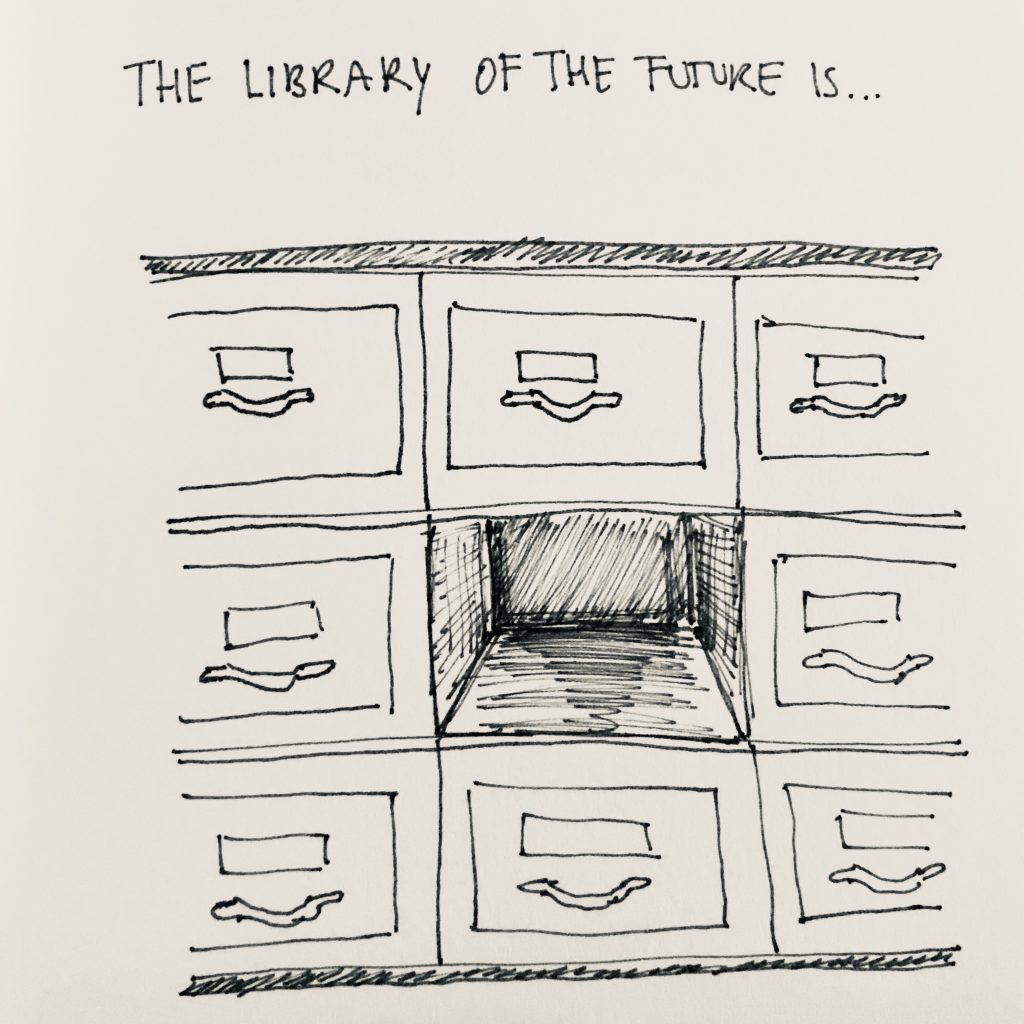
The library of the future is… #OpenBlog19
The library of the future is a physical place, with many entrances and floor and wings to explore. It houses collections of books and manuscripts, tablets, carvings, materials, things, artwork, cultural artefacts and many indices. The library of the future is for human beings and about human beings, our history, our knowledge, our ideas and dreams and hopes.
The library of the future is a place where you can find what you are looking for. A place in which to discover the unexpected. A refuge in which you can retreat from the world and find peace and quiet and contemplation. The library of the future is somewhere you can loose hours, days or whole years to following the red thread of inspiration.
The library of the future is free and open to all.
The library of the future is not dominated by digital data. The library of the future is not focused on making information useful. It does not require you to have a specific purpose or know what you are looking for. The library of the future rewards curiosity, accommodates procrastination and safeguards daydreaming.
The library of the future keeps growing and being added to. It’s bigger than it looks from the outside, expanding into the space that only librarians can safely guide us through.
The library of the future contains things we want to remember and things we try to forget. Recollections of wars won and loves lost. It contains everything ever published and posted, all the journals, newspapers, blogs, vlogs. sites and domains. The library of the future is our archive.
The library of the future is a place of debate, disagreement and dialogue. An institution of reflection and critical literacy. A way of distributing knowledge and the power that comes with that. The library of the future will have a branch near you.
The library of the future is a common good and owned by all.
The library of the future is recruiting… apply now. There are many vacancies.
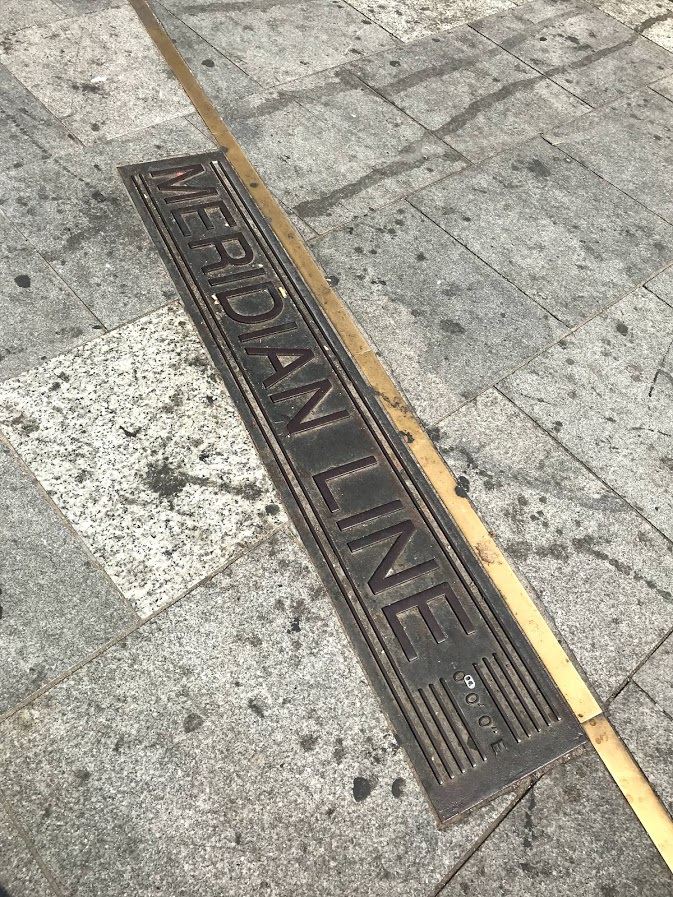
This week I had a really interesting conversation about how to communicate ideas and what role stories play in that. Shortly afterwards I crossed the Meridian Line in London and it made me think about all the different lines that connect our planet and us to each other. Networks, infrastructure, data… we often visualise the connections in a linear fashion. And most stories, too, follow that patterns, they have a beginning, middle and end, reaching from A to B… and back again.
But as an Anthropologist I’ve come across many stories that follow a different pattern, stories that we tell, not necessarily write down, that are transmitted as part of our cultural heritage in the form of songs and tales, art or dance or in material culture.
Over time, those stories can change, we may loose bits or make new additions. We may understand them differently as our context changes, we may not wish to remember them. Some stories never die, whilst others are forgotten.
But whatever shape or form or history stories may have, the act of the telling, is an important part of what we as human being do to make sense of the world. And our place in it. And our own stories. That is why I like to blog for example. It’s a strand of my story that I want to create and share, but also a tool for me to make sense of what I do and think about. It’s part of who I am and of my professional practice.
So when I cross the Meridian I think about navigation and Patrick O’Brian and history. I think about measuring the globe and map making. I think about Victorian explorers and the nature of time. It’s the tapestry of my stories, the frame of reference I have built over the years and that helps me make sense of the world and my ideas about it. Yours will be different, everyone’s is. But if the story I tell is good, then it will communicate my ideas to you and enough of my perspective to enable us to establish some shared understanding.
This week has been a good reminder that what I have to share, what I have to say, is already part of the stories in my head.
With the end of the year around the corner, I’m adding my contribution to the many excellent reviews and reports reflecting on Learning Technology in 2017. I work at the intersection of policy, research and practice, focusing not on technology as such, but on the professionals, the human dimension of technology in education. As such, it’s been an interesting year as the relationship between people and machines evolves. I hope that there will be three posts in this series, starting with this on on…
The ‘digital’ Trojan Horse and the rise of Learning Technologists
This year ‘digital’ was everywhere, specially in education. In the UK Matthew Hancock MP became the Digital Minister (incidentally, it looks like equality still has a way to go when it comes to ‘new paradigm’ Ministers in the G7), I was involved in a UK-wide open course to Develop Digital Skills led by Diana Laurillard and Neil Morris, we read much about the digital skills gap, there were a number of digital policy developments (UK Digital Strategy, Digital Skills and Inclusion Policy, Digital Skills Partnership to name but a few) and everyone from High Street banks to executive training providers is offering to train and educate… everyone in ‘digital’ including teachers.
In education the term has become shorthand for anything to do with using or being influenced by technology, added to existing terms to make new meanings, for example digital education, digital leadership, digital teachers and digital degrees. Beyond education we operate in a digital economy and try to engage with digital democracy. We leave digital footprints, manage digital identities and sign up for digital detox. Digital is a term that has left its clearly defined roots so far behind that it is challenging to unpack its meaning even when there is a clear context – and most of the time it is a convenient way for the ill informed to describe something perceived as new or disrupted or innovative without being specific about what’s actually involved.
Many times this year (for example taking part in the Department for Education’s edtech stakeholder group alongside colleagues from the Learning and Work Institute, the Ufi Trust, Nesta or Naace, in conversation with industry leaders like Panopto’s CEO Eric Burns or working with Aula’s CEO Anders Krohn on a guide to working with edtech start ups, writing about skills development and accreditation on the Efficiency Exchange or talking about FELTAG and workforce development or discussing professionalisation at Online Educa) I have found that the term doesn’t help when discussing learning, teaching or assessment with technology. That’s because it encompasses infrastructure and hardware just as much as having basic digital literacy and goes on to include learning design, purchasing decisions and strategic planning or governance of technology. Digital can mean many things to many people. Deciding how to ‘fix’ problems or address challenges requires more definition to begin with.
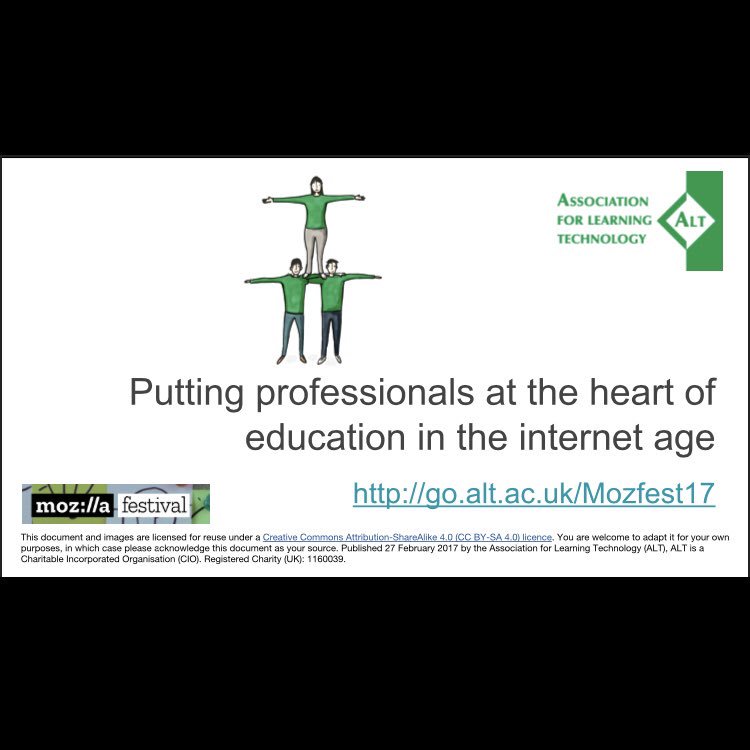
From Mozfest 2017: http://marendeepwell.com/cpd/talking-peer-based-accreditation-mozfest/
Understanding professional practice
I try to unpack what we mean when we talk about digital in education, for example in the context of skills needed in a professional context: whether we mean basic digital literacy that everyone needs to use technology effectively, or the specific skills required to support the use of technology in the classroom informed by pedagogic principles and subject-specific requirements. Or whether we are talking about a professional who takes decisions about which technology to use or buy, how to implement it, how to support the use of it for staff and learners alike. Or indeed whether we are talking about senior professionals who need to take effective strategic decisions about technology, associated risks and how to make intelligent use of it for their organisation.
The vagueness of the term and how it is used can be problematic because it leaves much open to interpretation and doesn’t push us to define and agree on what we actually mean. The language we use when we formulate national policies, when we set institutional strategies, when we define personal responsibilities matters. It shapes our understanding of the world and our part in it. In Learning Technology the language we use helps us understand how professional practice is changing and critically reflect on it.
And yet I find that the ubiquity of the term digital is extremely helpful in many ways. It builds a bridge between Learning Technology and wider social, political and economic developments. It is easy to use and less of a mouthful than other terms like technology enhanced learning. It is used widely across sectors and nations. It feels contemporary, modern, new. And that is attractive to many people.
Like MOOC before it, the term digital helps raise awareness of technology being used for learning, teaching and assessment. We can use it to foster a broader, critical discourse. It can be our Trojan Horse, to open gates in the minds of individuals and institutions who have their heads buried in the sand. We can use its ubiquity to help illustrate the scale of the challenges we are facing and how we might meet them not only in education, but the workplace and beyond. Often having a digital strategy or a post with digital in the job title can be a useful first step to starting a conversation about more complex issues.
The rise of Learning Technologists
What gives me hope in this ‘digital age’, is that there are now more professionals working in all different contexts and sectors who play a part in shaping how technology is used for learning, teaching and assessment.
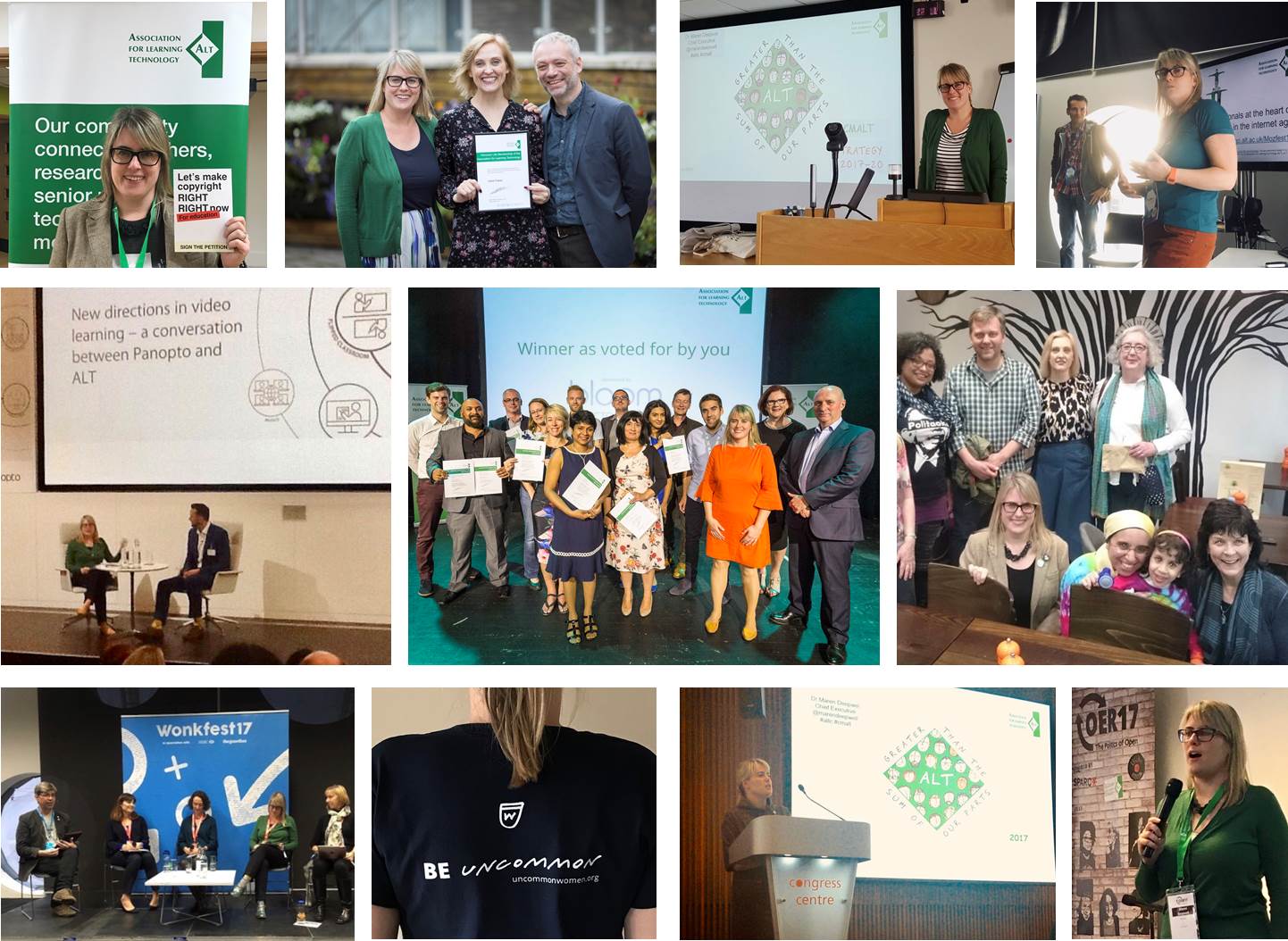
With over 3000 Members for the first time in its 25 year history and Members Groups all across the UK, ALT is a good example of how this professional community is growing. More and more roles in education now have a Learning Technology component and we see ever more senior roles demand such expertise also. On the one hand I still meet too many people who are looking for a magic box they can buy, plug in and which has a little green LED light that blinks and assures them that their organisation is now ready for ‘digital’. One the other hand more and more institutions invest in their people and create specialist roles to make effective use of Learning Technology.
Image from the ALT Annual Strategy 2017-2020. Images created by @BryanMMathers CC-BY-SA ALT
In many cases these professionals aren’t called Learning Technologists and instead have a whole variety of job titles. They may be based anywhere from the library to the IT department or their own department. In some cases they might be on their own, or work across all areas of their organisation. Or they might work independently as a consultant, trainer or manager. From schools, to colleges, private providers and universities, everyone needs more and more know-how in Learning Technology. We have seen a rise in the demand not only for training, but accreditation and professional development from all sectors. Projects like expanding ALT’s accreditation scheme and mapping the CMALT framework to other UK and international standards are a response to the rise of Learning Technologists. The breadth of professional practice that is showcased in the growing register of accredited CMALT portfolios meanwhile highlights that we now have an understanding of the skills and competencies required for this kind of work that is independent of platforms and tools and that remains relevant as we retrain and adapt to new technologies. My personal experience of gaining professional recognition as a Learning Technologist in a leadership role adds to my understanding of how the profession is evolving.
Yet as we move further into a world, and an education system where everything is ‘digital’, one question I get asked frequently is “How we know if or when we’ve arrived in the future that Learning Technology promised?”.
I discuss this questions again and again with policy makers or leaders, in consultation responses or with other experts for example on Wonkhe (here and here). Over the past 10 years I have worked with people who have thought about this question from many different angles. And we return to it frequently as we compare ourselves to what’s happening in other countries, other industries and at other times throughout history.
“How”, they ask, “can we have made progress when there are primary schools without WiFi, bans on mobile phones or laptops in the classroom, inspection/funding/accreditation bodies whose policies often don’t even mention the words technology or digital?”.
“How, and when, will we arrive in the vision of learning that the potential that technology has offered for so long?”.
From my perspective the answer is that we have long since arrived. The promised land of Learning Technology has simply turned out to be no less messy, inconsistent or challenging than what we had before. The forces of global capitalism still shape our education systems. “Are things better with technology in education?” is the wrong question to ask in my opinion.
Instead “How can we best use technology to achieve our aims for learning, teaching and assessment?” is a more useful way of thinking about the future.
And we need a diverse, critical and empowered Learning Technology community to help find the answers. I am glad that the work I do for ALT plays a part in making that happen in the UK and beyond.
I take a collegiate, collaborative approach to leadership and my work in general. I am lucky to have so many people to work, think and make things with. As you’re reading this you are likely to be one of those people, and I’d like to say thank you. You made all the difference to this year for me.
I have been reading a lot of stories recently and two of them in particular really inspired me: Frogkisser by Garth Nix and The Girl of Ink and Stars by Kiran Millwood Hargrave. Both are beautiful reads suitable for younger readers as well, but that shouldn’t put you off.
Both books take you on adventures, in one case following the perilous journey of a cartographer’s daughter across an unexplored floating island, in the other the footsteps of a princess who is leading a band of companions through danger to defeat evil and establish a universal bill of rights. Both books are excellent examples of accomplished, playful and lyrical story telling at its best – perfect for getting lost in new worlds of the imagination.
What they also do is to challenge the readers conceptions of established character types, such as princesses, wizards and heroes more generally. They talk of sisters, mothers and daughters – female leads are everywhere. In the Frogkisser for example, we visit the Tower of the Good Wizard, who turns out to be a young women with a preference for red boots… whilst Snow White is a retired wizard (complete with detachable long white beard). Garth Nix displays such playful mastery of the fairy tale tropes in the story that it makes you wonder where your earlier mental images came from and how they were fixed. As someone who has read A LOT of fantasy and science fiction I appreciate the flexibility and equality of stories such as Frogkisser especially.
Similarly, in The Girl of Ink and Stars, the narrative is wound around the process of reading maps, charting new territories and mapping out a lost, unknown place (saving everyone and the world in the process). The girl, our heroine, is at once capable and relate-able. She (re)writes history, shapes the narrative and her world through her work as a cartographer and through her eyes and measurements (explained in loving and scientific detail as her journey progresses) you can participate in the adventure. Stories, particularly poetic ones like this one, can create a world of greater equality, can change perceptions so much more elegantly, so seemingly effortlessly, than we can through policy or even direct action.
Like the women pioneers and activists and leaders and voices in our reality, the heroines of these stories help shape our imagination and our understanding of the world we live in. Get reading… or reading out loud to the younger listeners in your life.
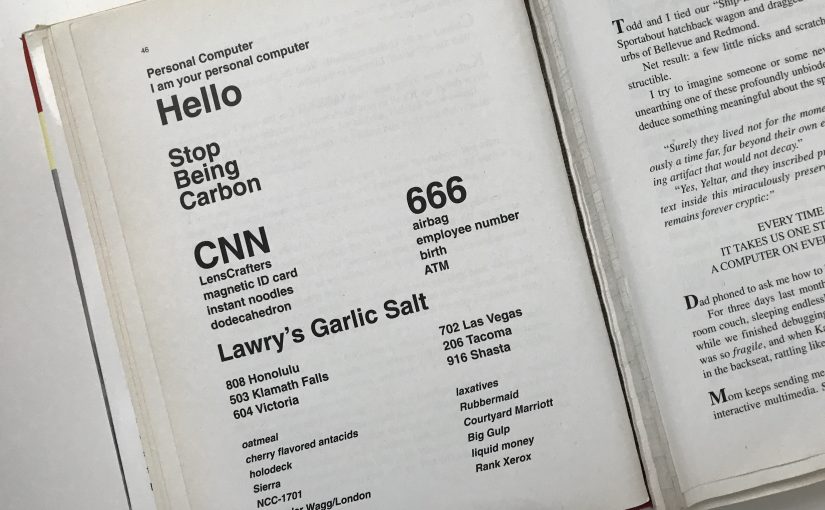
In 1995, when I first read Douglas Coupland’s Microserfs, I was fascinated by the ‘machine’s subconscious’ diary entries that cover pages and pages of the book. Outside of science fiction it was my first encounter with ideas of artificial intelligence and machines that may dream one day.
As someone who has written in their various journals near daily for three decades I was particularly interested in the relationship between what’s inside the main character’s head and the machine he confides it to.
Writing a diary or a journal is a very personal undertaking, and for many years now I find that the advantages of keeping back ups, being able to search and revisit past entries far outstrips any benefits of keeping physical records. Typing something like “Dear Diary….” into a digital interface feels a bit like having a conversation with a friend and confidant from the digital realm. By typing, writing down my thoughts using a laptop, I’m having a very long, very one-sided conversation with an imaginary machine friend if you like.
Writing at this time of year when everyone is either on holiday or about to be, I’ve thought about where my (imaginary) artificially intelligence friend may go on holiday in the future – and I do think he (‘he’ is a he in my mind) will go on holiday, because immortality is pretty boring after a while and everyone needs a change every now and then.
Into music: how about exploring music of a particular place or time, not just audio recordings, but all records of musical expression – travelling back in history to explore the sounds of a particular people or place.
Making pottery: if in any way like Star Trek’s Mr Data, then a more tactile pursuit will appeal as a holiday activity and making something with your hands and learning a new skill could be a challenging and rewarding experience.
Sitting on top of the world: if travelling either physically or digitally to let’s say a satellite orbiting the planet, meeting up with a friend and watching the world go by (literally) could be fun.
In a spreadsheet…: or a future, more elegant version thereof. Maybe machines will build mathematical landscapes or monuments to go sightseeing in the realms of 1s and 0s. What would a souvenir from that holiday look like?
For now, I shall enjoy the sunshine in a traditional, human way, and be glad to feel a warm breeze on my skin. Summer’s here 🙂