Category: leadership

  • #23things: Getting started with a team

    img_3141
    Team-made biscuit plate…

    As I mentioned in my previous post, I’ve signed up for some new open courses this autumn. Since then, I’ve encouraged my colleagues from the ALT staff team to join the 23things course and we are now embarking on it as a team.

    Like many organisations we are always looking for effective ways to provide CPD opportunities around use of technology and I think the course looks like a great way to meet that need. Given that we are a small, distributed group a course that is wholly online and has some flexibility as to when and how you learn seems ideal.

    As we want to take part as a team, we have set up some additional “taking part” support, including adding a discussion about our experiences to our weekly team meetings and a shared Google folder and doc “scratchpad” for everyone. While we are taking part in an open course I also want to create a safe space for everyone to experiment and share their views without them being public.

    So, I am joining in with this first post about what I’d like to gain from the course and also some reflections on the social media guidelines that we follow:

    First, social media guidelines: that’s something I think about quite a lot and as well as the guidelines of our host institution we publish our own policies governing our different platforms. Some of us are very active on social media, others less so – but events and membership activities are increasingly finding their voice on different platforms. So, as well as developing various digital literacy skills, the course will provide an opportunity for us to talk about our approach to social media as a team. I found Eric Stoller’s talk at the Jisc Digifest very inspiring on this topic.

    Secondly, what do I hope to get out of the course? Learning new things is definitely the top aim, but this time round I hope we can learn something new together. In our organisation we move very quickly from one project to the next and sometimes there isn’t enough time to enjoy the process of finding a solution to a problem or implementing something new. I hope the course will provide a way for us to share more of that experience.

    Open/closed? I have thought quite a bit about writing this post, because in the past when I have shared my practice openly I haven’t written directly about the colleagues I work with daily. There is a lot to consider when you share your practice openly and my own participation should support and contribute, not hinder anyone else’s progress. So I think the approach I will take is not to write about anyone’s personal experience or journey – or at least not without their express permission. I won’t share anything unless it is already in the public domain (and intentionally so) and with my colleagues’ consent. And I will contribute, just like my colleagues, in our internal spaces as well as this more public forum.

  • CMALT CPD Log: tracking professional development using Google Apps

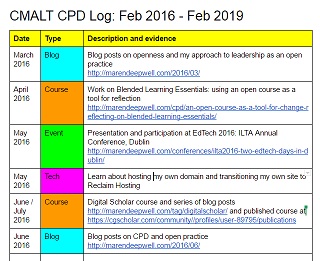
    Since gaining my CMALT accreditation in February, I have been struck by how much of a difference it has made to me (and I am not just saying that because I work for its awarding body…). As well as providing useful evidence for my work day to day, it’s made me take a more focused and considered approach to my Learning Technology work. Part of it is developing a habit to reflect, about learning to pause and take stock before moving on to the next thing. I’ve also started being a peer assessor for other candidate’s portfolios and that has been an interesting process in itself, making me feel more connected with other professionals working in the same discipline.

    As the portfolio has to be updated every 3 years (as explained here) I’ve been considering how I am going to track my own activities. Three years is a long time and I think I would dread having to compile everything in 2019. So, like other CMALT Holders before me, I have tried to devise an approach to help me keep everything in one place and link easily into my portfolio that I built using Google Apps for Education.
    CMALT_Log

    Main aims: keep a running log of CPD activities, make it as easy as possible to log these, keep the format linked to my portfolio so that I can transfer content at the review stage and keep evidence.

    First steps: I set up a Google sheet and a form initially, but found that I didn’t like it because typing longer text into each cell didn’t work for me and the form felt too impersonal. I wanted to give myself the flexibility to add reflection and expand the format whenever I want. So I started a new Google doc instead, with a table, free text sections and an appendix section with guidance from the ALT website. I also set up a folder for additional evidence to be stored.

    Collect evidence or risk loosing it: it became quickly apparent that a lot of evidence I was logging is contained in my blog. As I now host that on my own domain (thanks, Reclaim Hosting 🙂 I feel that this works even in the long term. However one course I participated in this summer has published my work only behind a log in. So I took screenshots of the key information and stored them in the folder in case I loose access in the long run. Certainly the process of logging the evidence was the reason why I did this – otherwise I don’t think I would have.

    Where’s my CPD heading? As well as aiding reflection and encouraging me to keep my work properly backed up colour-coding different categories of CPD (e.g. events, blog, course… etc) made it very clear what I have been focusing on and areas in which I could do more.

    Tags, categories, images… couldn’t I do all of this in a more elegant way? I am sure I could. There are apps out there that would certainly make it look and feel a lot more glossy. If you have found a way that works for you, I’d love to see how it works. For me, sticking with the same format as my portfolio works for now.

  • #DigitalScholar week 2: course structure v a trail of breadcrumbs

    CuriosityI’ve been working on my course outline as part of the #DigitalScholar course I’m participating in. The deadline is on Friday and I have been catching up on the guidance and help provided to get my submission ready. The topic of my course is using reflection as a CPD tool in Learning Technology.

    As I mentioned previously, the course is run on Scholar, a new platform for me, and I feel we are gradually making friends. The ‘creator’ tool we are using took some getting used to – but it soon becomes easy to use. I’ve still drafted most of the text in a Google doc in the first instance, but translating the draft into the creator interface was straight forward and I really like the fact that you are creating content in a format which can then be used in different ways, basically working in something like a publishing interface meets back-end content management. Anyway, one of the most useful pieces of guidance provided by the course team is a rubric which sets out what sections you need to include in the outline for your future online course, what kinds of things to consider, what potential participants might need to know and so forth. It’s very helpful as well as thought provoking – in particular when it comes to thinking about possible business models for future courses. My experience on courses like ocTEL for example, was all about delivering an open course without any financial contribution from participants. The #DigitalScholar process makes you reflect on that and what sustainable alternatives might look like. It’s useful and valuable to be challenged to think about this during the initial course design phase I think.

    But… yes, there is a but. I think the more I work on my course outline, the more I think about course activities, learning outcomes, accreditation or peer-review or indeed the underlying business model, the more I realise that the kind of course I’d really like to design would be quite different. Only by trying to create something new within a given structure, using the platform provided, have I started to realise what it is that I am actually curious about. It’s still a bit blurry, but some elements are starting to become clear. Here is what I have so far (and keep in mind that this is professional/personal development for me, so I am focused and what I am interested in rather than what I need to deliver at work):

    Minimal content. A little like various “thoughts for the day” or “image of the day” creative approaches already happening. Maybe via email or Twitter – but no learning objects as such, mostly just a prompt. Or a trail of breadcrumbs to follow.

    One way to curate contributions. That’s probably inspired by what we did with ocTEL, creating a way to use hashtags to collate contributions from across different platforms so that participants can stay within their native environments. It would probably be much harder to balance out the bias of any chosen platform in practice than I imagine, but this is all in my head anyway.

    No video. Just words. This is where the story element I am after comes in. Like reading a story, participants should be able to imagine things for themselves rather than being shown.

    Any pace. I think my ideal course would have no set pace, no fixed end date. A little like my experience of participating in Dave Cormier’s #rhizo15 course, there would be a no constraints.

    Reflect. The main focus of the course would be on reflection. Whether you do that in your head, draw it, write it down or share it wouldn’t matter. Reflection is a personal undertaking and the course wouldn’t need to measure that. It would be up to people participating to decide whether they reflect or how well it worked for them.

    Hmmmm. All in all I am not sure what I am thinking about is a course at all. Maybe it’s more an activity others could join in with.

    So, that’s my progress report from week 2 of the #DigitalScholar course. Thus far I have made a lot of useful connections, met a new platform, participated in a couple of inspiring online meetings, created a draft course outline and – well, come up with a completely different idea as well. Well worth it, I think!

  • 1, 2, 3, 4… 5 years as CEO: a new series of posts begins here

    photo 2Part of my focus in this blog is on sharing my approach to leadership as an open practice. This is my fifth year as chief executive of ALT, the Association for Learning Technology (if you want to find out more about ALT, visit the website) and over the next few months I will be writing a series of posts – each one reflecting on one particular aspect on my experience and work.

    I’ve been wanting to do this for some time and indeed I do write on this more frequently in a less open forum. But my fifth year in this role seems like a good time to do this and to use this series of posts not just as a tool for reflection but also to provide some insights for others. When I applied for this role in 2012 I would have liked to read something like this and I hope it might be of use to you.

    There is a lot I could write about and I have been thinking for a while on what topics might be best suited for these posts. For now, these are the themes I have settled on:

    • being a woman makes a difference;
    • I am where the buck stops. That can be a lonely place;
    • change is a good;
    • learning new things all the time is a must;
    • what motivates me.

    So, that’s what’s coming up. I haven’t written it yet, but this post is a bit of a road map for where I want to get to with this series of posts. Thanks for reading and look out for post number one, coming soon.


  • #OER16: Empowered openness

    Sea from the trainOn the train on the way to Edinburgh to the OER16: Open Culture conference I was past York and heading North when the sun came out. A while later the train tracks approached the coast and I looked out at the sea for the first time in months. A wide blue sea under an open sky. In the distance LEGO-brick like shapes of container ships appeared as we neared the shipping lanes and in the brilliant sunshine we approached our destination. It felt like this conference certainly had good meteorological karma.

    Running conferences is hard work, so as you might expect I didn’t get to go to half as many sessions as I would have liked – but what I did have was an experience worth sharing. If you participated in any part of the conference whether online #oer16 or in person, you will likely have your own take home moments. Here are a few of mine:

    MHighton_OER16Melissa Highton’s closing keynote gave me a glimpse into what it takes (and whom!) to make OER and openness work at scale across a whole institution, for hundreds of staff, tens of thousands of students and the wider community. Armed with a strong vision and persuasive arguments for senior decision makers it was awe-inspiring to hear at what scale and with what commitment Melissa leads colleagues working to achieve the university’s vision for openness. For someone in my position who has to make arguments for openness all the time, there was a lot to take away and adapt in this presentation.
    IMG_2569Making ‘open happen’ by doing it was also something that John Scally,  from the National Library of Scotland, inspired me with. Again, this is openness at scale with literally millions of openly licenced resources being ‘born digital’ in a major national undertaking. Like last year’s keynote speaker Cable Green from Creative Commons, John’s commitment to widening access and sharing with us an understanding of what it takes to open up the national collection of Scotland to all was eye-opening.
    IMG_2564Meanwhile throughout my two days #oer16 I saw participants all around getting involved in conversations, making new connections, getting stuck into workshops with everything from musical instruments to colourful creations. Poster-side discussions took place with a back drop of Arthur’s seat and outside in the welcome (and persistent) sunshine the conversations continued.
    IMG_2571The Wikimedians also had a lot of activities taking place on both days organising editathons including one on Women in Art, Science and Espionage, walk in “ask a Wikimedian” sessions and presentations . Their support for and involvement with the conference is only one example of how many connections this community has. Long-haul conference attendees staying in Edinburgh for the LAK conference the following week were an equally welcome addition.
    @BryanMMathers_OER16Looking back at the two days there is one theme that is particularly relevant to me and which Catherine Cronin explored in her opening keynote: participatory culture (and I am including a visual thought from the wonderful Bryan Mathers here). Catherine was speaking about openness, equity and social justice and her opening set the tone for what felt to me the key factor that made this conference work: participation. Participation as in having a voice, a stake in what is happening, a share in the common future, the future of the commons.
    Whenever I hear Catherine speak I reflect that despite the awesome challenges we face in terms of content, infrastructure, technology and policy it is ultimately a very personal thing to be in the open, whether through open practice, creating open content or shaping open policy.
    Emma Smith, whose articulate story-telling was spell-binding and thought provoking at the same time, made a comment that most academic ‘work in progress’ being shared is so close to the finished product that it is ready to publish. It is harder, more exposed, to share the actual rough drafts, the work in progress that isn’t something we feel proud of, our processes.
    Processes of practice, of production and ultimately of our own learning are personal. It’s about who I am, how I think, what I learn – and that is a scary thing to put in the open. And yet, as a magical glimpse into the world and work of Jim Groom proved, there is so much to gain, such potential, when we do.

    IMG_2566That is why we are working to take control over our own domains, our data – being empowered by how we use technology and how we contribute in open spaces. That’s what I am taking away from #OER16 and supporting that process to thrive will be my aim for the next year until OER17.

    Recordings of these keynote sessions and lots more available via the OER16 website. 

  • An open course as a tool for change: reflecting on Blended Learning Essentials

    One project I am currently involved in is a course on FutureLearn called Blended Learning Essentials.  In this short blog post I want to think about how this course, or others like it, can be used as tools for change.

    A bit about the course
    UntitledThis is an open course about using blended learning for vocational education and it runs for a total of 8 weeks in two parts. The first part covers the ‘essentials’ and the second focuses on ’embedding’ blended learning. Content and in particular the videos are created in collaboration with teachers/learners in vocational education contexts and shaped by current practice. If you’d like to see what it’s like for yourself, parts of the course are accessible without signing up: Going beyond reflection to data https://goo.gl/cwGRtQ, collaborative learning to improve learner support https://goo.gl/LwnCnA, sharing and re-using teaching ideas https://goo.gl/gHdsp9 and managing a culture change https://goo.gl/j7q17q.

    Change for learners and teachers
    One of the aims of the course is to provide an entry point to using learning technology effectively regardless of what participants already know or feel confident about. While that is a big ask it also highlights the fact that there is a big disparity in the relevant competencies across the sector. At one end there are enthusiastic individuals or institutions whose learners are benefiting from technology-enhanced innovation and at the other end of the spectrum are those who don’t know where to start. Learners may or may not have access to devices and networks, but once they do, they need to gain skills that will be useful for them in what they do next and teachers need to be able to support them in that. So one way in which a course like Blended Learning Essentials can become a tool for affecting change is to provide a path to building competencies and confidence for those who deliver learning. It could be incorporated into existing internal provision, to enhance what a provider or group can offer internally – or it can act as a way to start scaling up CPD.  Similar to another course I worked on in the past, the Open Course in Technology Enhanced Learning (ocTEL) it can provide flexible chunks of CPD depending on what the participant is most interested in.

    Decision makers who manage change
    While learners and those who deliver learning can make use of the course, I think that those in decision making roles also have something to gain. To begin with they can participate themselves, online and at their own pace, to refresh or supplement their own skills and knowledge. Particularly if you don’t get much time to have hands on experience with learning technology, the course can help bridge the gap. The case studies and discussion forums meanwhile can be used as a frame of reference for establishing where a particular organisation is in terms of making intelligent use of learning technology, what common barriers are or how to solve problems. Particularly the second part of the course (the last 3 weeks) are relevant in this context. Given that the course is free to attend and most of its resources openly licenced, it can be an efficient tool for up-skilling and provide paths to accreditation (accreditation is the part of the course that I have worked on most, so I am going to point to further information and in particular its mapping to CMALT for those who are interested).

    Some limitations
    I think this course can be a useful tool for affecting or managing change, from introducing blended learning, to scaling up provision or enhancing it. But there are also some limitations:
    It’s online: this is a free ONLINE course about blended learning. It requires you to get online, supports you to develop the skills to engage with it and while you can certainly participate with a group of colleagues and support each other face to face, being able and willing to learn online is a key requirement. If this is a major barrier for you or your institution the course could be a useful way to build your capabilities in this area;
    Accessibility: actually, in my experience the FutureLearn platform excels at making courses accessible and if you are in doubt it’s definitely worth exploring the “how to learn” resources they provide or make an enquiry;
    It’s not advanced enough: as the course is aimed at those who don’t already have advanced skills it can seem too basic for some. The discussion forums and social media conversation may be more interesting to those who find some of the content too basic or it might be a useful tool for supporting colleagues;
    So what?: One of the most interesting aspects of the course for me as to see how strong a driver learners’ future success is for getting individuals and providers do more or better blended learning. As everyday life and work require more skills for using technology it becomes more urgent that we use it effectively for learning, teaching and assessment. Other drivers for using blended learning might be providing more flexible provision, broadening access, scaling up or enhancing delivery, improving feedback & assessment…

    Things I’m thinking about next
    Working on this course has made me reflect on the conversation about open courses, what they can be used for, what they achieve in terms of creating communities, scaling up provision and supporting professional development.
    This course is a first in more ways than one, it’s the first course on this particular platform for the vocational education sector, to my knowledge it’s the first open course in this context that has attracted over 20k participants and it’s the first time we have seem a large scale response to the policy agenda in UK that is supported by some many organisations.
    It’s a tool we can make use of to affect change and we can probably use every bit of help we can get in achieving effective use of learning technology across the sectors.