This is a written version of my keynote for the ETUG conference in Kamloops, Canada, on the 21st June 2019. Thanks to the conference organisers you can now also watch the video of this talk.
You are more than a data point. Weaving a tapestry of hope and humanity.
It’s a real privilege for me to be here, to have been invited to contribute to ETUG’s 25th Anniversary Conference, and also to have the honour of taking part in National Indigenous Peoples Day.
I’ve dreamt of coming to Canada and this part of Canada in particular ever since as a teenager I discovered the books of Douglas Coupland and the art of Emily Carr. So when I met Clint Lalonde at ALT’s 25th anniversary conference in Manchester in the UK last year, and I heard more about the work of ETUG and the community here followed by the invitation to come and give this keynote, I started writing straight away. Parts of this talk are many months in the making, whilst other things I am going to talk about this morning are fresh off the press – so new in one instance, that you are going to be the very first audience to see them.
I have worked for ALT, the Association for Learning Technology, since 2008 and one of the reasons why I love what I do is that I have always been interested in how we, as human beings, relate to the world around us, and in particular how we relate to technology. For me, there is no better context than education and lifelong learning to explore how that relationship is evolving as digital technology becomes more pervasive in our lives.
There is a lot that we do as the leading professional body for Learning Technologists in the UK and some of it may already be familiar to you and has much in common with the work ETUG does. But there isn’t time to cover everything in this brief introduction and so instead I want to highlight our values of openness, collaboration, participation and independence, with our 3,500+ Members at the heart of everything we do.
The one question I often get asked about ALT, is what is Learning Technology or who is a Learning Technologist. Well… I’ve brought our definition along so you can see for yourself. I’m proud to be a Learning Technologist and one of my aims today is to unpack for you exactly what that means to me and who my professional self is… how my professional practice has been shaped by who I am. This element of my talk is a personal story, it’s part of my story and one example I will use to challenge the perception that the ‘march of the machines’ is moving us to a future in which we are all just data points, gadgets or messy human problems that need to be ‘solved’ by technology.
On the one hand, my perspective is informed by research, practice and policy making from 25 years of the Association’s work with thousands of professionals in the UK and from across the globe … on the other hand it is my personal perspective. I want to share what the world of Learning Technology looks like from my point of view in order to get across why it is so important that we develop a more mature and reflective, a more critical perspective in our professional practice and how we might set about doing so in the age of automation and technological determinism.
But let’s start at the beginning… and that goes back to Clint, who gave a wonderful talk last year that started with
“…When I grow up, I want to be a Learning Technologist… (said no child ever)… .”
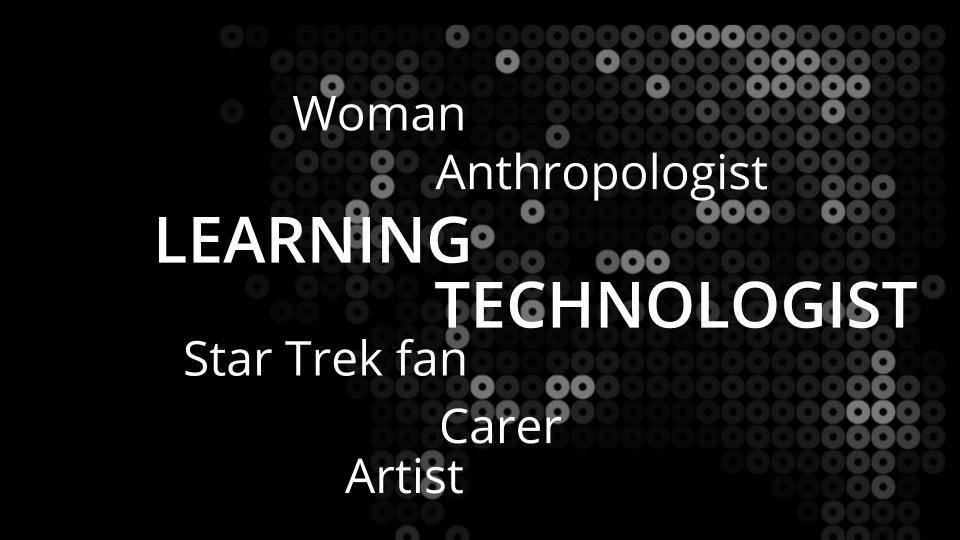
Well, I certainly didn’t start out on a path straight to becoming a Learning Technologist either, although I think I always wanted to be someone who works at the intersection of technology, learning and society, someone who plays a role in negotiating our relationship with innovation. On my way to becoming who I am today, many different roles have played a part: Being a woman, an Anthropologist, a carer, an artist… and a Star Trek fan 😉
As an Anthropologist I studied cemeteries, I learnt about the concept of being there, immersing yourself in the viewpoint of the other, to spend a year doing ethnographic fieldwork, walking in someone else’s shoes. Eating, drinking, breathing… being in the world that is not our habitual one, really learning what the world looks like through someone else’s eyes. In our own context, that someone else may be educators, researchers, librarians, students, IT Helpdesk – depending on where you yourself are situated. A Learning Technologist should be a bit of an Anthropologist at heart, always translating between sides that can’t see each other’s perspective, who don’t speak the same language, who don’t measure success in the same unit. A Learning Technologist works to bridge that gap, to translate one sides requirements into another’s user experience.
As an Artist I value curiosity. I understand that there is a certain amount of messiness that’s essential to the creative process of solving problems. I learnt about how there’s always more to discover, how things are always in flux and how we (re)invent even the end of (art) history to write a fresh chapter on our human endeavours. The creative process reminds me of how important it is that we are human beings with human bodies and human senses that shape how we perceive and interact with the world. We can only perceive the world through human eyes even though technology has enabled us to look at the world differently for many hundreds of years, from chalk paintings to photography and video. Each technological advance brings with it a new perspective, new insights. As a Learning Technologist a big part of what I do is keeping pace with change and negotiating the role of human beings with society, with technology, with each other. We help shape who, what and how we teach the next generation.
As a woman I learn each and every day about the limits of technology and the reality of privilege, prejudice and power. Whether it’s inherent algorithmic biases, gender data gaps in the datasets used to train AIs or mobile phones that aren’t designed to fit in my ‘smaller than the average man’s’ palms, all of these examples and countless others highlight how important it is to question how technology works, to interrogate what’s behind the dashboards and predictive models, the disruptive technology that is hailed as the next big thing.
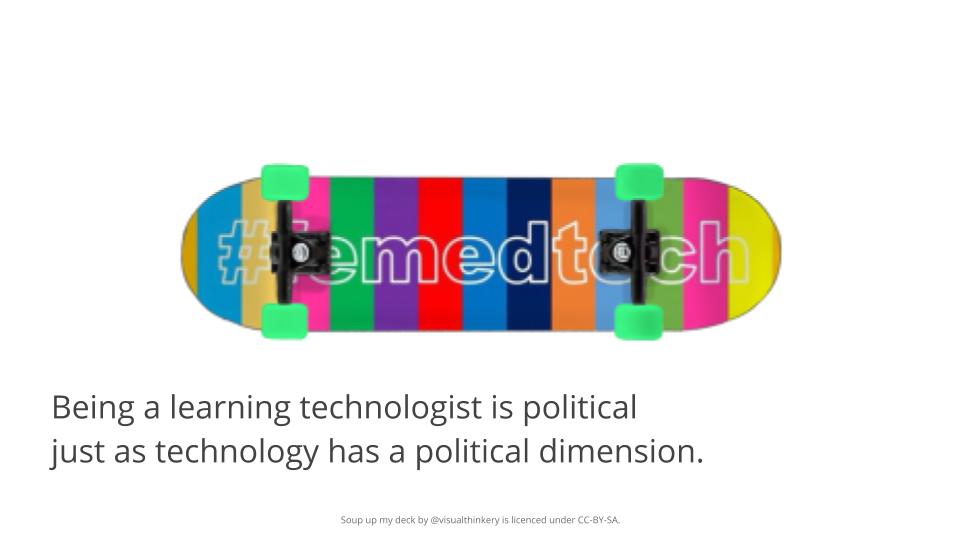
As a Learning Technologist I work to understand precisely these things so that I can provide expert advice to decision makers, ask vendors and developers the questions no one else might, to identify training and development needs for staff and students, to keep up to date with every new way in which technology challenges our values and our working practices from labour disputes to efficiency drives. Being a Learning Technologist is inherently political just as every technology has a political dimension.
I am also a carer for my elderly parents and this role prompts me daily to reflect on the importance of care and kindness. To care for others tests the limits of what even the most advanced technology can do in the face of naked need for certainty, comfort and warmth. Caring for the young and the old is often hard. But it is an essential part of what being human is all about. The journey we are on from birth to death is not one we can undertake alone. We are social creatures. We live, we love each other. We connect, communicate and care for each other. No one wants to die surrounded only by machines. Being human is not a quest for perfection. It’s simply how we experience our life, the world, the universe.
As a Learning Technologist I’m reminded of that every day. The business of learning and teaching and assessment would be so much easier if it involved one machine being taught by another machine with everything tidily captured in a data set for us to analyse and examine. Instead, we have a political, emotive, heavily contested definition of what education is, how we learn, what the purpose of it all is. Because we are all much more than a data point and that complexity is important to acknowledge. Our experience of the world, our way of learning and understanding the world is so much more than what can be captured in zeroes and ones. The ones and zeroes… in short, technology, is important, sure, but they should not define our lives or determine the shape of our education system.
As a Star Trek fan I developed my enthusiasm for the wonders of technology. I discovered my love for artificial intelligence and … androids. So much of how we interact with technology now, like tablets and voice recognition and mobile phones were all born in my imagination shaped by the Starship Enterprise, and the ship’s smooth glass surfaces, the talking computers and the crew’s ingenious problem solving inspired a lifelong love for being hard working and solving puzzles. As a Learning Technologist I often feel like there’s a lot of Star Trek in my world and some of the tech advocacy I come across is certainly trying to sell me a vision of the future that’s close to what sci-fi of a few decades ago promised. But what has stayed with me more than the glitzy computers is the value of things like craft, creativity and ultimately humanity (or its alien equivalent) that was and still is at the heart of Gene Roddenberry’s vision.
Being a Learning Technologist gives me the opportunity to think about some of today’s most urgent questions. My professional practice enables me to address some of the biggest issues we face. Technological innovation or disruption alone can’t help us articulate answers to such questions. As for example Audrey Watters wrote in her annual review The Stories We Were Told about Education Technology (2018) or as Martin Weller wrote in his blog series on 25 Years of Ed Tech “education is fundamentally a human enterprise” and as such we must situate our use of technology and our relationship with it in the theoretical, historical and critical frameworks from across disciplines. Just as I’ve shown by sharing how my own journey shapes my approach and practice, our own stories are particularly important in this context.
Some might think that day to day activities like designing LMS modules, explaining how open licencenses work or training staff in the use of social media is far removed from these ‘big’ issues that I am talking about. That the majority of us work within systems, frameworks and institutions that leave little freedom for addressing such questions. But let me share some examples of what I mean: take the value of labour. Last year, a new institutional policy for lecture recording was being developed at the University of Edinburgh. Melissa Highton, Assistant Principal and Director of Learning, Teaching and Web Services (LTW) at the University of Edinburgh, blogged openly about the process which started normally enough but then happened to coincide with industrial action at UK universities and suddenly the questions about the new policy went from pedagogical approaches, attendance levels and revision tools to such concerns as whether or not a university may use recorded lectures to “replace” teachers during strike action, enabling the institution to continue “delivering learning”. It is a huge credit to those involved that with input from all parties the process has resulted in a robust policy which was successfully adopted and now serves as a model not only for lecture recording policies in general, but also for openly sharing both the policy making and consultation approach and the resources created for wider benefit. It comes back to my earlier point, that Learning Technology is inherently political and that we need to be mindful of how our use of it shapes the value of labour.
Another example is an initiative that was recently announced in the UK focused on student suicide prevent which included a project which aimed to: develop an “Early Alert Tool, led by Northumbria University, which will identify students at risk of mental health crisis by mining data sources, like social media.” This and other national efforts to scale up the use of learning and learner analytics ask serious questions of us: they require us to articulate how we can make ethical use of such technology, what approaches we want to see adopted by policy makers and how we can cooperate with each other and with industry to educate ourselves and our students. ALT consulted its membership and submitted a response to the UK’s All-Party Parliamentary Group on Data Analytics. Of course, this example only scratches the surface of the scary realms that some of the more sophisticated surveillance products in education are operating in. Martin Hawksey’s recent keynote on surveillance, which demonstrates some of what is possible with readily available tech and a few hours of coding, should be your next read if you’d like to learn more.
Earlier this year, I took part in a panel discussion at the Royal Society in London on Human Transformation Remembering and Learning alongside Diana Laurillard and Diana made a point that really resonated with me: Diana reminded us of the enormous scale of the demand for education (at all levels) worldwide. Diana reflected on how many hundreds of thousands of teachers will be needed to provide education and training as more and more learners in the global South in particular gain access to education and come online. Technology properly and intelligently used, Diana argued eloquently, can help us scale up provision and broaden access for all learners, especially those who may otherwise not find access. But the teachers at the heart of that endeavour also need the requisite digital skill. Alongside the rest of the workforce, we in education face a huge challenge of continuously up-skilling literally everyone to keep pace with even the slowest pace of change and innovation. And that is another context in which we who work in Learning Technology face the sharp end of the adoption curve as we need to keep a step ahead not only of everyone, staff and students, who need the right skills, but also the decision makers, those who negotiate contracts with suppliers and take decisions about what technology will be used, so that we can advise them, help them ask the right question, provide an expert perspective situated within the learning context, rather than coming from the developer or sales executive.
With only these three examples we have uncovered the huge range of situations and contexts in which we work… and I want to focus next on what skills and capabilities we need and how we can make sure we have strong recognition for what we do. ALT’s work reaches back nearly three decades and we have seen Learning Technology change from a specialism adopted by single individuals from different disciplines and backgrounds to growing into a career path that attracts more and more professionals and leads from junior positions all the way to the most senior ones. I fall somewhere in between as I, too, have come to this work from a different background as I have recounted earlier. But for the past 10 years I have been working at the heart of developing and enhancing professional recognition in the UK and that has given me a lot of insight into how things are developing and what we do next.
ALT’s approach centres around these four core principles of professional practice: it starts with a commitment to communicate and disseminate best practice and also an empathy and willingness to learn from colleagues from different backgrounds and specialisms. It requires a commitment to keep up to date with new technologies and at the heart of it all is a commitment to exploring and understanding the interplay between technology and learning. Bryan Mathers worked with ALT Members of a period of months to create this visual thinkery so that we can share our approach more widely.
Building on these four core principles is ALT’s accreditation scheme, CMALT. CMALT stands for Certified Member of ALT. It took me three failed attempts over five years to finally submit my own portfolio for peer review, so I can share a bit of my own experience with you and I can happily say that I find CMALT to be worthwhile and valuable not only as an important professional mark of distinction for my CV, but as an opportunity to continue my professional development as a peer assessor.
If you haven’t come across CMALT before, here is a quick overview.
CMALT as a framework has operated successfully for over 10 years… but what I want to share with you next is a bit of a sneak preview of what is launching next month in ‘BETA’ and officially at ALT’s own annual conference this year, in September. It’s taken input from many ALT Members, 4 pilots, many consultation sessions, webinars and wider consultation via ALT’s Annual Survey over the past 18 months… but now the new and expanded CMALT framework is ready.
In addition to the existing CMALT accreditation, we have developed an expanded framework that provides two new pathways to accreditation: Associate CMALT and Senior CMALT.
Here is how we distinguish between the different pathways and who we think they will be most relevant for: because we understand that there is a wide breadth of Learning Technology roles and our current baseline of portfolios includes many different job roles, we include differentiators such as years of experience, what the focus of a role may be, how big an impact a role may have and so on.
I have been involved in the pilots both as an assessor and also as a candidate, as I have expanded and rewritten my own portfolio in order to test out Senior CMALT for myself. My portfolio, both the original and the expanded version are openly available via the CMALT portfolio register and also via my own blog. If you follow #CMALT on Twitter you can often find blog posts and shared portfolios and that sense of shared practice, of peer support and reflection is a big part of why I feel ownership over my portfolio in a sense that I haven’t felt with institutionally owned cpd activities. I host my CMALT portfolio on my own domain (with the help from the awesome folks at Reclaim Hosting) and it will develop as my professional practice does.
The new and expanded framework however still requires the same three elements in each section. It sounds simple enough but actually many of us struggle to take credit for our work in the first person, many of us struggle to articulate sentences like “I did this…”. Similarly, reflecting on failures is such a valuable but difficult undertaking. Very few feel comfortable to include examples of things that went wrong in their portfolio although this is a perfectly valid way to proceed and I personally find it’s a shame that this record of our professional practice doesn’t often reflect the extent to which we need to take risks, experiment and allow things to fail in order to succeed.
So, here is a quick preview of what the expanded framework looks like, starting with the four core competency areas required for everyone. This slide covers everything that Associate CMALT requires.
For both CMALT and Senior CMALT, additional areas need to be covered, including a specialist area, which candidates can define themselves.
Finally, for Senior CMALT we have designed a new part of the framework which focuses on an advanced area of practice that needs to address each one of the four core principles we looked at earlier. Personally, this is the part of writing my Senior CMALT portfolio that I enjoyed the most. I picked promoting equality in Learning Technology as my advanced area of practice and I then faced the challenge of having to relate that to how I keep up with new technology (actually, if you have read books like Invisible Women, you will know that the gender data gap makes a real difference to how technology is developed) or my commitment to disseminating best practice. It made me look at my work in a completely new and unexpected way.
I mentioned earlier that CMALT is based on peer assessment and everyone who gains the accreditation is strongly encouraged to become an assessor in turn. I wasn’t sure how I would feel about being an assessor to start with, but working alongside some experienced Lead Assessors I found that it has become an important part of my professional development. It constantly challenges my understanding of practice and as the peer review gradually scales up year on year, it provides a robust and yet agile foundation for our understanding of how professional practical is developing, allowing us to map how things are changing. The CMALT framework has been mapped to a number of other competency frameworks and we are always looking for new frameworks to map to. Do get in touch if you would like to collaborate with us.
“Why did we set out to expand the CMALT framework?” I hear you ask.
Well, my answer is simple: “because more and more roles in education require Learning Technology expertise.” Our existing framework has stood the test of time for over 10 years and continues to be at the heart of what we do, but we also know that the community we serve is growing, is diversifying and its needs are increasing.
For example, more and more Members of ALT have senior, management or leadership roles and Senior CMALT will provide a valuable pathway for them as they seek to progress from CMALT or to provide a stand-alone accreditation appropriate to their role and requirements.
The graph I have just shown you is from ALT’s Annual Survey and alongside the CMALT peer assessment process the survey generates open data, anonymised open data, which helps to map how professional practice is developing and which we publish annually both as a report and dataset, the work for which is led by Martin Hawksey. This year, for the first time, Martin used the data from the survey to provide a new analysis with a focus on gender, comparing responses from those who identity as male/female.
As you can see from this graph, the gender balance in the responses to our survey is fairly even and we think this reflects our overall membership quite well.
One example of this new analysis is a comparison of ranking enablers/drivers for the use of Learning Technology from the 2018 survey. We have picked out two examples: dedicated time and recognition for career development. You can explore further analysis and the survey data for yourself…. This brings me to my final point:
Gender equality is an important issue and one that I am passionate about. I support efforts to improve gender equality in many ways and I want to recognise the work of so many others who give their time and energy to do the same, for example Feminist Internet, which includes a partnership with UAL Creative Computing Institute to design a feminist Alexa, the @femedtech network which for the OER19 conference set up a SPOLT open space to explore feminist perspectives on open educational practice, contributions to which are still welcome, the Women in Red who work to address the gender balance of English language Wikipedia bios of which only 17% are about women and the Uncommon Women project which aims to advocate, amplify and support women headed up by Kelsey Merkley. Despite all the progress we have already made, we still have a long way to go when it comes to achieving gender equality.
The bigger challenge of which this is only a small part however is how to make education more equitable for everyone.
That brings us back to my own story, my own perspective and professional journey as a Learning Technologist, an Anthropologist, an Artist, Star Trek fan, a carer and a woman. Some of you may be familiar with the OER Conferences that we organise and with the wonderful work of Kate Bowles who gave one of the keynotes at OER19 this year entitled ‘A quilt of stars: time, work and open pedagogy’. Kate and many other speakers and participants created a strong narrative of hope, a thread of open practice that stitches us together, a tapestry, a patchwork, a weaving together. In her blog post about the conference, Kate described her reflections as “a scrap of practice that makes sense through the labour of others who take time to read it, think about it, share it, ask questions of it, extend it” and I feel her words eloquently highlight all the invisible work, the unbilled effort, that is so often crucial to making change happen, from grassroots activism to academic practice.
And this message of hope and kindness very much inspired my own theme today. It reminds me that I am more than just a gadget, more than data point on someone’s dashboard. We are all more than that and our professional practice is more than can be tracked in time spent, papers marked or support tickets answered. Our practice becomes fully realised when we adopt a more mature and reflective, a more critical perspective that is informed by our stories and recognises the importance of the labour of others. Communities such as ETUG and ALT are key to us collaborating and communicating in order to create a future for Learning Technology that is more open and equitable for all, to weave that tapestry of hope and humanity.
And with that I am at the end of my talk and I want to thank you and end by wishing ETUG a happy birthday from everyone at @A_L_T . Thank you.