This week I am officially started my coaching certificate and I am looking forward to getting involved in the course. In order to become an accredited coach, an ICF Associate Certified Coach, I am taking part in Katie Linder’s Higher Ed Coach Training.
After two years of very little formal CPD that didn’t have to do with charity crisis management, I am delighted to have this opportunity to learn and develop in an area of my leadership practice that I have long been passionate about: mentoring and coaching.
A few years ago I co-authorised a series of blog posts on mentoring with my amazing former mentor Margaret Bennett, and since I have continued to develop in this area. How I feel it’s time to formalise my skills and gain more insight into coaching.
My focus
There are two areas I am particularly interested in: leadership and executive coaching, which is growing in particular in Higher Education, and organisational development coaching, which is focused on helping organisations with cultural change and strategic transformation.
In my role as CEO I frequently advise and work with organisations who are seeking to develop their use of educational technology, develop and recognise staff in this area and to create a vision for their digital futures. Enhancing my skills to coach individuals and organisations through these times will add an important new skillset to the experience and expertise I have gained over the past ten years.
Continuing to develop in an executive role
This year is my tenth year as CEO and over the past ten years I have learnt a lot in my role. The past two years in particular have been challenging for everyone and leading my organisation through these troubled times has pushed me to develop new strategies and approaches fit for times of crisis.
I think this year is a good moment to shift the momentum and to start to actively plan for and respond to what I see on the horizon instead of reacting to what is happening in the moment.
Supporting women into leadership roles
Over the past few years I have actively supported other women who are looking to advance in their careers and develop their professional practice. As part of my coaching practice I will continue to offer support women moving into management and leadership roles.
One of the aspects of my coaching practice I will be developing this year is to offer individual and group coaching sessions, and I will be sharing further details of this later in the year.
Professional recognition
It’s important to recognise professional skills and expertise, and a big part of why I am spending my free time each week taking part in the course is to learn about and gain a new professional accreditation and also include it in my CMALT portfolio. I want to learn about the ethical standards and formal tools of the coaching profession alongside gaining practical knowledge about supporting the individual and organisations I work with.
It’s been three years since I first gained Senior CMALT Accreditation and I have found it extremely valuable to have this accreditation. I continue to undertake CMALT peer assessments and find this, too, an important way for me to continue my professional development.
My Senior CMALT Badge
Updating my portfolio
ALT requires portfolios to be reviewed and updated every three years in order to maintain Senior Certified Member status and I am afraid my three years were up in late 2021. I applied for an extension (last year was manic for many reasons), and now I need to get underway with my review process.
I have had a look at the guidance first (I haven’t actually ever updated my portfolio before) and here is what I need to do:
Overview of CPD activities over the past 3 years, with 3 examples discussed and reflected on in greater depth
Updated future plans (300 words)
Updated Confirmation and date
I am not sure what I am going to use as examples of CPD activities over the past three years yet, but I am going to get started on updating the other sections.
Sign-posting updates
My portfolio is a Google doc and a number of related files, all shared by a folder. For the three year review I am going to make a copy of my original document, re-name it and update that.
To make it easier to assess, I am going to highlight the updated sections.
I am going to start this week with the update process, and aiming to get everything ready within the next month.
At the end of last year I completed the first draft of the book and I am really pleased that despite everything that was going on last year, I managed to reach that important milestone. Along the way I made some changes to the structure of the book and now that the draft is complete, I can also see overarching themes emerging.
My plan was to continue editing the draft chapters over the holidays, but when I finally reached the end of the working year and having had my booster jab, I decided to take a complete break instead. It was much needed and I am glad to have had some proper time off.
My plan is to still fit in some editing this month before heading on a week long writing retreat at the end of January.
Talks and events
This month I am speaking at fewer events as many of the planned conferences have been moved to later in the year. In many ways this is a blessing as it gives me more time to focus on writing. At the end of December I looked back at the talks and articles I published in 2021 – and that were more than I expected.
One key focus for 2022 is going to be continuing work on the Framework for Ethical Learning Technology and I am looking forward to taking part in the THE Digital Universities Week and Ahead by Bett to share process and new developments.
Join our monthly radio meet up on DS106radio talking about the journey from learning online to working in distributed teams on Tuesday, 11th January 2022 at 19:30 GMT on DS106 Radio – chat with me or submit song requests #DS106radio.
Coaching update
I have had excellent coaching on my journey to becoming a CEO. My own experience has given me an understanding of how powerful the right coach can be and how valuable for developing your approach to being a leader.
In order to become an accredited coach, an ICF Associate Certified Coach, I am taking part in Katie Linder’s Higher Ed Coach Training. I’ll be blogging every month sharing my experiences and how this relates to leading virtual teams.
Writing buddy update
Posey celebrated her 1st birthday this month, so she gets featured 🙂
It’s the darkest day of the year, Winter Solstice, and for me the last working day of 2021. Yay! For the last blog post of the year here is a look back at what has been a busy year. Whilst it may not feel that way just now as we prepare for another uncertain festive season, this year has had a lot of highlights and much, MUCH, has been accomplished.
My year as CEO of ALT
Twelve months ago, I had a mountain to climb as a CEO. ALT had never been busier than in the year of the great online pivot, but the pandemic had a huge impact on our operations and ability to generate income from our charitable activities. Being an independent charity has strategic upsides, but it also carries risks that a year long crisis like 2020 only heightens. Even as an experienced leader I felt worried about what had to be accomplished in 2021.
Since then, things may not have become easier, but we have achieved what we set out to do this year: we are in a more financially stable position, our staff team is growing and we have delivered more for our growing Membership this year than ever before. If you haven’t already had a look, the 2021 Impact report celebrates some of our recent achievements accomplished as a community in the past year, and our Awards showcase highlights just some of the excellent practice going on.
We have welcomed hundreds of new members in 2021, and as ALT grows it becomes ever more important for us to strengthen our voice and increase our impact. If you haven’t already, please do take a moment to complete our Annual Survey.
I really enjoyed seeing Members show some of what’s really possible in Learning Technology when we move beyond crisis provision, and our collaboration with ITN Productions helped us share our expertise with a much wider audience than before. Watch the programme and find out more.
2021 in photos
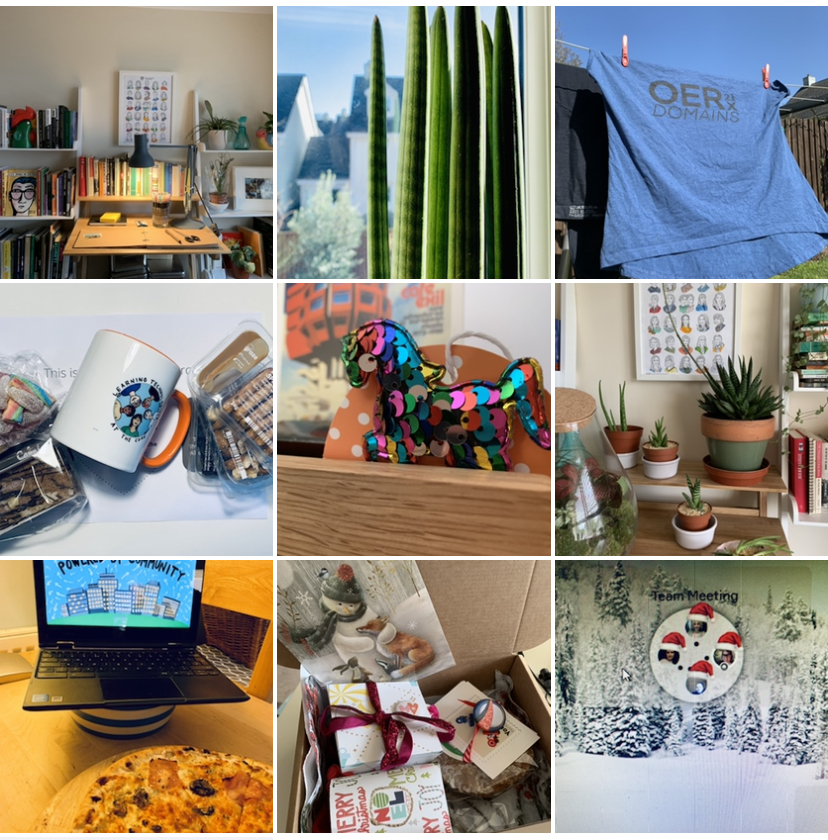
My team, our Board and all the colleagues I have worked with this year have been generous and imaginative under the continued pressure of a lot to get done and pandemic living. I am grateful that we continue to find ways to celebrate important milestones together and to reflect a little on all that is happening whilst we continue to lack opportunities to meet in person.
From pre-conference pizza nights to KaraOERke and from care parcels sent by post to snowball fights online, we have done what we can to keep our spirits up and support each other as a team.
I am so grateful to work in an organisation that continues to support us in a considerate way through these turbulent times and I want to express my deep thanks to Helen, our Chair, for all she has done this year to steer us through 2021. To you all, thank you!
Talks, keynotes and writing a book
Looking at my archive for this year, it appears that I have done more than I had realised. I have been able to contribute to some amazing ventures, attend many virtual conferences and work with inspiring leaders here in the UK and across the world.
Open Apereo 21 #ALT & #Apereo Screen side Chat: ‘Ethics & Learning Technology. Perspectives from the Pandemic’. With @bellaabramsIT, @drchuck, @14prinsp, @MarenDeepwell & @iandolphin24 – 8 June 2021;
FEresearch podcast episode episode 24 talking about the FE Community of Practice sector audit and AmplifyFE, hosted by Jo Fletcher-Saxon, 8 March 2021;
Alongside my work I have started writing a book on leading virtual teams, which is due to be published in 2022. The first draft is now complete, and you can read along with excerpts from draft chapters, come along to remote working radio sessions and sign up for regular updates.
I have really enjoyed working on the book as it gives me the opportunity to switch gears and focus my thoughts for a while.
My year with a puppy!
You will probably already have met Posey as I have posted plenty of photos of her over the past nine months. She has grown from a tiny puppy into a seasoned conference dog, who has her own conference badge and all. Posey is not a huge fan of work as it means there’s less time for play and walks, but she has been a huge joy and an excellent antidote to being at work for too long. She’ll be one year old soon and no doubt the next year will bring a whole new set of adventures as we start running together.
Posey
We’re heading to the beach
Today may be the darkest day of the year, but it also marks a turning point. Light is making its return, if gradually.
Everyone I know is tired and exhausted. Working in Learning Technology can feel… really hard in these times and the work never ends. We often don’t know what’s ahead. We try to support all the different stakeholders but thanks to most people’s experience of Learning Technology at scale being largely shaped by lockdown learning, there is a tension between what we hope to achieve as a profession and everyone’s desire to return to a world in which hugging and having coffee isn’t dangerous.
I am grateful that today is my last day at work for the year. I am looking forward to logging off and not looking at another email until it’s 2022.
Rest and replenishment is going to be my only focus and so we are heading to the beach to see the sunset.
To you I wish a peaceful end to the year. I look forward to seeing you on the other side. Or as we say in Wales…
Since my last post, I have been working on the Introduction to the book and that has been very helpful. It’s prompted me to write an overview of how all the chapters hang together and it’s help me get a clearer sense of the overall structure.
Apart from the conclusion, I have now drafted all chapters. I have decided to incorporate what was going to be a chapter on addressing inequality and inequity in remote work into each chapter as those questions came up again and again.
So now that I have a clearer sense of the shape of the book, I want to make a plan for revising and improving the drafts that I have completed so far, building up to a week long writing retreat in late January.
I really enjoyed the first Remote Working Radio session, and going to have more of these coming up in the near year.
Talks and events
The biggest event in the late part of the year was ALT’s Winter Conference. A wonderful couple of days, with a rich programme and lots of fun social activities to boot (thanks to Jim & Chahira for the KaraOERke!) .
#Pupdate
Posey is nearly a year old now and this is going to be the last #pupdate. It’s been a great year watching her grow and develop, discover her world and become an intrepid explorer.
Since my last post, I have been working on the Introduction to the book and that has been very helpful. It’s prompted me to write an overview of how all the chapters hang together and it’s help me get a clearer sense of the overall structure.
Apart from the conclusion, I have now drafted all chapters. I have decided to incorporate what was going to be a chapter on addressing inequality and inequity in remote work into each chapter as those questions came up again and again.
So now that I have a clearer sense of the shape of the book, I want to make a plan for revising and improving the drafts that I have completed so far, building up to a week long writing retreat in late January.
Remote working radio:
It’s time to start what will hopefully turn into a monthly radio meet up on DS106radio talking about the journey from learning online to working in distributed teams. The first one of these will happen today:
Hashtag: Chat with me or submit song requests #DS106radio
See you on the airwaves.
Chapter: Introduction
Below is an extract from the draft introduction chapter:
In 2017 I embarked on a journey of organisational transformation as the CEO of an independent charity, as we took our organisation from a traditional, office-based model of operations to a fully virtual, distributed team. In comparison to many businesses who were forced to adopt home-working in response to the global pandemic, we made the transition for strategic reasons over the period of a year. Instead of sending staff home with a laptop one day and starting home-working the next, we went through formal consultation periods and implemented the transition gradually, providing support and training at every stage. As a result we made a very successful transition and started to focus on how to evolve our approach to working as a virtual team beyond practical considerations from the outset.
When I set out to create a new vision for what working for our virtual organisation would be like I came across a lot of practical advice about infrastructure and business processes and I also read a lot of management books that seemed intent on helping leaders and managers to translate traditional power structures from the office to the virtual workplace with a strong emphasis on productivity, cost-savings and employee surveillance. None of what I came across helped to answer my questions.
What I was looking for was authentic insight into what it’s like to manage people remotely and to lead an organisation from home, and to do it well. And by doing it well I mean not only meeting budget targets and KPIs but to balance business needs with employee happiness and wellbeing. I was looking to find creative and fun ways to work with people you may never meet in person and to build meaningful working relationships. I was looking for ethical ways to work online that respect employee privacy and build trust between the organisation and its staff. In short, I was looking for the opposite of the ‘office-deficit’ model.
This is why I wrote this book. It’s the book I wish I had when I was setting out on my journey to lead a virtual team. I hope it will provide a source of inspiration and a prompt for reflection to my readers and will be of practical help with managing hybrid, blended and fully distributed teams and organisations.
If you’d like to keep in touch with book progress: