Working with Lou is easy as breathing, because Lou is such a prolific facilitator. It’s always a joy to work with someone who is THIS good at making collaboration easy, who makes everyone feel welcome and who has a gift for explaining complex concepts in such a way that you can relate very easily. It was such a joy!
Lou’s one of the people behind an innovative Instagram Magazine called Fusion, and inspired by our session I’ve submitted an article, which will hopefully be published in the summer.
The recording of the session is now available to watch and you can also access the slides with links to the resources we discuss:
I’m super excited for this blog to be featured in the Reclaim Hosting’s Women’s Showcase! The showcase was organised by Alexis Block, in celebration of Women’s History Month, and features a whole host of inspiring examples of projects and initiatives. I was particularly taken by the Feminist Digital Center, co-curated by Dr. Julie Shayne and Denise Hattwig (University of Washington Bothell) and The Hub Blog, created by Autumm Caines, Belen Garcia, Carla Veccholia, Chen Wang, and Jessica Riviere (University of Michigan–Dearborn) and… I also discovered a new project I had never come across before: SNC Kid Books – A Collection of Stories, created by Krissy Lukens (St. Norbert College).
I made my submission more to show my support for this initiative than expecting to be included, so it was particularly nice to have my blog featured alongside these amazing projects. Thanks, Alexis!
Here’s my shout-out from the showcase:
About the Project: Last but not least, we couldn’t not include our very own Maren Deepwell in this showcase. Maren has been blogging for nearly 20 years, and her site is a beautiful example of what it means to truly own your space on the web (something she’s been championing alongside us for years).
Her blog is more than just a collection of posts, it’s a record of her thinking, her leadership, and her journey over time. We love this one not just because it’s part of our community, but because it reflects the heart of what we’re all about: showing up, sharing your work, and building something that’s entirely your own. Maren writes, “My blog is my domain on the open web and its an important part of my identity, my practice and my leadership approach… I started blogging as a student… Little did I know that less than 10 years later I would become the CEO of the leading professional body for Learning Technologists in the UK, and that blogging would become a key component of my leadership in service of that community of thousands of members. Now that I run my own small business, my blog has become even more important in sharing my work, archiving my experiences and celebrating milestones – I’m blogging #4life”.
As our fearless leader Jim Groom likes to say, “Blog or Die!”. We’ll soften that just a bit, but the spirit holds: having a space to write, think out loud, and share your experiences is at the core of what we hope everyone builds here at Reclaim.
Maren’s Blog is built on Reclaim’s Shared Hosting service using WordPress.
It the end of the UK tax year, and I have spent most of this week on end of year paperwork. Fortunately, this blog post is not about that. Instead, I am returning to my favourite topic: blogging about blogging, or more precisely, blogging about keeping a blog. (The two are tangentially related, as my quarterly Director’s Report for my own business has a section about talks and events in it, which I was trying to complete when I noticed that, to my horror, I had yet to start the 2026 section of my archive page. So I fixed that as quickly as I could. Phew.)
I’ve previously written about why I think keeping an archive of my activities is so very helpful, not just for report writing, or compiling my newsletter, but in the longer term, to help me set goals, find strategies and reflect on my career journey. I’ve been working on a post about professional journalling, which I am hoping to publish next week as a follow up to this one, but this one isn’t really about writing, but more about having a domain, a home on the web, that I’ve kept and that I have added to for nearly twenty years. It really helps put things in perspective.
It also helps me sift and focus on what matters and what I am happy to leave where it is. For my purposes I don’t just want to have a record of everything I do or rely on automated processes or bookmarks. Instead I find great utility in the process of finding, evaluating and sifting the information. It’s like panning for gold. You sift through the water and find flecks of gold, gold dust that is then added to the vault and over time it compresses into bars (maybe that is overstretching the metaphor, plus my metal work memories remind me that gold bars are cast not compressed). You get my drift.
Often I learn things or see things I didn’t at the time of an event I spoke at or an article I wrote, and the process of finding the details, adding them manually to a page on my blog and then seeing the list grow each year is valuable to me (even though many of the links to things may break over time). What I gleam from the process increases my strategic and executive capabilities greatly and yet when I describe the process it sounds rather quaint. As if I haven’t discovered tools or services that could do all of this for me. I guess my sense is that I need to be doing it, to engage in the practice of sifting, recording and reflecting, otherwise there is no value in it for me.
There is a children’s book I am very fond of, it’s called Momo and it was written by Michael Ende (who also wrote The Neverending Story), in which a tortoise saves a girl from ‘grey men’ trying to take over the world with machines, and it’s the slow, meandering pace of the tortoise that renders them inconsequential (and thus invisible) to the ever rushing crowds around them. It feels like a very timely story to revisit. The process of keeping a blog, of adding to my own archive, is, metaphorically speaking, my version of the meandering pace of the tortoise, that which keeps me safe from the destructive rush of digital productivity and gives me time and space to think and imagine. Maybe it is time to revisit the Neon Flaneuse.
It’s been a few years now since I started working in my own consultancy business full-time and being my own boss really suits me. Every Monday morning I am grateful to not have my week shaped by endless meetings or arbitrary schedules. Most Mondays, I start with blogging, reflecting, planning. Less pressure to be at my most productive and more scope to navigate uncertainty, develop my strengths and enjoy the variety of free-lance life.
Life has stopped feeling unmoored in the way it did when my CEO days were fresh in my mind, and the demands of running and representing an organisation and a wide community of members still rang in my ears. Instead, life has taken on a new rhythm and I have found it most rewarding to experience all the scary moments, the lulls and the joys in between.
Education + Technology. Still.
What I am very happy about is to have found ways to return to and to continue to work in education + technology in new ways. I’ve found I enjoy working in Open Education and technology in ways that I had no time for in my executive role, and now that I am able to get stuck in to course development, writing tech case study or organising events, I love it again. Not as an industry in which I need to influence policy makers, but in a space that is still rich with experimentation and full of warm communities that are making a positive difference for their users, be they learners, educators or volunteers.
I’ve also continued to be a peer assessor for CMALT, the professional accreditation scheme for Learning Technology professionals, and that in itself has been a rich and rewarding activity. It is always inspiring to see peer practice portfolio and it reminds me that I need to keep track of the technical skills I have and am developing. I often undersell my technical knowledge because I often work alongside the select few who have a lot more to offer in that department, which skewers my perspective.
Note to self: you know more than you think when it comes to open source technical skills.
Coaching Leader Superpower
It’s been a few years now since I started coaching and also mentoring, and I found the work deeply rewarding. It’s been a learning curve to identify my coaching niche, and the type of leaders I can offer the best support to, but I found it and I enjoy the practice of being a thinking partner and offering a safe space to reflect and strategise. I’ve also brought mentoring early career leaders into the mix, and that has kept my on my toes to say the least. I might have over a decade of executive level experience, but nothing brings me down to earth and thinking hard more than mentoring someone about to embark on the first chapter of their career.
Coaching and mentoring has also become a superpower for my own leadership approach. It’s been so very useful to learn more about how to lean back, stop solving problems and create space in which colleagues can develop and be supported if needed. What I found out since I stopped running an organisation is that I never really stopped running an organisation, I just switched allegiances and now run my own instead. The CEO in me is second nature, and it’s fun to flex those muscles every now and then.
Confidence in the face of Unknown Unknowns
Career transitions are a bit like magic. A slight of hand. On the one hand everyone around you expects you to know what you are doing and how to get there, whilst also taking a leap of faith into the unknown. Not many are comfortable with you not knowing what’s next. And there are usually a lot of personal and practical circumstances at play, that determine how much freedom and for how long you can grant yourself to experiment.
And you fail and get rejected countless times along the way. Everyone does. It’s a necessary part of the process.
The book I found most helpful in navigating my own Unknown Unknowns is called “Working Identities” and I have blogged about it before. What really stayed with me from the book was the idea that you can’t think your way out of a career transition, particularly a big one. You have to work through it. It’s a process, it’s a practice, not a thought experiment.
Just like everyone else my own winding path through this transition looked different from what I expected and continues to surprise me. Every time I think I have it figured out, I realise I don’t. Or that there is another bit that doesn’t quite fit. Eventually I realised that this is it. I am doing it, and the process is what I am meant to be engaging it. It’s not a fault or an error that I don’t know exactly what the next year looks like. It’s part of doing what I am doing, part of being my own boss (and being my own employee, too).
And so, every week I am grateful and inspired and empowered by the process, by being my own boss and discovering new and interesting things. I love that I get to keep learning and developing and discovering and I get to pay the bills, too. I get to live and work by my values, shaped by what’s important to me and I get to give something back, too.
Thanks to all my clients and collaborators, and everyone in my networks for making this such an enjoyable new chapter in the story of my career.
This is the first year I am taking part in Podcasthon, the biggest charity event in the podcasting world! There’s no money involved—it’s all about raising awareness for various charitable causes and for my podcast, Leading Virtual Teams, I’ll be dedicating this week’s episode to support a charity and a cause that truly matters to me – mentoring emerging leaders with One Million Mentors.
Out Friday, 20 March!
Listen to the PodCasthon Charity Special from 20 March 2026. The podcast is available on different podcast platforms and I hope you enjoy the show.
As always, share your ideas and feedback in the comments, or on social media. If you have a specific questions or comment, contact me . I look forward to hearing from you.
Learn more about my chosen charity: 1MM (One Million Mentors)
1MM mentoring empowers young people to become the best version of themselves: building relationships – free of assumption and judgement – where they benefit from another’s experience and perspective and can think bigger, find their own answers and take the next meaningful step into their future.
I trained as a mentor with 1MM a few years ago and in the episode I share my experience and what made volunteering as a 1MM Mentor so rewarding 🙂
It’s been a joy to work on a new case study for Reclaim, this time featuring Ed Beck and his work on the SUNY Oneonta OpenLab. The case study is out now, and openly available, so you can have a read for yourself:
In this case study “Ed Beck shares insights into what it takes to move an open-source software solution from experiment to enterprise service. He also explores how to win the support of colleagues and secure the funding needed to build, scale, and future-proof such projects from the outset.”
It’s always interesting to hear Jim Groom’s interviews with pioneering practitioners such as Ed, and this conversation was no different: there was enough material to produce several case studies. Which is why we’re recording another interview with Ed, which is due to air very soon on Reclaim TV, this time taking a deeper dive into some of the themes that came out of the original conversation: namely how to win the support of colleagues and secure the funding needed to build, scale, and future-proof open source projects from the outset.
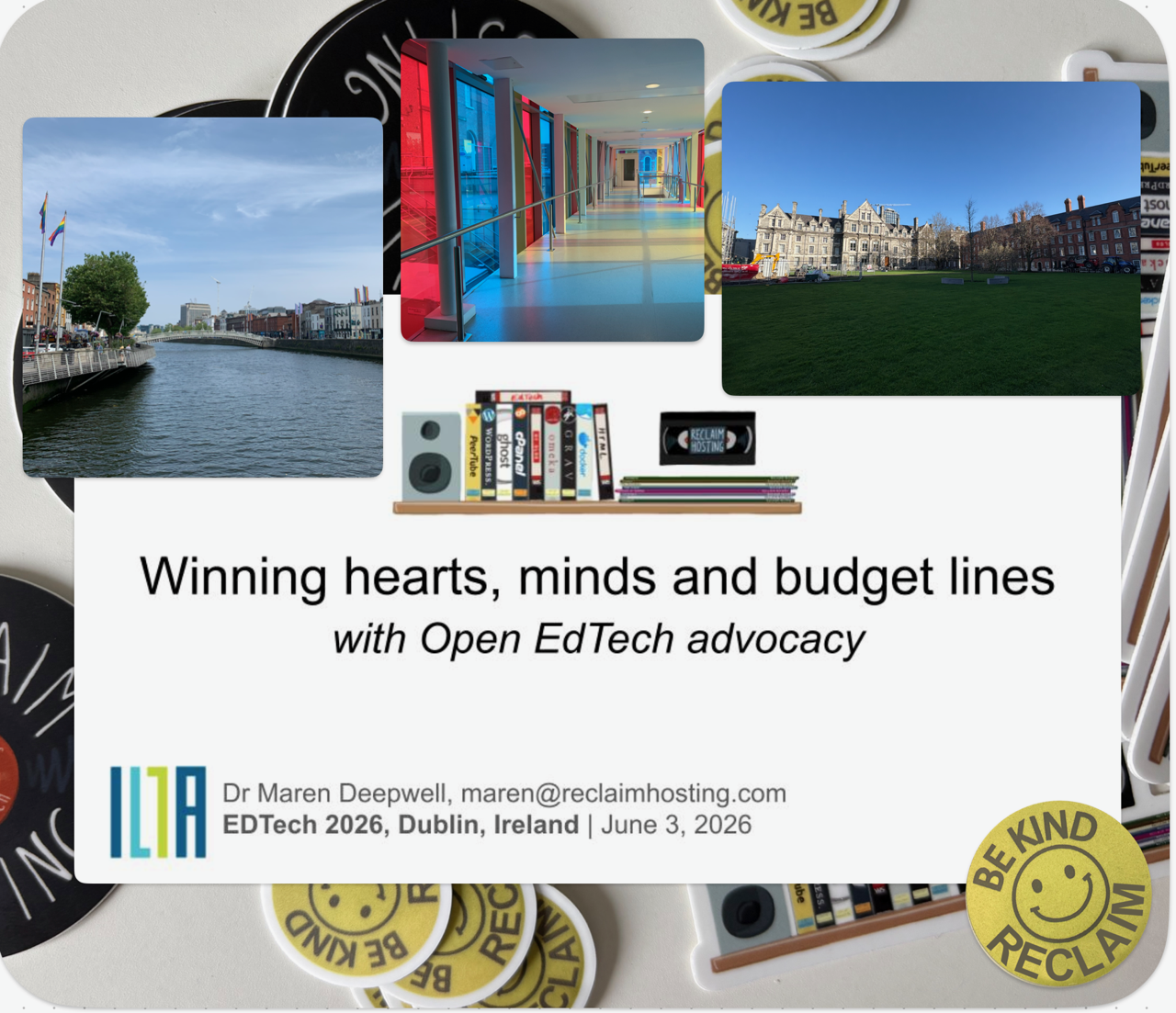
During the recent Open Education Week, I was reminded again and again how much scope there is to scale use of Open Source technologies and Open EdTech, and just how much advocacy and practical support is needed to continue to educate and empower edtech professionals to make that happen. With any luck, I’m hoping to talk more about this and similar projects at the upcoming ILTA Annual Conference in Dublin in June.