Author: Maren Deepwell

  • ‘Braided’ Blogging: Reflecting on collaboration

    ‘Braided’ Blogging: Reflecting on collaboration

    I’m always interested in new ways to keep blogging and recently I had the opportunity to try a new approach, which we might call ‘braided’ blogging. 

    This came about through a coaching conversation with Mark Corbett Wilson, whose blog, Talking with Machines, is definitely worth a visit. With a rich background in making art, storytelling and digital technologies, Mark is always up for trying new ways of collaborating on the open web and for this experiment we wrote a short blog post about collaboration and then remixed individual paragraphs into a new version, resulting in our individual contributions being woven or braided together. 

    At the start, this collaboration was asynchronous, each of us contributing via a Google doc, and the final process was completed in real time, with each of us editing the document in turns during a video call. 

    Reflecting on the process, here is what I came away with:

    To start with, I really enjoyed the playful aspect of this method, and the opportunity to try something new. I wasn’t really sure what to expect from the final version, and it opened my eyes to new perspectives on what we wrote in the original post. 

    Also, the collaboration shifted the emphasis from producing a finished post to blogging as a practice, the process in itself being valuable regardless of the eventual output. 

    What you don’t see in the finished text below is the conversation that happened between the lines. The collaboration in itself was both fun and creative, and gave us each the space to try something new and learn along the way. 

    A big thank you to Mark for letting me be the first collaborator to try this approach! I am really looking forward to seeing where you take it next. Read Mark’s post on Networked Narratives.

    Read the braided version 

    Learning and teaching are continuous and iterative. Reflection leads to insight and the repetition helps integrate your learning into memory. Applying your knowledge and experience to new situations is improvisation and leads to new discoveries.

    I try to keep a sense of playful experimentation in my work. It’s less important to get it right, let alone perfect, than it is for me to do it in the first place.

    I struggle with reducing ideas to simple linear text. I’m working out how hypertexts, graphing, microblogging, and mixed media posts can express and share my discoveries, learning and reflections. I use the internets, complexity and connectivist theories to inform my improvisations and grow my personal networks

    I trained as a sculptor before working in education. Similar to you, I started out making things before I turned to writing. 

    Whatever I do, a primary concern is with the quality of my work. Glassblowing and writing both have long traditions. How do we honor these traditions and continue to explore new possibilities while producing quality work as we transition from makers to writers?

    I think of everything I do in terms of practice. For me, it’s helpful to conceptualise what I do as a continuous process of learning, reflecting and sharing. 


    Cover photo by engin akyurt on Unsplash

  • Holiday ‘reflect-along’: What’s YOUR measure of success

    Holiday ‘reflect-along’: What’s YOUR measure of success

    Last year I released the first of these popular ‘reflect-along’ resources, designed for you to see how a particular tool is used in practice and to reflect along with me as we progress through the accompanying podcast episode. This year, I am sharing a resource all about defining YOUR own measure of success and reflecting on impact.

    It’s been a stand-out resource for many of my coaching clients this year, and I hope it’ll be a useful way for you to have a bit of fun at the end of the year, and try out something a little different. Use this episode to “reflect along” with me as part of your run up to the holidays (and hopefully a well deserved break!) or as you prepare to begin the new year.

    This tool is inspired by a visual thought (by the always inspiring Liz and Mollie) about how we measure success, what makes it rewarding to work in our team or organisation and how we measure success and impact. It’s a great prompt to collate evidence of all you have achieved at the end of the year, and align what you have done with what’s important to you.

    Listen along

    Find a cosy spot and get yourself a hot drink or take the episode outside and listen along as you walk. The important thing is to bring some curiosity to this exercise, and to be open to discovering something new.

    Find what’s important

    I recently shared a post on keeping my own archive, i.e. a list of things I have done, and in the spirit of festive list making, this is where we will start.

    The practice of making a list and adding new entries to it is useful in itself. You could probably use a tool to compile this kind of information for you, but there’s great value in the act of processing what you have done and reflecting on it as you make the list.

    To get started, add literally anything. You could add a workshop you have run or an event you attended, or even books you’ve read. You could add projects you have been involved with or led, or papers you have published.

    The key is not to worry whether something is worthy of being included, and to simply include everything. I find once you start making a list of everything, things quickly amount to more than expected.

    Make your measure

    There are different categories you could add to your own chart, for example opportunities for professional development and learning. Good non-salary benefits or working on a healthy organisational culture. You could add opportunities to travel and having fun. Although you can simply conduct a thought experiment, this tool is more effective if you actually take a piece of paper or open up a digital document to create your own measure of success.

    Here’s how:

    1. Draw a circle;
    2. List what factors are important to you;
    3. Mark out slices of the ‘pie’ according to importance.

    Once you have your completed chart, you can use it to reflect on what you want more of in the year ahead.

    Enjoyed this?

    Check out the Hybrid Working Wheel ‘reflect-along’.

    Don’t miss out on future resources. Subscribe to my free monthly newsletter 🙂

    [newsletter_form type=”minimal”]

    Featured image: Photo by patricia serna on Unsplash

  • Celebrating 100 podcast episodes and other ‘centuries’

    Celebrating 100 podcast episodes and other ‘centuries’

    In just a few weeks the 100th episode of Leading Virtual Teams is due to air. I’m delighted that an experiment I started a two years ago to mark the publication of my first book has grown into a weekly podcast featuring special guests on a regular basis.

    The format is still audio only (sorry, Youtube fans), but the podcast is now available via more platforms, including Amazon Music, Apple Podcasts, Spotify, Overcast and Pocket Casts . It’s also now recorded and edited using better tools, including my Neewer mic, Audio Hijach and Fission.

    It’s been a lot of fun taking inspiration from the original book and turn it into podcast episodes, resources and courses. And… this podcast milestone got me thinking about other ‘centuries’ that I celebrated this year… and there seem to be a few. So here goes:

    In spring, I celebrated a milestone on my coaching journey, as after two years of training and 100+ hours of coaching with over 20 clients I was set to formally complete the ACC credential of the International Coaching Federation (ICF). I achieved the final step in May, when I gained my ACC credential 🙂 . Fast forward to the end of the year which is fast approaching and I am closing in on 200 coaching hours, with over 30 individual clients and 20 group coaching participants.

    This year I have also continued to share my work openly, via my blog, podcast and newsletter. The newsletter, which started life just over a year ago, has now also gathered over 100 subscribers. It’s nice to see folk connecting with me and my work in this way, and I really enjoy compiling this monthly email as a way to take stock and mark my progress.

    A big thank you!

    Thank you to everyone who listens to the podcast and all my guests who have come on to join me for a conversation. It’s been wonderful to have the opportunity to talk about all things hybrid working, finding balance and learn a lot about stationary, pets, pot plants and metaphors along the way!

    Subscribe to my newsletter!

    [newsletter_form type=”minimal”]

  • Reflect, reframe, regroup. Inspiration for when life is messy.

    Reflect, reframe, regroup. Inspiration for when life is messy.

    I struggled to find a title for this post, because describing what it is about will lead to expectations it is not likely to meet. This post is about how to stick with things, be they new habits or intentions, plans or commitments.

    In my work as a coach I often read and share books about habits and how to stick to them, and there is a huge wealth of information out there about how to be more productive from the ever popular Atomic Habits by James Clear to Oliver Burkeman’s Four Thousand Weeks and so on. I go through phases of finding one of these titles or authors that really chime with me at a particular time in my life, and I love their approach for a while, find the inspiration I am looking for and… move on.

    Alongside the books there is an army of podcasts about the same subject, and I am guilty of adding to the genre with my own weekly episode of Leading Virtual Teams. Through my coach training I have discovered a lot of amazing coaches many of whom share their expertise on habits and productivity on their shows, and my favourite of these is Katie Linder’s podcast for Higher Education professionals, You’ve Got This. Katie led the coach training I completed and I find her particular mix of reading, writing, being creative and productive really appealing. Definitely a recommended listen!

    But…

    And yet, of course, there is a but… . Because life is messy. Life keeps changing, and evolving and however much the data we collect through the devices and platforms we use would like us to believe otherwise, moving forward is not always a straight, upwards curving line. And not every season of life can be productive. I recently read a wonderful book, Ebb & Flow by Easkey Britton, which beautifully explored the concept of periods of ebb in life as necessary and valuable.

    That’s where for me conflicting desires arise: one the one hand I understand and appreciate that not every week, month or year can be super productive. Sometimes life just gets in the way. On the other hand, I am very used to pushing ahead with things or sometimes have a sense of being behind already, feeling frustrated and keen to make a change. At times like that, I use a couple of approaches to help find a path through the messy reality:

    Reflect: Need vs. want

    First, I find some headspace to reflect on what I need versus what I want. I think best when I actually write things down or talk to someone about it. Here are some prompts to think through this:

    • What do you want more of?
    • What do you want less of?
    • What would make things lighter?
    • What do you need to prioritise?
    • What do you need to finish?
    • What do you need to pause/stop?
    • What do you need to start?

    Reframe: Essential vs. desirable

    Next, I try to reframe the situation, to look at things in a different light. My own high expectations or sense of accomplishment is often the biggest barrier to feeling contentment, so my aim here is to be very clear with myself what is absolutely essential to accomplish and what is desirable. I often find that things drop off my plate once I can clearly articulate to myself what I really need to do, rather than all possible things I could be doing. Here are some criteria I use to sort things into the two buckets:

    • Essentials often are: time sensitive, external (i.e. someone else is waiting for this), income generating, high impact
    • Desirables often are: open ended, internal (i.e. only I wait for this to happen), unknown/low impact

    Once I have sorted my long list of things to do into these two categories, I take a look at what I identified in the first step, needs vs. wants and check that everything makes sense. For example, if I have a writing project I absolutely love doing and it helps to get me out of bed in the morning, then it might move from desirable to essential. Likewise, if I find I have overcommitted myself and I need to say no to more things, I go over my list of essentials again to identify things I can finish quickly or stop all together.

    Regroup: Grind vs. joy

    Then, I look at the practicalities and set out to tweak things to prioritise joy. What that looks like may be different for you, but these starting points should give you a sense of what to consider:

    Determine how many weeks stand between you and your next break. How long before you can take time off, go on retreat, travel or something else that offers a break from routine for you. A break, whether a change or a rest is essential to my mind. If you find there’s no let up in sight, take a moment and think hard about whether you can change that. What would it take to get a few days off?

    Once you found out how long you have to go, add a countdown to your calendar or other app.

    Then take a look at each week ahead of you. In my case I found certain days of the week in which I had much fewer commitments, so I moved things around to block out time for what I wanted more of (in my case creativity and time to get outside). I also took a look at what would be the hardest/busiest of times and started to schedule some time and activities around those days that would offer me some balance.

    Time to rest, read, walk the dogs and so on.

    I saw a post recently my a fellow coach, Mrs T, who coaches Headteachers, and in it she described how when days got very busy, her initial tendency was to fit in even more in any moments of calm. Fit in more tasks during breaks and taking work home in the evenings or at weekends. She then shared how nowadays her instinct is to step back and take a breath instead. I could really relate to that. When things get hectic, I used to try to be more productive, more busy still. The steps I have outlined above, to reflect, reframe and then regroup offer an alternative to being ever more busy. In that direction burnout looms.

    I hope you find more pockets of joy. Even when life gets messy. Let me know how you get on.

    Related posts

    Subscribe to my free monthly newsletter:

    [newsletter_form type=”minimal”]
  • Critical Cadence.

    Critical Cadence.

    The picture heading this post is a photograph I took this morning. It’s my favourite river oak that stands tall over the River Taff along my morning run route. I love this tree and the way in changes with the seasons and I especially enjoy taking a moment to pause and watch its reflection in the the river.

    The current attempt to return to running is going quite well, thank you for asking. It’s either my third or fourth since 2020 and so far the plan is holding together. I am ‘training’ for a 5k race, which I arbitrarily set for mid December, in the hope that I would manage that distance by then and also my desire to reach a milestone before the holidays. Currently I am running 3-4 miles three times a week, gaining a bit more fitness as the weeks go by, and I have even signed up for an actual 5k Santa run for December. I am determined. And yet I have been here before and I know that there’re a lot of factors that can easily derail this effort like the others before it. So fingers crossed.

    What my morning runs have done happily, is give me lots more space to think and walking and running, moving through a landscape at my own pace, has been on my mind. You will have already gathered that from the coaching walk project I recently completed (yay!), but this week my interest is taking a new return as I have started to craft my submission for an upcoming conference I hope to take part in:

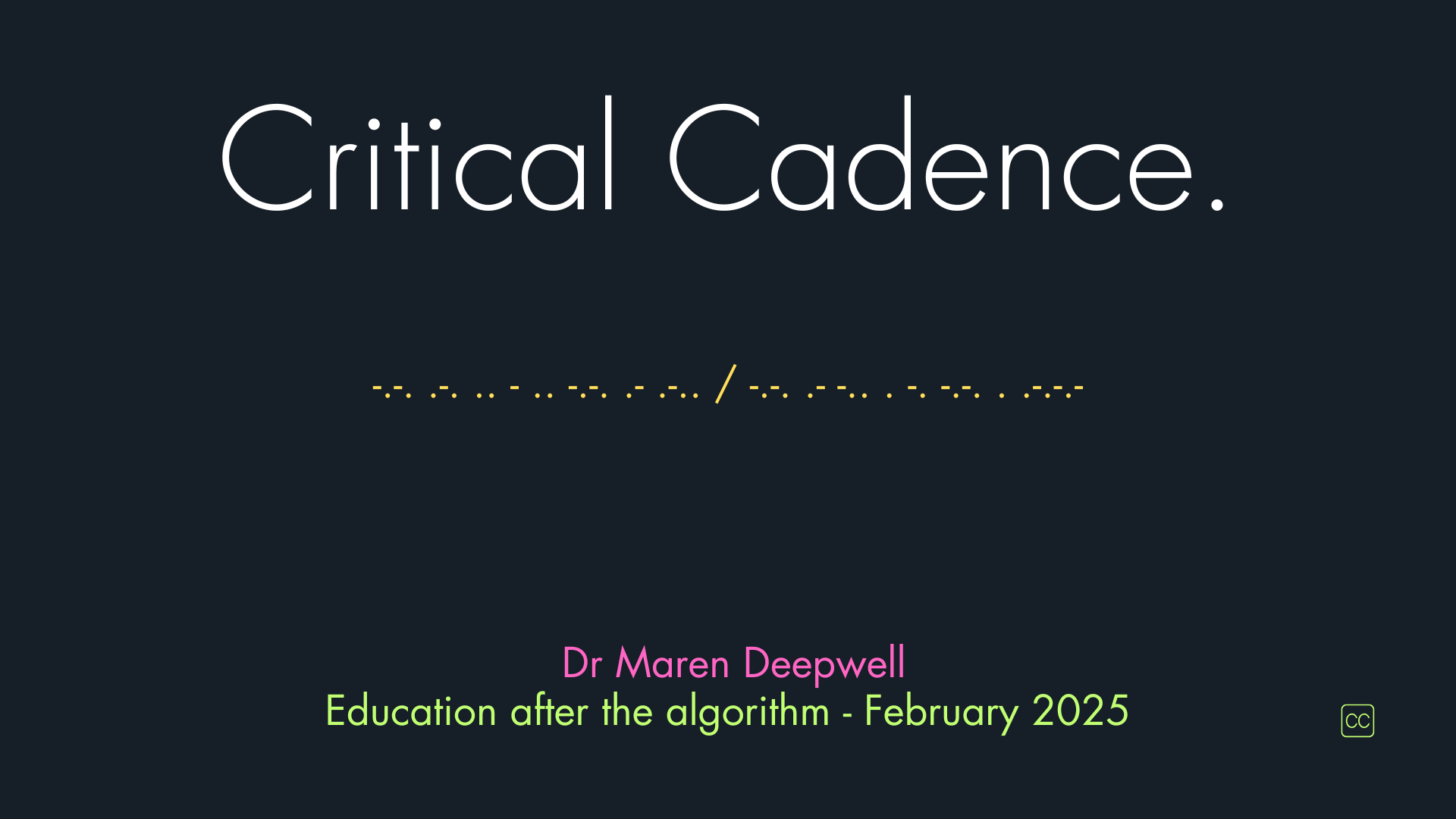
    Education after the algorithm:
    Co-designing critical and creative futures

    20th and 21st of February, 2025 – Dublin City University
    Dublin, Ireland

    The theme that I am most interested in is ‘Unplugged, low-tech and lo-fi approaches to digital education and research’ which includes outdoor learning and rewilding learning. One of the core questions the course related to the conference aims to address is “How can we be open, creative and even wild in our digital learning design and teaching work?” and I am really curious about how the metaphor and practice of moving, through walking for example, can be helpful here.

    Both in learning and at work the frantic pace of productivity is determined by the speed of digital tools. Notifications, comments, emails and other content arrive ever more quickly and demand a piece of our attention. Digital noise can easily lead to digital overwhelm and our senses suffer. I have started to explore the embodied perspective of hybrid working (and learning) in previous posts, and for my conference submission I am keen to build on that work to consider strategies of how we can change the cadence of our digital lives to be a little more… human. A pace of thinking and working and learning that is more conducive to reflection, to criticality. Hence the title ‘Critical Cadence’.

    I’ll share the finished piece when it’s done, but for now, I shall go and get writing. At my own pace.

  • How to get your blogging mojo back.

    How to get your blogging mojo back.

    In the best tradition of blogging about blogging, today’s post is all about getting started with or getting back into blogging. Recently I have had lots of conversations with folk who would like to blog more, but don’t. Or who feel they *should* be blogging more often, but they haven’t actually managed to do so.

    If that’s you and you are looking for ways to get your blogging mojo back, this post is for you. There’s no judgment here. Just some practical approaches you can try to get (back) to blogging regularly.

    But, first… ask yourself this question: do you want to HAVE A BLOG or do you WANT TO BLOG? These two things, to my mind at least, don’t necessarily mean the same thing. Lots of people, organisations and companies have blogs. Blogs that might function a bit like newsletters, or communicate community updates. A blog can be a really effective tool for communications and marketing, and as such, you might be obliged to blog as part of your job. That’s not the kind of blogging I am talking about in this post.

    This is not about having a blog, but about the practice of blogging itself. The process of getting whatever you want to say in a post and press publish. It’s about the joy of blogging, the sheer exuberance of having a space, a domain, to make your own.

    My husband-to-be and I often talk about blogging, and he has written many posts about blogging as an OER, blogging as an industry, blogging and academic identity and more. I strongly suggest you head over to his blog if that’s the inspiration you are looking for. Over here in this post, let’s focus on blogging as practice.

    Start small

    A blog post can be any format and any length. It doesn’t have to be 500 words with references. It doesn’t have to be any particular format. It can be one sentence, one image, whatever you want it to be. Your next post is not going to be a masterpiece, or the great novel you might dream of writing. Start small and give yourself a chance to succeed.

    Imagine what you would suggest to a student or a colleague who came to you for advice about how to get started with blogging. What would you suggest to them? What would you encourage them to do? What would be good enough?

    Apply those same standards to yourself and start small.

    Blogging is not a to do list

    Lots of colleagues I talk to have a list of things they wish they had blogged about but haven’t, which covers anything from conferences presentations to new pieces of work. They have an endless list of things they feel they ought to cover, and that can make the task of blogging daunting.

    Maybe it works for you to have a dozen unfinished posts sitting in your dashboard, ready to pick up again when your thinking has progressed and those thoughts have percolated sufficiently. If that’s part of your process, then stick with it.

    But if unfinished posts or lists of things you ought to blog about are a barrier to simply getting a post out there, I would suggest parking these for a time at least or deleting them all together.

    If you are looking for a topic, just tune in to your interests right here and now. What’s in your mind? What is interesting? What are you curious or excited about?

    Blogging as a habit

    I believe that blogging is a very rewarding habit to cultivate and given that I have blogged for two decades, it must be working for me. And it does. I get a lot out of the process, other than ‘having a blog’. Here is why I blog:

    • I’m excited about something I want to share
    • I need some space to think through or reflect on something
    • I want to document something for future use
    • I want to keep a record of things I have done
    • I want to journal (in a public way)
    • I want to have things to put into my newsletter
    • I want to share an image I love and talk about it
    • I want to celebrate something
    • I want to contribute to a conversation or discourse
    • I want to show my solidarity
    • I want to amplify the voices of others
    • I want to do something helpful

    All of these motivations ultimately mean that blogging makes me feel good. I write plenty of posts that no one reads and no one comments on, and it doesn’t make a difference to my process. Of course I want people to read what I blog about, but I don’t focus on that as I blog and its not my main motivation.

    I would, and often do, blog, where no one can read my thoughts.

    So might blogging do for you? What can you get out of the process? What do you want from it? Figuring that out is the key for blogging to become a regular habit. Just like anything else we try to do regularly, from exercise to reading, blogging has to serve us and reward us for engaging.

    Yes, AI-powered tools could blog for you, but why bother?

    As a blogger, many of the tools I regularly use now offer me, to put it politely, various levels of so called smart approaches to generating content more easily and quickly. From smart compose to full on writing posts for me. Sigh.

    Why bother? The point of blogging is to blog. Why would I outsource that to technology.

    Some (fun) ways to publish a post, quickly (with examples)

    Sometimes I lack inspiration for blogging, and I still want to do it. So I come up with easy ways to blog, quickly. This often helps me get out of my head and into a more creative frame of mind. It works wonders for taking stock in times of stress and often cheers me up as well.

    Here are some examples to help you find your own ways to have some fun, and publish a post, quickly.

    Right, let’s get blogging. Good luck!

    And because I blog every month… Subscribe to my newsletter and never miss a post 😉

    [newsletter_form type=”minimal”]