Tag: coachingResources

  • Creating space in a packed schedule

    It feels like it’s been a very busy week (month, year, decade…) and if your schedule is anything like mine, you probably don’t have enough time for being creative, taking breaks or anything else that injects a little bit of joy into the routine.

    There are many strategies for tackling this problem, and one approach I have been experimenting with is pairing habits.

    What’s pairing and how does it work?

    I first came across the concept in Gretchen Rubin’s Better Than Before and basically this strategy is about pairing a new habit you want to adopt, such as doing a short meditation session, with an established behaviour, such as getting up.

    There are two ways in which pairing can work: in positive ways (for example listening to an audiobook whilst walking the dog to create extra time for reading) and also in negative ways (buying too many snacks in the cinema).

    Finding focus

    I found for example that I associate standing at my desk with being responsive on chat and email. That focus on being available and the consequent constant interruptions made it very hard to focus on tasks that require space to think.

    Although I was still productive and got a lot done, I was putting off tasks that would need more focus and started on other things that I could fit around communicating.

    The solution was to pair tasks that need more focus with stepping away from my desk. Now I take my laptop with all email or DM apps closed to a table and write away from my inbox. When I sit down, even though I am physically less than 3 feet away from where I usually stand, I find it easier to focus on the task without distractions.

    Lunchtime reset

    Another example from my own experience is a negative pairing: I was good at taking lunch breaks but I was bad at actually resting. Instead, especially on days when I work from home, I started doing chores or life admin or watched things on my phone. I stopped working but I still kept going.

    Over time, I found that really exhausting and I was craving a break that would help me reset. The start of my day may be four hours of stressful meetings, so I wanted to find a way to help me break the negative pairing of lunch with getting things done.

    I identified things I wanted to stop (doing admin, chores, screen time) with things I wanted to do instead (go outside, play with the dogs, close my eyes for a few minutes).

    Initially, I found it hard to change my habits. I caught myself staring at my screen or sorting things out around the house. When I sat down to do something like a breathing exercise or a short meditation, I found myself thinking about work.

    Gradually however, I found ways to stick to and even enjoy my new lunchtime habit. I use a mindfulness app or other videos for 5-10 minutes and the guidance they provide helps me reset more easily. Weather permitting I have lunch outside, and my phone stays inside. I have stopped planning to complete chores during lunchtime instead making time outside of lunch.

    What could work for you?

    What habits are present in your life? Do you have any positive pairings that work for you or negative ones you’d like to change? How could pairing habits work for you?

    If you’d like to try this strategy for yourself, here are some questions to get you started:

    • What habits work well for you (at work, for your wellbeing, or another area of your life?)
    • Why do they work well?
    • Can you identify any pairings that you would like to change?
    • How would you like to change them?
    • What single change would have an immediate positive impact on you?

    Resources

  • Reflecting on different modes of working

    As part of my work on the Leading Virtual Teams book, I have been careful to define what is meant by terms describing different ways of working. It’s taken me a while to bring the various terms together, and to reflect on their meaning not just now, but also before the advent of digital technologies and more widely available, reliable, high speed internet connections.

    In my childhood days for example, selling Tupperware from your garage was a popular way for women to work from home alongside bringing up children, for example, and that didn’t involve Zoom calls or being online at all.

    Similarly, there are many industries in which distributed working (i.e. across a number of different geographical locations) or working remotely (away from a central location such as a campus or corporate HQ) has been commonplace well before we had the capacity to take much of our “office” with us in the form of a laptop or even mobile device.

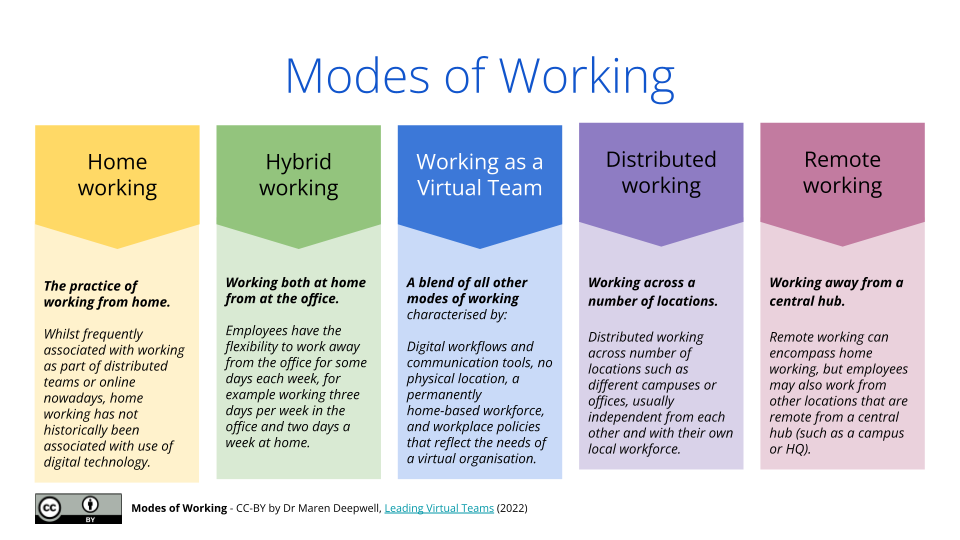
    Graphic showing an overview of different Modes of Working - CC-BY by Dr Maren Deepwell, Leading Virtual Teams (2022)

Home working: The practice of working from home.

Whilst frequently associated with working as part of distributed teams or online nowadays, home working has not historically been associated with use of digital technology. 

Hybrid working: Working both at home from at the office. 

Employees have the flexibility to work away from the office for some days each week, for example working three days per week in the office and two days a week at home. 

Working as a Virtual Team: A blend of all other modes of working characterised by:

Digital workflows and communication tools, no physical location, a permanently home-based workforce, and workplace policies that reflect the needs of a virtual organisation. 

Distributed working: Working across a number of locations. 

Distributed working across number of locations such as different campuses or offices, usually independent from each other and with their own local workforce.

Remote working: Working away from a central hub. 

Remote working can encompass home working, but employees may also work from other locations that are remote from a central hub (such as a campus or HQ).
    Graphic showing an overview of different Modes of Working – CC-BY by Dr Maren Deepwell, Leading Virtual Teams (2022)

    One of the key themes of the work I have been doing is reflecting on how the way we work impacts on us. More specifically, I am interested in how different modes of working impact on particular aspects of our lives such as physical and mental health, work/life balance or a sense of connectedness.

    Inspired by my coach training, in which our coach trainer recently asked us to practice with a coaching tool called Wheel of Life, I have adapted this coaching tool to explore different ways of working such as working from home, hybrid working,
    distributed or remote working and working in virtual teams and reflect on how the way you work impacts on you and your life.

    Here is one example focused on hybrid working:

    Example of a wheel adapted to reflect on hybrid working

    Each wheel contains eight sections, including one which is blank for you to add your own category. I have been experimenting with what categories to include based on the research I have undertaken, and the mix of what’s included changes for different modes of working.

    For hybrid working, you could reflect on and score:

    • Home working environment
    • Work/life balance
    • Physical and mental health
    • Care and family responsibilities
    • Socialising with colleagues
    • Commute
    • Office or campus work environment
    • and… a category of your choice

    Here is another example that I have completed for working as a virtual team:

    Example of a wheel with scores adapted to reflect on working in a virtual team

    In this example, I have added a lower score for “Virtual socialising with colleagues” and high scores for areas like “work/life balance” and “home working environment”.

    Try out this resource

    You can download this resource and use it or adapt it to better suit your particular needs.

    If you have any feedback or comments, I would love to hear from you. Contact me.

  • Coaching with me… unpacked

    If you are curious to learn more about coaching with me and why I work as a coach and what motivates me, this post is for you.

    Why do I work as a coach?

    I have had excellent coaching on my journey to becoming a CEO and in the decade since. Coaching has helped me through difficult periods of transition and to make big decisions under pressure. My personal experience has given me an understanding of how powerful coaching can be and how valuable it is for developing all aspects of my professional practice and values. 

    How does this fit with being a CEO?

    Being a CEO and leading the Association for Learning Technology is a very rewarding role, which takes up a lot of my focus day to day. Over time, I have learnt that I am more effective in my role if it’s not my only priority. I like to keep learning and keep some hands on practice alongside my executive role. So for most of the past ten years, I have worked as on a free-lance basis alongside my role as a CEO, devoting a day a week to other projects, including writing my book on managing virtual teams.

    I do some coaching with organisations and teams as part of my work for ALT, specifically supporting digital transformation and strategic development. Training to become a certified coach has given me the opportunity to offer some 1-to-1 coaching alongside my day job.

    Who do I work with?

    My approach is specifically designed for professionals working in education and learning technology, with a focus on leadership and career development, managing change and creative problem solving.

    I coach early and mid career professionals who are looking to develop in their career as well as established managers seeking to move into an executive position. I am focused on helping clients develop value-led, ethical and open leadership practice.

    Is this the right fit for you?

    Coaching can bring many benefits, but it isn’t the right fit for everyone or every situation. Coaching might be a good fit if you are:

    • Looking for space to focus on an important decision or period of change.
    • Feeling stuck and struggle with productivity or specific tasks.
    • Ready to plan for the next stage in your career.
    • Looking for something to think (or draw) with to solve problems.

    Coaching offers a range of tools, resources and strategies in a creative, safe space that is focused on your needs.

    Creativity built in

    With a background in art and design, I build creativity into all aspects of my coaching practice. We might use sketch notes, visual conversations and other creative approaches as part of coaching sessions, and to help tackle any problems you bring to the session.

    What is a coaching session like?

    I offer 1-to-1 coaching for individuals, usually for six online sessions. Coaching sessions are 60 minutes long and include:

    • Setting an agenda together, defining what the session will focus on and session objectives
    • Using powerful questions, activities and resources
    • Checking in on session objectives and making a plan for next steps

    2022: Discounted and Pro Bono coaching offer

    I currently offer discounts for paying clients as part of completing my coach training.

    1-to-1 Coaching: each six sessions £210 (normal price £420)

    • Exploratory conversation
    • Coaching plan
    • Six 1-hour coaching sessions (online)
    • Coaching resources

    If you are interested in coaching, get in touch to arrange a 30 min exploratory conversation.

    For professionals who are not supported by their employer and for whom cost is a barrier to coaching, I also offer pro bono coaching sessions. If you are interested in finding out more, please contact me.