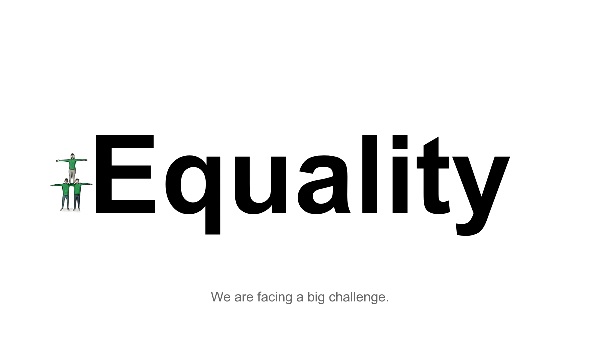
Together with colleagues we are talking about professionalisation and accreditation in Learning Technology today. You can access all slides and links to resources from our talk at http://go.alt.ac.uk/altcDigifest .
Tag: #altc
-

Open Education Week #femedtech
Next week is Open Education Week and in preparation to giving a keynote at the launch of a new ALT Members Group in Northern Ireland on International Women’s Day on 8 March, I have been revisiting my talk on equality and open practice that I gave last year. The talk specifically discussed the potential of Member Groups in creating greater openness and promote equality.

Over the past year, I have seen, supported and been inspired by a pletora of work being done all across sectors to promote equality, for example the Feminist Internet project, Kelsey Merkley’s @UncommonWomen campaign and the continued growth of the #femedtech community to mention only a few.
With this year’s OER conference just over a month away (if you haven’t yet had a look at the programme, you should…), it feels even more important to champion open practice for the cause of equality – open practice that empowers diversity and inclusion such as we saw discussed during #engageMOOC on Twitter recently. Open practice that fosters criticality and builds confidence, that helps better reflect the work that is being done for which there are no awards, such as the lessons we learn from managing change or failure.
-

An open perspective on organisational transformation?
This is a joint post with Martin Hawksey (cross-posted here).
We work for ALT, the UK’s leading professional body in Learning Technology. We serve a community of over 3,000 Members who use technology for learning, teaching and assessment and by extension we use it to support, engage with and represent ALT’s Members. Last year, the Trustees of ALT took the decision to move ALT’s operations away from a long-standing hosting agreement with a university to a more independent model, to ensure that ALT’s strategic aims and values are underpinned by an effective, agile base of operations providing more direct support for Members across the UK.
Thus we set out on a journey to transform our largely office-based team into a distributed, home-based workforce and to set up virtual operations fit to meet our changing requirements.
In this series of posts (which we are publishing on each of our blogs, see Maren’s and Martin’s, to begin with) we aim to share our experience as senior staff leading the transition and our team through the changes, sharing insights and lessons learnt as well as what we hope will be transferable know-how that others can apply in their context. We’ve framed this as a conversation in order to share our contrasting perspectives, and we may add more practical/technical sections as we go along.
We take an open approach to leadership, so it seems appropriate to take a similarly open approach to documenting this journey. Some aspects of this kind of transition however are necessarily personal to the individuals concerned and where we’d like to share something about the work of a particular individual we will seek their consent.
February
In this post we look back at February, the first month of virtual operations, sharing our perspectives on making a start as a distributed team.
Maren: Let’s start by looking back at the first month. For me the biggest thing that happened was seeing the project plan come to life, to hit all the milestones of making the physical transition, packing up boxes and making sure everyone got their stuff delivered to their new work spaces. We had been planning for this for such a long that it felt like a real achievement to actually see the boxes being packed, the room empty and to wave goodbye. It felt a bit like moving house, as lots of last minute things needed sorting out and decisions needed to be taken as they arose. We couldn’t plan for everything, but I felt the actual move itself helped bring out many small, niggly questions and needs that we could only then consider and deal with. What was your highlight?
Martin: For me the main focus was how do we ‘virtualise’ our operations. As some of our team already worked remotely there was already a lot in place. ALT has been a G Suite Education user for a number of years so we already had a culture of collaboration and communication using Google Drive, Hangouts and chat. In other areas we were starting fresh, for example, phone systems and physical file storage. Phones are interesting as most institutions have already moved to VOIP systems which use ethernet connections and a lot of the existing network infrastructure, plugged into a physical phone. There are a number of providers who provide services for phone systems that are entirely internet based and even Skype now has web based tools. We opted for a cloud service which still gave us Oxford based numbers and integrated into G Suite. We could have paid extra for a physical phone but as most of our daily operations are web based it didn’t seem like any point, plus the service comes with an app we can install on our mobiles if we wish. So now we have a virtual switch board and direct numbers for all of us. It has required some changes in the way we operate like how do you look across the room to see if another person can take a call, but overall I think it’s so far worked very well. It’s made me think if I should use the same service for my home phone. The process of moving to a virtual phone system seemed straightforward. Were there any challenges with phone systems or other technology you encountered?
Maren: The technology worked well overall and in some ways made it easier to begin to change the way we work. The two challenges I encountered myself and with colleagues was being overwhelmed by everything having to be done differently and secondly what to do when things went wrong. For example, day to day processes like filing expense claims or signing documents suddenly turned from something I never think about to requiring a new procedure. The new services we adopted, for digital signing of documents for example, are easy to use, but still take time to embed into workflows. Particularly at the beginning it felt like productivity was nose-diving because it takes a lot more time to figure out how to do something for the first time or to follow a new process. It’s tempting to take shortcuts instead of establishing robust processes and documenting the individual steps. The other challenge for me was that it was a new experience to have to support the team as a whole with new workflows virtually. Particularly when it comes to the finance systems, this was quite difficult for me to begin with. It was reassuring and useful to have options to provide support remotely and I think tools like screen-sharing and working synchronously online are becoming more and more useful as we get the hang of them as a team. What are your thoughts on providing support remotely for a whole team?
Martin: On the IT side there was the added burden that moving away from a host institution also meant moving away from centralised IT support they provided. As a result there is an increased degree of self-help particularly when it comes to hardware. The move away for institutional desktop provision is a double edge sword. On one hand members of our team on Windows devices are admins so can install software and hardware, on the other hand we need to mitigate that equipment and networks used are secure. Already we’ve encountered a situation where I needed to physically get my hands on a Chromebook to fix a problem. Fortunately we had already scheduled a face-to-face meeting so this wasn’t too much of an issue, but it’s a reminder that despite more reliable computing and ways of collaborating remotely you still need that personal touch. Overall however I think we are in a better place as we have ownership of everything we do. This also gives us freedom to look at other services we can use for support. Already aspects of our web services are maintained by third parties that we have chosen and as part of the transition we have and retained the services of a HR consultant. This seems like a very cost effective model for an organisation our size. Would you agree or are there hidden costs to consider?
Maren: In terms of the essential services our organisations needs, I agree that virtual operations are very cost efficient. Even taking into account set up costs like purchasing new equipment there will be savings and it certainly helps that we planned ahead and budgeted accordingly. In the case of infrastructure and tech, we already have a lot of expertise in house (which I think is unusual for an organisation our size) and we have turned that into an operational advantage. We also identified areas such as legal, HR or pensions in which we needed and procured additional expertise. The key factor in the decision making process has actually been putting our organisation’s values into practice. That’s given the transition a more strategic, people-focused outlook, and ensured we invest in areas that make a difference to staff or Members. Looking back, I feel that our values played a bigger part in the decision making process than I had anticipated. In the face of all this change and upheaval, having shared values that remain consistent has been a powerful force for creating stability. But, the transition has really only just begun.
-
6 years a CEO… the soundtrack
This morning my least favourite social media platform reminded me of a post from 6 years ago, and it linked back to this announcement from 2012, written by Martin Oliver, then Chair of ALT, about my appointment as CEO of the Association.
Since then, I have written many times to Members to report on progress and together with others shared the work we do, which I am very proud of. But this post is more personal, not about me representing ALT as an organisation. Because as I found out in the last six years, being a CEO is all about who you are and the people you work with.
To celebrate making it to 6 years as a CEO, I am going am going to share the top tracks from the soundtrack of the last 6 years and the reasons for why I love these songs:
Harder Than You Think by Public Enemy
Good for running, good for getting out of bed and a potent reminder that the example I set, the work I do, does make a difference (even if it often is…. harder than you think).Manic Monday by The Bangles
Needs no explanation really, not many weeks manage to start with anything else. This is a proper 80s reminder to have fun, work hard and hum along of things get really tough.Theme tune from Star Trek – The Next Generation
With Captain Picard being my all-time hero and the crew of the Enterprise and their adventures shaping most of the metaphors in my young mind, there is not a lot that I don’t imagine in terms of what’s happening on the Enterprise.Picture of You by The Cure
I used to follow the band along on tour when I was a teenager and I have every one of their albums. They are my favourite band and this song I like to listen to when I stand on a new stage, looking around a big, empty auditorium for the first time. Also works great on train journeys… a song to make me feel at home no matter where I am.Lost in the Supermarket by The Clash
Living in London for over ten years, I came to identify with this song a lot. Also, it’s The Clash.15 Step by Radiohead
I never knew that Radiohead was Oxford’s ‘local’ band before I lived there and as I am terrible at recognising people’s names and faces, I never spotted any of them in town. Of all their music, I love this song in particular.I went to see Midnight Oil play live in London last year and when the floor and the roof and the walls and every body was vibrating with the beat of the drums I was reminded that as human beings we are made to experience the world with all our senses. This is part of what you don’t see.
-

How to share credit and praise yourself… reflecting on the value of (deserved) recognition
Recently I have been spending a lot of time writing references, quotes and feedback for colleagues. And I found it easy to talk about their achievements, to praise their outstanding qualities and to describe how they made a difference. It’s easy to do when it’s for someone amazing, it’s easy to do when it’s not yourself you’re writing or talking about, I find.
But then I read something others or I write about ourselves, about our own achievements and what we have made happen and the tone is completely different. There are whole sentences of qualifying statements, there are plenty of “I feel that…” and “I may argue that…” to soften the tone. There are references to other people and their work, acknowledgements of contributions and so forth. Whether it’s for personal or professional reasons, plenty of us struggle to find a way to give ourselves the credit we deserve (self-promoting egomaniacs need not read on…) . And whilst I obviously do not advocate taking credit if you don’t deserve it, it is important to be able to accurately recognise the importance of your own work and its impact on order to develop more mature, reflective professional practice.
In my experience that’s not a gendered phenomenon, and can definitely apply to high achieving individuals as well. Plenty of brilliant people find it hard to accept praise, argue their own cause or believe in their achievements.
Since I was awarded CMALT, I keep writing updates to my portfolio and as part of that process (and beyond it) I am trying to improve how I apply this in my own practice and I have come up with a couple of rules for myself:
Acknowledge contributions: in my case nearly everything is a shared undertaking. So I start by giving credit to my collaborators, to everyone’s who has contributed and say thank you.
Mention my own role: once I have acknowledged what others have done, I also describe my own work, what I made happen, what I achieved.
Reflect on impact: whether it is good or bad, I reflect on the difference what we or I did has made. It’s a useful opportunity to ask for feedback, to acknowledge lessons learnt, to bring achievements into perspective.
Accept praise: genuine praise can be hard to accept, particularly from people whose opinion you value. Some people love being applauded, others don’t feel they deserve the credit. Accepting praise is a skill like any other and I find it is important to remember that sometimes others can see more clearly when we deserve it. If they make the effort to bestow upon you, accept it.
Hopefully this approach will help me find the right balance between sharing credit, celebrating what I do well and getting and giving others the professional recognition we deserve.
-
Re-post #altc: What we have been up to… an update from the Chair and Chief Executive of ALT
Together with the Chair of ALT, Sheila MacNeill, I wrote this update on the work we have been doing and we published this on the #altc blog recently:
Dear Members
A year ago we launched ALT’s Strategy 2017-2020 and since then we have made great progress putting our shared values into practice and working together to meet our aims.
We reported to Members and stakeholders from across sectors in ALT’s Annual Report [PDF] and at the AGM in September. Since then much has happened and so we are are now sharing more of what we have been up to:
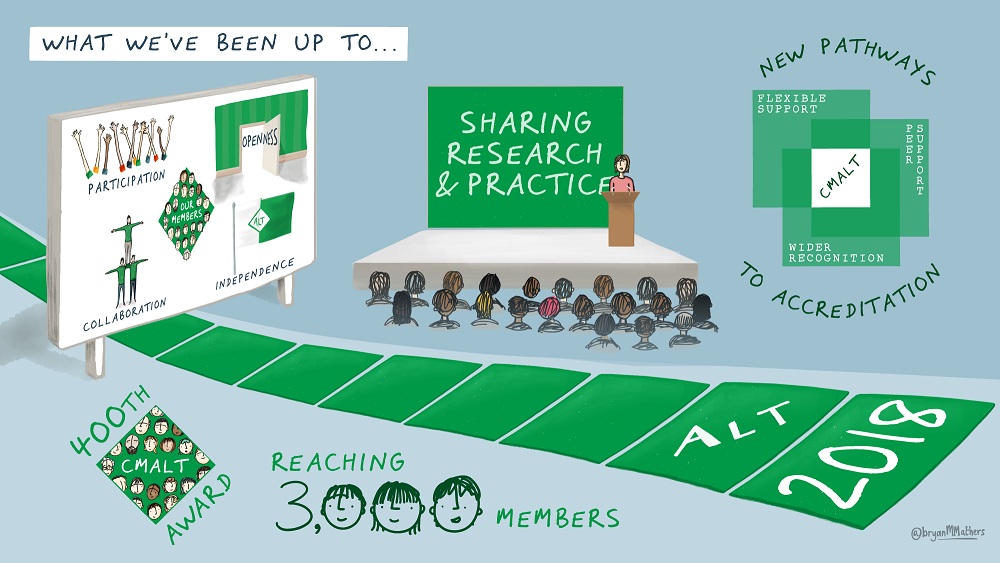
Sharing research & practice
2017 had a strong programme of events sharing research & practice in Learning Technology and making our independent voice heard in the UK and internationally. The OER17 Conference in London in April, our first Annual Conference to be held in Liverpool in September, the 4th Online Winter Conference in December; and throughout the year local Members Groups meetings brought professionals together to critically discuss topics such as next generation learning environments, micro accreditation and learning analytics.
Reaching new Member milestones
As our new strategy clearly states, we are greater than the sum of our parts. In 2017 we celebrated two membership milestones; the 400th CMALT Award and the growth of overall Membership to over 3000. This increase in numbers is making our voice in policy development stronger than ever before. The decision to keep our membership fees frozen for a third year has also paid off as increasing membership allows us to maintain and expand all of our activities. The more members we have, the more we can do for and with our community
Increasing impact
We continued to worked hard to increase the impact of Learning Technology for public benefit, establishing a new publishing partnership between ALT and Open Academia for our journal, Research in Learning Technology. Alongside the journal, the #altc blog flourishes and ALT’s Open Access Repository has had a mini renaissance, enabling Members to publish and deposit research and reports, such as the guide to working with startups in Learning Technology. All ALT’s publications continue to be edited by Members and reviewed by Members just like our peer-review for events and awards.
New pathways to accreditation
Over the past five months we have led a major consultation, Pathways to CMALT, with Members and the wider community. We want to expand the CMALT accreditation framework to provide new pathways to professional recognition for: Learning Technology professionals in the early stages of their career, for those for whom Learning Technology is only part of their role and also for senior professionals in management, leadership or research positions. Pathways to CMALT is the largest innovation project ALT has undertaken independently since the ground breaking ocTEL online programme. This year will see this exciting new project scaling up to include further mappings beyond the Jisc Digital Capabilities framework, the UKPSF and the Blended Learning curriculum.
Looking ahead to 2018
That brings us to what’s coming up in 2018, when we celebrate ALT’s 25th birthday! This is a special year for us as an Association and as well as new accreditation pathways and the first ALT Research Awards we’ll be working together across sectors and countries to achieve greater recognition for and representation of our Members.
Join us in making this year even more impactful for our community, help spread the word to more Learning Technology professionals and share what we have achieved as a community.