In my organisation I lead on providing CPD for a small team and providing meaningful, cost-effective opportunities for learning and gaining know how at a micro scale can be challenging. We’ve taken part in open online courses like Blended Learning Essentials and 23 things, we have a regular ‘show & tell’ slot at weekly team meetings, we take part in events and the networks we support and we sometimes have guests who share their work with us.
Still, I am always on the look out for new ways to learn and resources that teach me and my colleagues “how to…” do anything from using technology to improving governance. Over the years I’ve assembled a whole list of places I go to and people I follow from whom I learn beyond searching for random tips on the internet. People or communities who are experts at sharing their thinking, their way of working and helping you learn for yourself.
To me those tutorials, walk-throughs and case studies are invaluable resources. But even more importantly, I find that how someone shares their work and thus enables you to discover or do something yourself tells you much about their values. It can really inspire you and give you confidence for learning new things. That’s an important part of cpd in general and particularly true in my context.
With this in mind, I generally want to find more than instruction, and ideally I am looking for these three things from my “How to…” heroes.
I want to:
- Find out why I should care/explore/spend time on something
- Examples that I can relate to and that are more generally applicable
- References and further reading, things I can share and that are accessible for people who aren’t experts
So I’ve started making a list of whom we’ve learnt from a lot over the years to say thank you and acknowledge the power of openly sharing know-how:
API Evangelist Kin Lane introduced me properly for the first time to the world of APIs, what they are and why they matter. His API 101 was my place to get started and Kin’s writing is both accessible and inspiring.
Amy Burvall’s Graffikon site is really inspiring and opened my eyes to how visual thinking and expression can really become in a digital, black and pink kind of way. Education meets technology meets creativity in her recent book Intention: Critical Creativity in the Classroom.
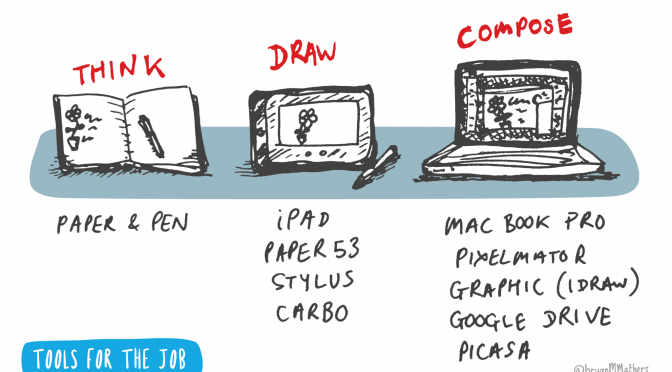
Bryan Mathers and his Visual Thinkery meanwhile represents for me a masterclass in thinking. Bryan not only shares his thoughts and what he captures from others, but also inspiring insights into his own creative process [the image heading this post Hey! How’d you do that? by @bryanMMathers is licenced under CC-BY-ND]
Catherine Cronin starts her site with the motto ‘learning | reflecting | sharing” and is often a starting point for me when I am looking to reflect on or think about complex issues. Her examples remind me of how to critically examine my own perspective and the forces that shape it.
David Hopkin’s meanwhile was one of the first blogs I discovered, and there is a wealth of “how to” posts (like this one) that are clearly written, useful for lots of professionals and easy to follow!
Ewan McAndrew, Wikimedian in Residence at the University of Edinburgh, shares a huge amount of knowledge about how to use Wikipedia and I discovered that you can listen to Wikipedia being edited through him. Magic.
FOS4L is an open course on flexible, open & social learning for professionals in higher ed & others. I’ve taken part and audited the course and will do so again at the next iteration. It’s an excellent way to discover all the things you don’t know about (yet).
Cable Green’s work and posts are one of the strongest examples of how to influence policy and make change happen in (open) education. In his posts, like this recent one on open licencing, he shares his reasoning and evidence for policy makers and educators alike with extensive references and materials licenced for re-use.
Melissa Highton’s blog for me is less about how to do and more about how to think and lead. It’s especially valuable as only very few senior leaders share their thoughts in the way Melissa does and that makes it even more powerful.
Joel Mill’s iLearning UK blog even comes with its own glossary and its this depth in the excellent resources he shares that I find particularly valuable. He showcases work from different educational contexts and connects all the dots. Always reminds me of what is possible.
James Kieft produces and shares edtech resources including videos that I’ve often recommended to others and that link to many other resources and tools to explore.
Alice Keeler is probably the one of my most frequently used sources for tips when it comes to using Google Apps for Education and her tips, while specifically aimed at teachers, are handy far beyond the classroom.
LTHE twitter chat is the only chat I lurk in regularly, sometimes contribute to and always find interesting. It’s a practical demonstration of peer learning that leads me to discover a huge number of ideas and resources. Thank you!
Martin Hawksey could run a masterclass on how to write easy to follow tutorials, but his blog showcases inspired innovation in practice far beyond technical “how to…” . A treasure trove for those looking to push the boundaries of edtech.
OUseful Blog by Tony Hirst has become even more rewarding to follow since I learned more about open data and although quite a lot of it is beyond my technical knowledge, it’s a place where I never fail to find useful inspiration.
Oliver Quinlan works at the intersection of learning, digital and education and was one of the first practitioners I discovered when he was still working in schools. He is now at the Raspberry Pi Foundation and shares everything from reading recommendations to practical tutorials. Prolific output.
Rhizo… in the past one of the most usefully challenging and inspiring learning experiences and one I continue to revisit as the conversation continues even long after the course has finished.
Chad Sansing’s work with Mozilla is a more recent discovery for me and I found his posts particularly helpful for gaining strategic “how to…” in the context of the web and education more generally. Posts like this one on successful facilitation I found very practical indeed.
Amber Thomas’s blog is a must read for the bigger picture on Learning Technology and institutional change management, particularly as a lot of what I work on focuses on the relationship between technology and people and its wider impact.
Santanu Vasant shares insightful thoughts and practice and I like the mix of thought pieces and practice approaches. I’ve discovered many new things through his consistent blogging and helpful tips.
Audrey Watters‘ work is where I turn to when I need “how to…” think critically, question, analyse and examine. Consistently brilliant scholarship that poses difficult questions while examining the financial, political and social realities of the edtech industry.
ALT’s #altc blog and in particular the case studies section I use frequently when I am looking to learn lessons from others or point someone else in the right direction. It helps me avoid trying to solve problems that other people have already mastered and keep up to date with current practice.
Last, but not least, I often dip back into the open course I originally helped create, ocTEL. Many of the course materials, like this module on leadership and management, don’t loose their currency and it continues to be a valuable resource to build on.
There are so many more entries to add to this list, or the next list on inspirational reading. But this one focuses first and foremost on things I find invaluable leading and sharing CPD and continuing my own learning.








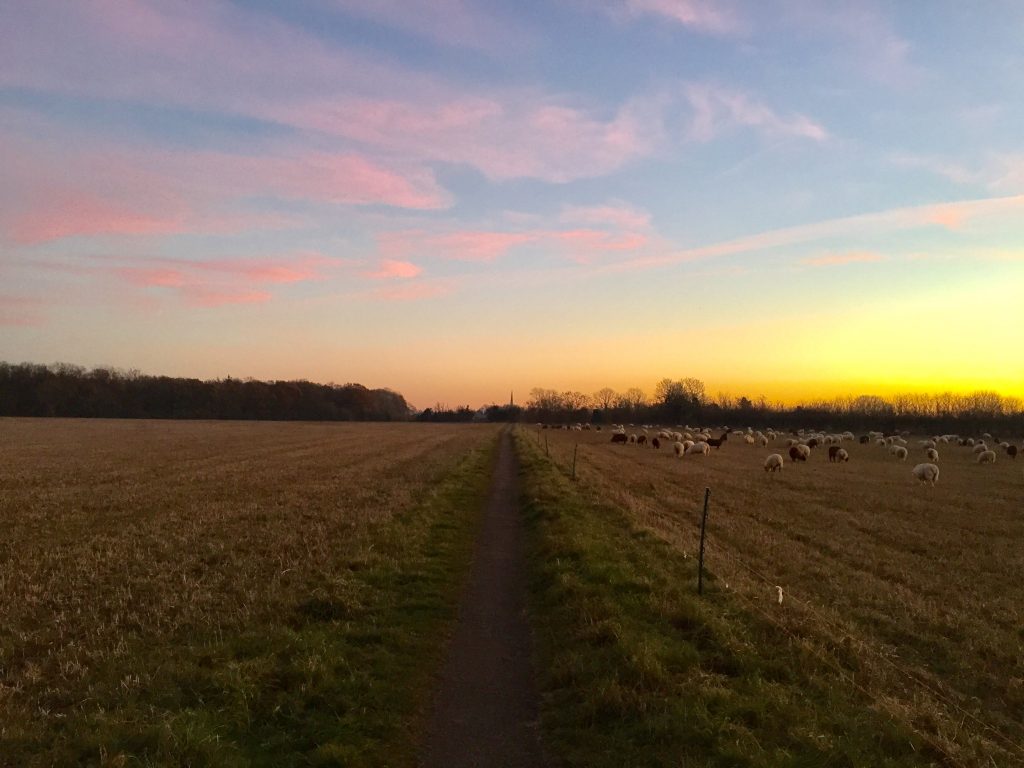 When I discovered that I love running it wasn’t because of the actual movement. It took me over 6 months to be able to jog gently and over a year to actually run. What I did enjoy straight away as being outside, moving through the landscape at my own pace and having time to get to know my thoughts within it. Over the past 18 months it’s become part of my everyday to head outside, mostly in the mornings, to get that time with myself in the world that surrounds me.