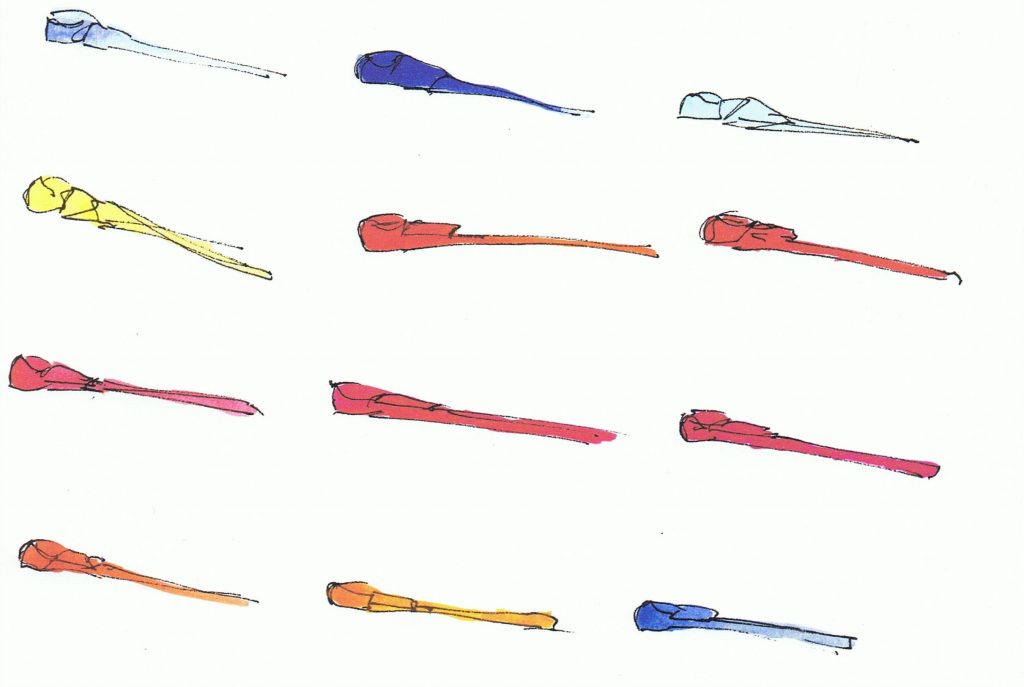
Shortly after I drew the Travelling Monument Kit I started a new sketchbook and that turned into a whole series of works, photography, drawings, sculptures and, I suppose, travel, too, all centred on swimming flippers and entitled ‘Travels with my flippers’.
The flippers became another layered metaphor, and worked for me on many levels:
The beach under the city streets… Inspired by the writings of the Situationists International movement I have written about in a previous post, the flippers were my tool to uncovering a sense of freedom and discovery. The idea, to me at least, of a beach, a place that is wild and natural, that is hidden under the geometric grid of the urban landscape has always been an attractive one. I can imagine that at a time when industrialisation and urbanisation were rapidly increasing and cities were encroaching both in the physical sense but also in the public imagination, the idea of going to discover a beach, a place of freedom and inhibition under the concrete of the pavements, streets and plazas was a radical proposition. Not following the rules of the city, to create one’s own path and map, following the currents of the mind, the imagination is a poetic undertaking that still appeals to me, just as it did then.
Then, I actually travelled with a pair of blue rubber swimming flippers that I bought in an old department store in Nicosia and put them into various places… taking photos along the way. It was surprisingly effective in situ and made people question how they read the space.
I created a sculpture of the slippers, in white resin, and they were beautiful, glossy objects, that always looked ocean wet. To the puzzlement of many they were ‘installed’ on ordinary pavement slabs in a pristine studio space for my fine art degree show without any further explanation. It worked for me, but it didn’t work as art. The context was too obscure, the metaphors remained unexplained and inaccessible outside of their own very peculiar aesthetic.
But it didn’t matter to me at the time, because the flippers acted as a metaphorical catalyst that inspired my practice as an artist. I filled sketchbooks and rolls of film, I wrote and dreamt and thought of things. The flippers also acted as a metaphorical accelerator, something to make the worlds of dense cultural theory I was reading easier to traverse. Swimming with flippers is a great deal easier and faster, they help us adapt to an unusual environment like underwater. It felt appropriate to use them as a tool for exploring critical theory, too.
Revisiting that now I find it interesting to revisit the idea, because I still do a lot to make exploring the worlds inside my head easier, to provide myself with the appropriate context for my professional practice (even if nowadays I don’t make and draw so many things anymore).
Although much of my everyday work is now digital, I still have many material symbols of my practice… laptop stickers, sticky notes, books, journals, pens, badges, conference lanyards, drawings, charts, things on my watch (like the watch face) and so forth. Also, cables, lots of cables, and an increasing amount of debris of older devices, chargers, cable ties, hard drives etc. And alongside these objects, I make just as much effort to create the right conditions to be creative, to think about complicated things. I have a workspace full of things that help – including artworks and mementos from trips I have been on or conferences I have attended.
And often it is an object or the space I work in that help me find time to write, to draw, to think. I respect the needs of my professional practice and I think that is what those flippers were ultimately about. They were travelling companions. Companions for thinking and doing, for my practice as an artist. They were symbolic and yet entirely practical. They were totems of my professional practice.
Signpost: This is a post from the Neon Flaneuse blog. The Neon Flaneuse is a blogging project for which I write about art, anthropology and edtech. It’s part of my professional practice but a project I pursue in my own time.
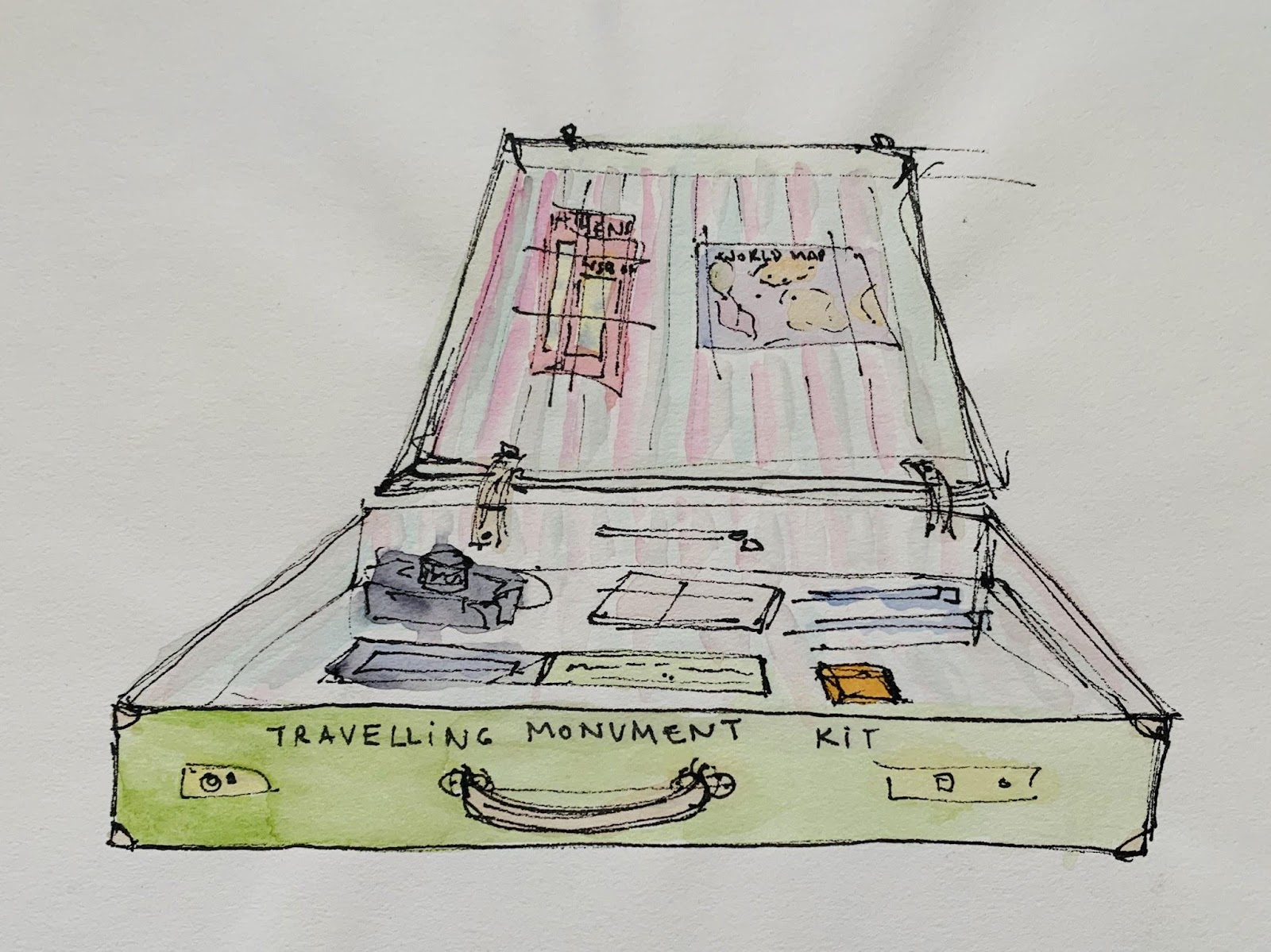
The Travelling Monument Kit – my original drawing
Nearly two decades ago I had an idea to create a Travelling Monument Kit. This is the original drawing which I still have in a sketchbook somewhere even though the actual suitcase I made has been lost in the mists of time (read: one too many house moves).
The idea of the travelling monument kit is really a layered metaphor, several ideas wrapped into each other, so let me try and unpack it for you.
Note: From here you proceed at your own risk… this is a post about a half remembered artwork on a blog about an imaginary character.
At the heart of the Travelling Monument Kit, what originally got me thinking about this idea, is the relationship between travelling and permanence. Travelling is all about leaving things behind, discovering new ones and changing perspectives… it’s about change. Monuments are normally fixed in place and time, permanent markers of things to be remembered. They signify that which we don’t want to change or forget or leave behind.
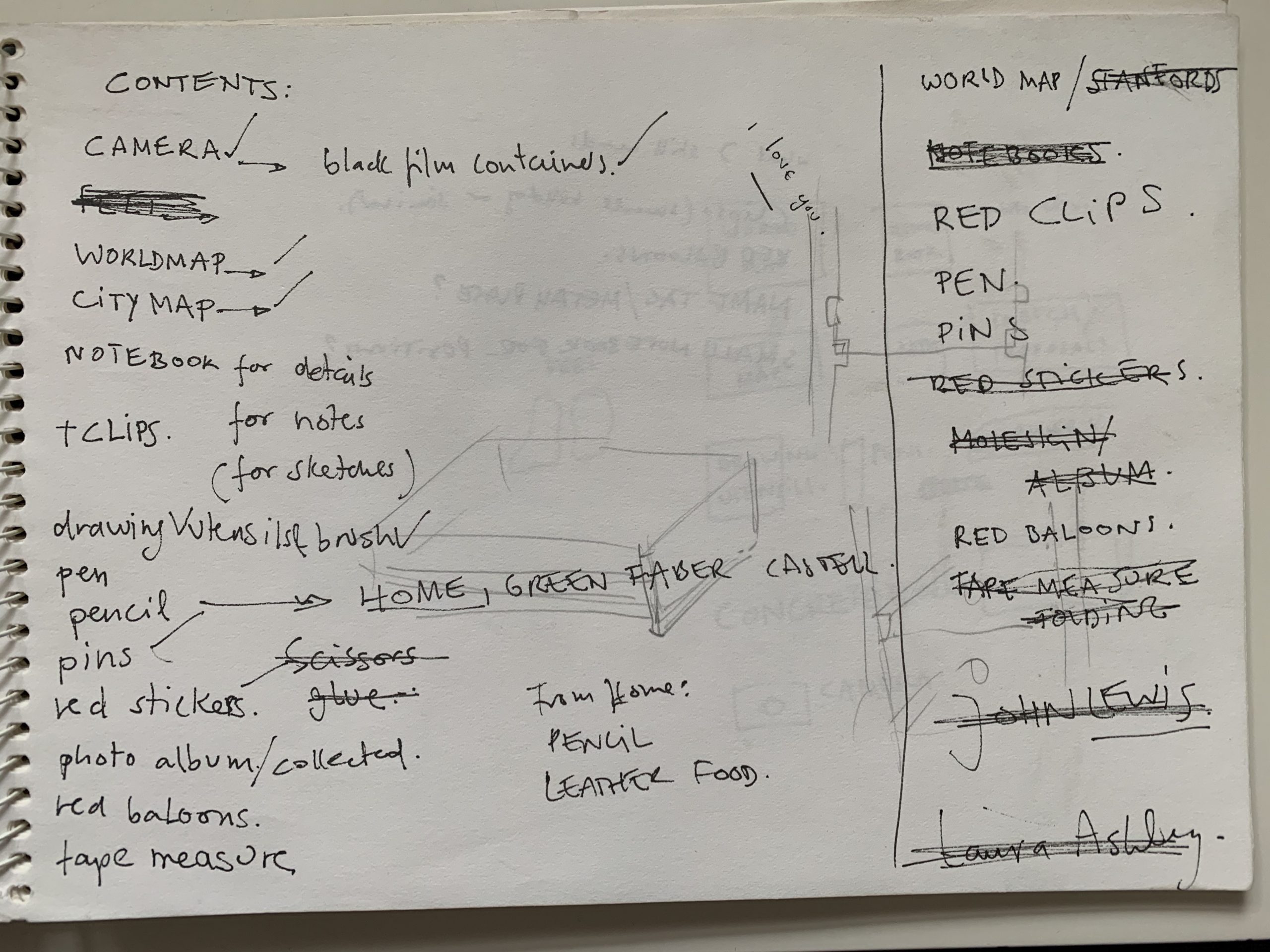
The Travelling Monument Kit contained maps, both a world map to put pins/markers on the chart and track the overall route, to record places visited; it included a camera to take photos of the travelling monument (the physical artwork included a Polaroid camera); a plaque with text to affix to or mark the monument on location; an album for recording and collecting the monuments.
I’m not sure anymore whether I originally imagined there to actually be anything else in the suitcase, or whether any given object or place identified could simply become a monument by virtue of the process of making it so, putting up the plaque, taking pictures, recording it and so forth. In real life I did both, create those kinds of monuments as well as choosing an object to actually travel with in the physical sense.
(The object I chose for that purpose was a pair of swimming flippers. Why? Because there was a beach underneath the city streets that I was interested in finding.)
In a way the Travelling Monument Kit explores how we can create lasting meaning amidst change. The process of ‘making a monument’ is very similar to, for example, going to a familiar restaurant in unfamiliar surroundings or finding connections between landscapes we are familiar with in a new place that is strange and different. It’s about creating something solid and strong, a connection, to bring things into perspective.
The Travelling Monument Kit is also in a suitcase. And that was a deliberate choice as well as being integral to the idea. It’s important that it’s a suitcase. It’s important in a number of different ways: a suitcase is purpose built for travel. It’s a native travel object. It is designed to be at home whilst travelling in a way very few things are. It’s never not at home because it (by definition) contains everything within it. Also, a suitcase is made to be in transit, on the road. In contrast to objects like first aid kits which are usually fixed in place and purpose, a suitcase is flexible both conceptually and practically. In the context of the Travelling Monument Kit it signifies that you can take the ability to create your own monuments, your own lasting meaning, memories and connections with you. You can pack it in a suitcase and never be without it.
The physical dimension is important, too. It’s important that the process isn’t digital, but focused on visual and material things. It makes a difference that the traveller, the monument maker, undertakes a physical, practical process. It’s important for the same reason as visiting physical monuments in the real world is distinct from seeing visual or digital representations of them. The sensory and embodied practice of interacting with a specific place or object is key to creating the connection, to making a memory, to establishing meaning. It’s particularly important for a traveller because our physical bodies can often be out of sync with new time zones or sleeping patterns, food, smells, perspectives. It can be disorientating to experience a lot of change, to encounter a lot of new places or people in quick succession. It’s necessary to relate to what we encounter with our senses and physical selves in order to make sense of things.
That’s where the historical dimension of the monument idea comes in. It’s about creating order, a timeline, it’s about finding a narrative, a story that connects the new markers we place on our map and brings them into perspective. It helps us create our own histories, to make sense and determine the meaning of things to us and in the context of our own internal worlds. It’s a lot like writing, I suppose, but also more than that.
The Travelling Monument Kit is not an instant monument kit. It’s not about appropriation. Technology and the tech industry keep looking for shortcuts to creating a sense of history, of legitimacy, of belonging in our lives. This artwork is not about quick ways to create the look of the thing – even though some of its elements are very visual, like taking a photo, putting up a plaque etc. It’s about a process, about experience and embodiment. At the time when I made this I didn’t own a mobile phone yet. I neither had nor dreamt of the affordances of such digital tools as are now commonplace. But even if I had done so, I don’t think it would have mattered that all physical elements of the Travelling Monument Kit could now be easily replicated or approximated with my phone. A camera, a custom map, a plaque, a photo album or record… I could easily replicate the look of the thing, make an app, an Instagram account. But it would be something entirely different from the original.
The intention that shaped the making of this Traveling Monument Kit was not focused on what it would create, although I did end up creating some travelling monument ‘books’. It wasn’t about creating and sharing content. The intention was to articulate, to think through the ideas, to create a sense of belonging whilst travelling, whilst being in flux and to foster that ability within yourself.
All themes that I still think about two decades later and which have developed new, interesting dimensions since.
In the sketchbook that the original drawing is from, you can follow the development of the idea:
Drawing
Kit contents
Kit ideas
Transitional Monument
Monument in Transit
Sketchbook pages relating to the Travelling Monument Kit
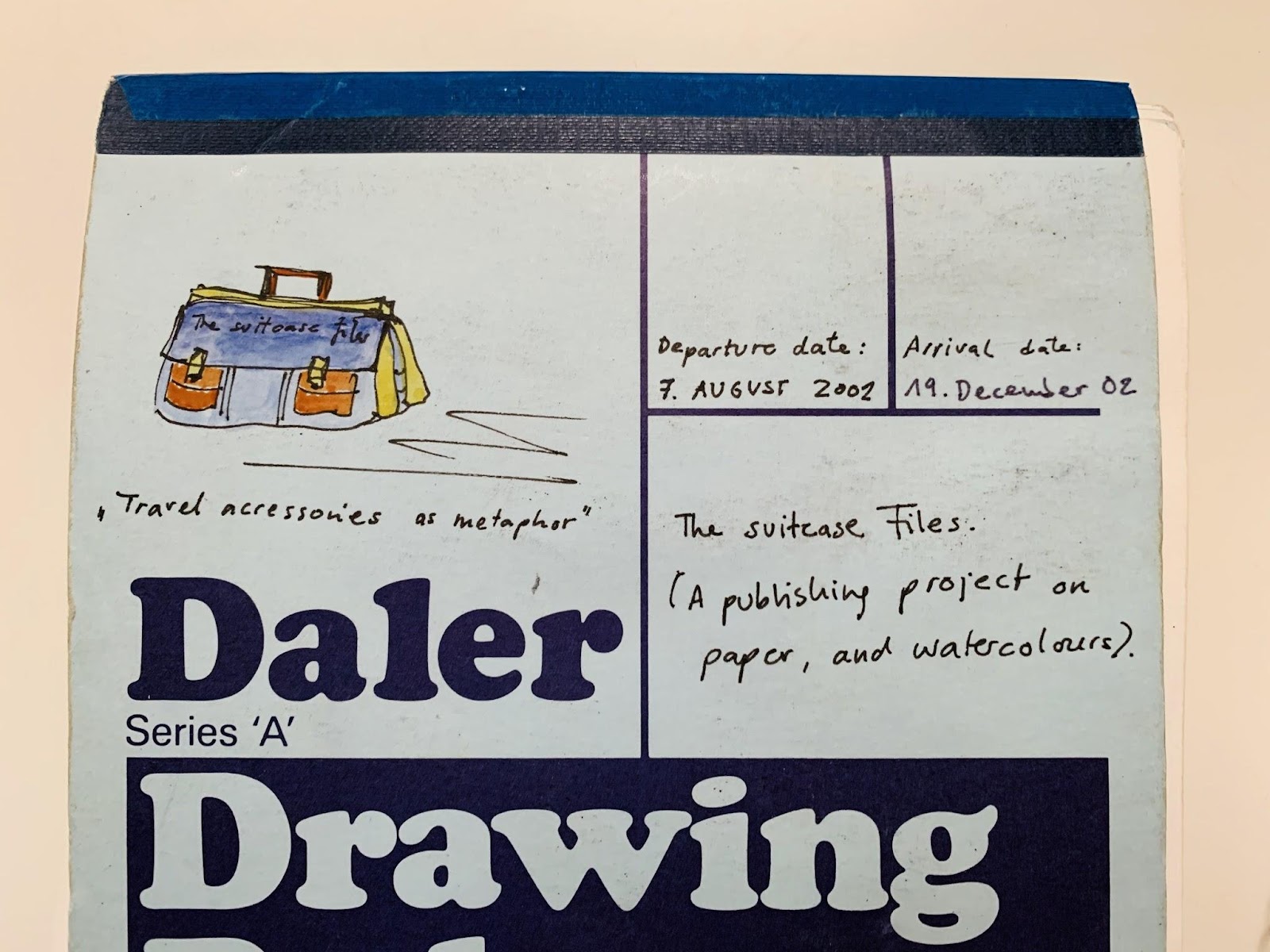
The Travelling Monument Kit itself is the final drawing in that sketchbook, after that there are only some blank pages. It’s as if the train of thought that had led to the drawing came to a full stop. The idea was created. I hadn’t thought about that before, how appropriate it was that the sketchbook ends after that drawing. It’s a useful thing to keep our own archive sometimes, to be able to go back and look at the physical objects that shape your thinking. Searching through my desk drawer revealed another interesting clue as to where my thoughts went next (this next sketchbook was probably bought in London but travelled to Athens where I was living at the time and back again and has followed me through all the house moves since 2002): the cover says it all: the suitcase files – travel accessories as metaphor.
Travel accessories as metaphor – sketchbook cover
Soundtrack for this post: Dusty in Memphis by Dusty Springfield
How do you cite a graphic novel? I’ve been reading Art Matters by Neil Gaiman, illustrated by Chris Riddell. And I want to write about it but simply quoting the words doesn’t work, so I have decided that pictures of the pages of the book may be better. They are all from the chapter entitled ‘why our future depends on libraries, reading and daydreaming’. (As an aside, I really recommend the book – it makes for inspiring reading.)
I’ve been looking for ways to think about my professional practice, my work and the future that isn’t bleak technological determinism, surveillance capitalism or decided by algorithms. I’ve found starting points for theory, policy and the wider context, but this post is more about the personal dimension, the ‘what do you get out of bed for’ part of any creative endeavour. Art Matters is a good book about practice and work, and although it is mostly written from the perspective of creative professionals like artists, musicians and writers, I think the heart of the book is just as relevant to working in education or edtech.
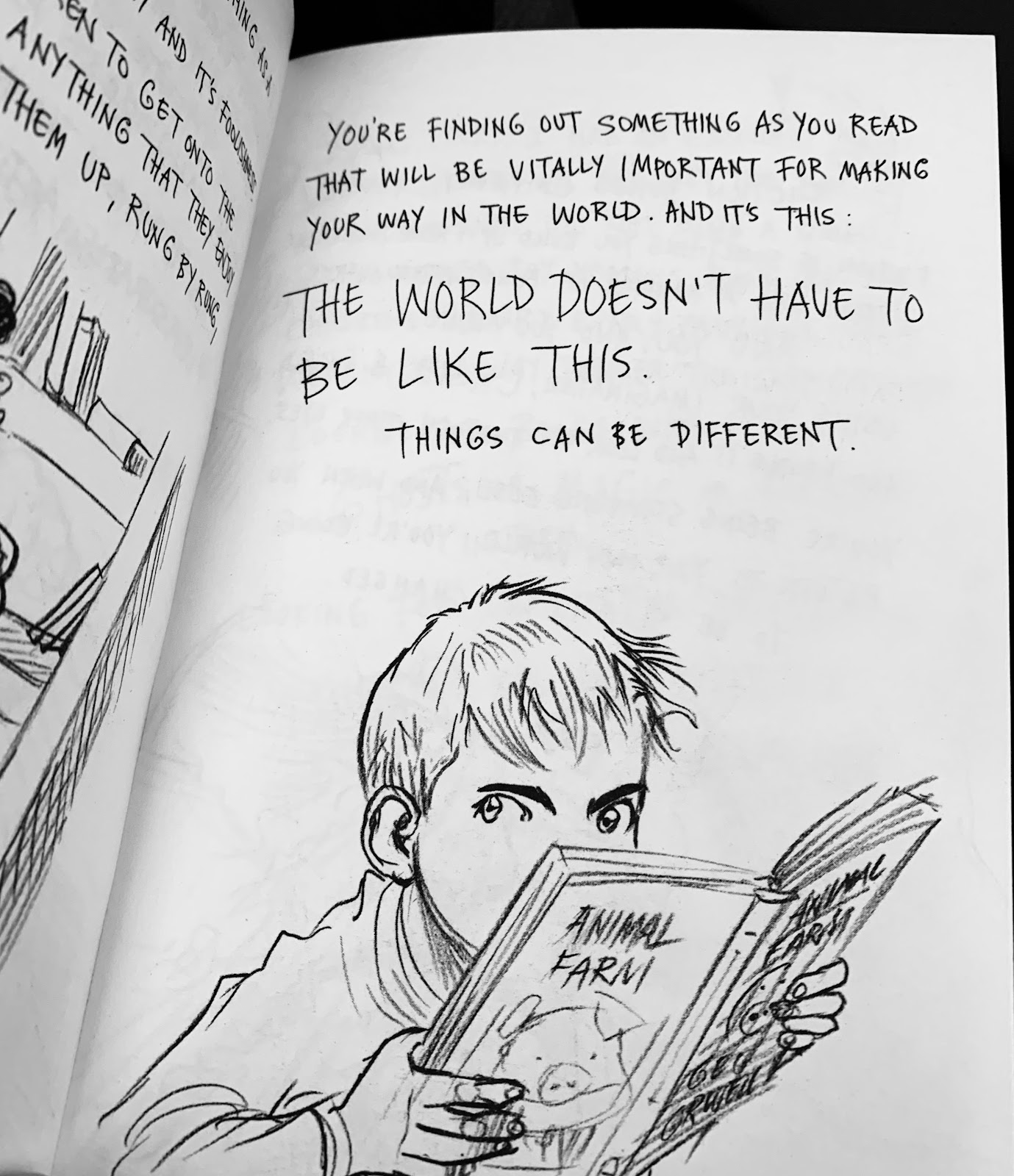
I read so much that I don’t often think about reading. So the page above made me pause. In this bit Gaiman talks about how important it is to read when you are young, or rather to get into the habit of reading for pleasure as early as possible. It reads:
You are finding out something as you read that will be vitally important for making your way in the world. And it’s this: the world doesn’t have to be like this. Things can be different.
This is about reading fiction, reading for fun, but I think it’s equally useful to consider in the context of reading policy, reports and so forth. Much of what I read about innovation, disruption and change, other than research, doesn’t seem to be about things actually changing, about things being different.
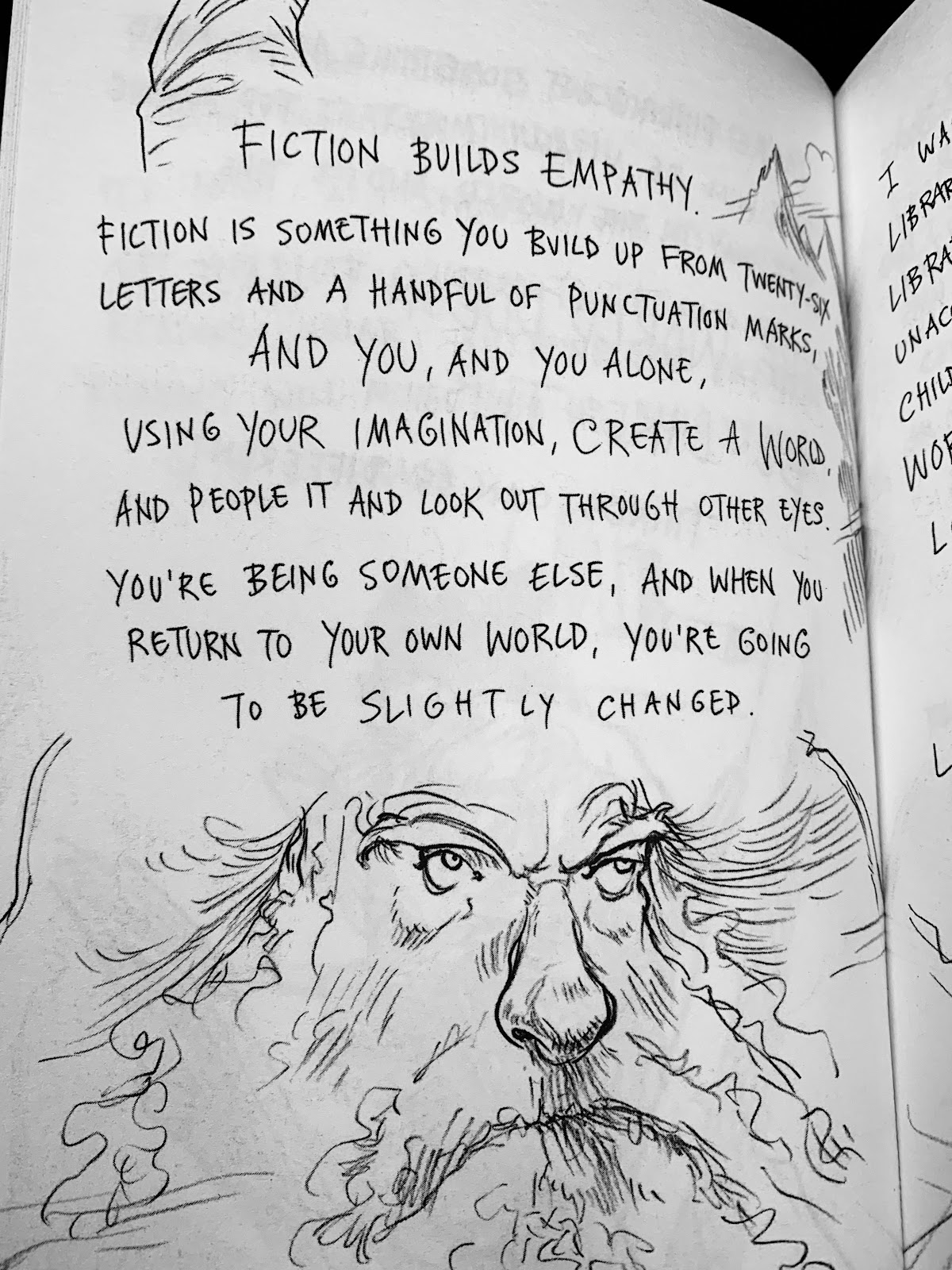
I like the idea that reading fiction builds empathy. It sounds very akin to ethnographic fieldwork. To see the world through other eyes. The idea that reading fiction as a journey that changes us is simple and powerful. It rings true to me. And it can be true of other stories, too. Really good lectures, inspiring keynotes, research.. the stories we tell. I hadn’t really thought about it in terms of building empathy before.
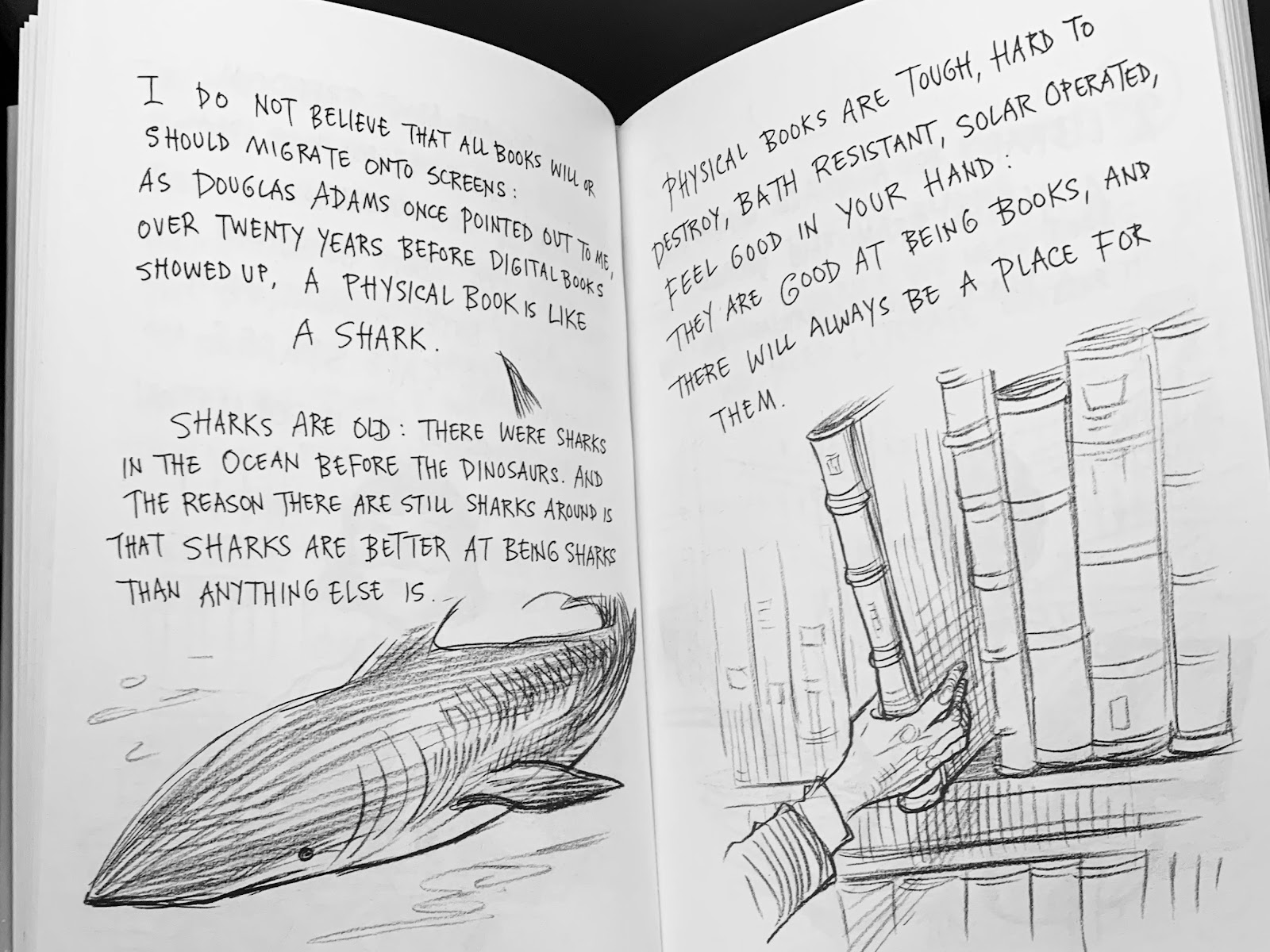
I read a lot in all media. And the pages of the book (above) made me reflect on how something like a book remains valuable and relevant even though there are other formats, alternative choices. It says:
I do not believe that all books will or should migrate to screens: as Douglas Adams once pointed out to me, over twenty years before digital books showed up, a physical books is like a shark. Sharks are old. There were sharks in the ocean before the dinosaurs. And the reason there are still sharks around is that sharks are better at being sharks than anything else is. … physical books are tough, hard to destroy, bath resistant, solar operated, feel good in your hand: they are good at being books, and there will always be a place for them.
I want that to be true. I think it goes back to what I wrote about in the last post, that it’s not helpful to frame our relationship with technology, with digital things, in terms of which one is better, which one becomes obsolete. It seems more helpful to appreciate that for instance physical and digital books can exist alongside each other. Like audio books and physical books, complimentary and each good in its own way. Plus, I really appreciate the bath reference. Sometimes there’s a story you can’t put down and you want to keep reading even in the bath. Some of my favourite books have spent days carefully drying out next to the radiator.
Earlier in the chapter Gaiman talks more about the importance of literacy, libraries and access to information. Even though it’s both interesting and important, I am going to skip that bit and hopefully let you read that for yourself. Instead, I want to come back to what he says about imagination.
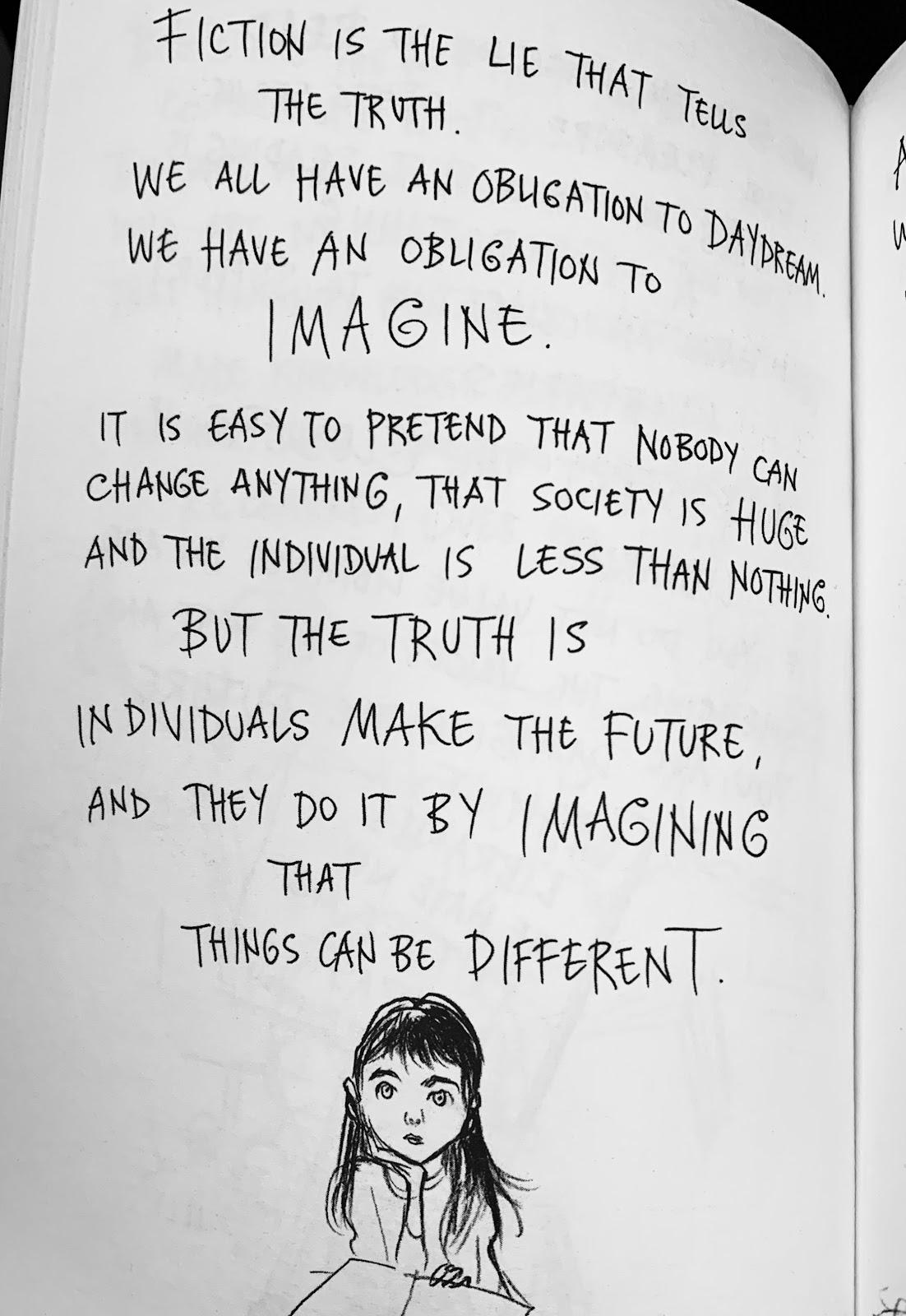
Fiction is the lie that tells the truth. We all have an obligation to daydream. We have an obligation to imagine. It is easy to pretend that nobody can change anything, that society is huge and the individual is less than nothing. But the truth is individuals make the future, and they do it by imagining that things can be different.
This is one of the radical bits of the book. There are quite a few, as it is mostly written like a call to action, a manifesto, but this bit in particular reminded me of something I have been thinking about recently: namely how hard it is to make something that is true for us, something that we feel is important, sound valid. Somehow I feel like I ought to proof.
Such words as ‘imagine that things can be different’ can easily sound trite and get dismissed quickly. Partly, I think, because of the responsibility they entail. It’s after all within my power to daydream, to imagine… to do better, to speak up, to make a change. It doesn’t require anything but my will to do that and so it’s entirely up to me. It’s within my power as an individual, a human being, but that means it’s also my responsibility – and that is the bit that many don’t feel comfortable with regardless of whether you are talking about inequality or technology or reading books or making art.
It’s what I really like about this book. It’s funny and it talks of failure. The loneliness of writing and the comic mistakes made. And the tragic ones. It’s about making choices and putting important things first. And so I am going to borrow yet more words from it to end this post with the following parting thought:
… ‘the things I did because I was excited, and wanted to see them exist in reality, have never let me down, and I’ve never regretted the time spent on any of them.’
Soundtrack for this post: Dreams by The Cranberries
Deep in the edtech sprawl, where daylight only rarely penetrates and you can hear the constant hum of servers being cooled, there is writing on the wall:
Is digital better? Is a computer better? Is AI better?
Passers-by hurry past these words, but they still read them. In those words they hear the deep thumping beat of the march of the machines. That sound is never absent from the edtech sprawl, forever thriving to mechanise, industrialise, to cut costs and increase profits. ‘Better’ may look glossy, sexy, new… but usually it is shorthand for something more, for devaluing labour for example. Deep in those dark and dank streets, there is a constant race to keep up, to remain relevant, to be employable. There is a competition to answer those questions about what is better, who is better. A machine or a human being.
Fortunately, we are making a map (with small moving footprints on it like the magical map in Harry Potter, only that the footprints on this map glow briefly in different neon colours… it is the Neon Flaneuse we are following after all) that will lead us to think about things in a different way, beyond the ‘digital dichotomy’. Beyond, to a more helpful and interesting part of the sprawl, where we can sit on a bench and watch the world go by. A bench which is still wrapped in the grey fog of the metropolis, but where the daylight sometimes penetrates. The bench has a plaque which reads: In Memory of Lilac and Flag.
There are two things I want to think about:
Creative professional practice, the way artists and designers work, which often blends different modalities of working, analogue and digital. Their approach provides a different starting point for thinking about the relationship between humans and machines or humans and data, more integrative than adversarial.
Also, experiencing art in person, rather than looking at a (digital) representation of or reading about it, may point in the same direction. May help our thinking take a step away from which is ‘better’, take a step back from the human versus machine narrative and get us to a more interesting place… .
Let’s think about art first. Many artworks are now catalogued online, and I can even take a virtual stroll through a museum or exhibition. The experience of reading about and looking at digital representations isn’t the same as experiencing a painting or a sculpture in person. Even if I wore a VR headset, and the recording or scan was extremely high resolution, it would be different to my first hand experience. It may be amazing, but it’s not the same as being there. It’s hard to articulate those different experiences I find because usually the language we use to talk about experiencing things through machines or the way in which machines function humanises technology. We use phrases like ‘the camera sees’ or the ‘the computer thinks’ or ‘the robot cares’ and that confuses the issue. So articulating the difference between what a human being does and what a machine does is tricky unless you are expert enough to use technical terms. Yet encountering art, a sculpture or a painting for example, is different for a human than it is for a machine. Obviously. There are many variables between an object, a person and a situation, that combine to create the experience. All of which contribute to the meaning that particular work of art may hold for the individual. Nothing holds meaning for a machine. Some elements of that meaning may be shared, like feeling small when encountering a large installation. Others may be so specific that they are singular. Some art or architecture is so spectacular that it is easier to engage with it because we know we should – we should look for meaning. But it can be hard to find, and taking a selfie, having a record, has become the predominant mode of engagement.
I like to imagine that with the Neon Flaneuse any museum I went to would suddenly be quiet, that people would magically melt away. All those labels and descriptions would also disappear and we would just follow our feet and stop and pause whenever something really captured our imagination. I went to art school for six years and yet never developed an interest in reading about art in museums. I still hardly ever read the labels. I know that I can remember enough about it to look it up in a book or on the internet later. But when I’m there in person, I want to really pay attention, to notice what I get from the experience.
Many people don’t feel that they really understand art. So they read the information provided in order to do so. It helps make sense, explains why something is important or what others feel was special about it. But if the museum was devoid of such clues, if there were no markers to tell you which one to pick, what would you go by? How would you know which one to like? Which one to take a picture of?
For me, personally, encountering art is all about the moment. There are artists whose aesthetic, ideas, style or mastery I admire. There are types of art of which I like the medium. There is art that I like because of its role in history. But for that I can buy a postcard or read a book. I don’t need to necessarily go to see Marcel Duchamp’s urinal or Rachel Whiteread’s house.
Instead, I want to focus on what I feel drawn to. A tortoise would be a good museum companion, making her way slowly and steadily through the levels. She could potter on whilst I stood still. People usually find that annoying. After all, there is always more to see, guides to follow.
A few years ago I spent the morning at the Scottish National Gallery in Edinburgh and the visit had two real highlights. Walking up to the museum I saw a big neon sign spelling out the words: everything is going to be alright. It really meant something to me that morning. It was just the message that I needed to see light up in bright lights. It made me smile despite being wet and cold.
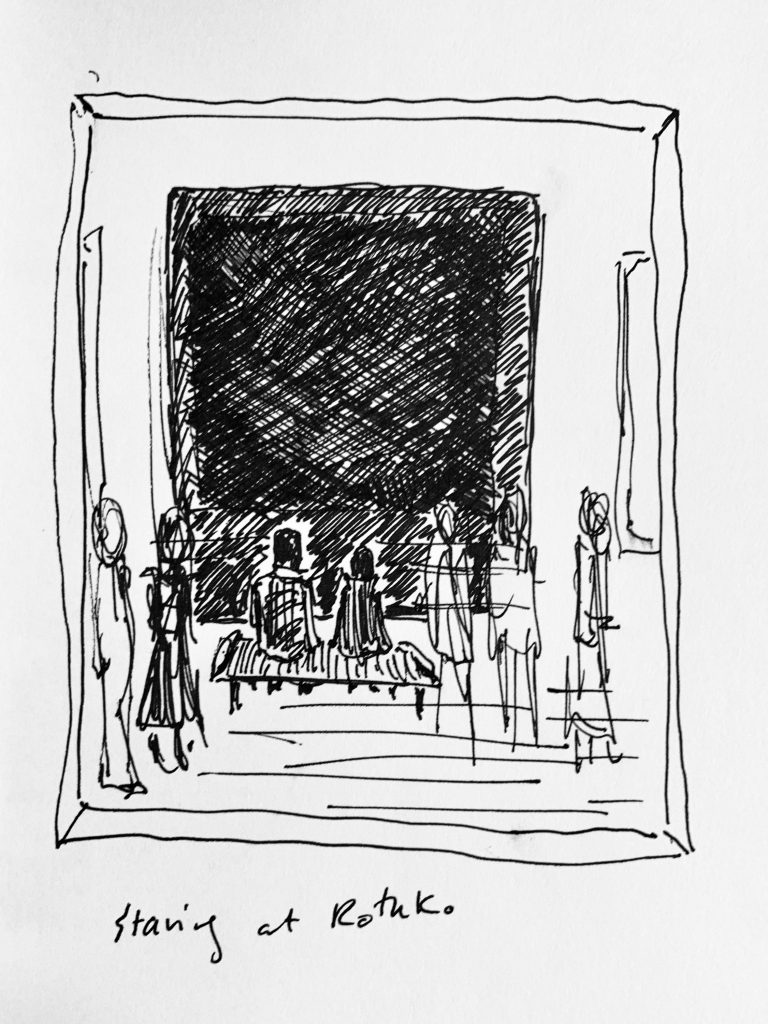
I went to see the Ed Ruscha exhibition they had on and some specific artworks I’d never seen before in real life. It was interesting but also what I had expected. No surprises, even though I learnt a lot. But in the last room of the exhibition I came across a painting that made me stop in my tracks. I sat down in front of it for so long that the school kids with their sketch pads were jostling me as they made their drawings and the security guard gave me funny looks. But that day this particular painting made me feel that sitting and staring at it, really drinking it in, was just what I wanted to do. It inspired me. It made me think and feel things I hadn’t felt before. Looking at it now on the Tate website I don’t connect with it in the same way. I still ‘like’ it and I get echoes of how I felt that day in Edinburgh but it’s different. The moment has passed, it’s become part of my story.
Coming back to those words on the wall, to the adversarial “which one is better” narrative… I don’t think it’s helpful to think in terms of which one is better. How we perceive the world isn’t better or worse than what we can measure or capture with tools and machines. Technology is useful. It enables me to learn all about that painting I saw in Edinburgh, to show it to you, to reference it and so forth. There is no competition as to what is better. Each type of experience, different ways to relate to and interact with the world have a different purpose and meaning. Both have value.
Creative professional practice has a long history of making use of technology. Digital technology has expanded the toolbox significantly but physical objects and other forms of knowledge are no less important. It seems perfectly logical to combine using original archive materials with digital sources to create physical models which can then be used to create a digital version and so forth. All have their place in the creative process.
There’s an interesting documentary series on the art of design that gives insight into this beautifully, but I’d guess talking to most creative professionals or visiting an art school or studio will highlight the same. The point is that we use whatever is the most useful without creating a hierarchy of what’s better. There is a joy in creative practice which I feel is absent in much of the work in educational technology.
So instead of asking which is better, a print maker or a printing machine, a teacher or a teaching machine, we ask different questions. We don’t set up a dichotomy which focuses on measurable indicators rather than purpose and meaning. We move beyond the digital dichotomy and we keep walking and go to the museum. Pick something and spend some time sitting with it. You won’t need to take a selfie. You will remember.
At the museum
Soundtrack for this post: Our Day Will Come by Amy Winehouse
Andy Warhol wrote a book called THE Philosophy of Andy Warhol (From A to B and Back Again) published in 1975 and as you might expect, it’s a bit of a strange read. It’s definitely not a book that takes you in a straight line from A to B. It’s more of a peek into a very singular imagination. One which you can easily get lost in. On the contents page of the book at the very top is the phrase “You Can’t Argue with Your Scrapbook” (I like that EVERY word is capitalised even in the contents section – it gives you an immediate sense of the importance of the ramblings that are to follow… ) and this is very much what this post is going to be like. A walk through of some pages of my scrapbook, sorry, My Scrapbook, about how we experience spaces, particularly urban spaces and to think about an embodied perspective as well as a technologically mediated one. I’m thinking about why how we perceive and interact with our environment matters and how it can become an act of resistance. Curiosity v capitalist conformity if you like.
It was this tweet that brought these ideas back to the forefront of my mind:
Do any of you still allow yourself to get “lost” driving in a city (either your own or one that’s new to you)? Or, do any of you explore a city w/o using some mapping tool?
The thread of all the answers makes for interesting reading. Although the idea of getting lost by car feels like an America’s concept to me. I am not sure most of the places I drive to are big enough to get lost in on purpose or with fun to be had (unless you count British one way systems). But the tweet struck a real chord with me because I feel that in this age of search and GPS getting lost is underrated. Whenever I see a tourist navigating Oxford or London with their phone held at eye level, staring with concentration at the street-view of where they are, reading the notifications that pop up about buildings and sights as they pass, I wish they would put the phone away and look around instead. I wish they would follow their feet and experience the place for themselves and discover makes them curious. Not to follow a predetermined route or learn only about what others or an algorithm deem important.
There are three concepts/metaphors related to getting lost and walking in the city that I am interested in: the slow walk or ‘ flanerie’ through the city that Benjamin and Baudelaire wrote about, the ‘derive’, that drifting through urban space that Guy Debord first wrote of and that was an important part of the Situationist International movement and the embodied practice of exploring a place with all our senses engaged to create a phenomenological perspective which is often associated with studying landscapes in Anthropology and Archaeology.
As an aside, as I mentioned in the introduction to this series, I really need to find some more diverse references for these ideas and concepts. The current list is only a starting point – I did create the Neon Flaneuse not a Flaneur intentionally. Suggestions and links via Twitter to @neonFlaneuse would be gratefully received.
Anyway, let’s get back to The Scrapbook and why these three concepts can be useful to think with now, in our context:
Phenomenological studies of prehistoric landscapes may not immediately spring to mind as an obvious reference point… but how we create meaning through our experience of a particular place and what mediates that experience is highly relevant to our relationship to technology. It helps articulate the contested, shifting nature of places and encourages us to consider the limitations of what we can capture about a place or an object (in images or words or other data). Placing primary focus on human experience, our individual points of view, presents an interesting challenge to data driven narratives.
The following two quotes give you a better idea (feel free to skip this bit, it gets less dense again further down). The first one is by Barbara Bender (2006) , an Archaeologist and Anthropologist who wrote much about landscapes but her work could be equally applied to cityscapes and urban sprawls:
‘Landscape’ is . . . ‘the world out there’ as understood, experienced, and engaged with through human consciousness and active involvement. Thus it is a subjective notion, and being subjective and open to many understandings it is volatile.’
The second quote is from Chris Tilley, who alongside Barbara Bender was at the Department of Anthropology at UCL when I was a student there and my PhD supervisor.
He talks about how we as human beings experience things, places or objects, through our senses, i.e. an embodied perspective, shaped by our physical bodies. He argues in his introduction to Identity, Place, Landscape and Heritage (2006) that ‘as our ‘involvement in the world is always situated as taking place from a point of view’ and also situated in time what we can capture and communicate is necessarily limited. Or, as he puts it,
‘The body is both interpretational constraint and enabling condition for the construction of meaning.’
If you don’t find this kind of phrasing particularly accessible, then you know now what my years as a research student were like.
What is relevant to me is that a lot of technology places an emphasis on only one of our senses, the visual, and often neglects all the others. This doesn’t just hold true for how we use tech but also extends to representations of the world that are based on data we collect, on words and images and other information. So if I walk down a street and I smell a bakery, I might go there and buy a donut. A drone wouldn’t. What smells delicious to me may not appeal to you. What feels like a steep climb or a tall step or a big jump to me… may be perceived differently by someone who is taller or stronger or braver. My primary way of making my way through the world is to rely on my body, hence it enables me to make sense of the world. And as there is no other way for me to be alive (AI evangelists need not apply here) it is also a constraint, i.e. the only way for me to make sense of the world.
Add to that all that ‘being me’ brings with it and add that to the way I interact with the world or with particular places and then multiply by all the other people on the planet and you get what Barbara Bender means when she says our involvement in the world is always situated.
Complicated quotes aside, the situatedness of human experience is a concept that is very relevant to human-computer interaction. Without sufficiently being able to understand and plan for that element of human social interaction problems of mutual intelligibility arise, and Anthropologist Lucy A. Suchman has written much on this subject, including this book which I will be adding to my reading list (and which I came across in a post on situated degree pathways – thanks 🙂 )
Already 1,000 words written and lots of obscure references thrown in and I haven’t even gotten to the second idea I wanted to discuss yet. I am not sure that bodes well for this new blogging venture, but we made it to the beach now in any case… .
Another book I came across (and which is now on my reading list) is The Beach Beneath the Street – The Everyday Life and Glorious Times of the Situationist International by McKenzie Wark. According to Wikipedia, McKenzie Wark is Professor of Media and Cultural Studies at The New School in New York City. Wark’s work sounds really interesting and whilst I have come across some of her writing on technology, there is clearly a lot more to discover.
Thanks to Wikipedia (and as I don’t have any of the source materials to hand) you can read a very comprehensive summary of what the Situationist International movement was all about. Although its active period as an artistic and later political movement (1950s-1970s) is behind us, its critique of advanced capitalism is directly related to the concerns about surveillance capitalism, social alienation and passive consumption that we currently discuss. The beach metaphor comes into it in relation to ‘situations, moments of life deliberately constructed for the purpose of reawakening and pursuing authentic desires, experiencing the feeling of life and adventure, and the liberation of everyday life’.
Drifting through the city, following wherever your feet may take you, stepping off the map, getting lost in the sprawl of the metropolis… following your curiosity. Taking time, being present. Not being tracked. If the Situationist International movement was revived today it would probably be a mindfulness tracking app with ethical, vegan wellbeing product tie-ins on Instagram. I don’t want to look for it in case there already is one.
But the radical vision at the heart of the movement, the anger and resistance that found its expression in the insurrections in France in May 1968, must not be lost. The desire to be liberated from the capitalist quotidian, to find alternatives to the prevailing social and economic narrative, is now more relevant than ever. Looking up, reclaiming our streets and cities from row upon row of homogenous shops and offices for communities not corporations is a fight to be fought now as it was then.
But there is no time as we are on our way to 10,000 steps a day. No time to stop, slow down.
Which is where the Neon Flaneuse and its origin come in.
I imagine, that if you were invited for tea by the heroine of my story (she only drinks Lady Grey, in case you are wondering) and had a look at her bookshelves, you’d find a book that every self respecting Flaneur ought to own: Momo by Michael Ende. Published in 1973, one of the book’s themes is the commodification of time, but it also features a ‘living doll’ and many other technologies which a few decades later read like an edtech development plan or marketing manual (not a lot has been written about Momo, but this article in Kronoscope contains a useful summary).
One of the main characters in the book is the tortoise Cassiopeia, a magical tortoise which can communicate through words that appear in glowing letters on her back: FOLLOW ME.
By following the tortoise, and walking at the pace of the tortoise instead of rushing faster and faster, the girl Momo makes her way to try and save the world. The pace of the tortoise is important in the story, and as a metaphor it resonates with the concept of “flanerie”, of slowly walking through the city. The pace at which you may perceive and discover things, get lost and drift for a while.
It’s a romantic metaphor I admit, but it is also a radical one. It is radical in part because it rejects our path as a linear narrative from A to B, it rejects conformity in favour of curiosity. It is radical because it is about stepping off the grid and onto the beach, to really look. Perception that may lead to reflection and resistance.
‘Follow the Tortoise’
Soundtrack for this post: Heart of Gold by Neil Young and his album On the Beach.
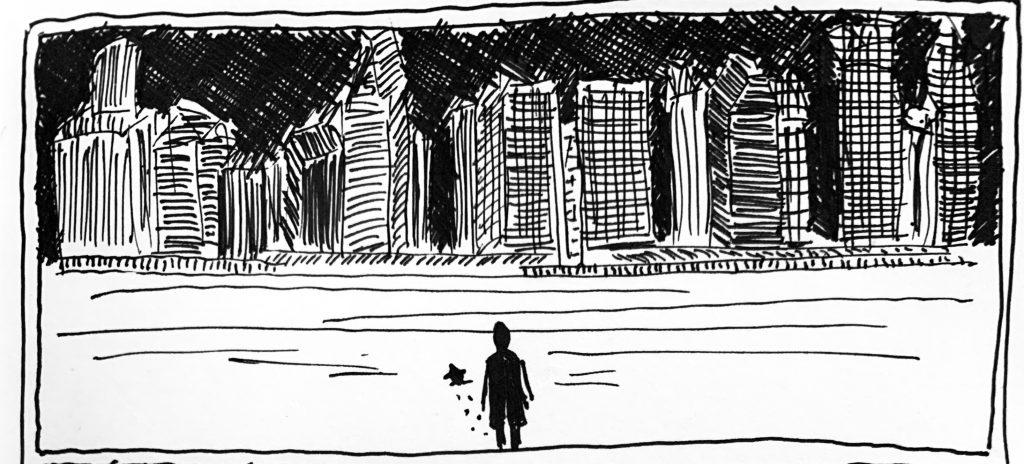
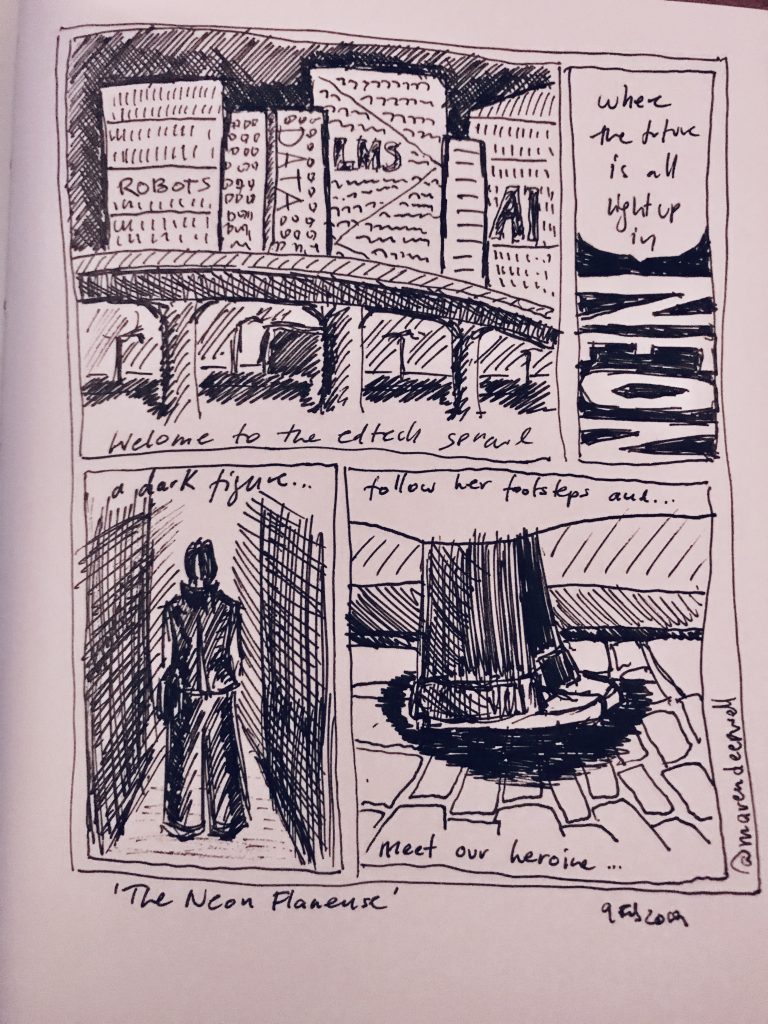
It was a rainy night and the neon lights of the arcades were reflected in the pools of water on the streets… in the air was the smell of wok fried herbs and spices from the street food vendors and a chill wind was coming up from the docks. Above the rushing crowd of late night shoppers and workers hurrying to the train home stood the towering office blocks and residential high rises. … Welcome to the edtech sprawl… where the future is all light up in neon… a dark figure… follow her footsteps… and meet our heroine:
The ‘Neon Flaneuse’ 2019
Welcome dear reader…
This is the first post of a brand new blogging project and that’s a special moment. But before we jump right in, here is how this all began:
The idea of the Neon Flaneuse was originally inspired by the Call for Proposals of the Domains19 conference for which I wrote the following submission:
The Neon Flaneuse: taking steps towards empowered professional practice
The flaneur or flaneuse, a person who saunters around observing society, a loafer, a lounger, was a popular figure in 19th century Paris. A model of the urban explorer in shopping arcades lit with gas lights. Walter Benjamin later popularised the figure of the flaneur in his Passagenwerk as an archetype of the modern, urban experience.
The flaneur combines a keen sense of observation and curiosity with a the slow pace of leisure and contemplation. A tortoise, the preferred pet of the flaneur, could set the pace of exploration. Yet as the industrialisation of cities increased and the pace of life grew more rapid, the figure disappeared. Enter: the neon flaneuse, the explorer of edtech sprawls who turns her critical gaze on the rapid pace of innovation, who poses questions about our relationship with technology, data and an uncertain future.
This short talk lights up in neon light not students or institutions but the people that make it all happen: whether your work is teaching, technology or training others, you can take steps towards empowered professional practice by exploring:
How to work in the critical age of educational technology?
What are the risks and upsides to working, thinking and reflecting in the open?
How can we promote equality through empowered professional practice?
Like the flaneuse of the 19th century, it can feel like we are running out of space to wander, explore and ponder and out of time and privacy in a world of social networks and constant connectivity. Like the flaneuse of the 19th century we work in a context where the dominant perspective is still that of the privileged, male, white classes – a gaze that we need to develop awareness of and critical approaches to challenge and subvert.
The final avenue of exploration will be the growing #femedtech network, a professional network curated via the @femedtech Twitter account. As one of the volunteers active in the network I will share ideas and lessons learnt as well as a call to action to get involved in promoting equality for everyone in educational technology and establish a more empowered professional practice in the process.
So join me and the Neon Flaneuse on this saunter through the edtech sprawl of professional practice as we explore how we might light up the future. Hoverboards welcome 🙂
… As it happens, I wasn’t able to go to the conference or deliver that session as planned, but I liked the idea so much that it kind of stayed with me. At the same time, I have been thinking about how I could make something more of my fledgling thoughts about edtech, art and anthropology.
So this newly minted blogging project, which will hopefully become a sketchbook of drawings and words and maybe even GIFs, is a bit of an exercise in connecting the dots between my different academic interests but also a prompt for me to think about educational technology in a different way, taking a step back from the work I do day to day.
It’s the darkest time of year and like many I sometimes struggle to find ways to express my thoughts or find the will to keep writing, to keep articulating and sharing, to use the voice I have and value it regardless of what else might be going on. So as well as being about art, anthropology and edtech this is a venture of joy and resistance.
I want to use the metaphor of the Neon Flaneuse to explore, to wander, to get lost in new ideas and ramblings. To create something that will give me joy and provide inspiration. It’s about the kind of alternative futures, the hope that Laura Czerniewicz so eloquently searched for (and found) in her OEB keynote. It’s my way of thinking about the stories that Audrey Watters reminds us we need to tell about edtech, its history, theory and its future. Our future.
I’m not sure where this will go over the next year and that is a good thing. I have this big blank canvas on my own domain to play with and I’m going to follow my feet and see where it takes me, tortoise in tow.
Soundtrack for this post: A rainy night in Soho by The Pogues – further listening suggestions for the playlist are welcome 🙂