It’s #OpenEducationWk and I’ve been inspired by activities and blog posts from across the community, including a special edition of the #LTHEchat (helpful intro here) and a number of webinars organised by the ALT Open Education Special Interest Group (including a preview today of the OER16 Open Culture conference coming up in April). Seeing so much commitment to and enthusiasm for scaling up open practice and resources has been a joy – but it’s also made me think about sustainability in the long term.
Many of us have plenty of problem solving to do right here, right now – and planning for the long term is not often a top priority. When it comes to creating open educational resources or sharing open practice it can be hard enough to do in the first place without thinking about how sustainable a particular piece of work might be when someone comes across it in 10 or 20 years. One of the immediate benefits of sharing something can be the feedback from colleagues, the conversation and knowledge exchange it stimulates and the connections we build through them. So our networks grows bigger and stronger and become more sustainable.
But what about our resources we share? What about them in the long run? In Learning Technology in particular many are fond of big sweeping statements (see Audrey Watter’s Hack Education project for an eye opening reality check) that make it sound as if a project or initiative solves a particular problem once and for all (and for everyone). Hyperbole along the lines of “no more textbooks – EVER” or “the END of the universities” makes it sound like we operate only a stone’s throw away from #edtech nirvana over the horizon. But without the right meta data, without considering interoperability, without updating and re-sharing things much of what we create remains useless to others. Enabling others to find and make sense of resources or assess their usefulness in their context is challenging while looking for what you need often leads to broken links, missing licences, taxonomies that only make sense to those who designed them and repositories that have long since fallen into dis-use.

Institutional structures, if they support openness, can help with some of these issues while we have access to them. But when jobs change, people move on or institutions evolve these internal structures can become inaccessible. Like the huge aircraft boneyards that become material metaphors of the age of air travel, our open landscape has its own spaces where all the dead OERs reside. When the lifespan of open resources is so limited the investment they represent also has limited benefit. Particularly when it comes to publicly funded resources there is a lot more we could do to ensure that what funding there is has an impact beyond its immediate beneficiaries.
This is why policy is so important. The work Creative Commons are leading in the US for instance (here is further info about their #GoOpen campaign) or the work of the Open Education Consortium help create robust ways to enabling open practice, create and share open resources at scale – to ensure sustainability in the long term. When institutions embrace openness, like the University of Edinburgh has done recently by adopting a new OER policy, they bring us a step closer to making openness sustainable in the long term.
Which brings me make to where I started: openness for eternity? How can we make it work in the long term? Make sharing openly sustainable, scale-able and useful? From the global movement via national and institutional policies to individual practice it is a formidable undertaking. Weeks like this, #OpenEducationWk, show that we are making progress.



 What I found particularly interesting in both talks were the connections between the wider issues facing us and technology used for learning and teaching. For example the importance of young people gaining the skills to become good digital citizens, to be empowered in their relationship with technology and the internet – and to be able to engage with wider issues (political, social or economic) effectively by using technology. While these skills are needed to make effective use of Learning Technology it was interesting to reflect on how many other areas of life now require digital literacy and skills.
 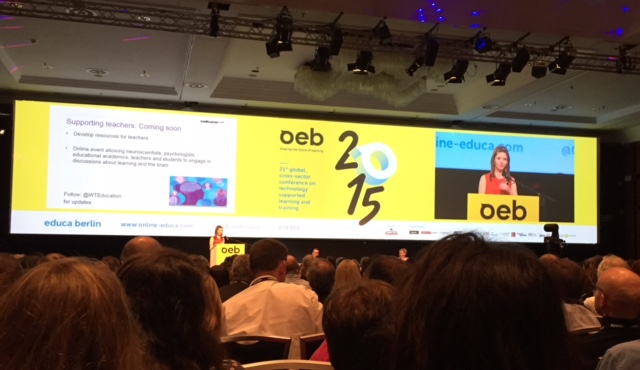 Meanwhile the focus on neuroscience and advance in trying to understand how our brains work was a sobering reminder of how little we know as yet as well as opening up a new perspective on the huge potential of research currently being undertaken. Some of the examples of ‘myth busting’ in the session were particularly revealing, e.g. many in the audience were surprised to find out that while personal preferences could certainly be observed, research could not demonstrate that different ways of delivering learning made a difference. This stood in contrast to a teen-led discussion the afternoon before where young people clearly expressed their own preferences e.g. that they felt they learnt better when using a mobile phone or video than making notes on paper in the classroom. One common thread for me however was a strong sense of trying to give people, both learners and teachers, more control, more power. In the face of rapid change and innovation there can be a sense of powerlessness, of loss of perspective – and much of the conference reminded me that skills, knowledge exchange and transparency can make a big difference in creating empowered use of Learning Technology.
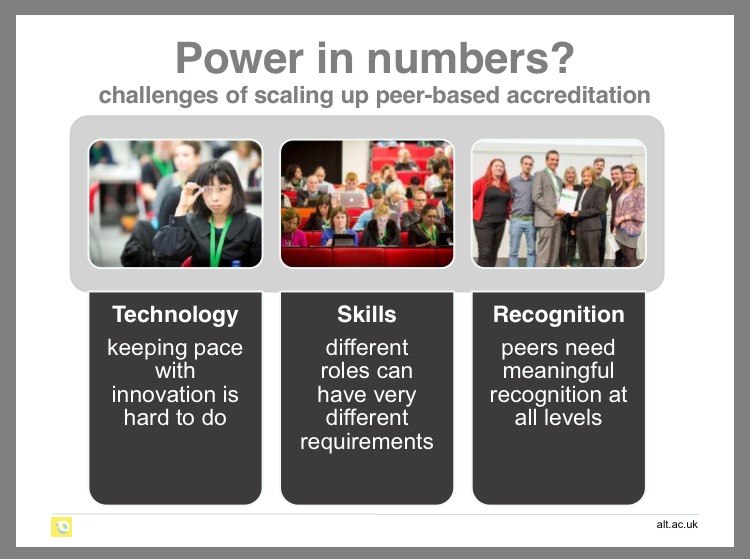
  The panel I contributed to for example had a focus on peer-based accreditation and assessment. If you’d like to have a look at my presentation, you can see some snapshots and download it (CC-BY)
  With an event as large and varied as this, it’d be easy to write many different posts focused on entirely different sessions from world class research to thought provoking debates. Personally I have taken a lot of inspiration away and in particular a fresh perspective on the enduring question about Learning Technology and its impact. We keep asking whether it really makes a difference, whether it has a positive impact on learning outcomes, test scores or learner success? What events like this help me see is that as our world changes, as everything from our economic structures to social behaviours is shaped in part by the technologies we also use in the classroom, Learning Technology and its critical, reflective and above all empowered use becomes ever more crucial to all lifelong learners.