Category: leadership

  • One year without an office…

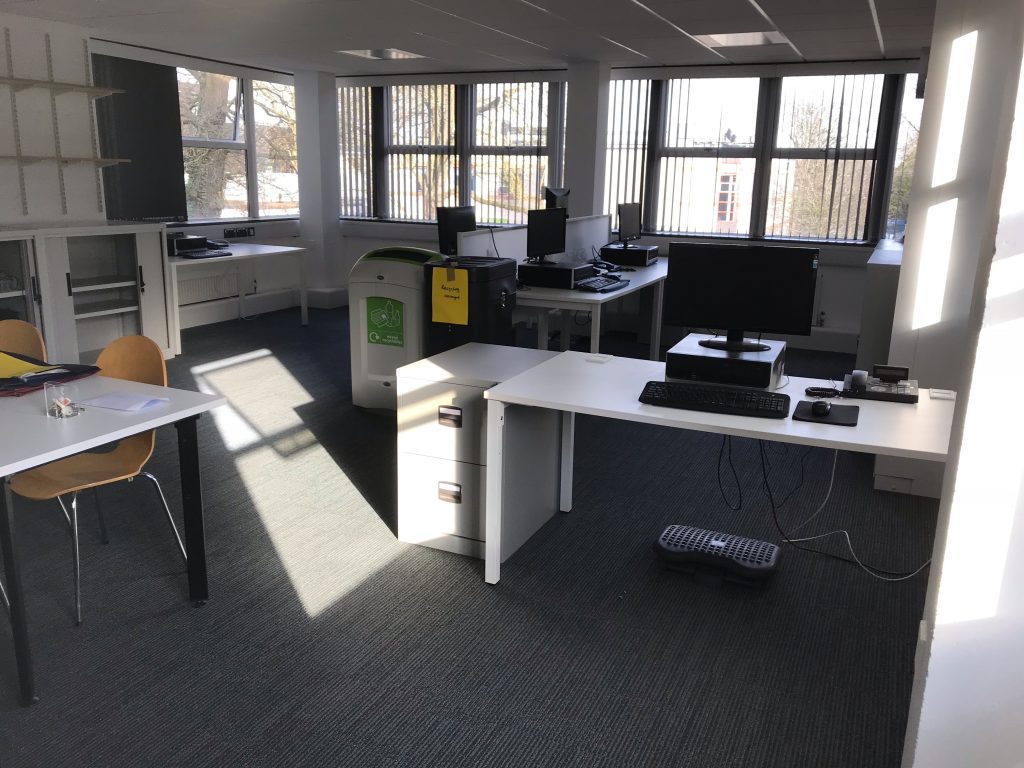
    A photo of the office with furniture but otherwise empty
    The office…

    A year ago this week I locked the door to this office for the last time, handed back the keys to the estate manager (never seen such a tidy move, he said) and left the building – leading my team, my organisation into the brave new world of being a distributed organisation, a virtual team.

    You can read all about what happened next… the official updates for Members written by Trustees and myself, in formal reports and audited accounts and the less formal account published in a joint series of posts with Martin Hawksey, which includes even podcasts. All together these will give you insight into how resources were saved and reinvested more effectively, strategic aims achieved with more impact, lessons learnt, home working cultures established and so forth. I am proud of that record one year after closing the office and whilst this is of course an ongoing progress of transition, there is clear evidence that all the aims we set out for the transition when we originally started planning 2 years ago have been achieved and even exceeded. It’s been a team effort.

    So what’s it like to be a CEO without an office?
    What’s it like to represent a long established professional body without a physical base?
    How does it feel to be a Line Manager, everyone’s boss, remotely?

    Well, let’s start with the last one: currently I manage 6 people and 4 of the 6 were recruited as virtual team home workers, to be part of a distributed organisation. I spend the same amount of time on all the things you do to manage, support, motivate and be there for others – just the way in which we connect and the locations where we see each other are now more varied. In turn, everyone, including myself, spends just as much time and effort being part of a team – again, just in different colourways and with different challenges. Instead of dirty cups that no one has washed up or bins that overflow, we focus on the logistics of office supplies or connectivity. Instead of having light bulb moments sitting around a meeting table, we have inspiring ideas meeting around a document. It works, we deliver and perform.

    As the leading professional body for Learning Technologists the Members we serve as an organisation are probably more likely to appreciate the potential of technology when it comes to running an organisation. Many people involved in ALT have experience of being part of a virtual team, collaborating with others who are not based where they are and they appreciate the power of a distributed network. So when we moved from having most staff based in one location to having staff based all around the UK, there was nothing but welcome for the opportunities that opened up. Members have hosted us for the day when we all come together or have a visit, kindly providing us with a base for the day. More support for volunteer-led activities all around the country makes us a stronger community and provides greater contact with Trustees as well. If for those already involved in the organisation it hasn’t been an issue, there have been plenty of partners and other organisations who have taken some convincing. I often meet with the question of where am I based, and when I explain that we don’t have a physical HQ anymore, they aren’t really clear how that can work?! Or indeed how professional or serious we can be if the address on our business cards is now to the website. We do of course have a registered address, and a postal one for correspondence, too – but the small amount of physical post that arrives at either (and indeed our old address one year on) is rarely more thank junk mail. Although we really do appreciate the holiday greetings 🙂 That said, as we continue to work together even for those who were initially sceptical the issue of where we are based fades into the background. We deliver what we promise, we are responsive, we work hard to help where we can and all of that builds trust better than bricks and mortar.

    But the question most personal to me is probably what’s it like to be a CEO without an office. To some people, it’s a akin to what it would have been like to be upper class without an estate. The office, the estate, the shiny things within bright white rooms or dark grey rooms or brightly coloured rooms with free food and pool tables… the assistants, the clothes, the coffee, the meeting rooms, the tech, the desk, the chair – the drama of welcoming guests to your office! What kind of CEO can I be without all of that? Most of the CEOs I meet are seriously wondering (and in many cases they already have to contend with my gender, age, nationality to overcome their preconceptions). Of course, there are plenty of other CEOs and leaders who are working, and have been working for decades, without an office, based remotely or travelling a lot. That’s not a new thing in itself. But sadly in many cases those in power fit the traditional template here in the UK and so their casual insistence to visit our offices, meet over coffee etc often turns to puzzlement when there is no physical space for them to pinpoint that represents the organisation I lead. For me, it’s helpful. It can be very insightful to see how people react to the “no office… virtual organisation” answer to their question about where I am based. It helps me chose how I approach them better. For some, it endows me with tech credentials (she needs to know something about tech if she runs the organisation from home…), for others, it conveys a sense that I have a flexibility approach to work, maybe understand more about work/life/family balancing acts. It can also signal that I care about putting resources where they make the most impact for the charity, rather than having a plush office. A year in, what I know for certain is that without an office I can very much be the CEO I want to be, maybe more so than before. I love the freedom not having to manage physical space has opened up and the bigger perspective it has given me.

    So this Wednesday, when the first anniversary comes around, I shall be raising a glass to mark the occasion. Not to celebrate exactly, but to remind myself of something a colleague said to me the day we handed the keys back. It’s quite remarkable what you can achieve when you put your mind to it. Cheers.

  • Senior CMALT: Open Access research & promoting equality in Learning Technology

    Part of my professional development for this year was to take part in the pilot schemes for new pathways to CMALT, ALT’s accreditation scheme for Learning Technology professionals. I acted as an assessor for the Associate CMALT pathway and updated and submitted my own portfolio, which was originally accredited in February 2016, for assessment for the pathway for Senior CMALT. Now that the pilot has been concluded, and I have been awarded Senior CMALT alongside colleagues who also took part in the pilot,  I am updated the openly shared version of my portfolio here as well as on the official CMALT portfolio register. 

    In contrast to others, I did not choose to create a new portfolio in order to take part in the pilot, primarily because it is due to be updated in February 2019. Instead, I have added additional sections to my portfolio as follows (the other sections remain unchanged as they are already in line with the requirements of this pathway):

    • Specialist option(s): second specialist option added, Open Access research publishing in Learning Technology
    • Advanced area: new advanced area added, Promoting equality in Learning Technology

    As this is a pilot of the scheme, it remains to be seen what the finalised guidance for this new pathway will say, but my portfolio will help provide a baseline of examples for future candidates.

    For the first new section, I drew on an area of my work that I had previously not included in my portfolio:

    I have led and worked on a number of Open Access projects supporting research in Learning Technology including establishing the ALT Open Access Repository in 2009 (the wALTer Project), overseeing the transition to Open Access for ALT’s journal Research in Learning Technology (for which I contributed to the report on “The Transition to… Open Access”) and in 2017 the second and third transition of this journal from its Open Access publisher, Co-Action, to be sold to Taylor & Francis and subsequently taking independent ownership of the journal, which is now published by ALT in partnership with Open Academia. Since 2012 I have had responsibility for the journal, working together with its Editors and Editorial Board. In 2018 I led the establishment of a new strategic working group of the journal. The new group will help steer the development of the journal with representatives from other scholarly bodies including ascilite, ILTA and the OLC alongside our Editors. The group is chaired by Prof Neil Morris, who also chairs the Editorial Board.

    Over the past 18 months I have negotiated the contracts for both transitions, first from Co-Action to Taylor & Francis and then from Taylor & Francis to ALT in partnership with Open Academia. I have project managed both transitions, supporting Trustees in their decision making as well as the Editorial Team. During this time ALT has had to suspend operations of the journal for several months and I regularly communicated with Members and other stakeholders during this time (including a transition announcement, publisher news, re-launch update and thank you). As part of my work with the working group, I have researched current practice for Open Access journals around journal impact factors and alternatives to these, including altmetrics, h index and Eigenfactor, some of which I have shared in blog posts and at the ILTA Annual Conference, EdTech2018, at IT Carlow, Ireland, in June 2018.  Under my leadership, the journal has adopted Open Access best practice and has recently been awarded the DOAJ seal and has also resumed steady operations and is now publishing regularly including a recent themed collection on Playful Learning.

    The other new section I have added is the advanced area of practice, and for this I chose to focus on how my practice contributes to promoting equality in Learning Technology. This is something I have written about before and also presented as part of my keynote at ALT’s Annual Conference in September 2018.

    From this section, I’d like to share the reflective element in particular – relating how my work addresses the core principles of the CMALT framework:

    Reflection

    I have not only chosen this advanced area because I think it is really important to the success of my practice, but because in my view it has a particular relevance to Learning Technology professionals. Reflecting on the core principles of CMALT, here is how my area of advanced practice, promoting equality, relates to them:

    • A commitment to exploring and understanding the interplay between technology and learning: Learning Technologists are often at the centre of negotiating an organisation’s, or a group’s, relationship to technology, for example students relationship to a social network or staff engagement with a cpd course. We are able to inform the perspective other, less expert, users have of how technology is used, understand how it affects our lives and our identities. How the data or content we create affects our work. At best, Learning Technologists empower staff and students in their relationship with technology, help them gain a more critical, reflective and thus effective long term engagement with the tools and platforms they use – and hopefully shape or create in future. It is a big responsibility and a big opportunity at the same time. If our practice, my practice, is shaped by values that prompt us, me, to promote equality, create greater equity and so forth, then we can make a real difference.
    • A commitment to keep up to date with new technologies: for me an important aspect of keeping up to date with new technologies is to understand their context: how they are financed and by whom, who has developed or tested them, or what kind of data sets informed their working, whom are they aimed at and what do they promise? What is their business model and how is it sustained? One piece of work I did this year is to collaborate with startups on a guide about how Learning Technologists can work together with start ups and through that project I had many useful conversations with CEOs of edtech startups. They were all young, white males and invariably the conversation about organisational culture reflected the pressure of moving at the speed they needed to whilst trying to have a more diverse team being in conflict with each other. It was an interesting first hand experience of how keeping up to date with technology and the constant need to catch up and adapt does not foster a culture that promotes equality. It is also an example of how our perception to need to keep pace with innovation, to move ahead, is used an an excuse, either consciously or subconsciously, not to diversify.
    • An empathy with and willingness to learn from colleagues from different backgrounds and specialisms: This is the core principles which most closely relates to promoting equality. In my own team I have led to establishing a strong practice of weekly meetings that include a show & tell element for example, enabling everyone in the team to ask questions, share ideas or show each other new tips or tricks from spreadsheet shortcuts to new tools we could use. Together as a team we take part in online cpd courses such as 23Things or a GDPR course on Futurelearn and I value the opportunity to learn alongside my colleagues, gain a sense of their perspective and understanding and to reflect this in my own.   
    • A commitment to communicate and disseminate effective practice: Lending your voice to raising issues around equality is not a task for women, but for everyone and I am grateful to have many male colleagues who play an important part in this. But I don’t think you need to explicitly reference equality at all to effectively promote it. Simply taking a balanced view in whom you reference, whom you include in your perspective, can have a most powerful effect. For me, the OER Conferences are a good example of how to promote equality in Learning Technology, how to amplify the voices of those less often heard.

    There is a lot more I hope to achieve when it comes to promoting equality in Learning Technology. I leverage what I have to make a difference and I do my best to take every opportunity I can to do so, but whilst I have a growing network of inspiring allies to work with, there is a multitude of indifference who will ask “So what?”.

    For many, equality is something that doesn’t have anything to do with them. It’s not something they want me or people like me to go on about. It’s not a an issue because…”women can participate if they want”, because “no one is stopping them”, because “I haven’t experienced discrimination so it doesn’t exist”, etc. etc. Insert any number of cliches!

    CMALT is a peer-based accreditation framework that retains its value because there is a continuous cycle of developing our understanding of what it means to be a Learning Technologist and what we understand to be good or best practice through being assessors and updating our portfolios. I think promoting equality is a big part of what makes me a good Learning Technologist and I hope that this new section of my portfolio demonstrates that.

    If you would like to have a look at the full version of the portfolio I submitted for the pilot, you can access the Google doc version and the evidence folder.

  • #altc keynote preview: Beyond Advocacy at ALT’s Annual Conference

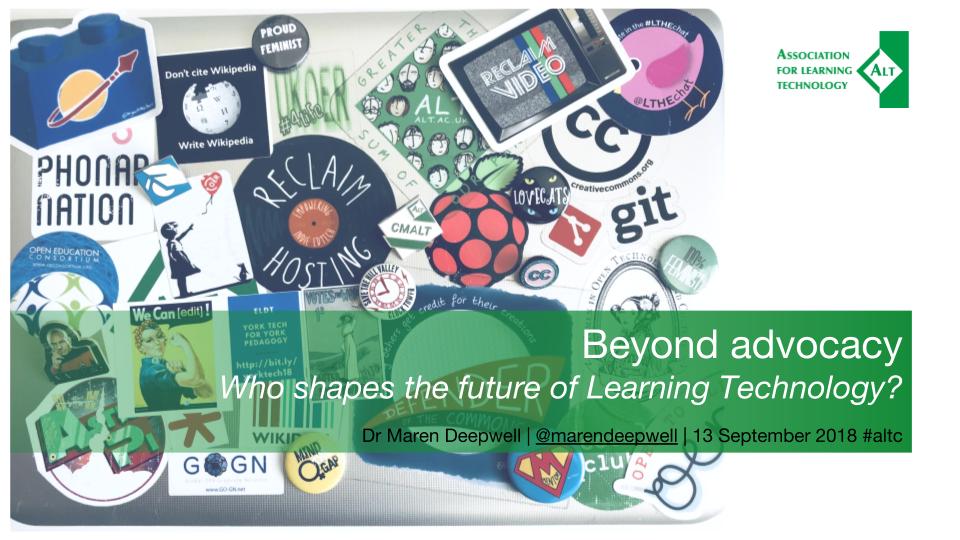
    I am really looking forward to giving a keynote as part of ALT’s upcoming 25th Annual Conference, and I am even more delighted to do so alongside the inspiring Amber Thomas, whose work I have followed and admired for a long time and also Tressie McMillan Cottom, whom I can’t wait to meet in person.

    So, here is a preview of what the keynote is going to be about and also a link to watch it on the day 🙂

    Beyond advocacy: Who shapes the future of Learning Technology?

    This keynote poses the question ‘who shapes the future of Learning Technology?’. We will explore current thinking about what drives how we use technology in learning and teaching and questions the promise of tech that never quite delivers. For decades, technology has promised solutions to help us learn, teach, assess and care better, and yet these visions of the future are always just beyond the horizon.

    But how do we move beyond that promise?

    How do get beyond tech advocacy and realise the potential of our professional practice for the benefit of learners and the greater good?

    To start answering these questions I will explore how professional practice has developed charted through new research into ALT’s CMALT accreditation scheme and share examples from recent collaborative work promoting equality in Learning Technology.

    See the programme page for more details. 

  • Beyond hype or dystopia: Looking ahead to ALT’s Annual Conference 2043

    No, this isn’t a typo, this post is actually about looking ahead to a conference in 2043, 25 years from now…

    The prompt for this post is that Members of ALT are celebrating the 25th Annual Conference of the Association, which makes this year a valuable opportunity to reflect on how far we have come, all the things we have learnt and everything that has changed as well as the big challenges that are still ahead. I have been following and hugely enjoying Martin Weller’s series of blog posts “25 years of Ed Tech” so if you have missed it, go and read it now.

    But what about looking forward to the next 25 years?

    With the most recent Horizon Report being published this week, I have been wanting to look ahead beyond the future that futurists predict. And I enjoyed the post that Audrey Watters published “The Horizon never moves” in which she sets out some key ways in which the hype in the edtech industry is always about what’s just beyond the horizon, what’s ‘almost there’.  And then I have seen a (to me) new t-shirt appear on my Twitter feed which bears the slogan “tech won’t save us”. Thus prompted, I want to look ahead at the future in a manner that is free of predictions, free of the promise of technology or the solutions that are on the horizon. Instead this post is about stepping outside of hype and dystopia, instead sharing what I hope ALT’s Annual Conference (or an event like it) will be about in 2043:

    First, I hope that there will be an independent Association for Learning Technology in the UK in 2043 and that the voice of its Members will continue to have grown in influence and reach as it has over the past 25 years. 

    Also, I hope that as a professional body ALT will have as diverse a range of professionals leading it as it has today, continuing to challenge notions of professionalisation, fight for recognition of the value of the work Learning Technologists do and continue to expand our understanding and practice of how technology is used for learning, teaching and assessment. Regardless of what education and training provision will structurally look like by 2043, we will still be using technology to help us learn, develop and accredit. 

    Long before 2043, I hope that the business model that supports the work ALT or similar professional bodies do will enable every Member to attend its events, with neither time nor cost being a barrier that prevents professionals to come together either in person or virtually to move their work forward.

    By 2043 I hope that sharing critical reflection, pose questions and importantly disseminate failures will have become more common place than it is now. That conference sessions are less focused on reporting success or promoting solutions and geared more towards collaboration, debate and forming relationships. For that to be possible, the way in which language and in particular terminology around Learning Technology are used will have to become less divisive across sectors. I hope that we will have overcome the tendency to dismiss what we haven’t created ourselves or in-house, or what is expressed with different words than those we would use ourselves.

    From a global perspective, I hope that the conference will have stronger ties with other events in the UK and across the world and contribute to the wider dialogue that addresses the fundamental questions of how we as human beings relate to technology and how we shape our future. My vision of the future is one of empowered professionalism, not one determined solely by the forces of technological determinism. 

    The most powerful part of the conference in my experience is to get a sense of one’s agency within a community, to hear different voices and see contrasting perspectives that help open up new horizons and stop my professional practice from becoming too focused on internal concerns or limited to being relevant only in a cosy echo chamber.

    The last point I want to add is that I hope that the future Learning Technology will be shaped less by the privileged, powerful and established than it is now. That in 2043 it is no longer unusual for people with fewer resources, people of colour, for women, for young people, for learners and others who find it hard to make their voice heard to play a part in determining what their future looks like. 

    So here is to the next 25 years in Learning Technology.

    I’ll see you in 2043. And hopefully in Manchester this September where our work to bring about the kind of future we want to be part of continues https://altc.alt.ac.uk/2018/.

  • My CEO’s report to ALT’s Members, August 2018

    My CEO’s report to ALT’s Members, August 2018

    This is a re-posted from the #altc blog

    Dear Members

    As I write this we have just one month to go before the largest event we organise each year, our Annual Conference. This year, as we celebrate 25 year of ALT, there is much to look forward to and this report covers some of the key developments across the Association.

    Your voice #altc #altc25

    First, I wanted to draw your attention to an ongoing project from ALT’s President, Prof Martin Weller, who has been blogging about the 25 Years of EdTech in this series of posts, counting down to 2018! Members have also started writing posts for publication on the #altc blog and we are inviting contributions tagged #altc #altc25 to add to this growing collection of voices and views from across our membership.

    Vote for your choice in the Learning Technologist of the Year Awards 2018

    As many of year will be aware, we have launched a new category of Award this year, celebrating outstanding achievements in research in Learning Technology. The judging panel, has reviewed, short-listed and interviewed this year’s entries and after careful deliberation the panel has selected the finalists. Now it’s up to you to vote for your choice for 2018 Community Choice Award. There can only be 1 winner, so you select your front runner from all individual, team and research project entries. Good luck, everyone!

    Vote https://altc.alt.ac.uk/2018/awardsvoting/

    Conference preparations

    With over 100 Members involved in the preparations for this year’s event, we look forward to welcoming as many of you as possible in Manchester and online. Alongside our Members who work hard to review papers, shape the social programme and chair sessions, we are particularly grateful for the support from our sponsors this year: Catalyst, VScene, Blackboard, MeeToo, RMResults and UNIwise.

    The Trustees of ALT have also made funds available to support 10 participants to come to the conference in memory of ALT’s former President, Doug Gowan, enabling those otherwise unable to attend to contribute and have a voice at the conference.

    With 140+ sessions, the programme this year includes research sessions, poster presentations, workshops and many short presentations.

    Register https://altc.alt.ac.uk/2018/registration/

    Changes to ALT’s Constitution

    At this year’s Annual General Meeting on 12 September Members will be voting on a resolution to adopt an updated version of ALT’s constitution. We will write to all Members to set out the proposed changes in more detail when the papers for the AGM are distributed, but the main changes to the constitution are to ensure ALT’s governance has more long term stability and is in line with best practice recommended by the Charity Commission. Thus the terms of service for the Vice-Chair, Chair and President of ALT, which currently are limited to 1 year and rotate annually, will be brought in line with the terms served by Trustees overall under the update constitution.

    Read more about ALT’s next Annual General Meeting.

    Staff team

    As our activities are growing and in particular the CMALT scheme is now being developed to offer new accreditation pathways to Associate and Senior CMALT, we also require more staffing resource and we have just welcomed Susan Greig as ALT’s new Operations Manager. Susan will support ALT’s operations including taking on the overall management of the CMALT scheme and related CPD activities, work with Special Interest Group and enhance communications.

    As senior staff Martin Hawksey and I continue to share our experiences of transitioning ALT’s operations to a fully distributed, virtual model of operations and we have now published 6 monthly blog posts and a podcast in this series on open leadership ‘Sharing our approach to leading a virtual team’.

    A note of thanks #CMALT

    I’d like to end my report with a note of thanks to all who have contributed to the CMALT consultations. As well as informing the development of the new Associate and Senior CMALT pathways, Certified Members led a ‘visual thinkery’ conversation with Bryan Mathers, resulting in these new visuals for the principles of ALT’s accreditation scheme. Thank you to everyone involved.

    session 2 – principles of CMALT

    We will be holding the first CMALT Ceremony as part of the AGM on 12th September to further enhance the recognition of the scheme. If you have been accredited or updated your portfolio in the past year, we look forward to congratulating you in Manchester.

  • On a tangent to leading a virtual team… going on holiday

    On a tangent to leading a virtual team… going on holiday

    This blog is mostly about the work I do, and things I find interesting. But, as a Learning Technologist in a leadership role, I think a lot a lot about work/life balance even if I don’t share much about my life away from work on this platform. The current series of posts written jointly with Martin Hawksey in which we take an open approach to leading a virtual team has prompted me to reflect on how important it is to be aware of a how less formal, home-based work environment can affect one’s well being. As I have holidays coming up, I wanted to share my approach to taking a break. In an environment where many talk about their work ethic, on being indispensable or never having weekends or evenings off, it’s important to also talk about taking time away from work, taking a break.

    So, here is what works for me when I want to get away:

    Lists: a list of things to do before I go away, a list of things to handover/cover, a list of urgent things for when I get back, a list of long term things for when I get back, a list of things to check… ticking things off my lists and having somewhere to note all the things I won’t get done, is essential.

    Ruthless inbox clearing: delete, delegate, deal with… always nice to see how a firm deadline focuses the mind and suddenly everything that has been languishing in my inbox for a while is gone. I also make an effort to send much fewer messages in the week before I go away, to get fewer responses back.

    Make sure everything is covered: as a Line Manager and in a role where things have to be covered whilst I am away, I am fortunate to have colleagues who will deputise or cover for me. I put my arrangements in place well in advance and remind everyone that I’ll be away, to help them plan ahead, too. It’s a good opportunity for me to model what a handover looks like and how to plan ahead around urgent deadlines.

    Keep for everything that I’ve forgotten: I am a big fan of Google Keep and use it for managing my to do lists. In the first few days whilst I am on holiday I’ll remember lots of things that I have forgotten and so I make a special list to which I can add everything that comes to mind. If I write it down, I won’t worry about it and it’ll be waiting for me when I get back.

    Really actually go on holiday: if I intend to have proper time off, I don’t monitor email at all. I set my out of office and that is it.

    Interesting reading: one of my main priorities when I don’t have to work is to catch up on lots of reading. That may be work-related research at times, and having that to look forward to is a big motivation for me.

    I look forward to having a break from my usual routine, time to go for a run when I’m usually at my desk, time to spend with family and friends, time to stay up late… time enough to feel more curious, keen and inspired again when I head back to work.