Author: Maren Deepwell

  • Big challenge ahead: talking about equality #iltaedtech17 #femedtech #oer17 #altc

    Big challenge ahead: talking about equality #iltaedtech17 #femedtech #oer17 #altc

    This week I am looking forward to giving a short talk at the EdTech 2017 Conference, the annual conference organised by the Irish Learning Technology Association (ILTA). This year’s theme is TEL in an Age of Supercomplexity: Challenges, Opportunities and Strategies. 

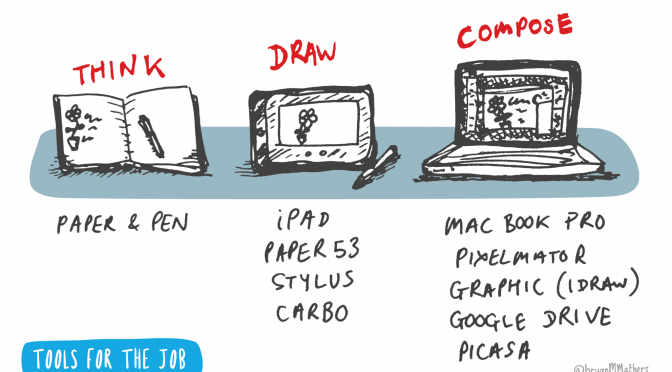
    The event has what looks like a great programme. My own focus is on exploring how openness can be a tool for Learning Technology professionals to promote equality. I am going to look at three specific examples of this, starting with work that’s happening close to home in the ALT Member Community and in particular our local Member Groups – illustrating this with the visual thinkery created for ALT by Bryan Mathers. The other two examples I want to talk about are the emerging FemEdTech network and the voices still echoing from the OER17 conference. I’ve shared my slides below and I look forward to the conversations and feedback in response to my contribution – and a special thanks to Catherine Cronin who has already provided me with some very helpful comments!

    Below is the full transcript of my talk:

    Thank you for giving me the opportunity to share with you how individuals are taking action to promote equality in Learning Technology, equality in our profession and across sectors – equality for individuals and within institutions.

    Equality. We are facing a big challenge. Looking around this room everyone among us has witnessed inequality in some form. On a global scale policy and strategy are necessary to address some of the most fundamental challenges that stand in the way of greater equality for all – but what I’d like to explore is how taking action on a personal basis, taking action as part of our professional practice, can make a difference. Make a difference through openness – openness as in for example sharing OERs, using open licencing, through open governance and open practice at all levels.

    The first example is the work of ALT’s Member Groups, and also Special Interest Groups who share their practice and collaborate openly, all across the UK and beyond. Aligned to ALT’s aims the Learning Technology professionals who are active in these groups share the values we have set out as a community and sharing their experiences, both failures and success. These groups, by being inclusive and community-led, have contributed to making our membership more diverse and their work continues to contribute to strengthen equality in our profession.

    Now, the emerging femedtech network is a new initiative that is led by Learning Technology professionals who are taking personal action to promote equality and to do so through open practice, conversations and events. It’s an important effort to create a safe space that is also open and inclusive. We want to celebrate and extend the opportunities offered by education in/and/with technology – to women, and to all people who might otherwise be disadvantaged or excluded. If you haven’t already, I urge you to look at the work that this network is beginning to undertake.

    My last example are the voices still echo-ing from the OER17 conference convened earlier this year by Josie Fraser and Alek Tarkowski. Josie, Alek and the organising committee made a concerted effort this year to create a more diverse, inclusive programme with a distinctive all female keynote line up and a programme that inspired a lot of critical reflection and conversation long after the event – and indeed that conversation is still going on. Catherine Cronin, who was part of the closing plenary at the conference, later reflected that the themes of criticality, equality and social justice were at the heart of OER17. It was a powerful example of many individuals taking action together – through openness – and making a difference.

    Days like today give us that opportunity, to reflect on how we, as individuals, as a professional community, can take action to achieve greater equality through openness, to harness technology to do so – and then to go and make a difference.

  • Creating a #cpd #cmalt portfolio as a solo undertaking

    Creating a #cpd #cmalt portfolio as a solo undertaking

    At a recent session with a group of Learning Technology professionals we discussed how to best compile a portfolio for CPD and accreditation such as for the CMALT scheme. One of the options we discussed was to join forces either as a group within an institution or with peers elsewhere. In many instances that involves meeting up for writing sessions, progressing through the process at the same pace and sharing work in progress. There are a lot of advantages to this, but what if you don’t have that option? I wrote my own portfolio pretty much in isolation until it was very close to completion (full disclosure: it did take me three attempts over a 5 year period to actually complete it, so my approach is not necessarily the one to follow. On the other hand, I’ve learnt from the mistakes I made). So this post contains a brief overview of how to compile a CMALT portfolio as a solo undertaking.  

    Step 1: I started with the structure, copying the heading structure that’s required into a blank Google doc. At the start is the contextual statement, the future plans section is last and in between are all the required Core Areas as well as a placeholder for the Specialist Area.

    Step 2: I then looked at the structure and tried to write down 1-2 examples of work I had done in each section. I added no details at this stage, just enough information for me to be able to identify what I meant. It was very quickly apparent that I had a lot of examples in some sections, none in others. So I moved some around which could fit into other sections. Once I had covered all Core Areas it was easier to decide what to pick for my specialist option, basically something I hadn’t already covered.

    Step 3: Once I had the structure and at least 1 example in each area, I started with the section I thought would be easiest (1b in my case) and added a description and some evidence. Once I had those, I added the reflection at the end. That’s what I did for each section in turn. Some took longer, usually because evidence was time consuming to collect or reflection felt harder. Because I already had a scaffold (i.e. the heading structure and at least 1 example for each section), working on the portfolio moved ahead at a much better pace. In previous attempts I hadn’t planned ahead and found the blank pages ahead daunting each time I moved on to a new section.

    Step 4: Once all the required and the specialist areas were complete, I took a step back and started writing my contextual statement and the future plans section. That was a lot easier with the rest of the portfolio in place because the examples I used shaped what I wrote. Also, having reflected on my work made thinking about the future much more straight forward.

    Optional step 5: Because I wrote my portfolio in isolation, without peers or feedback or someone to compare it with, I felt some feedback would be useful before I submitted it. I sent it to a few people and they came back with useful comments which were incorporated. I also shared it with colleagues who were directly mentioned.

    Hearing about the sharing and support that groups or peers provide sounds like a great way to undertake CPD. In my case, writing my portfolio was mainly confined to odd anti-social hours and I needed to progress at my own pace. If, like me, you are on your CPD or #CMALT journey in a solo capacity, I hope this post is helpful and good luck!

  • Cemeteries of the web: parallels between Victorian burial culture and digital infrastructure

    Cemeteries of the web: parallels between Victorian burial culture and digital infrastructure

    For over ten years I’ve been working in Learning Technology, but before then I spent five years doing research as an Anthropologist. I wrote a thesis about cemeteries and more specifically about the contested nature of cemeteries as cultural and material spaces. I often get asked what the link is between my work in Anthropology and Learning Technology and for me there are many. One of the strongest is that in both cases what I am most interested in is how we deal with change – and what’s left behind.

    I’ve also been catching up on a year’s worth of The Contrafabulists podcasts and episode 18, recorded 14 August 2016, deals with questions around permanency online, ownership of domains and digital infrastructure – our control or lack thereof over these issues and so forth (it’s a great podcast series by Audrey Watters and Kin Lane so if you haven’t listened to it, I think you should).

    Whilst listening it struck me that there are interesting parallels between what I studied and what this episode of the podcast was about, between Victorian burial culture and digital infrastructure. Here are some examples:

    The illusion of permanency: one commonality for example is that a lot of digital infrastructure gives a promise of permanency in order to secure our engagement and content and Victorian entrepreneurs created urban cemeteries with the same promise. In the digital realm your posts, pictures or updates remain in place while their are valuable to the platform, but can disappear or become inaccessible with no or little notice. The newly created burial space in Victorian cities would similarly be described as a place for eternity, not just safeguarding bodily remains, but securing status and remembrance for future generations. And like its digital counterpart, cemeteries, too, could disappear for building projects or urban development with gravestones stacked unceremoniously against a wall or used as paving material.

    Ineffective legal/governance frameworks: another commonality and a key issue common to both is lack of an effective legal/governance framework. For example platform user agreements that are too complex to understand or difficult to enforce – but in particular frameworks that do not take into account what happens when things change, what happens beyond the current profit predictions. Like the commercial cemetery companies in Victorian London, tech companies often operate and grow on the basis of quickly realised profits. Not many plan for the long term.

    Perpetuating inequality: similar to the way in which digital infrastructure helps shape and control the actions of and narrative around our lives, Victorian cemeteries were design to do the same. Through their architecture, which echoed classical eras, through their layout, which privileged the wealthy and powerful, to the burial culture, which assigned places to men, women and children according to their status and station as well as religion, and even extending to the landscape and natural elements like plants and views, every element of the space was designed to construct a narrative of power. The history that Victorian burial culture records is the history of the ruling class.

    There are many other examples, but what is most pertinent for me is that at the height of their popularity, Victorian cemeteries and the burial culture they embodied seemed unassailable, completely dominant. They had a deep impact on contemporary culture and development. What they celebrated and assigned value to was shaped by but also influenced Victorian society and culture in turn, spreading far beyond London and even England’s physical borders across the world throughout the British Empire. There was no notion that not even a century later very little of this culture would endure. Today, many of the most political, most powerful spaces of Victorian burial culture have become nature reserves, tourist attractions or slowly decaying urban wastelands.

    Similarly, parts of our digital infrastructure can seem so dominant, to ubiquitous that it is hard to imagine what’s beyond them. In both cases we have limited control over what matters to us and enforcing it comes with compromises. In general digital platforms  operate on the premise that we either ignore or accept an uncertain future or otherwise make our own provision to whatever extent that we can – by securing our own domains and data.

  • CPD #cmalt as a springboard into openness and ownership

    CPD #cmalt as a springboard into openness and ownership

    Recently there have been a lot of interesting posts on Twitter #cmalt about how compiling a portfolio of your professional practice can be an open process (if you have not come across the #cmalt accreditation scheme, have a look at the ALT website or watch this).

    My own portfolio was accredited through CMALT in early 2016 and since then I’ve shared both posts about the process and the portfolio itself. But reading the recent posts made me think afresh about how undertaking CPD like compiling a CMALT portflio can be a springboard into openness and ownership – and some of the considerations I had when deciding on these issues.

    Considering others: in the context of a portfolio that describes and reflects on professional practice taking colleagues into consideration is key. Even though the CMALT process requires you to focus on writing in the first person, to reflect on your individual practice, anyone with management responsibilities or who works as part of a team, needs to consider how others are portrayed in what they share. In my case, I asked colleagues for permission if it was necessary to refer to them directly and I chose examples of practice specifically because they were suitable for sharing.

    Continuous reflection doesn’t have to be open: one of the key benefits of gaining CMALT for me is that it prompts me to continue my reflections on an ongoing basis as I collect evidence of practice for the update to my portfolio every 3 years. Some of this is work in progress or hastily written, so I don’t share it. I choose what I share, when and with whom and it’s valuable to have safe, closed spaces within my CMALT folders and documents that encourage critical reflection as well as recording achievements. The process of deciding what is open and what is less open in itself is a valuable experience.

    Contributing to our understanding of professional practice: as well as sharing my portfolio I have also added it to the sharing initiative run by ALT. It’s not openly accessible to everyone, but only to members or individuals registered for the cmalt scheme. I think this offers the advantage of being able to contribute to a wider picture of what professional practice in Learning Technology looks like as well as helping others find useful examples in their sector, job role or specialist area. It also provides an alternative way of sharing practice instead of putting your portfolio out on the public web.

    Taking ownership of what you share: I compiled my portfolio using Google Apps for Education (more info) and I use the same tools now to track my CPD and collect evidence as I go along. Loosing access to portfolios or evidence on institutional systems is a real risk for many and I wanted to keep my content for the long term. Recently, I have decided to take that a step further and started transferring my portfolio onto this site, my own domain (thanks to Reclaim Hosting!).

    Some of it is already available now at http://marendeepwell.com/cmalt/  and in the fullness of time it should enable me to take even more ownership of my professional practice and the recognition I gain.

  • Input welcome: promoting equality in Learning Technology through openness

    Input welcome: promoting equality in Learning Technology through openness

    I am working on a slide deck to give a short presentation at the upcoming EdTech2017 conference (1-2 June, Institute of Technology Sligo, Ireland)on promoting equality in Learning Technology through openness. The proposal I submitted already includes a number of examples, but the inspiring (and still growing!) list of blog posts following the OER17 conference has made me consider what else I might include. In particular, there are two aspects of my talk I am going to be researching further and if you have any suggestions or references any input is most welcome:

    • “Where are we now”… in terms of equality in Learning Technology. I am thinking both about the edtech sector in general and the way in which the use of technology for learning, teaching or assessment can help promote equality;
    • Reading and ideas for good practice. As this is a short talk I’d like to include a list of where to go next so that participants can follow up further.

    If you can contribute any references or other ideas, please leave a note in the comments or via Twitter to @marendeepwell . Thank you.


  • My #OER17: many voices taking action

    My #OER17: many voices taking action

    What a week it’s been #OER17… As I wasn’t able to catch that many sessions while running the event, I am enjoying reading, watching and catching up with everything. And there is a lot out there – photos, drawings, presentations, videos, recorded live streams and an ever growing number of blog posts. Thank you for sharing!

    Before the conference I had three hopes:

    First, learn & listen about how Learning Technology can support openness. I am thinking here about technology used for learning, teaching and assessment in any context (ALT’s definition is useful here) not the more specific ‘educational technologies’ like VLEs or e-portfolios.  The huge potential of technology for all kinds of openness is evident – but what this conference made me think about is how critical it is for staff and students to gain sufficient understanding of the tools, platforms or networks to make informed use of them. That would include understanding what data about them is collected and how it is used, what footprints they may leave and for how long and so forth. Providing support for developing this kind of fluency can be difficult, in particular when in many institutions the concept of openness is contested. I came away with many questions and a sense that there is much to tackle once I get back to my desk…

    Image of a Virtually Connecting Session
    Photo of Lisa Taner, Lucy-Crompton-Reid & Maren Deepwell at a Virtually Connecting session at OER17 taken by Martin Weller

    My second hope for OER17 was to make time for people and conversations. That was probably the most enjoyable aspect of my days, and like many other participants I was delighted to be able to connect in person with many individuals from my social networks. One of the highlights was joining a Virtually Connecting session with Lisa Taner and Lucy Crompton-Reid, facilitated by Martin Weller – and I am grateful to Maha Bali for inviting me. You can now watch it on YouTube . Meeting participants from different continents and having a conversation that bridges the physical divide was a great way of seeing things through someone else’s eyes. The social events before and during the conference were another good time for catching up and I was impressed by the bowling, ping pong and karaoke going on all around.

    Together with Bryan Mathers I ran a workshop and Bryan has kindly shared all the content from the presentation and the featured image above, the ‘Live Thinkery’ I helped facilitate. The workshop was called “from Voice to Visual” (prezi is here) and we were looking at the creative journey of the ALT visual strategy. If you haven’t already, visit Bryan’s page dedicated to OER17 and find all of his visual thoughts, all licenced CC-BY – thank you, Bryan!

    CC resist by @bryanMMathers
    CC resist by @bryanMMathers at http://visualthinkery.com/project/oer17/

    Conferences and communities like this are special to me, so my third hope was to enjoy the two days (and not ‘just’ do the day job). With so many inspiring and engaging sessions in the programme it is hard to pick out any specific ones. What brought it all together was the plenary panel. The recording of this session and the content created during the session are life affirming and I particularly enjoyed the Storify #OER17 #IWill shared by Catherine Cronin. Asking everyone to share their intention, their hope for making change and taking action was a powerful reminder of how much individual action matters, how much each of us matters. My experience of OER17 was a testament to that.