Author: Maren Deepwell

  • Coming up #oeb17: Re-articulating what we value – a new vision for Learning Technology professionals

    Coming up #oeb17: Re-articulating what we value – a new vision for Learning Technology professionals

    I am looking forward to a panel discussion at Online Educa Berlin 2017 this week, as part of the Business EDUCA: Learning L&D Needs session. The session is about:

    Creating learning solutions which enable workforce development is no easy feat. And becoming an effective instructional designer will often require a degree, courses and field experience. This session will discuss the skills practitioners need for the L&D department of the future, as well as how we can learn the profession and remain relevant to our organisations.

    You can view the full programme of the conference and more information about the session here.

    My contribution is focused on professionalisation of Learning Technology in the UK informed by results from ALT’s Annual Survey and the development of the CMALT accreditation framework (slides).

  • Forging new pathways to professional recognition

    Forging new pathways to professional recognition

    This past month I’ve been doing a lot of travelling and contributing to a number of face to face and virtual consultation sessions about ALT’s accreditation scheme for Learning Technology professionals, CMALT.

    From Mozfest to Committee Meetings and from webinars to individual focus groups I’ve been hearing why fellow professionals value CMALT accreditation, what could be improved and how we may expand the scheme to offer valuable and robust peer-assessed recognition for a broader range of professional achievement. You can read more about the project on ALT’s website and also sign up for more information and to take part in the pilots.

    It’s been really interesting to hear about how the scheme could be developed and people’s experiences of their own journey to accreditation and then onward as a peer assessor.

    Last week the consultation coincided with a celebration of recent accredited staff at the University of Edinburgh and I was honoured to take part in giving out the awards.

    It reminded me once again how varied a professional landscape we have in Learning Technology and to how many different roles all across an institution the work of making intelligent use of technology for learning, teaching and assessment extends.

  • Talking peer based accreditation #Mozfest

    Talking peer based accreditation #Mozfest

    Some time ago I wrote a blog post about how ALT contributes to this year’s Mozfest together with my colleague Martin Hawksey. It was the first time for us to take our work to this event – one of the biggest of its kind anywhere in the world. Mozfest brings together a unique and diverse community from across the world and everyone gathers at Ravensbourne College in London over a weekend packed with all kinds of sessions, activist talks, making and discovering. 

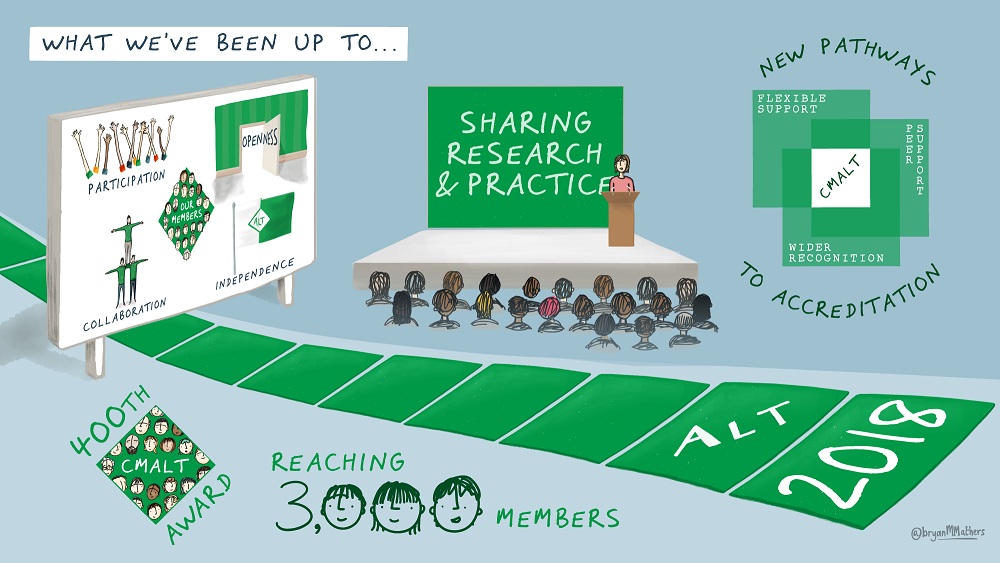
    If you are keen to find out what we talked about at Mozfest when we were joined by Bryan Mathers who contributed his Visual Thinkery to the workshop, have a look at our slides & links at http://go.alt.ac.uk/Mozfest17 which also include Bryan’s capture of participants’ contributions:

    Slides from our Mozfest workshop
    Contributions captured by @BryanMMathers

    Both Bryan (link to Bryan’s session on The Seven Co-operative Principles ) and Martin (link to Martin’s session: Machina a machina: An introduction to APIs through Google Sheets) also ran other sessions during the weekend and I am including links to them so you can explore a bit further.

    For me, my own first experience at Mozfest, which I thoroughly enjoyed, can best be summed up in these photos. It was an amazing experience – a big thank you to everyone involved in making it happen!

    VConnecting with Josie Fraser, Martin Hawksey & co
    The BEST badges
    Not a view out of the window our workshop participants were prepared for…
    I wanted to go to this session
    One of my favourite discoveries #Mozfest
  • Don’t think you are brilliant? Think again…

    Don’t think you are brilliant? Think again…

    … and yes, I am thinking about you 😉

    But, before we get too far ahead of ourselves, let’s go back to the beginning and how I came to (nearly) write those words on an assessment form.

    As a Certified Member of ALT I act as a peer assessor for portfolios submitted by candidates hoping to gain the accreditation. It’s part of my continuous professional development in Learning Technology and in the most part it is a rewarding, equitable and collegiate activity that I really enjoy.

    In recent months I’ve graduated from learning about the assessment process and gaining experience in collaboration with Lead Assessors to becoming a Lead Assessor myself and now that I am doing more assessments I have started to reflect on the professional practice I am seeing through various submissions. It’s interesting to see what others do, what they specialise in and how they reflect on their practice or research. Personally, however, I am often taken aback by how little confidence or sense of achievement is conveyed in the work being presented. So much that should be celebrated can be overlooked or left unacknowledged. So few seem to have the confidence or awareness to recognise their own achievements or even present them as such. In short, I often find myself wishing to convey congratulations or compliments alongside more practical feedback.

    And then, there are the blog posts or thoughts of others in my field who seem to find it hard to feel their voice is important, that their perspective is worth listening to and that their work goes beyond the ordinary. Like so many before me I find again and again that those who shout the loudest about their own accomplishments are usually least deserving of our time and attention. Which makes it even more critical that those who need encouragement and support receive it.

    I think a peer-based accreditation process like CMALT that has a strong element of self-reflection can help you realise that you’re brilliant (and yes, again, I do mean you…).

    Why is that you ask?

    Here are three examples:

    Firstly, making a long list of all you have done can help you gain a sense of perspective. In Learning Technology we often move on from one project to the next so quickly that we forget to pause and recognise what we’ve achieved and what difference it has made.

    Secondly, building a portfolio in a format and manner that you choose, that you can tailor to your preferences and style, can help you build a narrative of your professional development that you take ownership of. It’s not someone else imposing a structure or crediting specific actions – you choose and shape what you present.

    Thirdly, reflecting on what you are good at might surprise you, might point you in a different direction than the one you thought you were heading towards. You might realise that you are great at something that you never even realised before. You might be able to see your professional practice in a new light.

    You might not have time or the inclination to engage with a scheme like CMALT. But you should make time to reflect and recognise your own strengths and achievements.

  • Celebrating #AdaLovelaceDay 2017 and promoting equality

    Celebrating #AdaLovelaceDay 2017 and promoting equality

    Today we are celebrating #AdaLovelaceDay and for me this is a good reminder to acknowledge all the brilliant women I work with in Learning Technology and beyond. We may have a lot still to achieve when it comes to equality, but there is something we can all do to help achieve it. Earlier this year I talked about how openness can be a tool for Learning Technology professionals to promote equality at the ILTA Annual Conference (slides and transcript).

    The closing thought of my talk feels very relevant today:

    Days like today give us that opportunity, to reflect on how we, as individuals, as a professional community, can take action to achieve greater equality through openness, to harness technology to do so – and then to go and make a difference.

  • Re-post #altc: my autumn report to Members as CEO of ALT

    Re-post #altc: my autumn report to Members as CEO of ALT

    You can read all my reports to Members of ALT on the #altc blog by following this link. The blog is always open to new contributors, for full details about how to write for the blog, see the information posted here.

    Dear Members

    I’m starting this report by looking back briefly at the 2017 Annual Conference which took place in Liverpool in early September. If you haven’t already, I’d like to encourage you to explore the inspiring list of posts and resources shared by participants to get a flavour of this year’s highlights and read posts about the conference by keynote speakers and award winners. Equally recommended reading is ALT’s Annual Report which was approved by Members at the Annual General Meeting and this year contains a new report written jointly by Trustees reporting on progress made delivering ALT’s 2017-2020 strategy. I am proud to see how much progress we have made in the last twelve months.

    A personal highlight for me was the Honorary Life Membership awarded to Josie Fraser, a richly deserved honour for an outstanding member of our community. As always, I am grateful that alongside the hard work and time contributed by everyone involved, my colleagues, Martin, Jane, Kristina, Tom and Jane, were recognised for their efforts making it all happen. You can read my personal take on organising the conference on my blog.

    The Annual Conference sets the tone for the next few months at ALT and one of the outcomes of this year’s event is a renewed focus on policy, which was reflected in David Kernohan’s Wonkhe article ‘Edtech? It’s all about policy’ and my keynote contribution to the FELTAG 2017 Forum, on workforce development to maximise Learning Technology impact . Also this month, ALT Trustee Lorna Campbell and Ambassador Joe Wilson alongside others took part in the 2nd World Open Educational Resources (OER) Congress in Ljubljana, Slovenia, sharing their insights via social media and reporting back to the wider community. This focus on policy across sectors will continue in the run-up to this year’s ALT Annual Survey and the now established Winter Online Conference in December.

    The work of ALT is largely led by Members who give up their time to get actively involved and lead ALT’s governance and activities across sectors. It is always important to acknowledge how much Members contribute, but sometimes a special thank you is in order. That is why I’d like to join the Trustees of the Association led by Prof Neil Morris, Chair of the Editorial Board, would now take this opportunity to say a thank you to the Editors of the journal, Lesley Diack, Amanda Jefferies, Peter Reed, Fiona Smart and Gail Wilson. Throughout the unprecedented difficulties with the journal the Editors as a group have played a key part in supporting the journal during this year of transition and their tireless efforts have ensured that we have weathered the transition as well as possible and supporting authors and readers throughout. Having published eight articles since July and processed dozens of new submissions I am glad to say that the journal is now operating fully.

    In October we convene ALT’s Operational Committees and the Editorial Board of the journal as we begin the work of the new academic year. More Members are now actively engaged in the work of the Association, taking part not only in our governance, but leading activities and establishing new Members Groups across the UK, most recently in the North East of England.

    This year’s Annual Report reflects that alongside our efforts to meet our strategic aims, we must continue to put our values into practice. In addition to what we set out in our strategy, that we value participation, collaboration, openness and independence, we also work to achieve greater equality and diversity in our community of Members and helping us champion this are this year’s winners of the Learning Technologist of the Year Awards.

    Leading professionalisation in Learning Technology is about setting standards and recognising achievement on a national scale. It is also an opportunity to shape our professional identity and this year’s conference really brought home to me how powerful an example our Members are setting.