
Author: Maren Deepwell
-
Competition and collaboration
…”We face a lot of uncertainty at present. At times when funding cuts, reform, a General Election and other factors put additional pressure on all providers, the first instinct is often to focus inwards.
Intelligent use of Learning Technology has become a greater factor in many ways over the past year or two, with recommendations such as those proposed in the Government’s response to the FELTAG report highlighting the changing needs of employers and learners alike. Senior staff, teachers and trainers are doing much already to implement innovation, to develop the necessary skills and capacity to scale up their use of technology for learning, teaching and assessment.”…
You can read my full article in FE News here. Published 24 March 2015.
-
Reports as chief executive of ALT
In my role as chief executive of the Association for Learning Technology, I write regular reports on the work we do with and for our members. You can read all of the recent reports in ALT’s online newsletter.
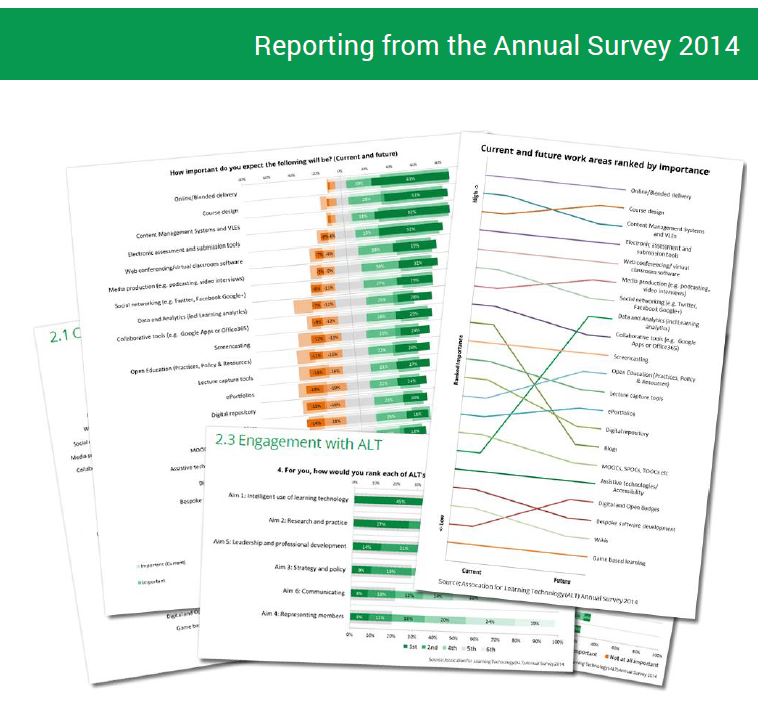 In my most recent report I mentioned ALT’s new Annual Survey, findings from which have been published at the end of February 2015. The report and the related data are now openly accessible via ALT’s Open Access Repository. You can download both here. The findings provide interesting insights into the priorities of ALT members for the year ahead, including a marked rise in learning analytics and related use of data. I am really interested to see how these trends will change in the next twelve months.
 -
Reflections from the Bett show 2015 on the future of technology for learners
…”At the Bett show we heard from two Ministers, who each shared their vision for the future of technology in education. In my work for the Association I have been involved in Education Technology Action Group (ETAG), as well as the Further Education Learning Technology Action Group (FELTAG), and I listened with interest to find out which ideas and recommendations would be included in their speeches.
Both Ministers duly acknowledged the role of Learning Technology, its potential and its impact. They both spoke about the future, about preparing learners for it, and how technology could help. Ministers were followed by senior speakers from Google and Wikipedia on the first day, and Apple on the second day, who in different ways also spoke about the future and the role that technology has, does, or will play in education. Meanwhile, across the exhibition at the Technology in Higher Education Summit, I also listened to Dave Cormier from the University of Prince Edward Island in Canada, who spoke about a different way of learning. Rhizomatic is the term he used (and if you are interested in challenging your concept of learning and teaching I certainly recommend you seek out his work). But he started his talk with a backwards glance to the late 19th century and the role of school education in preparing young people for work – life in the factories that were fuelling the industrial revolution.”…
You can assess my full article via FE News here. Published 5 February 2015.
-
How are you meeting the FELTAG challenge?
…”In recent months there has been much talk of the implications of FELTAG, the Further Education Learning Technology Action Group. Much of this has been focused on understanding what constitutes online delivery and what the implications of having to achieve a certain percentage of online delivery are.
One clear implication is that more teachers, technicians, managers and support staff will be using technology for learning, teaching and assessment. This means that more of us will need to know how to use Learning Technology effectively and engage in continued professional development in order to build a sustainable, cost-effective approach to using Learning Technology within our colleges and other learning providers.”…
You can read my full article in FE News here. Published 17 November 2014.
-
Big data? Learning analytics? Do you know enough about your learners’ data and what you do with it?
…”With policy and commercial developments firmly focused on ‘big data’ and all that entails, I was interested to come across quite a few sessions and speakers talking about how we use data in learning, particularly formal education at ALT’s Annual Conference earlier this month.
Earlier in the year, as part of ALT’s work for ETAG, the Education Technology Action Group, we had invited contributions from a range of individuals and organisations and received what I think is a really helpful contribution from Simon Buckingham Shum & Simon Knight, from the Knowledge Media Institute, Open University, UK (you can read their submission in full in this blog post from 5 June 2014). Personally, I found the way in which some of the terminology is explained helpful, for example, the way in which the concept of learning analytics was visualised”…
You can read my full article in FE News here. Published 24 September 2014.