Tag: #edtech

  • Collaboration in practice: Contributing to Emergency Rations #EdTechRations

    Collaboration in practice: Contributing to Emergency Rations #EdTechRations

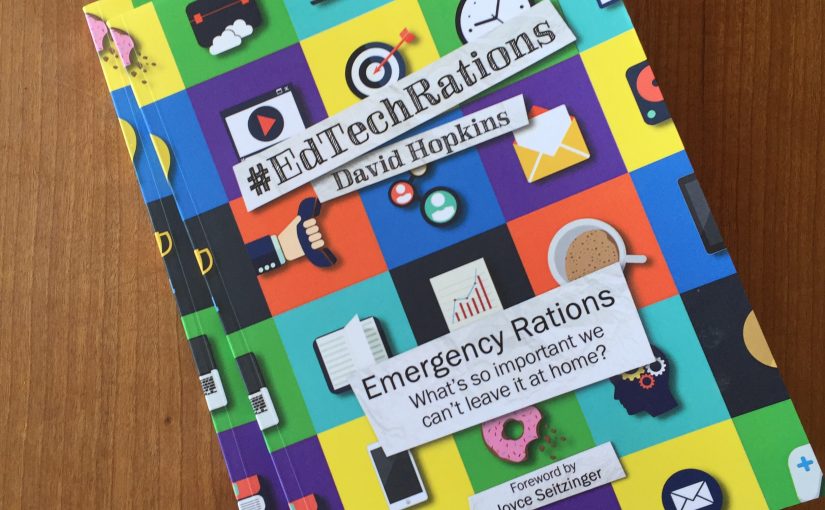
    This week saw the publication of a new book edited by David Hopkins called Emergency Rations #EdTechRations. This is a volume of contributions from dozens of individuals across sectors and below is a short description of  what the book is about:

    “What’s so important we can’t leave it at home?”

    This book is a collection of 40 world leading teachers, academics, influencers, critics and practitioners who have answered the question “have you ever walked out the door to go to work, the shops, the gym, etc. and realised you’d forgotten to pick up your smartphone? And then turned around and gone right back for it?

    It was fun to contribute my own emergency rations and I enjoyed having a writing challenge of a different kind for a change. Seeing the finished product drop through my letterbox and leafing through so many different contributions, mostly written in words, but also drawn and illustrated, made me reflect on what a productive collaborative effort this has been.

    A lot of the work I do is collaborative and I know first hand that getting a large group of people to produce something specific for a specific deadline is no small task. We used a range of platforms from Slack to Google Docs and Twitter along the way and I learnt a lot from reading and commenting on drafts of colleagues and then going back to review my own.

    In the end what I included only represents a small part of the content I ended up writing, but the other bits will end up in blog posts or journal articles over time.

    A big thank you to David for pulling everything together!

    For my part, I am going to use this experience to set my sights on more writing projects in future, both collaborative and individual. It’s been an inspiring experience to see collaboration in practice.
  • The Future of Education in the House of Stairs…

    The Future of Education in the House of Stairs…

    I am looking forward to participating in the OEB Midsummit in June. Speakers have been invited to provide a quote about the future of education and you can read what others have written already on the event’s website (click on a speaker’s name to see their quote).

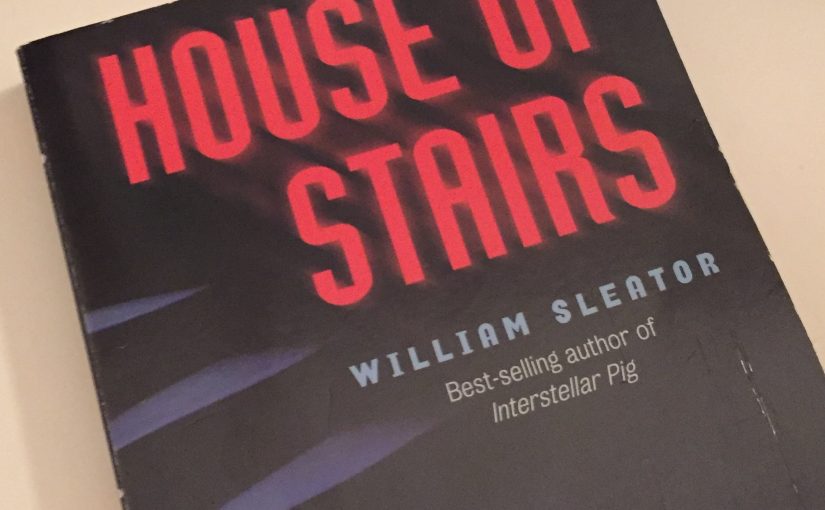
    Whilst I was thinking about what I might say, I read through what the others have written and one quote from Audrey Watters is “I’m afraid that the future of education will be built by people who read dystopian science fiction novels and liked the “innovations”.” That made me think about books I have recently been reading by William Sleator. I am only familiar with his young adult novels and one book in particular has stuck in my mind for the past 20 years or so: it’s called House of Stairs and was published in 1974.

    When I read it as a young adult I was most interested in the individual characters, five 16-year old orphans, trapped in a seemingly endless space that is filled with white stairs. The stairs become their world, the landscape in which they negotiate each other and themselves. As their struggle to survive intensifies their relationships do, too. At the end of the book [spoiler alert…] they are rescued. Yet despite the relative safety they find themselves in, their experience alters their behaviour and lives irrevocably. Some resist, others comply, and all pay a high price. It is not a happy ending and the vision of a dystopian future where even the most basic of rights and choices are beyond the characters’ control stayed with me.

    Reading it again recently I thought less about the individuals, although the story is still gripping, and more about those in charge. Those who watch over their experiment as it comes to its gruesome conclusion. The powers that be (political or economic) have needs that this experiment must meet and the fate of the young protagonists is only incidental, it is revealed, to the wider effort. They have no agency, no say over their fate or future.

    To be able to think, analyse and reflect is empowering. Having agency, having the power to determine the shape of things to come, seems to me to be a purpose of education. In the House of Stairs only extreme resistance offers the chance to exercise your own will, to have any form of agency.

    I just hope that the people Audrey Watters is talking about don’t have the same bedtime reading as me.