Tag: #altc

  • CPD #cmalt as a springboard into openness and ownership

    CPD #cmalt as a springboard into openness and ownership

    Recently there have been a lot of interesting posts on Twitter #cmalt about how compiling a portfolio of your professional practice can be an open process (if you have not come across the #cmalt accreditation scheme, have a look at the ALT website or watch this).

    My own portfolio was accredited through CMALT in early 2016 and since then I’ve shared both posts about the process and the portfolio itself. But reading the recent posts made me think afresh about how undertaking CPD like compiling a CMALT portflio can be a springboard into openness and ownership – and some of the considerations I had when deciding on these issues.

    Considering others: in the context of a portfolio that describes and reflects on professional practice taking colleagues into consideration is key. Even though the CMALT process requires you to focus on writing in the first person, to reflect on your individual practice, anyone with management responsibilities or who works as part of a team, needs to consider how others are portrayed in what they share. In my case, I asked colleagues for permission if it was necessary to refer to them directly and I chose examples of practice specifically because they were suitable for sharing.

    Continuous reflection doesn’t have to be open: one of the key benefits of gaining CMALT for me is that it prompts me to continue my reflections on an ongoing basis as I collect evidence of practice for the update to my portfolio every 3 years. Some of this is work in progress or hastily written, so I don’t share it. I choose what I share, when and with whom and it’s valuable to have safe, closed spaces within my CMALT folders and documents that encourage critical reflection as well as recording achievements. The process of deciding what is open and what is less open in itself is a valuable experience.

    Contributing to our understanding of professional practice: as well as sharing my portfolio I have also added it to the sharing initiative run by ALT. It’s not openly accessible to everyone, but only to members or individuals registered for the cmalt scheme. I think this offers the advantage of being able to contribute to a wider picture of what professional practice in Learning Technology looks like as well as helping others find useful examples in their sector, job role or specialist area. It also provides an alternative way of sharing practice instead of putting your portfolio out on the public web.

    Taking ownership of what you share: I compiled my portfolio using Google Apps for Education (more info) and I use the same tools now to track my CPD and collect evidence as I go along. Loosing access to portfolios or evidence on institutional systems is a real risk for many and I wanted to keep my content for the long term. Recently, I have decided to take that a step further and started transferring my portfolio onto this site, my own domain (thanks to Reclaim Hosting!).

    Some of it is already available now at http://marendeepwell.com/cmalt/  and in the fullness of time it should enable me to take even more ownership of my professional practice and the recognition I gain.

  • Input welcome: promoting equality in Learning Technology through openness

    Input welcome: promoting equality in Learning Technology through openness

    I am working on a slide deck to give a short presentation at the upcoming EdTech2017 conference (1-2 June, Institute of Technology Sligo, Ireland)on promoting equality in Learning Technology through openness. The proposal I submitted already includes a number of examples, but the inspiring (and still growing!) list of blog posts following the OER17 conference has made me consider what else I might include. In particular, there are two aspects of my talk I am going to be researching further and if you have any suggestions or references any input is most welcome:

    • “Where are we now”… in terms of equality in Learning Technology. I am thinking both about the edtech sector in general and the way in which the use of technology for learning, teaching or assessment can help promote equality;
    • Reading and ideas for good practice. As this is a short talk I’d like to include a list of where to go next so that participants can follow up further.

    If you can contribute any references or other ideas, please leave a note in the comments or via Twitter to @marendeepwell . Thank you.


  • My #OER17: many voices taking action

    My #OER17: many voices taking action

    What a week it’s been #OER17… As I wasn’t able to catch that many sessions while running the event, I am enjoying reading, watching and catching up with everything. And there is a lot out there – photos, drawings, presentations, videos, recorded live streams and an ever growing number of blog posts. Thank you for sharing!

    Before the conference I had three hopes:

    First, learn & listen about how Learning Technology can support openness. I am thinking here about technology used for learning, teaching and assessment in any context (ALT’s definition is useful here) not the more specific ‘educational technologies’ like VLEs or e-portfolios.  The huge potential of technology for all kinds of openness is evident – but what this conference made me think about is how critical it is for staff and students to gain sufficient understanding of the tools, platforms or networks to make informed use of them. That would include understanding what data about them is collected and how it is used, what footprints they may leave and for how long and so forth. Providing support for developing this kind of fluency can be difficult, in particular when in many institutions the concept of openness is contested. I came away with many questions and a sense that there is much to tackle once I get back to my desk…

    Image of a Virtually Connecting Session
    Photo of Lisa Taner, Lucy-Crompton-Reid & Maren Deepwell at a Virtually Connecting session at OER17 taken by Martin Weller

    My second hope for OER17 was to make time for people and conversations. That was probably the most enjoyable aspect of my days, and like many other participants I was delighted to be able to connect in person with many individuals from my social networks. One of the highlights was joining a Virtually Connecting session with Lisa Taner and Lucy Crompton-Reid, facilitated by Martin Weller – and I am grateful to Maha Bali for inviting me. You can now watch it on YouTube . Meeting participants from different continents and having a conversation that bridges the physical divide was a great way of seeing things through someone else’s eyes. The social events before and during the conference were another good time for catching up and I was impressed by the bowling, ping pong and karaoke going on all around.

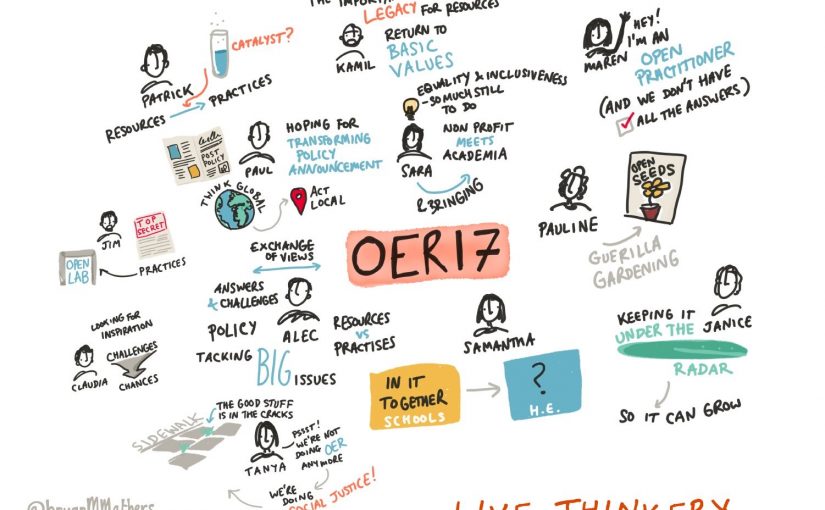
    Together with Bryan Mathers I ran a workshop and Bryan has kindly shared all the content from the presentation and the featured image above, the ‘Live Thinkery’ I helped facilitate. The workshop was called “from Voice to Visual” (prezi is here) and we were looking at the creative journey of the ALT visual strategy. If you haven’t already, visit Bryan’s page dedicated to OER17 and find all of his visual thoughts, all licenced CC-BY – thank you, Bryan!

    CC resist by @bryanMMathers
    CC resist by @bryanMMathers at http://visualthinkery.com/project/oer17/

    Conferences and communities like this are special to me, so my third hope was to enjoy the two days (and not ‘just’ do the day job). With so many inspiring and engaging sessions in the programme it is hard to pick out any specific ones. What brought it all together was the plenary panel. The recording of this session and the content created during the session are life affirming and I particularly enjoyed the Storify #OER17 #IWill shared by Catherine Cronin. Asking everyone to share their intention, their hope for making change and taking action was a powerful reminder of how much individual action matters, how much each of us matters. My experience of OER17 was a testament to that.

  • Time to be… open #OER17

    Time to be… open #OER17

    We’re getting ready for the OER17: The Politics of Open conference this week. As one of the organisers of the event my main focus has to be on making sure everything runs as well as it can – but it’s also an opportunity for me to spend a few days with a community who shape the future of open education around the globe. And this year the conference has a stellar line up across 2 days with sessions set to challenge the politics of openness from the personal to the national.

    Image of ALT laptop stickers
    Stickers featured in the workshop

    There already is a plethora of blog posts by practitioners reflecting on and setting out their thoughts, hopes and inspirations. It makes for inspiring reading and personally I can’t wait to see some of these conversations play out at the event. I might have to write a follow up blog post (with a particular focus on a workshop I will be running jointly with Bryan Mathers called ‘From Voice to Visual – the making of an open strategy’ ). For now, here is what I’ve got in mind for my own #OER17, beyond the running of it:

    First, I’ll be looking out for new opportunities for Learning Technology to scale up, support and strengthen Open Educational practice. Technology isn’t always the answer, but I often think it can do more for openness.

    Second, I’ll be making time to have conversations. This year I am prioritising people over the programme… so if you are at the event in person or joining into one of the streamed sessions (or my first venture into Virtually Connecting thanks to Maha Bali!) come and say hello.

    Third on my list for this week is to enjoy OER17. That might seem like an obvious one, but it’s worth remembering. Over the past 12 months I have seen volunteers and colleagues pull together an event that has grown in participation, influence and voice. It’s going to be an amazing opportunity for everyone to come together and hopefully translate into practice and policy what they experience this week – taking action for open education.

  • Equality, empowerment, accreditation and beyond. My fantasy conference proposals… #altc

    Equality, empowerment, accreditation and beyond. My fantasy conference proposals… #altc

    Every year around this time when I encourage my peers to submit proposals to the ALT Annual Conference, I reflect on the fact that as one of the organisers I can’t submit a proposal myself. And given that as a Learning Technologist this is one of the key events in my diary each year, I have often thought about what I would submit if I wasn’t affiliated with ALT. So here are some of my fantasy proposals, ideas in the making, that I won’t be submitting (again) this year. If you have your own ideas then your chance to submit your 250/500 word proposal is still open until 20th (or soon to be 27th) March. Take your chance & make your voice heard.

    Poster, Theme: Wildcard: Poster showing how peer accreditation for Learning Technologist works based on the CMALT framework, which is mapped to a number of other accreditation pathways including the UKPSF, the Jisc Digital Capabilities Framework and Blended Learning Essentials. CC licenced so that the model can be adopted by participants in their own contexts.

    Lightening Talk, Theme: Empowerment in learning Technology: Empowered #edtech governance. A fast paced, visual take on how to work collaboratively with decision makers to build new strategies, using work with cross-sector stake holders as examples. Would include a 1 page “recipe” handout to take away and try out in your own organisation.

    Presentation, Theme: Learning Spaces: this presentation would be led by three apprentices/interns whom I have worked with in the past year and they would take participants on a tour of their learning spaces, both physical and virtual. The tour guides would explain how spaces are used and lived in, why and for what purpose. We would reflect on issues like privacy and agency in different spaces and importantly what happens in the spaces and time periods between things, i.e. between institutions, between life stages, between qualifications. We’d question how Learning Technology can provide continuity for life long learning both online and in person.

    Panel, Theme: Empowerment in Learning Technology: Working in Learning technology one of the things I am passionate about is equality. Particularly for those working as open practitioners there are so many ways in which inequality and discrimination can impact on our ability to achieve our aims. This panel would bring together 5 exceptional practitioners to share their own strategies for empowered practice in Learning Technology and to reflect critically on how their approaches are challenged. We’d invite participants to contribute their own tips and tools in advance and during the discussion, ending up in a series of posts providing practical information that would be useful to both learners and professionals.

    Workshop, Theme: Wildcard: Learning Technology: top 10 complete failures. This is one of the sessions I’d like to go to but somehow it doesn’t seem to make it onto any conference programme. Presumably because no institution pays for their staff to go and share the details of how they lost money or worse when Learning Technology failed. And indeed because no one wishes to have this particular reference added to their CV. Still, other conferences now include specific sessions where we explore what happens when things go wrong. What happens when projects don’t deliver, students don’t use the tools or academics simply don’t co-operate. The list of forgotten, crumbling Learning Technologies is long. This workshop then would include the brave colleagues I have known and worked with over the years who would be prepared to share their perspectives so that we don’t have to make the same mistakes over and over again. Participants would be contributing their own stories. Ideally one or two policy makers and industry experts would be contributing, too.

    You probably have your own ideas as to what sessions you’d like to go and see at the conference. Submit them… .

  • 2008-2016 in Learning Technology #altc

    I missed 2008, but every year since then I have participated in ALT’s Annual Conference. While I work for ALT in my ‘day job’ I also attend the conference as a Learning Technology professional (and this year as a Certified Member of ALT for the first time…). So as well as work, for me it’s CPD, a great opportunity to expand my network and a chance to find out about research, new thinking in the field. While a packed, parallel programme means that I never get to see all the sessions I would like, I want to try and pick out some of the key moments from the last eight years, things that made me think, changed my mind or simply stayed with me.

    2015 – Ripples #altc: last year my work commitment focused on the AGM and that meant I had less time than usual to focus on the academic programme. So from 2015 one of my strongest ‘take aways’ is the long list of blog posts that was compiled by participants afterwards. It includes reviews, reflections and in depth posts about individual sessions. Thoroughly recommended reading (particularly welcome in the exhausted week that follows each conference for me).

    ;

    2014 – Audrey Water’s Monsters: a year of keynote and invited speakers that coincides strongly with my personal interests at the time, including wonderful talks from Jeff Haywood, Catherine Cronin and Bryan Mathers (you can watch all of them on YouTube). But for me, that Thursday morning in the front row in the giant auditorium in Warwick, listening to Audrey Waters weave a spell-binding narrative on the future of Learning Technology was an experience that has stayed with me. Audrey made me think about who has the power to decide about the future of Learning Technology – and how to empower practitioners and researchers to have more of it.

    2013 – 20 years of ALT: a very special year for the community as we celebrated the 20th anniversary of ALT, marked by a session led by former Presidents‘ of ALT looking at over the two decades. The conference was opened with a learner perspective, led by Rachel Wenstone from the NUS and also featured talks by Dame Wendy Hall discussing the role of the web and a keynote by Stephen Downes. All three made my think about the forces that shape Learning Technology. There were even fireworks that lit up a rather damp Nottingham sky.

    2012 – knitting in the main auditorium: that’s a special year for me as it was my first as ALT’s chief executive. The playlist reveals a broad array of speakers from across sectors, but one of the sessions that I can still picture in my mind vividly is this invited session with Steve Bunce, who engaged participants in the presentation and got us all finger knitting! Sometimes it’s good to be reminded that pedagogy doesn’t necessarily require the shiniest, newest gadgets… . With Eric Mazor, Richard Noss and Natasa Millic-Frayling together with James Clay, Sarah Porter and others completing the line up of invited speakers it’s another playlist worth revisiting.

    Looking north towards Hallingskarvet behind Kraekkja in Hardangervidda, Norway
    Looking north towards Hallingskarvet behind Kraekkja in Hardangervidda, Norway by Seb Schmoller

    2011 – political climate & “Live Beta”: a year with a cold theme. Two of my strongest memories of that year are firstly an impressive keynote by John Naughton, whose column in the Guardian and other writings I have since followed. As I was particularly interested in the political dimension of Learning Technology at the time, his talk resonated strongly with me. A very different experience also stayed with me, the “ALT LIVE – BETA” experiment which was led by members who were streaming interviews with speakers and other content live from the conference. It was another step in our efforts to enable participation widely and openly and in some ways it set the precedent for a lot of the work in this area we have done since.

    2010 – Don’t lecture me…: As one of the most watched keynotes from the past few year’s Donald Clark’s talk “Don’t lecture me” is probably already familiar to you (if you haven’t seen it, you can watch the video with and without the ‘Twitter track’ – which in this case I suggest you watch, too). For me that year Sudhir Giri from Google, who shared his perspective of how Google use their own tools for internal team communication, skill sharing and CPD fascinated me. Given that for several years we have been running our own Google Apps for Education domain which now facilitates a large part of what we do in ALT, that is hardly surprising. I am only glad that our has only a handful of users, rather than the multitudes that the Googlers make up.

    2009 – 100th CMALT Holder: My first ALT Annual Conference which took place in Manchester. Also, my first time to hear Diana Laurillard give an eye-opening keynote, which left me with the distinct impression that there was quite a lot about Learning Technology for me yet to learn. However, given that I was most involved in ALT’s accreditation and membership services at the time, the milestone of celebrating our 100th Certified Member has stuck most strongly in my mind. It also set me on the path to achieving CMALT myself, which…. erm….. I did in 2016!

    If you have your own memories you want to follow up, the past conferences page on the ALT website can be helpful – or browsing the YouTube playlists which go back to 2008. This year’s conference, as ever, feels to me like there is even more to look forward to. See for yourself: https://altc.alt.ac.uk/2016/ – and I hope to see you in Warwick.