Tag: #altc #edtech #femedtech

  • A personal #altc preview: Edinburgh or virtually, here we come 🙂

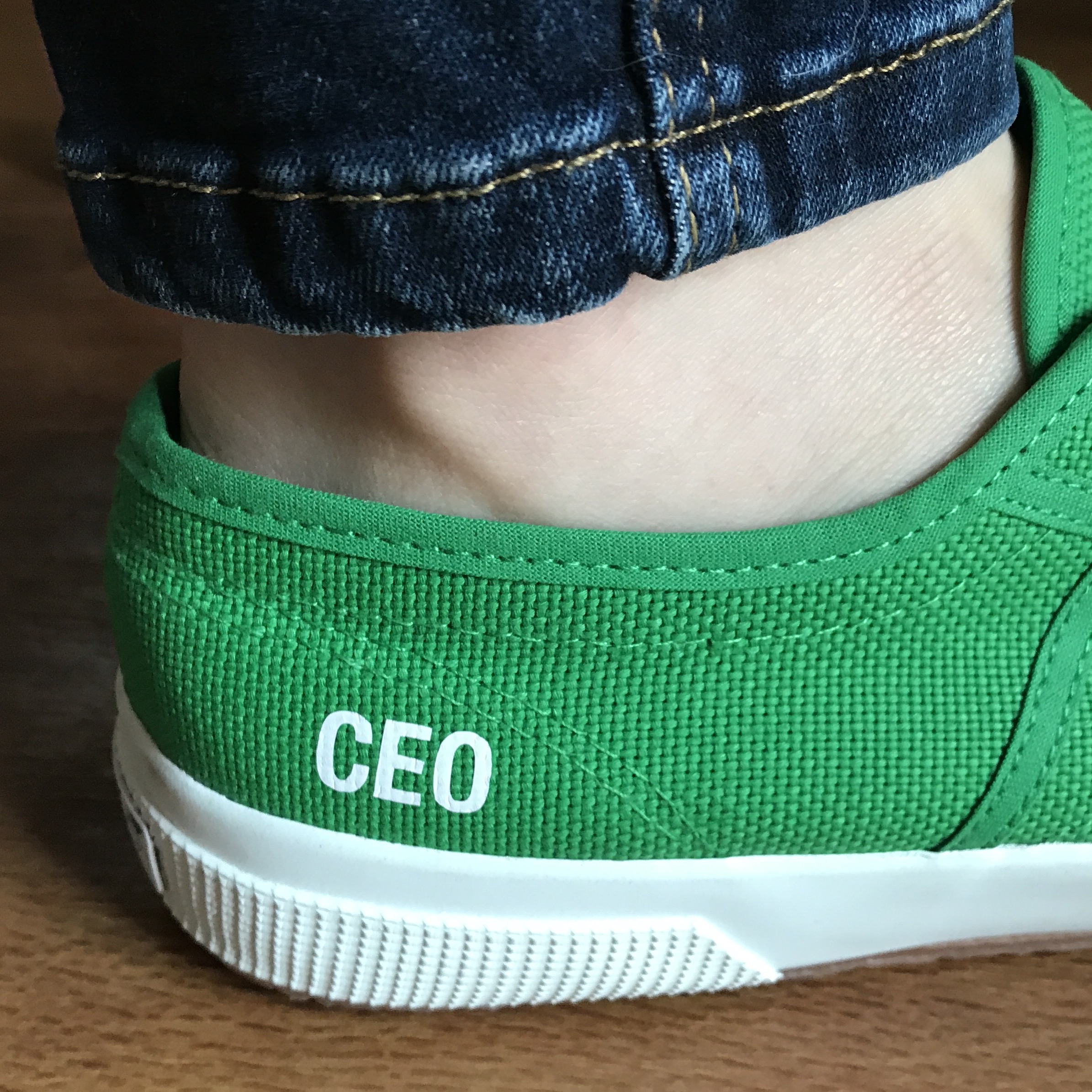
    It’s nearly September and since 2008 that’s meant that – at least in my world – it’s time to get ready for ALT’s Annual Conference. It’s an exciting time of busy preparations, 101 things to remember and, importantly, shoes to line up to pack for the week ahead (those of you who know about #shoetweets will understand).
    Remixed with the Fabulous Remixer Machine

    As ALT’s chief executive my role in the conference run up is all about strategy, income generation, academic review procedures… in short, there are A LOT of spreadsheets involved and reports to write. It’s rewarding work and very important to ALT as a membership organisation. But there comes a time, and that’s today, when my thoughts turn more to what attending the conference would be like if I were a delegate… which sessions I would like to go to, whom I’d like to see speak or catch up with.

    So here is my personal #altc preview, if I was attending as a delegate, either virtually or in Edinburgh:

    In some ways I attend the conference virtually every year, because so much time is devoted to the conversation on the #altc hashtag. I really enjoyed reading what’s in store on social media and online this year in this post by Lorna Campbell. I particularly liked this bit:

    The ALT Conference has always had a really lively and engaging social media presence, which draws in participants from all over the world. I’m delighted to help facilitate this as part of ALT’s social media team, along with partners in crime Rich Goodman (@bulgenen), from the University of Loughborough, and photographer Chris Bull (@chrisbull1980).  My role is to livetweet the conference keynotes from ALT’s official twitter account @A_L_T, while Rich will be tweeting Chris’ photographs, which really capture the buzz and energy of the conference.  You can see Chris’ pictures from last year’s ALT Conference on ALT’s flickr channel, and in keeping with ALT’s strategic commitment to openness, they’re all Creative Commons licensed.

    That sent me down a rabbit hole of looking at photos from previous years and reminded me how much sessions like the Assembly Meeting, the Annual General Meeting and the CMALT Ceremony as well as the Learning Technologist of the Year Awards help make the conference the wonderful experience it often is. So these sessions are definitely in my calendar:

    My other plan for engaging with the conference, and other events I attend, is to try and find sessions about which I know very little and go to those in order to discover something new. In that spirit, the following session also get included on my #altc calendar:

    Last, I am planning to take some time to spend in the exhibition at the ALT Stand meeting Members. In my first year, when I didn’t know anyone, I was greatly relieved to be seeing some friendly faces, to be made to feel welcome and to have people to talk to who shared what their day to day work was like. A few years on and I still find sitting at the stand and listening the best use of my time for much of the conference. I might also have some #femedtech stickers and badges on me… 😉

    I’m also going to try and join into some of the remote activities like VConnecting and look out in particular for blog posts starting to flood in now that the guest posts written in the run up have concluded in a lovely welcome from the Co-Chairs.

    So, Edinburgh or virtually, here we come. This may be the calm before the storm, but I feel there is a fair (conference) wind blowing and that is something to be celebrated given the times we live in. For whatever joy, inspiration and enthusiasm next week holds in store, I think we are going to need every ounce of it in the year ahead. And maybe we will raise a ‘wee dram’ to that #altc.
  • Re-post: HUMANITY OF DATA.. #ALTC

    This post was originally published here http://femedtech.net/published/humanity-of-data-altc/ .

    Nice to CC you by Dr Maren Deepwell CC-BY-SA

    Inspired by this post by Frances Bell and the upcoming ALT Annual Conference I have been reading up on a this approach for “aspirational metrics” D’Ignazio & Klein (2018) use for their forthcoming book Data Feminism, and in particular their thoughts on the humanity of data, which I’m quoting below:

    We acknowledge the humanity of data

    We recognize that the transformation of human experience into data often entails a reduction in complexity and context. We further acknowledge that there is a long history of data being “all too often wielded as an instrument of oppression, reinforcing inequality and perpetuating injustice,” as the group Data for Black Lives explains. We keep these inherent constraints in mind as we write, attempting to introduce context and complexity whenever possible, and acknowledge the limits of the methods we discuss as well as their strengths.

    It’s of particular interest to me as I’ve talked a lot about gender equality in the last six months and ever since I have added graphs and tables to the talk, people have listened a lot more closely. There’s a lot to be said for having tangible, measurable indicators of progress or even lack thereof when it comes to talking about topics like gender inequality in the workplace, but I also worry that by focusing on the charts and graphs, on the data, we don’t do enough to acknowledge what’s being lost in the analysis. At least I don’t feel like I’m succeeding at putting something like the approach outlined above into practice the way I think it should.

    Partly, I believe, that is because it’s much easier to create a dialogue when the conversation is less personal and as a result less confrontational. It’s much more possible for most people, in this case for most men, to talk about recruitment targets or percentage point increases than it is to witness the narratives that in this context women may share about their everyday experience of discrimination or harassment.

    When we create visual representations of our human experience, in this case of women working in learning technology, much of what the authors call the complexity and context is reduced to commonality. In order to communicate the scale of the challenges we face we must reduce our individual stories to let’s say a single headline. A headline that grabs your attention, that conveys urgency and relevance.

    And yet…

    Whilst I know that there are big advantages to using data and data visualisations to tell this kind of story, and I am an avid reader of work that helps us chart and address the gender data gap, I think that it also helps to depersonalise the problem. Charts are rarely labelled ‘me and you’ if you know what I mean and it’s far easier to feel that the problem is somewhere else, someone else’s responsibility… rather than right here in this room and cause for personal action.

    That then is my hope for our conversation at the conference this year and for the values we share: that we will use whatever communication methods are at our disposal  to make more people feel that they have a role to play in fighting for gender equality (in learning technology), and further, that it is each and every one of us that needs to take some personal responsibility to make that change happen.

  • A year in socks and shoes and stickers (2017: part 3)

    A year in socks and shoes and stickers (2017: part 3)

    This is the third and final part in this series of posts. If you’ve missed them, you can go back and read part 1 and part 2 of this series of posts, looking at my year Learning Technology in 2017.

    I’ve already covered some of the highlights of my work for ALT, big issues we’ve encountered in Learning Technology this year and talked about the professional community I am part of. As a Learning Technologist I spent most of my time working for ALT, but I do get involved in other projects, support other causes and learn new things as part of my professional practice.

    I benefit greatly from using Learning Technology to manage, implement, support and learn. I embrace it with a healthy dose of critical reflection. Yet I experience its limitations and drawbacks like everyone else who has ever stood at a lectern, in front of an expectant audience, desperate to be rescued as the inevitable technical glitch occurs. And this year has certainly brought with it the usual amount of things going wrong!

    To ‘do it properly’, Learning Technology calls for a paradigm shift or a culture change. It requires you to win hearts and minds. It needs buy in from everyone, new skills and continued support for all, including senior staff. It works best when it’s embedded, strategic, well funded. It isn’t a panacea. It is transformative. It has enormous potential. It entails thorny questions and ethical implications. It requires constant renegotiation. It often goes wrong. It demands that we takes risks.

    Each year since I started working in Learning Technology has brought me face to face with things going wrong. Whilst I know what it takes to make things a success I can’t avoid risking failure. I can’t stick to what’s tried and tested because the goalposts keep moving. New technologies are developed, new possibilities explored and new approaches required. So, like the wider, global professional community I am part of, I rely on my network to achieve the best I can. I learn from the successes AND the failures that others share and in return I give back and contribute what I can.

    So in that spirit, and to end my review with sharing practice openly, here are snapshots of some of my favourite moments of 2017: 

    Snapshots

    "Week Five: Google Hangouts, Collaborate Ultra and Wikimedia" flickr photo by interactive.content https://flickr.com/photos/interactive-content/29187670640 shared under a Creative Commons (BY) license
    “Week Five: Google Hangouts, Collaborate Ultra and Wikimedia” flickr photo by interactive.content https://flickr.com/photos/interactive-content/29187670640 shared under a Creative Commons (BY) license

    At the start of the year I wrote a guest post on the #altc blog, reviewing the #23things course called #23things – how taking part turned into a digital knowledge habit. The post was about an open online course run by the University of Edinburgh that I took part in together with my colleagues at the end of the previous year. Nearly a year on, a weekly show and tell slot in our meeting meetings continues to encourage us to share tips and tools regularly and this course set a lasting example of how we could expand CPD within a small organisation.

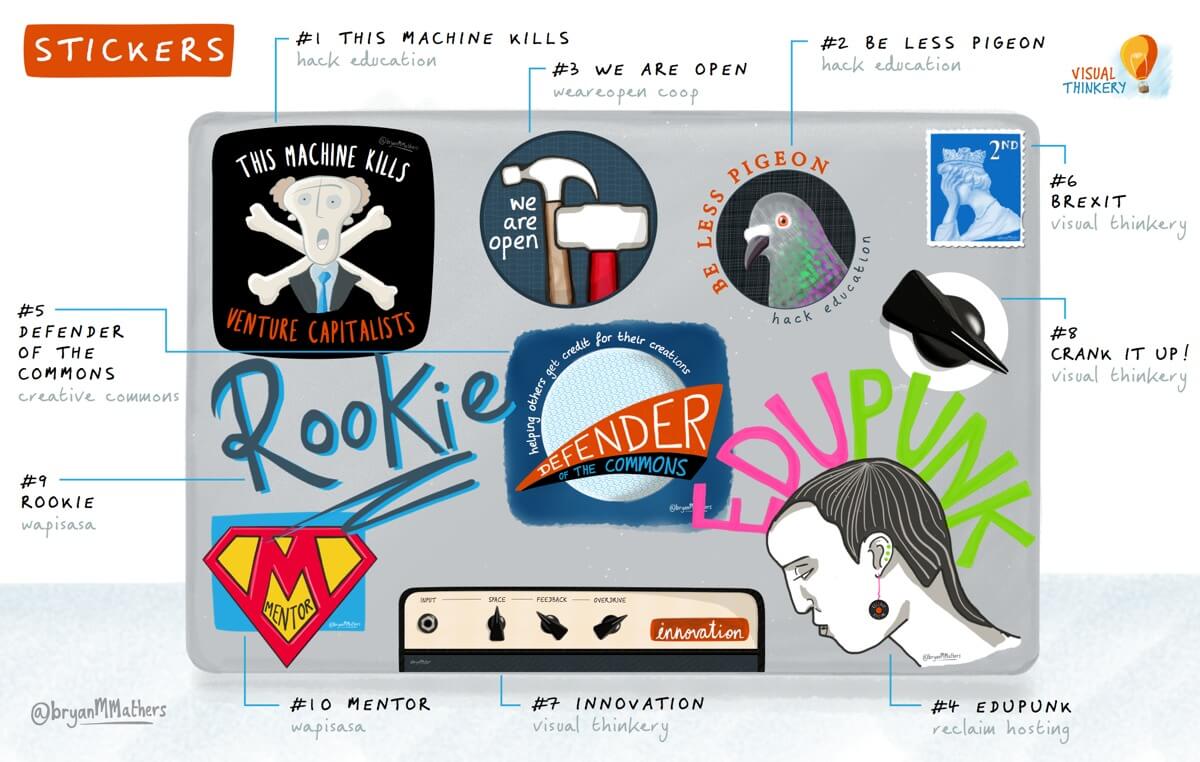
    Visual Stickery by @BryanMMathers campaign https://www.indiegogo.com/projects/visual-stickery-laptop-art–2#/

    Also early in 2017 I supported this brilliant campaign by Bryan Mathers, offering a range of options to support the work of Wapisasa CIC (Community Interest Company). I am a great fan of Bryan’s work and the causes he champions and as well as supporting a worthwhile cause I got the best laptop stickers anyone could wish for.

    Emergency Rations, edited by David Hopkins http://www.dontwasteyourtime.co.uk/books/edtechrations/

    In March a new book edited by David Hopkins was published and I was delighted to be able to contribute one of the chapters. It was a really rewarding collaborative writing process (read about it) and I wrote about the things that I can’t live without, professionally speaking (my edtech rations outtakes).

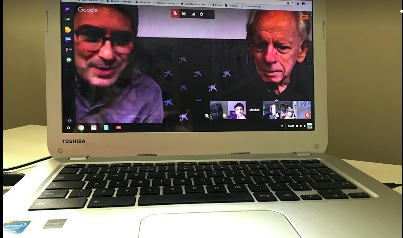
    Appraisal via laptop… from left to right: Maren Deepwell, Josie Fraser, Martin Weller

    I have a lot of support, many people who help me achieve what I do and one of the ways in which I develop my practice further is a robust annual appraisal process. This year I met with Josie Fraser and Martin Weller to discuss progress and set goals for the coming year – a thoroughly inspiring day that set out some very ambitious targets and got me thinking about how I could develop further in a new way. As you can see from the picture, plenty of stickers were involved… . Having heard many others’ experiences of appraisal and mentoring in their roles, I think I am fortunate indeed to have had many exceptional individuals to work with over the past five years and each of them has contributed to my work. You know who you are. Thank you.

    The KingPin Bowling Alley in Bloomsbury, OER17 Conference social

    The OER17 Conference in London in April had a rather unusual social programme, with an evening at the KingPin Suites in Bloomsbury, where there was karaoke (which I stayed well clear of), table tennis (again, not for me) and plenty of drinks, snacks and music…. as well as bowling. A good time was had by all, I believe. And I was comprehensively out-bowled by my colleagues Tom and Martin. 

    Bon Stewart ‘beaming in’ to the Future Happens workshop at the LSE

    I also took part in one of the excellent Future Happens workshops run by Donna Lanclos, David White and Peter Bryant this summer, at the LSE in London. It was a great day of thinking and doing that really inspired me both in helping to promote this particular work but also because it gave me great pleasure to see Bon Stewart in action. Bon took part remotely, intervention style, from her base in Canada and it was an impressive example of how much can be conveyed by a remote speaker if they are as good as Bon Stewart! Of course, I had the pleasure of witnessing the electric ‘real life’ keynote Bon gave later in September at ALT’s Annual Conference.

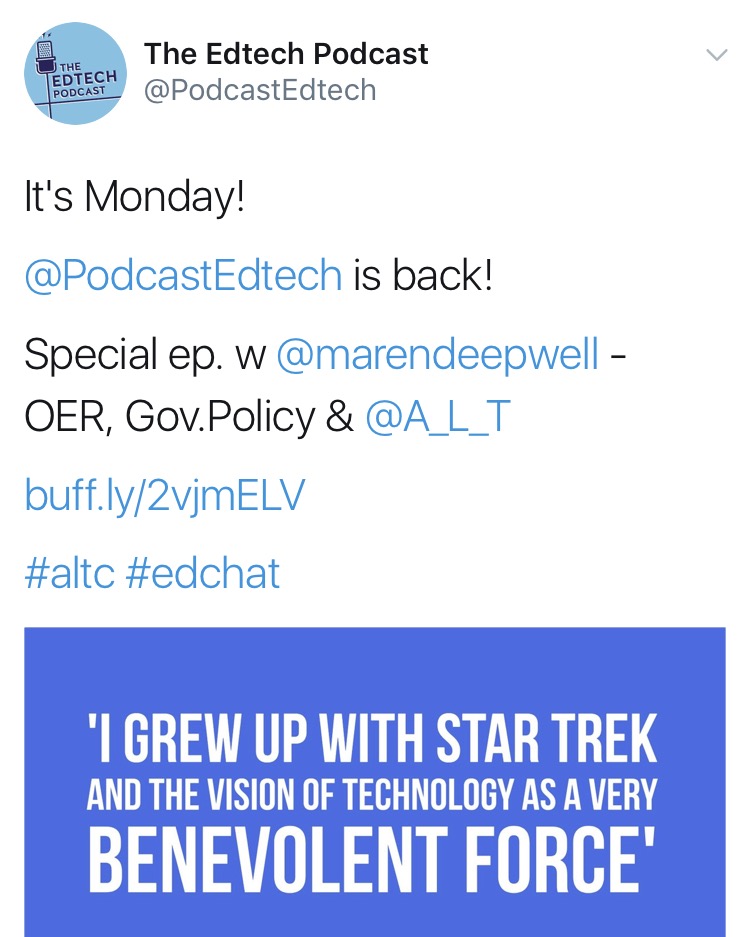
    During the summer I also recorded my first podcast as a guest on Sophie Bailey’s Edtech Podcast. I really enjoyed it and we ended up talking about quite a few things besides Learning Technology.

    Exploring further into different recording media, I joined Lorna Campbell, Sheila MacNeill and our congenial host John Johnston on Radio Edutalk. Together we discussed ALT’s Annual Conference and a lot of other things. As I am not a fan of being on video, I found myself really enjoying this kind of recording, chatting in the evening with colleagues on the other side of the country to an unseen audience.

    Running to support Learning Technology across ALTerrain… with thanks to Bryan Mathers

    Inspired by the visual thinkery from Bryan Mathers and together with a few of my fellow running colleagues, we created a t-shirt that helps support the cause we work to advance in a completely different context – on pavements, trails and at races up and down the country. Still work in progress, I think, but no doubt it won’t be long before you can spot a running Learning Technologist near you 😉

    VConnecting at #PushingHE in Barcelona

    One of the most memorable moments of my year in terms of conferences was a VConnecting session I joined at the #PushingHE Conference in Barcelona. The session was packed with excellent speakers from Tony Bates and Yishay Mor to Rikke Toft Nørgürd and Allison Littlejohn. It was an amazing line up and a really interesting discussion. However, what made this session stick in my mind is that it took place the day after the Catalan Independence Referendum. The impact of what was going on in the conference host city was so palpable it really framed the discussion and made our thinking about pushing the boundaries of Higher Education and Learning Technology much more political. It really demonstrated the power of Virtually Connecting. 

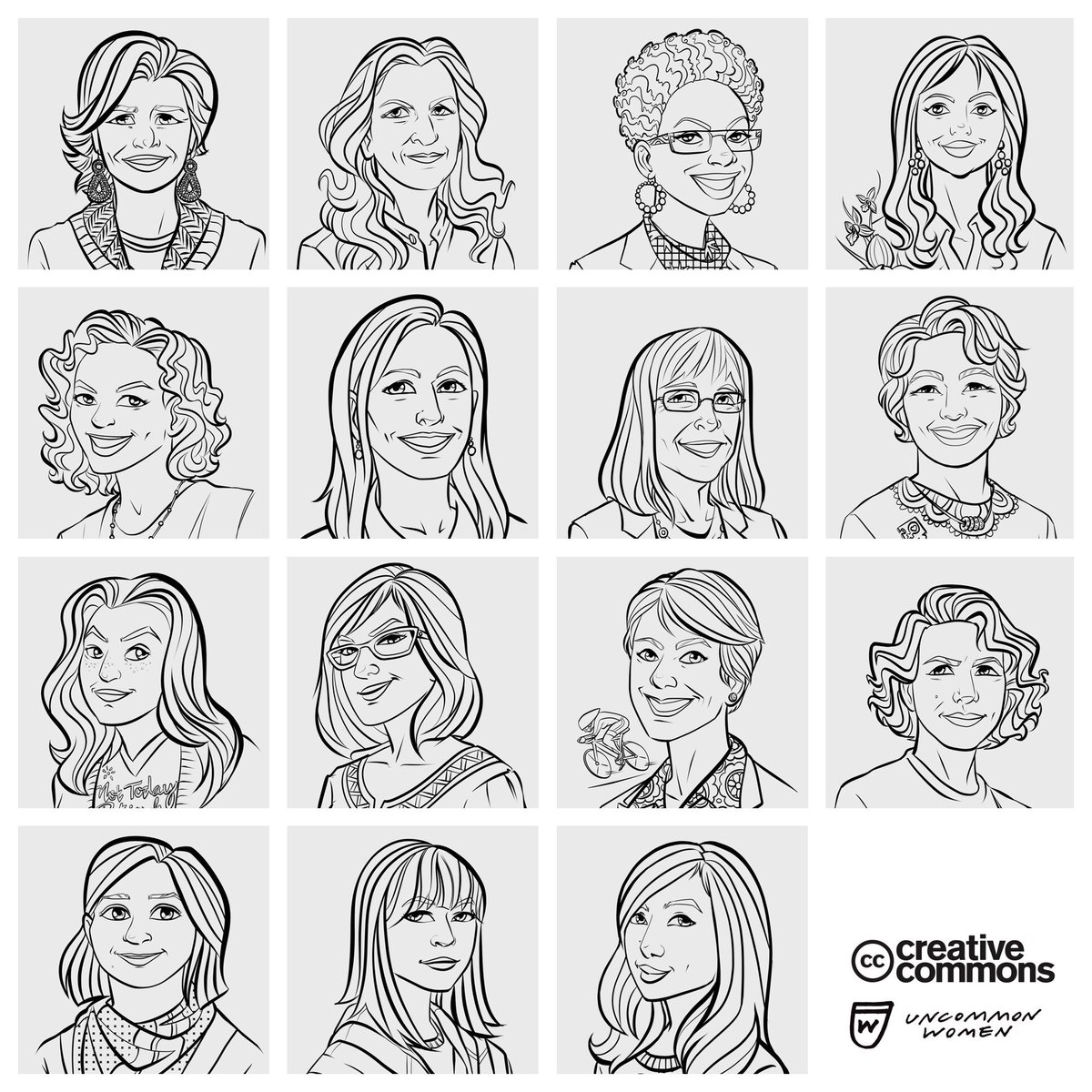
    Image result for uncommon women colouring book

    Another one of my conference highlights of the year was going to Mozfest where I met Kelsey Merkley and Ryan Merkley and received a copy of the wonderful uncommon women colouring book. Thanks for the kind gift (my own portrait is still work in progress). 

    I also discovered the feminist internet this year, thanks to Charlotte Webb and her talk at Online Educa. It’s been a great year to meet many outstanding women from all around the world who work in education and technology and work, like me, to achieve greater equality. 

    I’ve come to the end of this series of posts, and I’ve enjoyed sharing some of my thoughts with you, some insights and hopefully some useful links and ideas for further reading.

    I ended my last big event of the year, taking part in a virtual fireside chat, hearing the crackling of (real) marshmallows being toasted over flames whilst colleagues were sharing their fears and hopes for openness in education and Learning Technology. It was a reminder of how much the human dimension matters when it comes to what we do, what I do.

    So on that note, thank you for reading and to you a peaceful end of the year. I am looking forward to 2018.

    The Open Education SIG fireside chat, at the ALT Online Winter Conference