Category: CPD

  • #23things: Getting started with a team

    img_3141
    Team-made biscuit plate…

    As I mentioned in my previous post, I’ve signed up for some new open courses this autumn. Since then, I’ve encouraged my colleagues from the ALT staff team to join the 23things course and we are now embarking on it as a team.

    Like many organisations we are always looking for effective ways to provide CPD opportunities around use of technology and I think the course looks like a great way to meet that need. Given that we are a small, distributed group a course that is wholly online and has some flexibility as to when and how you learn seems ideal.

    As we want to take part as a team, we have set up some additional “taking part” support, including adding a discussion about our experiences to our weekly team meetings and a shared Google folder and doc “scratchpad” for everyone. While we are taking part in an open course I also want to create a safe space for everyone to experiment and share their views without them being public.

    So, I am joining in with this first post about what I’d like to gain from the course and also some reflections on the social media guidelines that we follow:

    First, social media guidelines: that’s something I think about quite a lot and as well as the guidelines of our host institution we publish our own policies governing our different platforms. Some of us are very active on social media, others less so – but events and membership activities are increasingly finding their voice on different platforms. So, as well as developing various digital literacy skills, the course will provide an opportunity for us to talk about our approach to social media as a team. I found Eric Stoller’s talk at the Jisc Digifest very inspiring on this topic.

    Secondly, what do I hope to get out of the course? Learning new things is definitely the top aim, but this time round I hope we can learn something new together. In our organisation we move very quickly from one project to the next and sometimes there isn’t enough time to enjoy the process of finding a solution to a problem or implementing something new. I hope the course will provide a way for us to share more of that experience.

    Open/closed? I have thought quite a bit about writing this post, because in the past when I have shared my practice openly I haven’t written directly about the colleagues I work with daily. There is a lot to consider when you share your practice openly and my own participation should support and contribute, not hinder anyone else’s progress. So I think the approach I will take is not to write about anyone’s personal experience or journey – or at least not without their express permission. I won’t share anything unless it is already in the public domain (and intentionally so) and with my colleagues’ consent. And I will contribute, just like my colleagues, in our internal spaces as well as this more public forum.

  • 23 things & coding… new open course adventures

    Recently I have been writing about setting up a new CPD log using Google Apps for Education. After a couple of busy weeks (at ALT’s Annual Conference) I have been searching for a new open course to try for this autumn. I really enjoyed my experience taking part in the Digital Scholar course and now I am ready for a new adventure.

    So, first up and already underway, I have registered for the 23 Things course from the University of Edinburgh. Recommended by a colleague on Twitter I found the course a really inspiring proposition.

    While there are quite a few familiar topics, I hope it’ll be a good opportunity to keep up to date with current practice and find new tips and ideas. I might also see if any of my colleagues might join in and utilise the course to help us provide some internal CPD. One aspect of the course I am already finding really useful is the community blog.

    Another new course I have signed up for gets underway next month and is run on FutureLearn for the Open University: Learn to Code for Data Analysis. More of a challenge given what little I know about this but it’s definitely an area I am keen to develop in. In addition to what looks like a great course tutor team and content, the course also runs on a platform that I have worked with myself and I am keen to experience another course as a participant. Judging from the hundreds of enthusiastic posts in the welcome forum, I am certainly not the only participants who is looking forward to the course getting underway and not the only novice either.

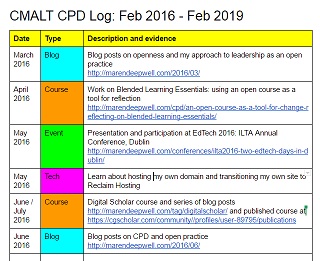
  • CMALT CPD Log: tracking professional development using Google Apps

    Since gaining my CMALT accreditation in February, I have been struck by how much of a difference it has made to me (and I am not just saying that because I work for its awarding body…). As well as providing useful evidence for my work day to day, it’s made me take a more focused and considered approach to my Learning Technology work. Part of it is developing a habit to reflect, about learning to pause and take stock before moving on to the next thing. I’ve also started being a peer assessor for other candidate’s portfolios and that has been an interesting process in itself, making me feel more connected with other professionals working in the same discipline.

    As the portfolio has to be updated every 3 years (as explained here) I’ve been considering how I am going to track my own activities. Three years is a long time and I think I would dread having to compile everything in 2019. So, like other CMALT Holders before me, I have tried to devise an approach to help me keep everything in one place and link easily into my portfolio that I built using Google Apps for Education.
    CMALT_Log

    Main aims: keep a running log of CPD activities, make it as easy as possible to log these, keep the format linked to my portfolio so that I can transfer content at the review stage and keep evidence.

    First steps: I set up a Google sheet and a form initially, but found that I didn’t like it because typing longer text into each cell didn’t work for me and the form felt too impersonal. I wanted to give myself the flexibility to add reflection and expand the format whenever I want. So I started a new Google doc instead, with a table, free text sections and an appendix section with guidance from the ALT website. I also set up a folder for additional evidence to be stored.

    Collect evidence or risk loosing it: it became quickly apparent that a lot of evidence I was logging is contained in my blog. As I now host that on my own domain (thanks, Reclaim Hosting 🙂 I feel that this works even in the long term. However one course I participated in this summer has published my work only behind a log in. So I took screenshots of the key information and stored them in the folder in case I loose access in the long run. Certainly the process of logging the evidence was the reason why I did this – otherwise I don’t think I would have.

    Where’s my CPD heading? As well as aiding reflection and encouraging me to keep my work properly backed up colour-coding different categories of CPD (e.g. events, blog, course… etc) made it very clear what I have been focusing on and areas in which I could do more.

    Tags, categories, images… couldn’t I do all of this in a more elegant way? I am sure I could. There are apps out there that would certainly make it look and feel a lot more glossy. If you have found a way that works for you, I’d love to see how it works. For me, sticking with the same format as my portfolio works for now.

  • 2008-2016 in Learning Technology #altc

    I missed 2008, but every year since then I have participated in ALT’s Annual Conference. While I work for ALT in my ‘day job’ I also attend the conference as a Learning Technology professional (and this year as a Certified Member of ALT for the first time…). So as well as work, for me it’s CPD, a great opportunity to expand my network and a chance to find out about research, new thinking in the field. While a packed, parallel programme means that I never get to see all the sessions I would like, I want to try and pick out some of the key moments from the last eight years, things that made me think, changed my mind or simply stayed with me.

    2015 – Ripples #altc: last year my work commitment focused on the AGM and that meant I had less time than usual to focus on the academic programme. So from 2015 one of my strongest ‘take aways’ is the long list of blog posts that was compiled by participants afterwards. It includes reviews, reflections and in depth posts about individual sessions. Thoroughly recommended reading (particularly welcome in the exhausted week that follows each conference for me).

    ;

    2014 – Audrey Water’s Monsters: a year of keynote and invited speakers that coincides strongly with my personal interests at the time, including wonderful talks from Jeff Haywood, Catherine Cronin and Bryan Mathers (you can watch all of them on YouTube). But for me, that Thursday morning in the front row in the giant auditorium in Warwick, listening to Audrey Waters weave a spell-binding narrative on the future of Learning Technology was an experience that has stayed with me. Audrey made me think about who has the power to decide about the future of Learning Technology – and how to empower practitioners and researchers to have more of it.

    2013 – 20 years of ALT: a very special year for the community as we celebrated the 20th anniversary of ALT, marked by a session led by former Presidents‘ of ALT looking at over the two decades. The conference was opened with a learner perspective, led by Rachel Wenstone from the NUS and also featured talks by Dame Wendy Hall discussing the role of the web and a keynote by Stephen Downes. All three made my think about the forces that shape Learning Technology. There were even fireworks that lit up a rather damp Nottingham sky.

    2012 – knitting in the main auditorium: that’s a special year for me as it was my first as ALT’s chief executive. The playlist reveals a broad array of speakers from across sectors, but one of the sessions that I can still picture in my mind vividly is this invited session with Steve Bunce, who engaged participants in the presentation and got us all finger knitting! Sometimes it’s good to be reminded that pedagogy doesn’t necessarily require the shiniest, newest gadgets… . With Eric Mazor, Richard Noss and Natasa Millic-Frayling together with James Clay, Sarah Porter and others completing the line up of invited speakers it’s another playlist worth revisiting.

    Looking north towards Hallingskarvet behind Kraekkja in Hardangervidda, Norway
    Looking north towards Hallingskarvet behind Kraekkja in Hardangervidda, Norway by Seb Schmoller

    2011 – political climate & “Live Beta”: a year with a cold theme. Two of my strongest memories of that year are firstly an impressive keynote by John Naughton, whose column in the Guardian and other writings I have since followed. As I was particularly interested in the political dimension of Learning Technology at the time, his talk resonated strongly with me. A very different experience also stayed with me, the “ALT LIVE – BETA” experiment which was led by members who were streaming interviews with speakers and other content live from the conference. It was another step in our efforts to enable participation widely and openly and in some ways it set the precedent for a lot of the work in this area we have done since.

    2010 – Don’t lecture me…: As one of the most watched keynotes from the past few year’s Donald Clark’s talk “Don’t lecture me” is probably already familiar to you (if you haven’t seen it, you can watch the video with and without the ‘Twitter track’ – which in this case I suggest you watch, too). For me that year Sudhir Giri from Google, who shared his perspective of how Google use their own tools for internal team communication, skill sharing and CPD fascinated me. Given that for several years we have been running our own Google Apps for Education domain which now facilitates a large part of what we do in ALT, that is hardly surprising. I am only glad that our has only a handful of users, rather than the multitudes that the Googlers make up.

    2009 – 100th CMALT Holder: My first ALT Annual Conference which took place in Manchester. Also, my first time to hear Diana Laurillard give an eye-opening keynote, which left me with the distinct impression that there was quite a lot about Learning Technology for me yet to learn. However, given that I was most involved in ALT’s accreditation and membership services at the time, the milestone of celebrating our 100th Certified Member has stuck most strongly in my mind. It also set me on the path to achieving CMALT myself, which…. erm….. I did in 2016!

    If you have your own memories you want to follow up, the past conferences page on the ALT website can be helpful – or browsing the YouTube playlists which go back to 2008. This year’s conference, as ever, feels to me like there is even more to look forward to. See for yourself: https://altc.alt.ac.uk/2016/ – and I hope to see you in Warwick.

  • My last week as a #DigitalScholar?

    PeerTomorrow is the last live session of the Digital Scholar course. In this post I will share my experience of week 4 and look back briefly at the course overall. So, last week was all about the peer review process and reviewing each others’ course outlines. At the end of the week, we each received the feedback provided by our peers and mine was definitely useful. Some comments were very factual, pointing out a typo or missing information, while others made me think about how a particular section of my proposal could be re-framed or re-ordered to make it clearer. What I found particularly useful:

    I know what I am talking about, but will my audience… : I think that is a key benefit from being part of a course with such a diverse group of participants. At least one of my reviewers was completely unfamiliar with what the course I was proposing was about and their comments made me want to improve my outline to make it easier to understand.

    Where, what, when… : I have a tendency to repeat things when I write and using 100 words where 20 will do. Some of the feedback prompted me to be more strict about where information was included and where it could be omitted. The Scholar interface and the course rubric also helped with that.

    No one knows who you are… : I rarely get blind feedback on work that I produce and as I have a senior position it can be hard for others to give me critical feedback. Even if you try and take a very collaborative approach, those kind of barriers make a difference. So I appreciated my “blind” feedback in particular because it was rather blunt.

    Is this the end of my #DigitalScholar journey?
    While this week is the last week of the course I am not sure I am ready to leave things behind. I am looking forward to tomorrow’s live learning moment, a meet up which has established itself quickly in my weekly routine as something I look forward to. I’ve also made some good connections with other participants and I hope they will continue to develop beyond the course end date. In terms of the work I did during the course, developing the course outline has been a really interesting undertaking. I think I have a good idea for how to develop it further in a work context, applying some of the ideas to my day job – and I also have come to realise that I have some other ideas, the bread crumb style course I mentioned in a previous post, that I might explore in my own time. Both have helped inspire me to engage directly  with open course design and delivery for the first time since my work on the ocTEL course finished.

    If you would like to read more, you can find all my previous posts about the course: starting with the first one looking ahead at the course, followed by the week 1 post about meeting the community and joining in, then my post for week 2 which focused on my process of designing the course outline and imaging another and also my post for week 3, which was about the peer review process.

  • Peer review as a #DigitalScholar: week 3

    This week our task on the #DigitalScholar course was all about per review. From creators of our own course outlines we turned into reviewers for our peers and provide feedback on a number of theirs.

    In contrast to reviewing short abstracts for conference proposals or fully thought out research papers, reviewing course outlines is a different experience for me. For example, after only a week or two of developing, quite a big proportion of what I have reviewed (and produced myself) is work in progress and thus often a lot more interesting. My peers are taking a more risks trying to put together an innovative course. I like reviewing work in progress as it exposes more of the thought processes – my own and my peers’.

    Also, it’s been fascinating to see the range of different proposals and topics. The discourse on online courses I am most familiar with is based in Higher Education, primarily in the UK and the US, and the course outlines I have seen are targeted at participants all around the world, including in a number of developing countries. The audiences that have been identified are quite different from the ‘typical’ MOOC participant I so often read about. In contrast the course outlines are all about helping communities not connected to formal education provision.

    I read an opinion piece in the future of universities today, from Times Higher Education, and one of the views presented was that technology has found a home in universities, but that nothing has really changed. This kind of perspective is common because it reflects our consistent need to learn, to assess, to prepare new generations for a broad range of professional futures. Learning Technology may change the way we do things or enhance them, but the fundamental processes remain unchanged, the article argues. On the other hand, the DigitalScholar course highlights the scale at which for example the availability of online courses, such as the ones we are designing, are changing things. Identifying a need that an online course can meet is a first step to making use of Learning Technology that really acts as a “game changer” – providing training, CPD or supporting crisis management.

    So, thanks to Reda and the course team for another inspiring and engaging week of the course. I am already looking forward to next week.