This week on the #23things course that I am participating in together with my colleagues I read an article on diversity, described thus:
Can computers be racist? Big data, inequality, and discrimination– An excellent article, including video of a lecture given by Dr. Latanya Sweeney, on how big data can perpetuate and exacerbate existing systems of racism, discrimination, and inequality (see this week’s full text here)
I found the article really stimulating not least because I am interested in the growing movement behind public interest technologists (link to the full article). One paragraph in particular caught my eye, specifically a recommendation on how we may overcome the bias in relation to inequality inherent in big data practices:
Pressing for “algorithmic transparency.” By ensuring that the algorithms underpinning critical systems like public education and criminal justice are open and transparent, we can better understand their biases and fight for change.
It’s a recommendation I think makes a lot of sense, but I have come across many instances where this isn’t the case. In many cases only the expert developers involved in creating the system really understand how it works. That leads me to consider where efforts to make algorithms underpinning critical systems more open and transparent will meet the growing expertise professionals in for example education need to have in order to approach the technology at their disposal in an effective way.
Yet while the article has certainly prompted me to think and read further, it’s also reminded me that even the simplest or most commonplace technology can create problems. #23things uses examples like exploring accessibility features on mobile devices or the use of emoji/bitmoji to get us thinking about wider issues and those are easy to relate to. Anyone who like me functions as tech support for family members for example has likely been grateful that a mobile phone’s text size or colour contrast adjusted to suit the needs of elderly users. There is a huge spectrum of issues that opens up before you when you start focusing on accessibility and diversity.
For me, these two of the #23things are a useful reminder that this is an essential part of what we do every day and that there is always a lot of room for improvement.
This talk is for the FELTAG 2016 conference taking place on 28 September 2016 in London. Having given plenty of talks about FELTAG in the past few years, I have been pondering what I really want to say to my audience in twenty minutes. Part of being the opening keynote is that you get to speak first and help set the tone for the day, but looking at the agenda of what’s to follow, it feels a bit like every case study and best practice example imaginable will be well covered. In addition, I had a conversation recently with Bryan Mathers about Revisiting FELTAG, and the resulting visual thought which I have linked to in this post (and which was published here) , made me think about where we go from here – what does the future hold for FELTAG? I hope this talk will help us find the way.
CC-BY @MarenDeepwell
Westminster Abbey: where it all began for me was in February 2013 when I was the new chief executive of ALT and was invited to represent our members as part of this group convened by Matthew Hancock, who was then Minister of State for Skills and Enterprise in BIS. The picture shows a foggy morning view of Westminster Abbey as seen from the meeting room in BIS where we met. Subsequently I have been part of FELTAG’s cross-sector successor ETAG, the FELTAG Coalition, our own FELTAG SIG, FELTAG panels, responses, updates, its evolution and most recently I revisited FELTAG with Bryan Mathers. But in February 2013 there was only one thing about FELTAG that I was interested in: firstly I was trying to figure out the “G”, namely who the other members of the group were, their aims and vision. Many of them are in the audience today, but others are no longer directly involved. As a group we stopped convening formally as soon as our recommendations were finalised in late 2013. But once the original group had done its work came the time for action. The “A” that gives FELTAG its power.
FELTAG Report (2014) http://www.feltag.org.uk/
Teachers: The original report included ambitious recommendations and a vision that demanded a change in culture, in thinking. It was as radical as was possible at the time, but what followed in the Government response, progress updates and so forth was not, at least in my view. However, it is extremely complicated to try and operationalise change in a rapidly evolving technological, social and economic context and even harder to devise robust drivers for change through funding and inspection mechanisms that hold so much sway across the sector. So trying to define in quantitative terms what progress should be made was in some ways a logical next step. The infamous 10% online learning quota requirement comes to mind here. This particular recommendation about bringing the workforce up to speed was meant to recognise that teachers play a key role in the intelligent use of Learning Technology, not machines.
Technology: Yet while we may have thought a lot about teachers, about people generally, the technology quickly took centre stage. It was clear to all that there is a consistent disparity between different providers across the country, some struggling with providing basic infrastructure while others are investing heavily. At the same time various threats technology embodies became more pronounced as we read about the automation of jobs, the power of big data networks, the might of the technology companies. At times it seemed as if instead of finding ways to empower and support people in learning and teaching, Learning Technology could be a fast track to restructuring them out of the business of education all together.
Conflict: It think this quote from David Noble from his book Digital Diploma Mills captures the conflict at the heart of the FELTAG recommendations perfectly. It juxtaposes the potential of technology to scale up, reach out and increase output with the power of human agency in learning and teaching, and with the importance of the teacher, support staff, managers or governors. Further Education is passionate about its learners.
Now I have thought about the first three letters (G, A and T), I want to turn my attention to the “L” in FELTAG. L stands for Learning. And for Learners (all of us). It’s at the heart of what FELTAG was and is about.
Source: YouTube Clips from ALT https://youtu.be/V_a9En4YgH8
Learning Myths: One of the challenges we face in Learning Technology is knowing how to make the best use of it. It’s the “what works and what doesn’t work” dilemma that is hard to answer. However even if we take technology out of the equation, keeping up with what we know about learning and how we learn best can be challenging. Lia Commissar from the Wellcome Trust recently illustrated how high a percentage of UK teachers still believe in learning styles. The answer to her quiz questions as the one in the picture above is “not true”. Highly recommended viewing.
The business of learning: I suppose in many ways the crux of the matter is that as an industry Further Education is faced by challenges from many different directions. There is little continuity of strategy or support, competing demands from employers, government agencies and not least a growing base of learners at all stages of life. Fitting what is essentially a messy, individual human experience and life stage transition into a business-enterprise model using technology can often result in a drive to standardise interaction and provision, a wish for being able to predict what happens next, when and to whom. Cue the rise of learning and learner analytics.
Sheila MacNeill speaking at the OER15 conference. CC-BY-NC ALT
Empowerment: If we compare the power the technology industry has and the pace of technological innovation to what we have, you might get the impression that we like using new gadgets and spend more time online than anywhere else, that we hear about the rapid pace of change, the rise of the machines, the arrival of artificial intelligence… but it can feel like we don’t have a lot of control over our destiny. But that is not true. At some level the forces we feel at work are all in the power of people like us, indeed some of them sat in the room I described earlier, on that damp February morning in 2013 with a view over Westminster Abbey. They were there at the invitation of a Government Minister and represented not only industry and education sectors, but policy, funding, media and other interests. The action I took as a member of the group was to take responsibility to empower those within my sphere of influence to meet the challenges Learning Technology poses head on, together and – importantly – in the open. Sharing, collaborating and helping each other. As a professional body the Association I serve facilitates, represents and supports this growing community.
The future is always just beyond the horizon: This quote and the others I have used in this talk I came across while reading Audrey Watter’s excellent Hack Education blog. It’s full of thoughtful and thought-provoking thinking about the future. And it reminds me frequently that each time I read one of these predictions about the future of education(al technology) I am sad to think that people are going about their business, waiting for the FUTURE to arrive and never taking action to make their vision come to life in the here and now. I think for me FELTAG was about that. Coming together to make a stand. We wanted to draw a line in the sand beyond which the future was actually going to materialise, finally. Not just for some, but for everyone in Further Education.
It has been over a century since Thomas Edison predicted the demise of books in schools and his predication has failed to come true. It’s also been over three years since that first meeting of the FELTAG group. We are now beyond FELTAG, we are finally living the future that’s always been just beyond the horizon and that’s a lot of responsibility for each of us.
Hello, and welcome to thing no.3 of the #23things course (also, this is my 100th post on this blog)… As I mentioned previously I am taking part in this course together with my team. If you are curious about our approach read the post, but here it is in a nutshell: we have given ourselves permission to lurk, audit, explore or participate in each thing as we deem fit on an individual basis. So… this is my attempt to contribute:
This task starts with searching for yourself on Google and that’s where I have paused. It feels strangely personal writing about my own search results, but then of course that is the point of the exercise. This information is already in the public domain and easily discoverable by anyone. Why did searching for myself give me reason to pause? I want to explain why, using 10 screenshots I took:
Front page: The most public version of ‘me’ is on the first page of results. Like most of you I monitor the information about me online regularly and the results presented here are what I expected. It’s sometimes surprising how high events I participate in appear in the search results, but so far, so good.
Old News: In contrast to the first search results, this is not a list I look at frequently, but I’m already uncomfortable. Giving interviews or quotes is a circumspect business but no matter what I say it can read badly after a few years (or sometimes far sooner). Looking at this list also reminds me that I am not consistent when it comes to archiving news items, so I suppose one advantage of having whatever you say archived and indexed is that you can compile at least a partial list at a glance. Next!
Videos: I often ignore how much video there is now of me. Granted, it’s a tiny amount in comparison to others, but not even 10 years ago there was no video of me at all. In most cases the video is a recording of a live event either in front of an audience or online. It’s often improvised, never polished and can make for cringe-worthy watching for me. On the other hand, some of my favourite moments in my professional life have been in front of an audience, so on balance I think I am glad to have these videos and hope that some are useful or interesting to others.
And now… images: this is where you can go down all sorts of rabbit holes and find surprises. First up: pictures in weird settings or combinations:
Images I have no control over and that are ranked highly, can feel like an annoying part of my digital footprint. In other instances the images are not of me, but made by me or posted by me at some point in the past. It can be fun to rediscover a former self , but it strongly reminds me that each time I publish anything, this post included, I make a decision to add to this expansion of stuff about or by me:
Some images, like this one above for example, I posted at some point and thought I had removed. Others, like the one below, are a blast from the past. In this instance it shows an outdoor trade-show of funerary wares, mainly coffins, that I visited as part of my doctoral research.
Finally, there are also images I post on sites like JustGiving, when I was raising money for Cancer Research. I am not sure how I will feel seeing this in a few years time, particularly if my personal circumstances or those of my family are different by then. What if you find images of raising funds for someone who is no longer with you?
All of this information about me is on the surface. I haven’t really started digging into what else you can find about me online and there are dire warnings about what can be done with personal information that isn’t safeguarded. That’s one reason why I am taking part in this course. Being online, particularly as an open practitioner, is making yourself vulnerable. Josie Fraser gave an inspiring keynote at ALT’s Annual Conference this year and I’ll end this post by encouraging you to watch it. Don’t let trolls follow your digital footprints…
As I mentioned in my previous post, I’ve signed up for some new open courses this autumn. Since then, I’ve encouraged my colleagues from the ALT staff team to join the 23things course and we are now embarking on it as a team.
Like many organisations we are always looking for effective ways to provide CPD opportunities around use of technology and I think the course looks like a great way to meet that need. Given that we are a small, distributed group a course that is wholly online and has some flexibility as to when and how you learn seems ideal.
As we want to take part as a team, we have set up some additional “taking part” support, including adding a discussion about our experiences to our weekly team meetings and a shared Google folder and doc “scratchpad” for everyone. While we are taking part in an open course I also want to create a safe space for everyone to experiment and share their views without them being public.
So, I am joining in with this first post about what I’d like to gain from the course and also some reflections on the social media guidelines that we follow:
First, social media guidelines: that’s something I think about quite a lot and as well as the guidelines of our host institution we publish our own policies governing our different platforms. Some of us are very active on social media, others less so – but events and membership activities are increasingly finding their voice on different platforms. So, as well as developing various digital literacy skills, the course will provide an opportunity for us to talk about our approach to social media as a team. I found Eric Stoller’s talk at the Jisc Digifest very inspiring on this topic.
Secondly, what do I hope to get out of the course? Learning new things is definitely the top aim, but this time round I hope we can learn something new together. In our organisation we move very quickly from one project to the next and sometimes there isn’t enough time to enjoy the process of finding a solution to a problem or implementing something new. I hope the course will provide a way for us to share more of that experience.
Open/closed? I have thought quite a bit about writing this post, because in the past when I have shared my practice openly I haven’t written directly about the colleagues I work with daily. There is a lot to consider when you share your practice openly and my own participation should support and contribute, not hinder anyone else’s progress. So I think the approach I will take is not to write about anyone’s personal experience or journey – or at least not without their express permission. I won’t share anything unless it is already in the public domain (and intentionally so) and with my colleagues’ consent. And I will contribute, just like my colleagues, in our internal spaces as well as this more public forum.
Recently I have been writing about setting up a new CPD log using Google Apps for Education. After a couple of busy weeks (at ALT’s Annual Conference) I have been searching for a new open course to try for this autumn. I really enjoyed my experience taking part in the Digital Scholar course and now I am ready for a new adventure.
So, first up and already underway, I have registered for the 23 Things course from the University of Edinburgh. Recommended by a colleague on Twitter I found the course a really inspiring proposition.
While there are quite a few familiar topics, I hope it’ll be a good opportunity to keep up to date with current practice and find new tips and ideas. I might also see if any of my colleagues might join in and utilise the course to help us provide some internal CPD. One aspect of the course I am already finding really useful is the community blog.
Another new course I have signed up for gets underway next month and is run on FutureLearn for the Open University: Learn to Code for Data Analysis. More of a challenge given what little I know about this but it’s definitely an area I am keen to develop in. In addition to what looks like a great course tutor team and content, the course also runs on a platform that I have worked with myself and I am keen to experience another course as a participant. Judging from the hundreds of enthusiastic posts in the welcome forum, I am certainly not the only participants who is looking forward to the course getting underway and not the only novice either.
Since gaining my CMALT accreditation in February, I have been struck by how much of a difference it has made to me (and I am not just saying that because I work for its awarding body…). As well as providing useful evidence for my work day to day, it’s made me take a more focused and considered approach to my Learning Technology work. Part of it is developing a habit to reflect, about learning to pause and take stock before moving on to the next thing. I’ve also started being a peer assessor for other candidate’s portfolios and that has been an interesting process in itself, making me feel more connected with other professionals working in the same discipline.
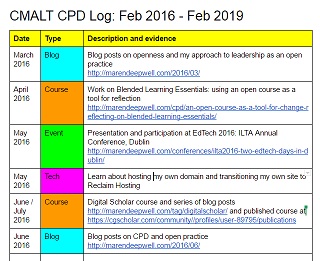
As the portfolio has to be updated every 3 years (as explained here) I’ve been considering how I am going to track my own activities. Three years is a long time and I think I would dread having to compile everything in 2019. So, like other CMALT Holders before me, I have tried to devise an approach to help me keep everything in one place and link easily into my portfolio that I built using Google Apps for Education.
Main aims: keep a running log of CPD activities, make it as easy as possible to log these, keep the format linked to my portfolio so that I can transfer content at the review stage and keep evidence.
First steps: I set up a Google sheet and a form initially, but found that I didn’t like it because typing longer text into each cell didn’t work for me and the form felt too impersonal. I wanted to give myself the flexibility to add reflection and expand the format whenever I want. So I started a new Google doc instead, with a table, free text sections and an appendix section with guidance from the ALT website. I also set up a folder for additional evidence to be stored.
Collect evidence or risk loosing it: it became quickly apparent that a lot of evidence I was logging is contained in my blog. As I now host that on my own domain (thanks, Reclaim Hosting 🙂 I feel that this works even in the long term. However one course I participated in this summer has published my work only behind a log in. So I took screenshots of the key information and stored them in the folder in case I loose access in the long run. Certainly the process of logging the evidence was the reason why I did this – otherwise I don’t think I would have.
Where’s my CPD heading? As well as aiding reflection and encouraging me to keep my work properly backed up colour-coding different categories of CPD (e.g. events, blog, course… etc) made it very clear what I have been focusing on and areas in which I could do more.
Tags, categories, images… couldn’t I do all of this in a more elegant way? I am sure I could. There are apps out there that would certainly make it look and feel a lot more glossy. If you have found a way that works for you, I’d love to see how it works. For me, sticking with the same format as my portfolio works for now.