This is a very special keynote to me and I am grateful to the Trustees of ALT to invite me to speak at ALT’s 25th Annual Conference. This post shares the slides and some of my notes for the talk and you can also watch a recording from the conference here . Thanks to James Clay for this video sketch note of the talk.

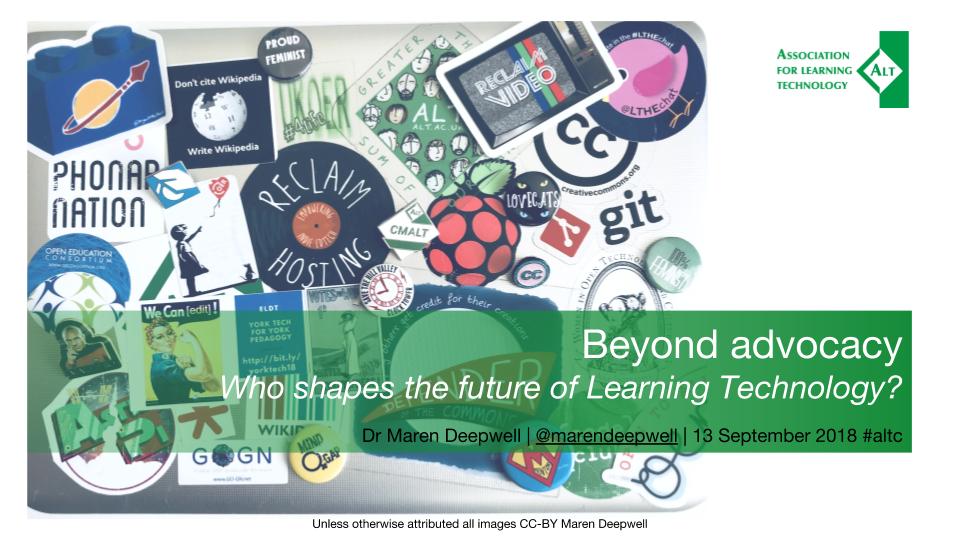
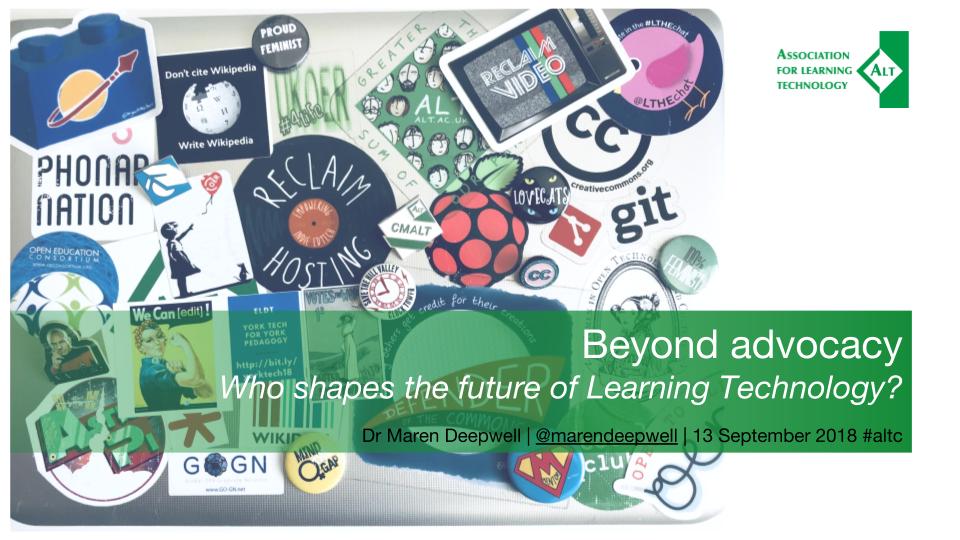
I wanted to introduce myself via the skin of my laptop, which has been tattooed, to borrow a phrase from Bryan Mathers, with my experiences as ALT’s CEO over the past six years. When I started to prepare for this keynote I thought a lot about how I could tell a story from my personal perspective, rather than in the voice of the organisation I lead. Because thanks to working at the heart of what ALT does, with Members from across all education sectors in all parts of the UK and beyond, I have the privilege of a very unique perspective, one that encompasses everything from global Learning Technology policy to a single teacher using a new gadget for the first time. I can’t cover all of that in less than an hour of course, but I do want to give you as much insight as I can into my perspective, what it’s like to be standing in my shoes, and so the photos in this talk are from journeys I’ve taken to work with Members from Oxford to Edinburgh, from Belfast and Galway to Cardiff and London. They paint a picture of the landscape that I work in, what the world looks like when you are standing in my shoes.
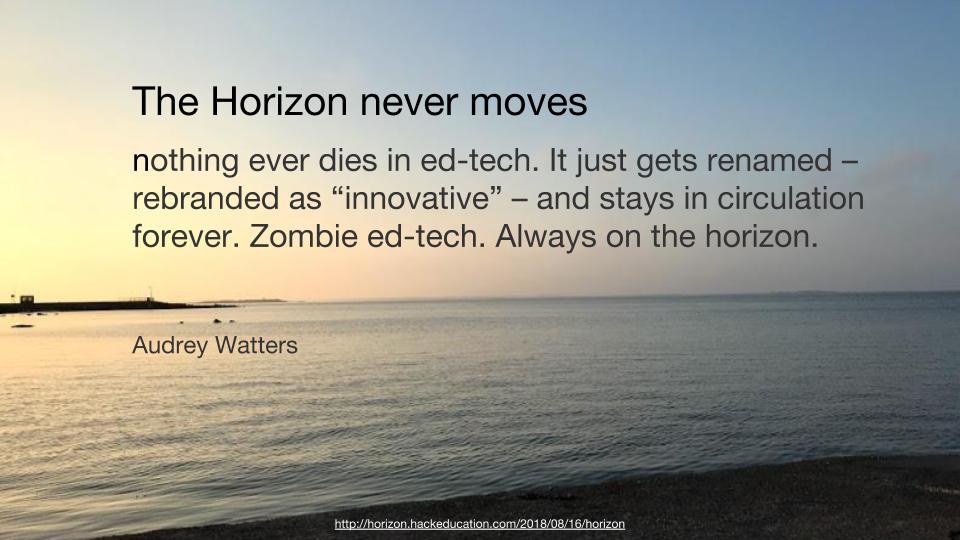
I hope that this talk will help us to critically examine our perspective – and in particular why our gaze is always drawn to what we are promised is just around the cover, just over the horizon. In her analysis of the most recent Horizon Report, Audrey Watters updated her project to track the predictions that the report has made over the years, examining whether what advocates promise actually comes to pass. Audrey writes: ‘Your takeaway, now and then and always: do not worry about what this report says is “on the horizon.” I bet you in five, ten, twenty years time, folks will still be predicting that it’s all almost here.’
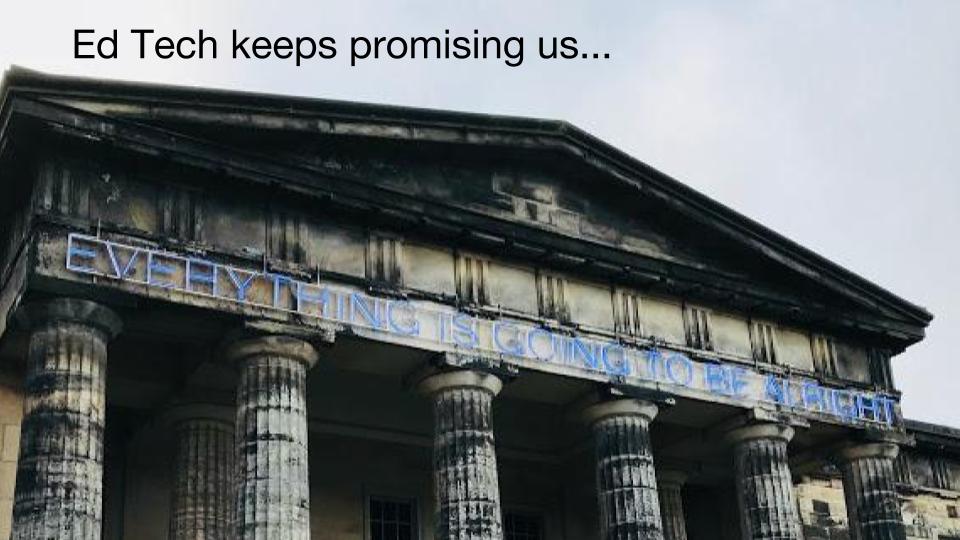
What does it mean for us if we are locked into a perpetual cycle of not arriving, of advocacy for tech that does not deliver to its full potential? We can go back through the history of Learning Technology and come across solutions promising to ‘solve problems’ from cutting costs or reducing teacher workloads to improving learning outcomes or increasing student satisfaction. But have these solutions really delivered for all learners? Does the way we think about and make policy for Learning Technology work? Or does this approach when viewed on a global scale, place the UK firmly in a policy context that the Finnish education expert Pasi Sahlberg describes as market-led privatisation, text-based accountability, de-professionalisation, standardisation and competition resulting in, in his view, unsuccessful education policies? I think so.
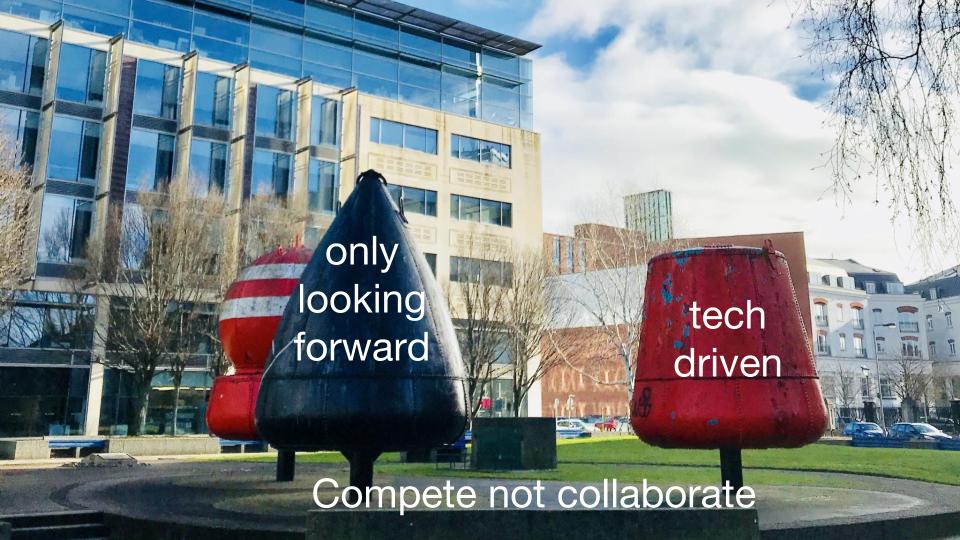
Advocating for what’s just beyond the horizon causes 3 issues: first, it gives us the sense that technological innovation is the driver behind change, the only solution to solving the problems that we face. The dominant narrative here is that we are at the mercy of inevitable innovation, the endless march of the machines and that we need to keep running in order to keep pace with progress. This in turn highlights the second problem: a perspective informed by advocacy focused only on what’s ahead increases our perception that we need to compete harder in order to achieve constantly moving goal posts. Compete with other countries as we move up or down league tables, with other institutions, with each other. Instead of making the most of sharing what we have, we don’t like to adopt something that’s ‘not made here’, we re-invent, re-design and re-solve problems and create content over and over again in a race to be the first, the best, the most successful. The issue is that this perspective of continual advocacy tends to ignore the history, the research, the evidence that we do have (and we have decades worth of it by now!). Does being focused on and advocating for what’s always just beyond the horizon also absolve us from ethical responsibility? We’re always talking about the future not what’s happening now?
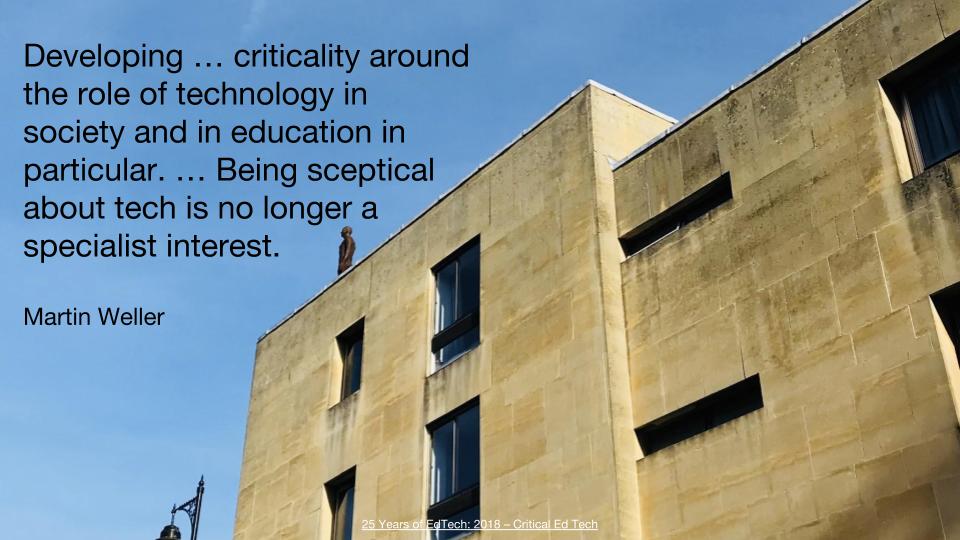
I argue that we have the history, the evidence, the research to shape a different perspective, to walk a different path in the future of Learning Technology and there are an increasing number of voices that articulate how things are changing, who are shifting the discourse to a more critical ground. Martin Weller’s inspiring series on ‘25 years of Ed Tech’ is a great example of this (and definitely worth reading if you haven’t come across it yet). He emphasises the need for taking a critical approach to our thinking in Learning Technology, to examine the (commercial) interest that influence its development, ‘for example, while learning analytics have gained a good deal of positive coverage regarding their ability to aid learners and educators, others have questioned their role in learner agency and monitoring and their ethics.’
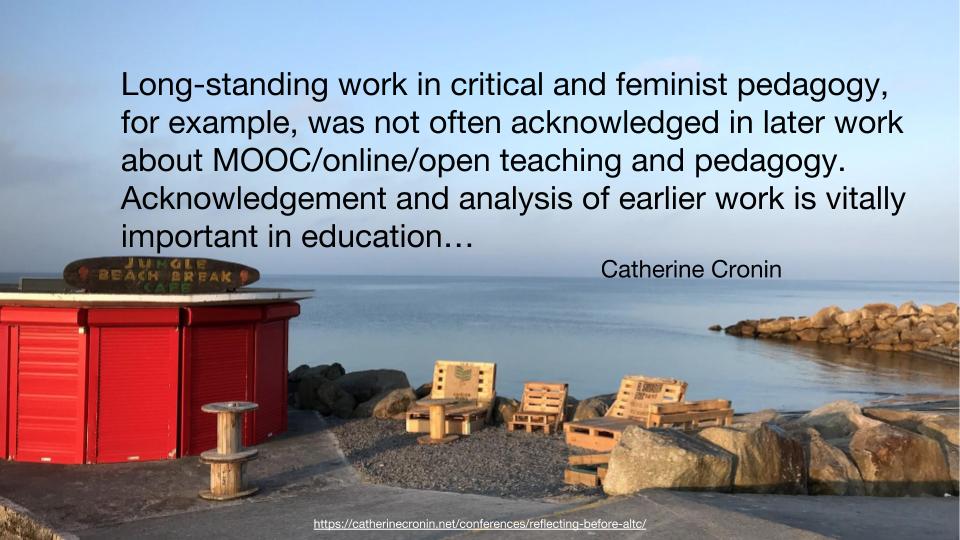
Another important influence on my thinking and our wider discourse work examine the role of gender and equality in Learning Technology, led by man inspiring role models including Maha Bali, Frances Bell, Anne-Marie Scott, Bon Stewart, Josie Fraser, Donna Lanclos, Melissa Highton, Clare Thomson, Helen Beetham, Lorna Campbell, Sheila MacNeill, Laura Czerniewicz, my fellow keynote speakers this year Tressie MacMillan-Cottom and Amber Thomas, and many others who I am sorry not to mention by name. In her reflective post ahead of the conference, Catherine Cronin reminds us that often ‘long-standing work in critical and feminist pedagogy, for example, was not often acknowledged in later work about MOOC/online/open teaching and pedagogy. Acknowledgement and analysis of earlier work is vitally important in education’.
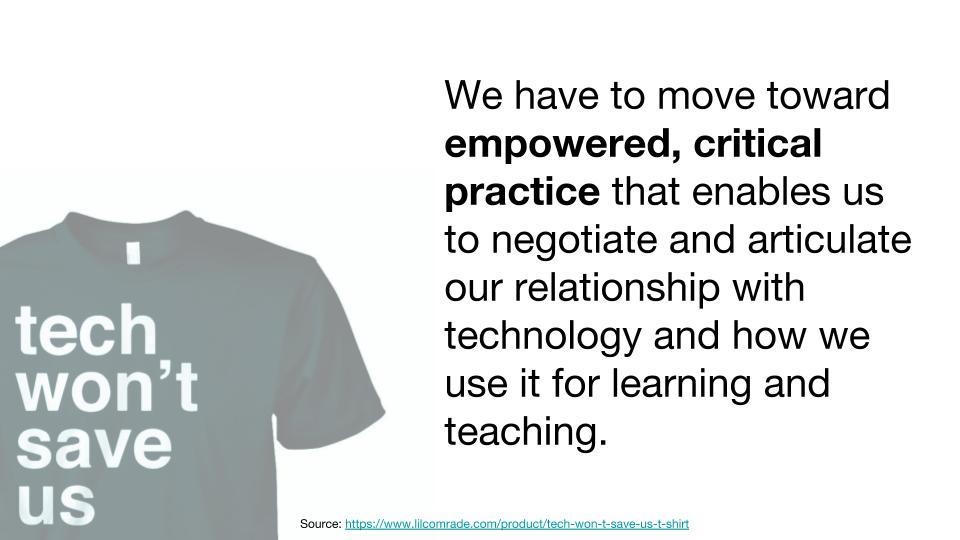
With ever growing challenges facing us, and decades of research and practice to inform our thinking, it seems clear that (Ed) Tech won’t ‘save us’. It won’t save us because it shouldn’t be the driving force behind what we do. Instead, we have to move beyond advocacy for tech that is the answer to all our problems. Towards empowered, critical practice that enables us to negotiate and articulate our relationship with technology and how we use it for learning and teaching. This isn’t to say that technology doesn’t have significant potential and I don’t meant to dismiss the role that industry plays or how much technological innovation contributes to the way we learn, teach and work. Learning Technology can bring big benefits for learners and educators – but it needs to be an empowered relationship instead us being threatened to be buried under an avalanche.
So my questions are: How do we move beyond advocacy? How to we realise the potential of our professional practice for the benefit of learners and for the greater good? How to we move to using Learning Technology to meet some of the biggest challenges we are facing globally right now?
These are big questions. I’d like to share some examples from my own recent work as a starting point to answering these questions. Putting Learning Technologists firmly at the heart of that effort, I’m going to start by looking at how professional practice has changed, using the example of ALT’s accreditation scheme, CMALT.
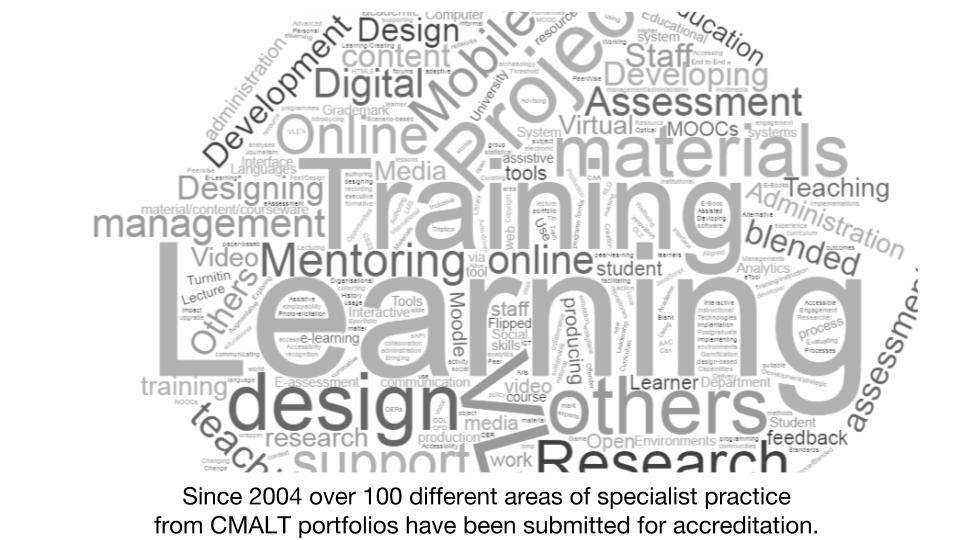
Building on the work Shirley Evans, Trustee of ALT, and my colleague Tom Palmer have done in the past two years to collate information from hundreds of portfolios submitted for accreditation since 2004, I’ve started examining if and how the evolution of Learning Technology as a profession can be charted by what specialisms individuals have chosen to demonstrate their practice with. Since 2004 over 100 different areas of specialist practice have been defined and starting to group these into different categories quickly became difficult as they had to be so general as to become meaningless instead of insightful. That in itself is interesting, because it emphasises how diverse the profession is and continues to be.
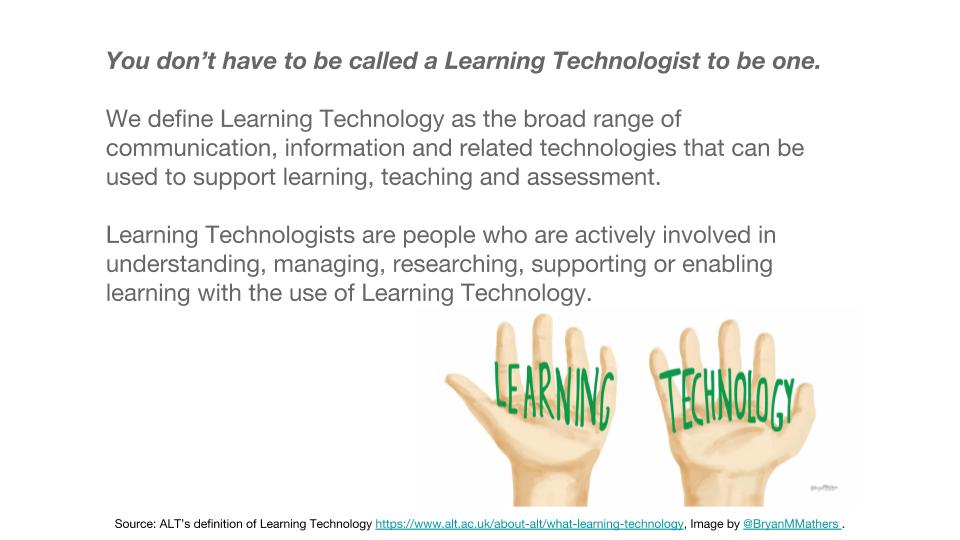
It brings us back to ALT’s definition of Learning Technology ‘as the broad range of communication, information and related technologies that can be used to support learning, teaching and assessment. Our community is made up of people who are actively involved in understanding, managing, researching, supporting or enabling learning with the use of Learning Technology.’ and reminds me of the original maxim that still holds true: you don’t have to be called a ‘Learning Technologist’ to be one. To me, it aptly reflects the reality of how differently we as individuals and within organisations approach the challenge of making effective use of Learning Technology and I feel that great strength lies in embracing and respecting this as a hallmark of our profession instead of trying to exclude or ignore words or people who don’t fit within a more narrow definition. Even if we don’t speak the same language or use the same terms to describe our work, the growing body of CMALT portfolios is a powerful example of what we do share.
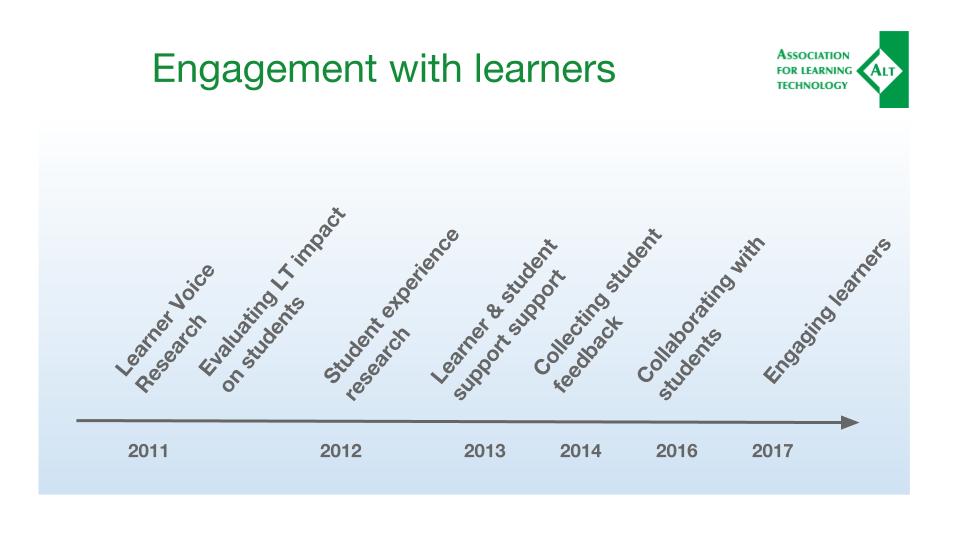
Instead then of focusing on the bigger picture, my work has focused on drilling down into the detail of how specialist areas have developed and this first example shows specialisms related to engaging learners. It is interesting to see how even the titles chosen reflect a changing relationship to working with learners, from a more distant research or evaluation approach to focusing on support and feedback and then to collaboration and engagement.
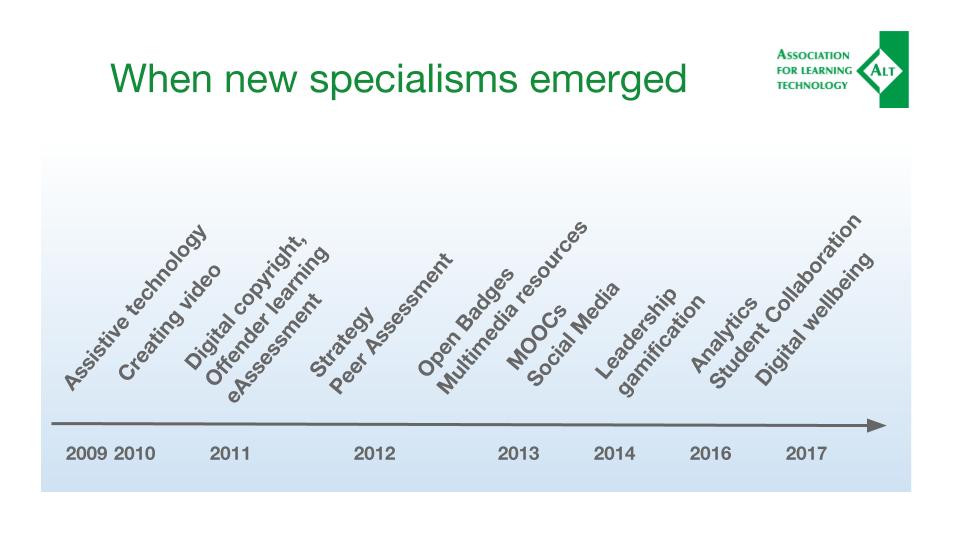
Another interesting question to ask is when particular kinds of work became important or developed enough to constitute specialist areas of practice and this slide shows examples of ‘firsts’, i.e. when particular kinds of practice were first submitted for accreditation as specialist areas over the past ten years. It only took a year after 2012’s ‘Year of the MOOC’ for instance for it to appear on this list for example. Meanwhile, more recent examples of new specialisms include digital well being, student collaboration, analytics, gamification and leadership. More and more CMALT Holders have started to share their portfolios via ALT’s CMALT Portfolio Register, opening up their practice and at the same time contributing to our ability to gain a better understanding of how professional practice is developing and changing.
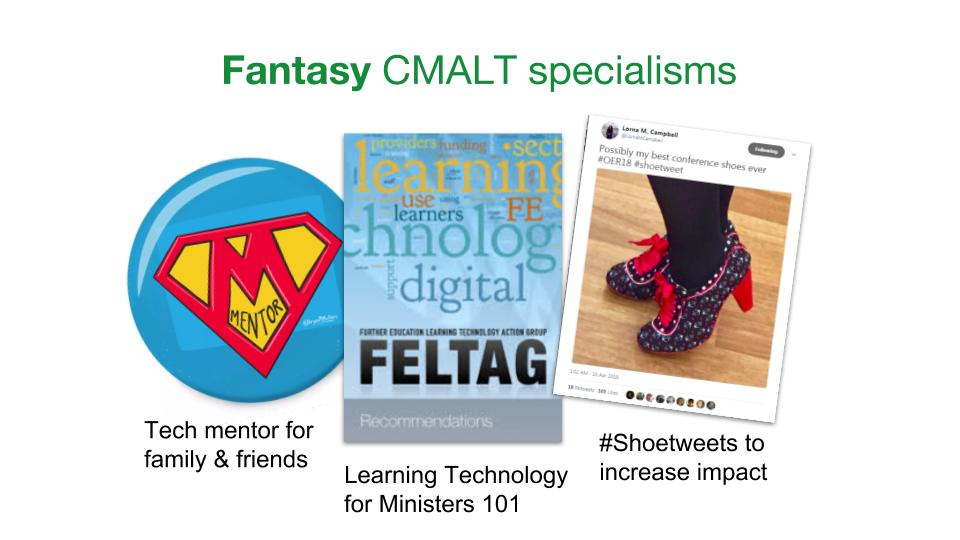
One question we should ask is to what extent the kind of best practice usually included in portfolios submitted for accreditation, in particular if they are subsequently shared more widely, reflect the reality of professional practice? What isn’t included in this picture? What is left out? Most of the time, anything that’s gone wrong: all the times when a pilot didn’t lead to full scale implementation, when a new gadget ends up gathering dust in the back of a cupboard, when colleagues didn’t co-operate, students gave negative feedback or leadership failed. Learning Technology is a risky business and sharing what didn’t work is still not widespread. But there is something besides failures that isn’t reflected in this picture and that is all the work that is hard to put into words. Hours spent building someone’s confidence or overcoming their resistance to change. Days devoted to influencing decision makers to make the right choices when it comes to strategy or procurement. Teams who translate between faculties or directorates in order to arrive at a common consensus for the new VLE. I can think of many examples of what specialisms I’d like to see appear on the list – and I am sure you can, too.
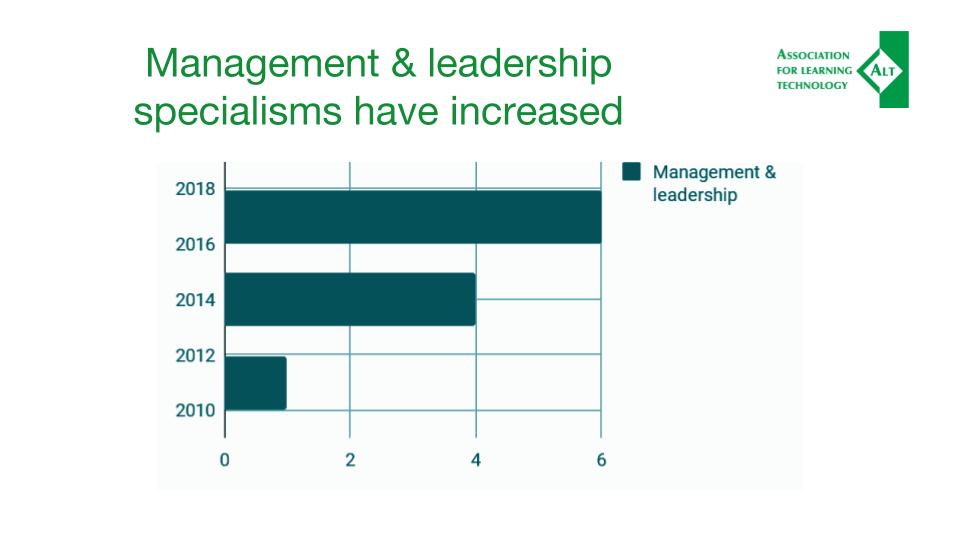
One of the trends however we can follow over the past ten years or so is the gradual increase in the number of people who choose a management or leadership related specialism as more and more Learning Technology professionals move into more senior roles. Their expertise in Learning Technology becomes more important as technology becomes more complex and our demands of what it can achieve for students or staff on a large scale become more ambitious.
In consultation with Members of ALT this has informed the development of new accreditation pathways over the past 18 months, and the second pilot of both Associate CMALT (a new pathway for early career professionals or those for whom Learning Technology is a smaller part of their role) and Senior CMALT, for senior professionals whose work involves management, leadership, research or similar advanced areas of practice, are about to be concluded. These new pathways mark the first expansion of the CMALT framework since 2004 and I want to share some early findings from the pilot groups to date.
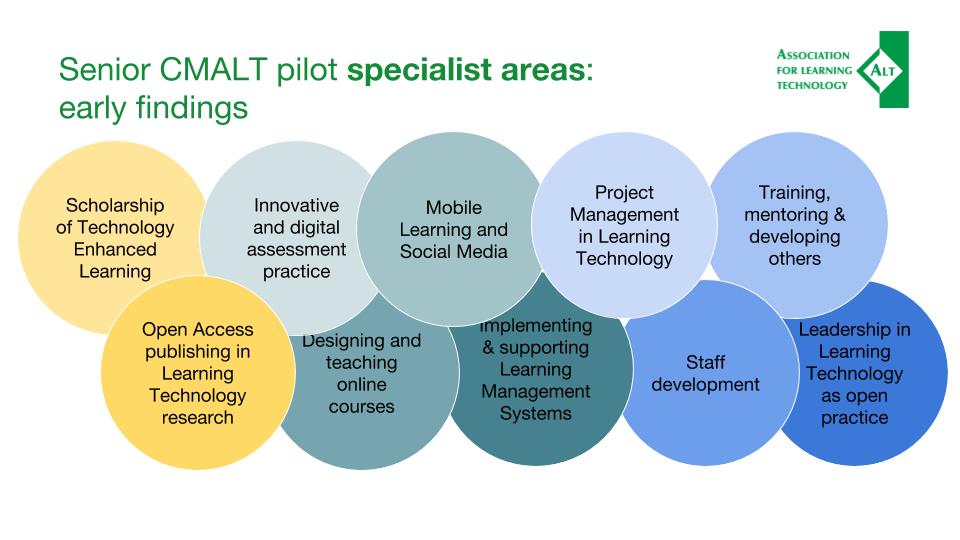
The requirements for Senior CMALT include two (instead of one for the existing CMALT pathway) specialist areas of practice to be described, evidenced and reflected on. The subjects chosen to date reflect a broad range of practice from scholarship and Open Access publishing, to assessment, online courses and mobile learning to staff development, training and leadership. Similar to the earlier chart which showed a diverse range of different specialisms over a time these choices reflect how more senior roles in Learning Technology are developing their focus.
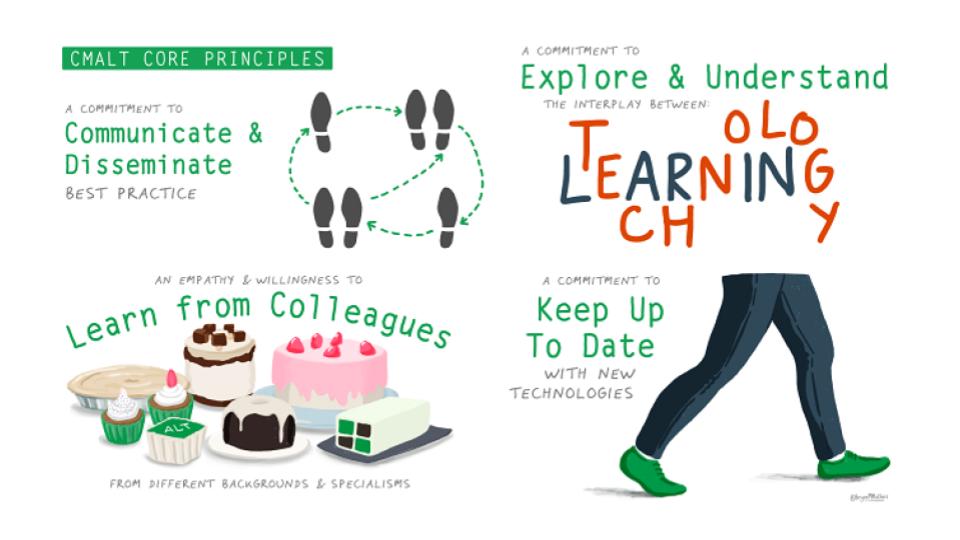
A new requirement added to Senior CMALT is an Advanced Area of practice, which needs to be specifically related to the four CMALT Core Principles. The visual thought here shows the result of consultation with and discussion amongst Members who came together to re-articulate these principles afresh as part of the work to develop new pathways to CMALT. This is particularly relevant to the earlier question of how far the practice evidenced for CMALT reflects the reality of our professional everyday as to me these shared principles are a strong example of how we articulate what may be less straight forward to share about the work we do. To me these principles reflect professional practice beyond advocacy.
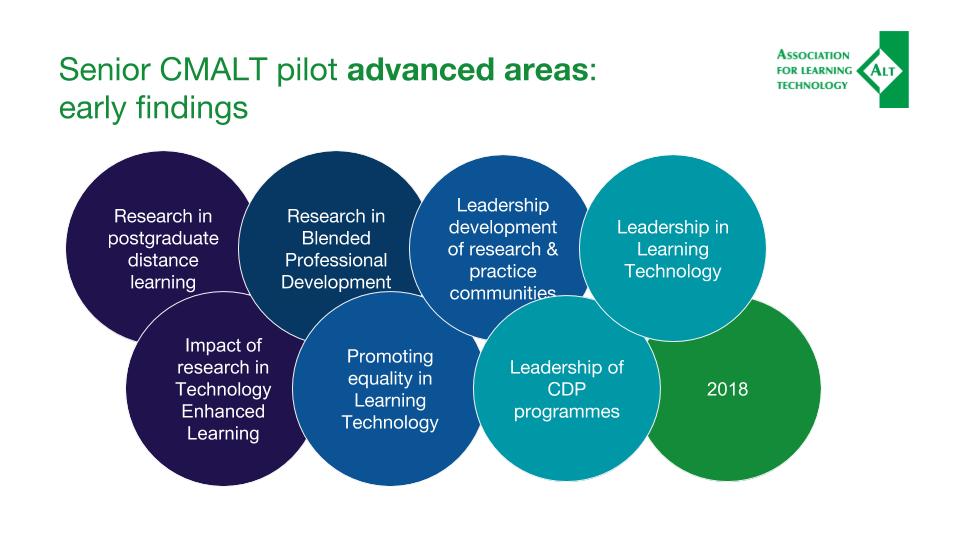
Now we can see the earliest topics chosen by participants of the pilot groups for Senior CMALT and what areas of their practice they have chosen to as Advanced Areas relating to the core principles and these range from research focused topics, such as research in postgraduate distance learning or blended professional development to leadership of cpd programmes and leadership in the development of research and practice communities. At this stage the insight we can gain from this is still limited by the necessarily small numbers of professionals involved. But it does give us a glimpse of what critical approaches to professional practice in Learning Technology may develop and this will become more interesting as this pathways is fully established and the number of examples we have increases.
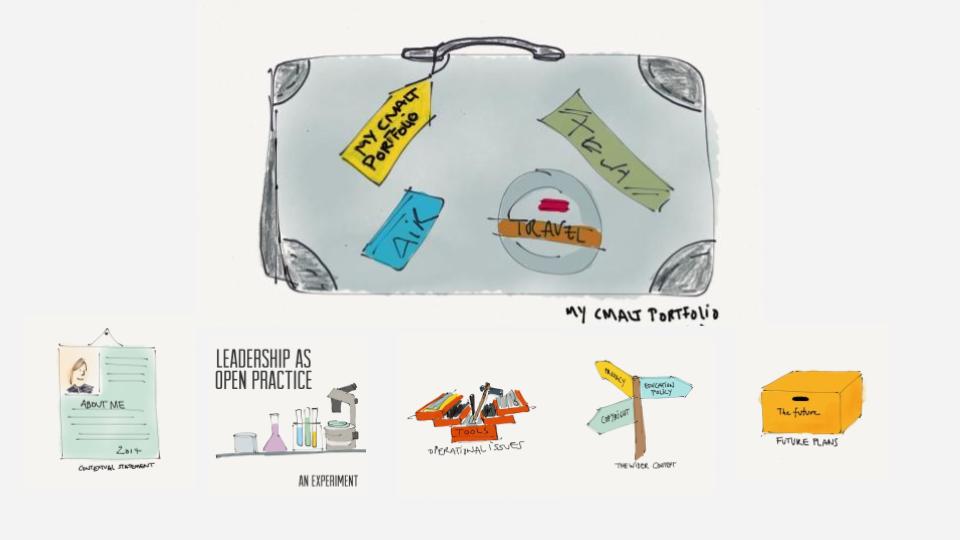
I gained CMALT two years ago and I found the process very rewarding. It was valuable to step away from the perspective of having managerial oversight and put it to the test as a professional, becoming a candidate myself and seeing the other side of the process (you can access my portfolio here and note that my portfolio was assessed by Trustees of ALT to manage the conflict of interest). So when the opportunity came up to put one of the new pathways through its paces, I opted for Senior CMALT and set to work expanding my portfolio. It prompted me to reflect on how I have moved my own practice towards a more critical perspective.
As my Advanced Area of practice I chose promoting equality in Learning Technology and I soon realised that this was harder to translate into a portfolio of evidence than I had imagined. It’s my own “CMALT Fantasy Specialism” and I am fortunate to have had some very helpful critical friends who provided input to ensure that it didn’t turn into a nightmare.
So to unpack what this part of my work is about it’s important to explain the context in which my understanding of equality is grounded and to do this I want to share an extract from what I wrote in my portfolio:
Whilst my position is indeed one of relative privilege, it is nonetheless an experience of inequality.
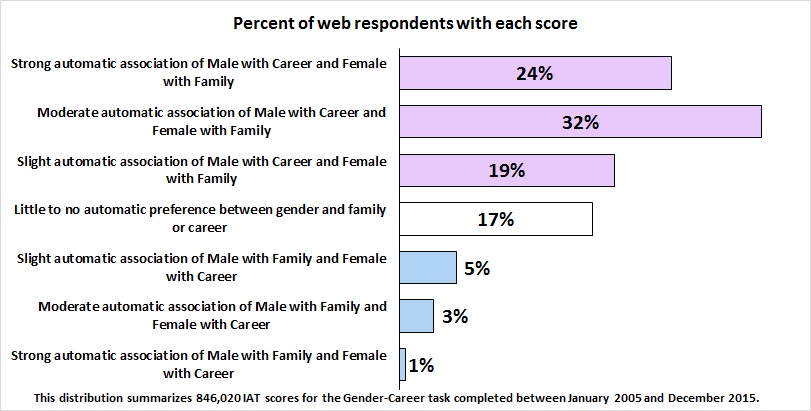
As a space in which we work, Learning Technology sits at the intersection of the tech industry, education, politics and the third sector. When I started working in Learning Technology I had no concept of how much inequality there is and how much it would affect every single day of my professional practice and that of every colleague, every learner. Particularly as a Learning Technologist in a leadership position it can be sobering to see the kind of structural inequality Laura Czerniewicz (who stood in this stage 3 years ago and inspired us with her talk on Inequality in Higher Education) and others speak of on a national or global scale. But whilst the bigger picture is important to my work, examples of inequality I have experiences can be found far closer to home, in the day to day working life many colleagues can relate to, such as being the token woman on a ‘manel’ to seeing reports about empowerment illustrated exclusively by white women in high heels to being the only women on a table of policy makers representing “the sector” to having to be introduced by male colleagues as ‘the boss’ in order not to be mistaken for their PA, from not being allowed to ask questions at events to not being invited, not being funded, not being considered for an opportunity. The list of examples goes on and on and for me it’s difficult to describe dispassionately.
The need to promote equality in Learning Technology goes far beyond the personal (and as I have acknowledged in my case a personal position of privilege). Inequality is structural and political and frequently apparent in the development of Learning Technology, such as algorithmic bias shaping the way new technologies operate. I admire writers and researchers who analyse, chart or expose inequality and I actively use my position to take action to promote equality. I have specifically chosen to attempt to develop this area of my practice in my portfolio because that in itself can contribute and I have selected three examples of how I promote equality as a Learning Technologist. …
One of the examples of practice included in my portfolio is volunteering to support the FemEdTech initiative and at this point I’d like to give a big wave to everyone involved in #femedtech who help us foster more criticality in Learning Technology by helping us create a more diverse, a more inclusive perspective and community. And this isn’t an effort that is relevant only to women or people of colour or any other other group that fights for equality and against discrimination. Although it may seem like an obvious point to make, equality is for everyone. It concerns all of us.

Grass roots projects like UnCommon Women demonstrate that one of the key ways in which we can achieve greater criticality is greater collaboration, knowledge exchange and openness. Our practice is political, it’s personal and active participation in any of these initiatives makes a difference. It helps us articulate a narrative that isn’t dominated by advocacy alone and expands our personal learning networks beyond those we already know and feel comfortable with, help burst the filter bubbles that surround us.
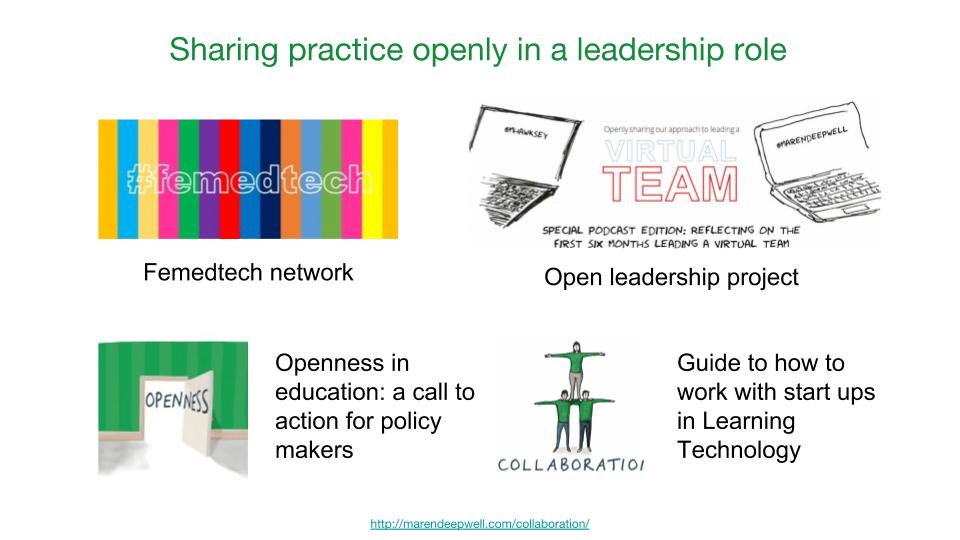
For my own work, focusing on open collaborations is intensely practical and an efficient way to making things happen. I leverage this approach in my work for ALT for example for providing input to policy makers such as the call to action for policy makers collaboratively developed and published at the start of this year. Or working with start-ups and academics to bring together a guide for how to work together. Or developing ALT’s own approach to operating as a virtual organisation, a project in open leadership that I work on with Martin Hawksey. Collaboration and inclusivity help foster criticality, inform my thinking through the different perspectives I encounter and inform strategy.
I follow in the footsteps of others (including the outstanding teams and individuals who were amongst the winners of the Learning Technologist of the Year Award announced yesterday) who have leveraged their open practice to make change and spark more critical professional practice.
Criticality helps ensure that we do not leave answering the big questions, facing the big issues up to others without making our voice heard. Criticality and collaboration are at the heart of professional practice that enables us to work in partnership with industry, to inform how products and services are developed and to influence policy that effectively governs our relationship with technology and the tech industry. We do have the power to shape our future and we do have a vision of what that future should look like. To close, I’d like to focus on that future.
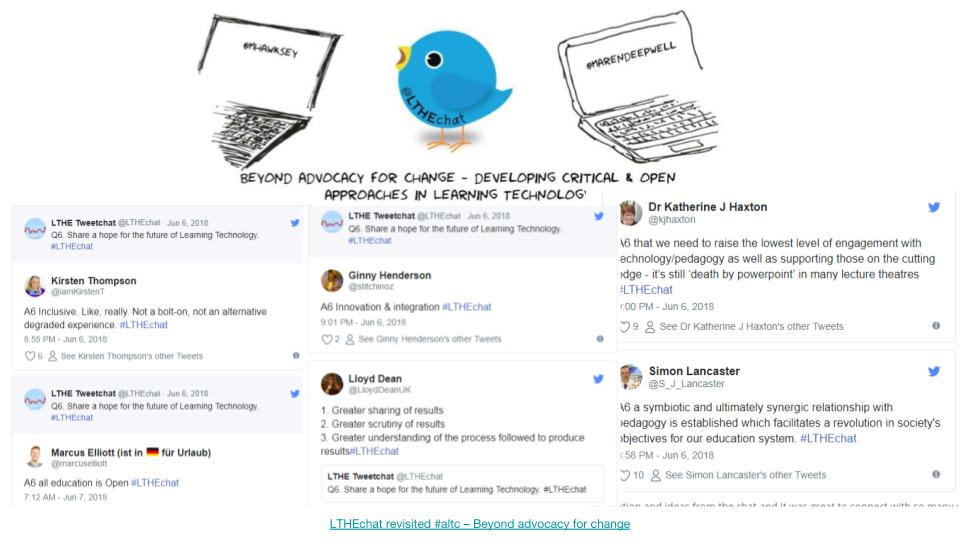
Who shapes the future of Learning Technology? That is what we asked participants in the LTHE chat in June, when we discussed developing critical and open approaches in Learning Technology. We asked participants as the final questions of the chat to share a hope for the future of Learning Technology. Their vision is for Learning Technology to be ‘inclusive. Not a bolt on, not an alternative, lesser experience’, that ‘all education is open’, that we will combine ‘innovation and integration’, that there will be ‘greater sharing of results, greater scrutiny of results and greater understanding of the process followed to produce the results’, they highlighted the ‘need to raise the lowest level of engagement with technology/pedagogy as well as supporting those on the cutting edge’ and they hoped that ‘a symbiotic and ultimately synergetic relationship with pedagogy is established which facilitates a revolution in society’s objectives for our education system’.

These are their voices, their hopes, their vision (and you can explore the conversation with TAGSExplorer). So, when we ask who shapes the future of Learning Technology – my hope is that we don’t leave it up to others. My hope is that we continue to participate in the conversation, that we make our voices heard and listen to others.
When I first stood in this theatre in 2009 I saw great potential in what could be achieved by this community and I wanted to contribute to it. Nearly 10 years later I have seen parts of that vision come true, but there are much bigger things still to come.
And that is up to all of us. So I invite you to share your hopes, your vision and make your own voice heard: 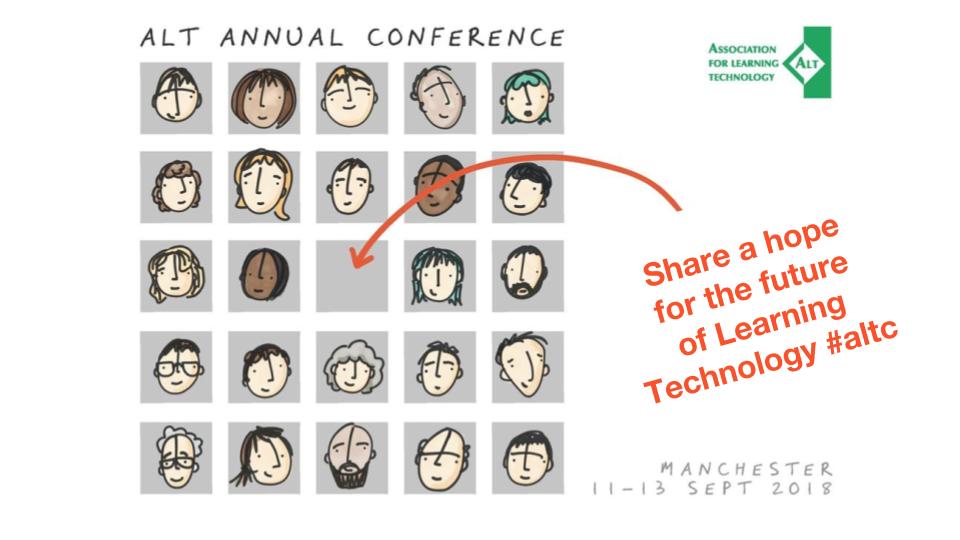 Last, but not least, I’d like to thank the Trustees of ALT who have given me the opportunity to speak here today and to thank you for listen (reading).