Author: Maren Deepwell

  • Finding humanity in a hashtag… my third time curating the @FemEdTech Twitter account

    This month, February 2020, is the third time I volunteer to curate the @femEdTech Twitter account. If you haven’t come across it before, I encourage you to:

    When I curated the account the first time, in May 2018, I wrote about my week as a curator in this post, and I reflected on what’s involved, setting up a TAGSExplorer and other accounts that inspired me.

    The TAGSExplorer View in May 2018
    The TAGSExplorer View in February 2020

    As you can see, things have changed a bit since my first time curating!

    In March 2019, during my second stint at the Twitter deck of the FemEdTech network, I also wrote a post. This time, I reflected more on how people were contributing to what was then a much bigger and broader conversation. I shared examples of how we worked together to grow our network, to spread the word and to raise awareness of the challenges we are yet to overcome in order to achieve greater equality in Learning Technology.

    At that time I had started including information about this in talks I gave, including for example:

    And more of which I covered in a review at the end of last year, celebrating a #FemEdTech kind of year.

    Which is why this time round, reflecting on my time as the account’s guest curator, I want to step away from the hashtag, from the online network and share with you how the network has changed my every work and life, how the work we do translates into the world outside of the Twittersphere.

    Making momentum
    One of the things that you can only really guess at from the online conversation is how much making goes into building any kind of momentum, and I mean that literally. Just now, with the quilt project, you can watch the process of momentum becoming material. But before the quilt, there were badges and signs and letters and stickers, parcels sent across the country and sometimes across the world, to distribute tokens of belonging to this community. Cat memes, photos, blog posts, radio shows, podcasts, artwork, drawings… people create all kinds of things and over time it creates real momentum:

    Meeting strangers
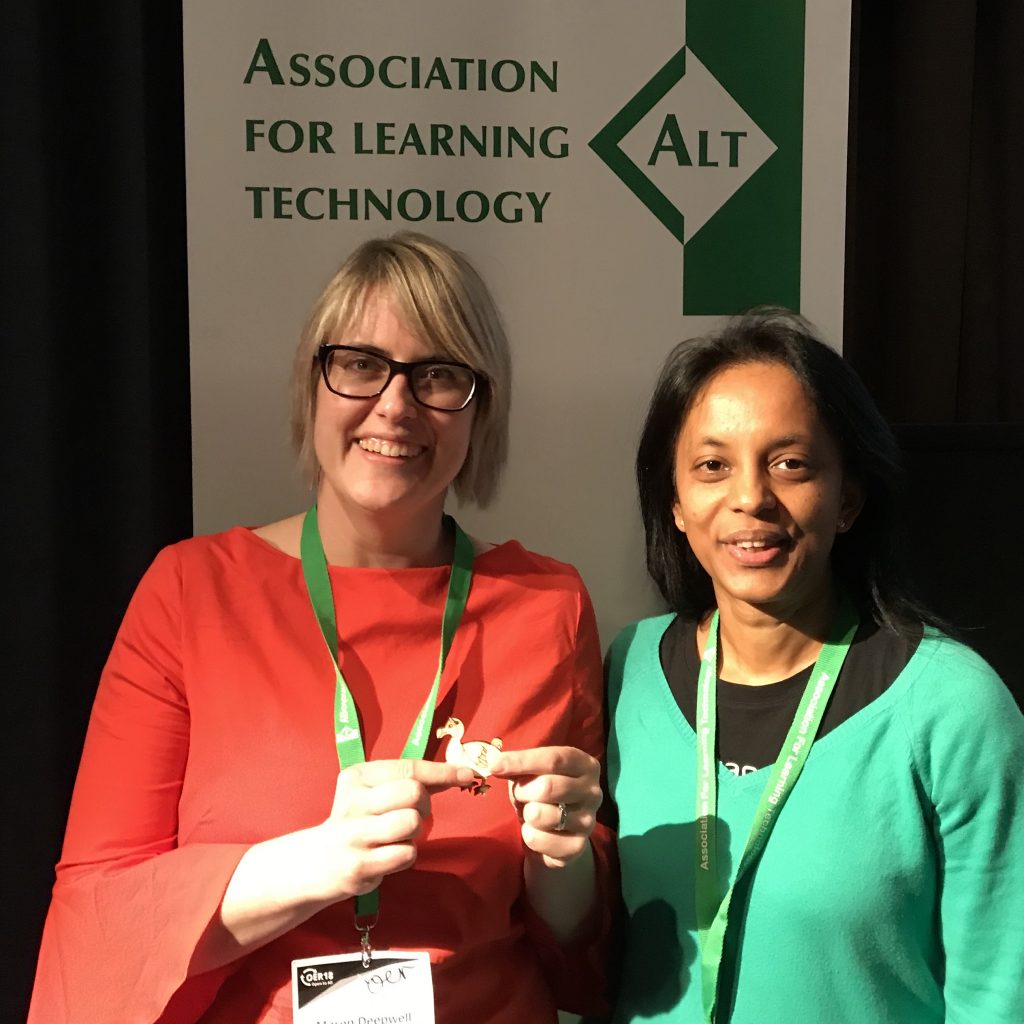
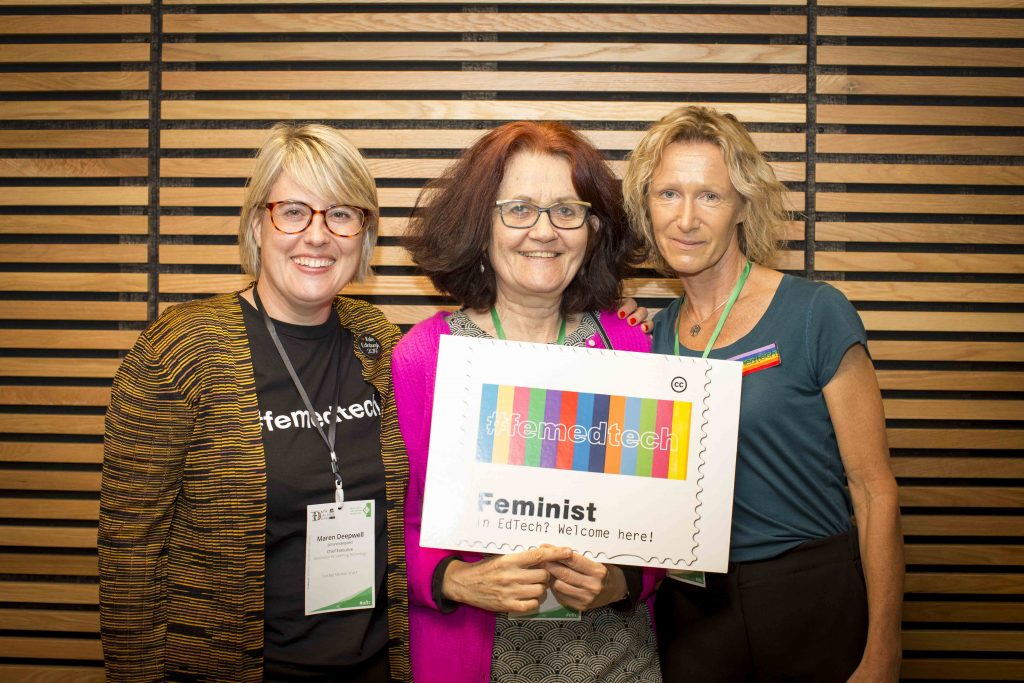
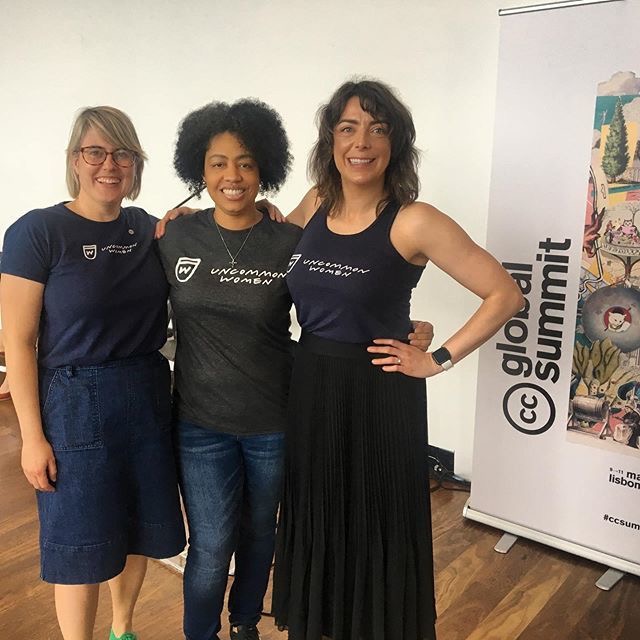
    The other thing that has really changed is to meet individuals who are also active in this network in person. Two years ago when I mentioned this topic, no one had even heard of it. Now, it’s been a while since I last went to an event at which I didn’t have a conversation about it, met fellow supporters, seen badges, stickers or exchanged hugs. Some of us even have the t-shirt ;).

    Photobooth at ALT’s Annual Conference 2019 (Photos on Flickr)

    It’s surprised me how powerful it is to have these meet ups. They act as a catalyst for activities and collaboration well beyond the day on which they take place. They also help to encourage those who give so much of their time and effort to the network, giving me an opportunity to say thank you to someone who has helped me or supported me or someone whom I have only ever ‘met’ on Twitter. It’s powerful to have a way to bring the conversation to promoting equality, it gives us permission to discuss common issues around HR policies, professional development, career progression and collecting data about these things and to share new developments.

    Hashtag and humanity
    Being part of this effort, the work that the hashtag #FemEdTech has grown into, gives me hope that there are more and more people, some of whom I already know and some of whom I will never meet, who take an active role, who make a contribution – and for that I am grateful. I am grateful to those who recommend less visible colleagues for keynotes on the big stage, to those who work to make their events and conferences more welcoming to all, to everyone who helps to amplify the voices of those who are heard less often and those who champion causes like gender equality in their professional practical.
    It is definitely not an easy gig. But for every exasperated, eye rolling, impatient or indifferent listener, I also meet one who does care, who wants to know more, who might get involved.

    It’s often an uncomfortable experience to stand on a stage or sit around a meeting table, telling your audience about injustice, discrimination, about the gender pay gap and inequality. Even if you are able to share positive trends or hopeful new initiatives, the message remains one of “always more to do”. No matter where you look, no matter what kind of inequality you fight for, there is always more to do. We may not all agree on what the most urgent priorities are in our individual, institutional or national contexts, but I hope that we share a sense of urgency, a drive to do better as professionals in Learning Technology, as human beings.

  • Five: Flippers as totems of professional practice

    Drawing of Flippers

    Shortly after I drew the Travelling Monument Kit I started a new sketchbook and that turned into a whole series of works, photography, drawings, sculptures and, I suppose, travel, too, all centred on swimming flippers and entitled ‘Travels with my flippers’.

    The flippers became another layered metaphor, and worked for me on many levels:

    The beach under the city streets…
    Inspired by the writings of the Situationists International movement I have written about in a previous post, the flippers were my tool to uncovering a sense of freedom and discovery. The idea, to me at least, of a beach, a place that is wild and natural, that is hidden under the geometric grid of the urban landscape has always been an attractive one. I can imagine that at a time when industrialisation and urbanisation were rapidly increasing and cities were encroaching both in the physical sense but also in the public imagination, the idea of going to discover a beach, a place of freedom and inhibition under the concrete of the pavements, streets and plazas was a radical proposition. Not following the rules of the city, to create one’s own path and map, following the currents of the mind, the imagination is a poetic undertaking that still appeals to me, just as it did then.

    Then, I actually travelled with a pair of blue rubber swimming flippers that I bought in an old department store in Nicosia and put them into various places… taking photos along the way. It was surprisingly effective in situ and made people question how they read the space.

    I created a sculpture of the slippers, in white resin, and they were beautiful, glossy objects, that always looked ocean wet. To the puzzlement of many they were ‘installed’ on ordinary pavement slabs in a pristine studio space for my fine art degree show without any further explanation. It worked for me, but it didn’t work as art. The context was too obscure, the metaphors remained unexplained and inaccessible outside of their own very peculiar aesthetic.

    But it didn’t matter to me at the time, because the flippers acted as a metaphorical catalyst that inspired my practice as an artist. I filled sketchbooks and rolls of film, I wrote and dreamt and thought of things. The flippers also acted as a metaphorical accelerator, something to make the worlds of dense cultural theory I was reading easier to traverse. Swimming with flippers is a great deal easier and faster, they help us adapt to an unusual environment like underwater. It felt appropriate to use them as a tool for exploring critical theory, too. 

    Revisiting that now I find it interesting to revisit the idea, because I still do a lot to make exploring the worlds inside my head easier, to provide myself with the appropriate context for my professional practice (even if nowadays I don’t make and draw so many things anymore).

    Although much of my everyday work is now digital, I still have many material symbols of my practice… laptop stickers, sticky notes, books, journals, pens, badges, conference lanyards, drawings, charts, things on my watch (like the watch face) and so forth. Also, cables, lots of cables, and an increasing amount of debris of older devices, chargers, cable ties, hard drives etc. And alongside these objects, I make just as much effort to create the right conditions to be creative, to think about complicated things. I have a workspace full of things that help – including artworks and mementos from trips I have been on or conferences I have attended.

    And often it is an object or the space I work in that help me find time to write, to draw, to think. I respect the needs of my professional practice and I think that is what those flippers were ultimately about. They were travelling companions. Companions for thinking and doing, for my practice as an artist. They were symbolic and yet entirely practical. They were totems of my professional practice.

  • Two keynotes: from human/data interaction to scaling up Learning Technology

    This year has started with two very different keynotes: the first in January I wrote for an event on scaling up Learning Technology which was chaired by Dr Michael Flavin, and the second, a joint keynote with my colleague Martin Hawksey, was written for a one day workshop organised for the Data Human Interaction Plus network.

    If you’d like to have a look at the slides and references for the two talks, you can access them here:

    From empowered professional practice to empowerment in the age of surveillance: opportunities for human data interaction – joint keynote with Martin Hawksey for the Human-Data Interaction Network Plus

    Some common themes emerged for me from contributing to these two events:

    More tech-critical voices
    This year I feel I am hearing more voices that are critical towards use of technology in education and more broadly our relationship to technology as a society and as individuals. More people are questioning where the boundaries of technology and the tech industry should be, who should enforce them and how. I hear suggestions of limiting our use of technology or at least to stop proceeding unquestioningly with scaling up what we do. There are more questions being asked about ethics, policies and equality – questions that are becoming more specific and informed, not simply articulating a general, vague concern.

    More wholesale digital adoption
    At the sometime there is a growing number of institutions who are ‘doing digital’ across the board. The examples I come across most often are focused on systems or platforms more administrative in nature or common software packages and productivity tools. But the transformation can still be powerful and there is often a drive to up-skill and develop the workforce and the learner population at the same time. This is very much about digital skills and literacy not often about the more expert design, implementation or support of Learning Technology more specifically but this often gets conflated in the way the process is described. Whilst on the whole a very positive move, there are two challenges that I often see come up next: first, as the tools change iteratively the process of training users has to continue and fostering a culture which normalises that is hard to do. Hence there is a lot of messiness in how people use technology long term, little patches, work arounds, small idiosyncrasies which accumulate over time. Everyone has legacy systems, spreadsheets, databases and so on they don’t know what to do with. The other challenge is to find enough resources (of every kind) to continue to do Learning Technology beyond the core systems you have scaled up and to invest in the expertise you need to do that in the long run rather than to outsource innovation to private sector companies and loose that capacity.

    Negativity, pace and productivity
    Whilst I still meet with a lot of genuine enthusiasm for technology a lot of narratives I have come across during the start of the year are driven by negativity, primarily about the wider context. Political, social and economic factors shape our perception of technology. The pace of innovation continues to be a factor also: should we try to keep pace, and why? Will technological change keep accelerating and how does this impact upon the world we live in? Meanwhile I feel productivity has snuck into our ways of thinking about research and practice. Playful approaches, mindfulness, even time specifically set aside for ‘moon shoots’ is really all about doing ever more with less. Always contactable and on the go whilst in reality there are too many meetings in which nothing happens at all.

    Resistance and hope, articulated
    Against this rather bleak backdrop however, power is rising. Expertise is multiplying, action being taken and there is a drive to resist surveillance capitalism and to find alternatives that can provide hope whilst still offering functioning business models are cropping up more and more frequently.
    It’s always a privilege to be invited to contribute to events as a speaker and if the first two talks of 2020 are anything to go by the resulting discussions will be extremely interesting this year.

  • Virtual Teams: The heartbeat of a virtual team

    Virtual Teams: The heartbeat of a virtual team 

    Welcome to this month’s post (cross-posted here) in which we, that is Martin Hawksey (@mhawksey) and Maren Deepwell (@marendeepwell), openly share our approach to leading a virtual team. If this is your first time visiting this post series or you’d like to review what we’ve posted in 2019 Maren has a Virtual Teams summary page.

    This month we are talking about Slack, scheduling team meetings, and how our use of technology and different tools affect the rhythm of our work as a virtual team. 

    January

    Maren: It’s the start of a new year, a new decade, and January is not usually the most inspiring month for me at work. But this month is different, partly because there are some exciting things afoot at work (a new strategy is in the works, new visual thinkery being produced and new data to analyse…) but primarily because thanks to inspiration from our recent podcast guest Olaf Hubel (listen to the episode here) my experiment to create a better rhythm to our working as a virtual team is a real success and already making a huge difference. Result! In essence we haven’t really changed what we do or how we work together, but since the start of the year we have started to schedule specific activities at a new regular slot: for example, Mondays now start with an informal ‘watercooler’ catch up in late morning, giving us all the chance to say hello, catch up on the weekend and spend some time together not focusing on work. One to one catch ups for individuals (which is 5 for me) are now all on Tuesdays, and again, having a regular day for these and the same day for everyone has saved me A LOT of time and also seems to make it easier and more efficient for everyone to plan for those meetings. On Wednesday we have our full team meeting, which has moved from Tuesday to Wednesday, and I feel this is working really well also – giving us all a chance to catch up with each other and what’s happening across the organisation. And, last but not least, we have found a regular slot on the last Thursday of each month for our team sprints that we started last year – focusing on actively working together online synchronously. Small tweaks overall, but that bit of extra regular scheduling has made a huge difference and everything feels (to me at least) like it’s happening in a better rhythm now. It’s as if our virtual team now has a more regular heartbeat. What are your thoughts? 

    Martin: I think all our team have also benefited from this tweak to our weekly calendar. Having a regular slot for catch-ups means I know when I have to prepare all my questions by and also better judge if something can wait or if I need to contact you at another time by different means. Initially I thought a Wednesday team meeting would mean that at the start of the week I would have to wait longer to find out where others are at with their work, but as it turns out, I think it works better because it encourages touching base with other team members more frequently. [An interesting point, dear reader, is after Maren drafted the start of this month’s post we had a chance to briefly discuss it in our one-to-one where I was able to say I thought the change was very positive however a small observation was that the Monday watercooler chat, which was scheduled for 10:30am, felt like after we all said hello first thing Monday put us in a limbo period where, for me anyway, I had to save small talk until we hung out together later. On mentioning this to Maren we immediately updated the timeslot to 9.30am – a nice reminder of why these shared posts are useful.] I thought it was interesting when we discussed this that you said you didn’t know why I just didn’t change this in our calendar. Reflecting on this I relate it to you being the conductor in our little quintet virtual team ensemble and it not really being my place to set the rhythm. Hopefully with this suggested timing change rhythm is just being finely tuned. As part of our continual tuning January also marks our annual home working check-in. This is where we all individually review our homeworking setups, share tips and also put in any requests for hardware/software. The most popular request has been for monitors, either more or bigger (our team clearly know my soft spot). You’ve shared the changes to our team calendar, is there anything else you’d like to share from another year as a homeworker?    

    Maren: Looking back at my own assessment, this is now the third time I am reviewing my set up and reflecting on it. For various reasons I have made a lot of tweaks to my equipment over the last six months and so this time round my focus was more on the way my days and weeks function, like for example walking to the post office in order to get fresh air, even if I could use the local post box instead. Similarly, I made notes on things like finding the right balance between working hard and taking regular breaks, building in reminders to move, to pause, to prioritise my well being alongside my work. So I guess alongside the regular schedule of meetings, catch ups and sprints, I have also found a rhythm to my own home working. I feel more comfortable, more settled in this mode of working and I have learnt to explain it to people more readily and clearly than I could at the start. I have always found it hard to hear people talking about our team as “the office” of ALT. Whilst I know what they mean, I really dislike that short-hand for referring to staff. To me, it’s absolutely important to acknowledge, even implicitly, that we are talking about colleagues, or specific individuals, who do the work that is essential to the running of the organisation. I prefer talking about a distributed team much! It moves the perspective away from a faceless admin resource to consciously talking about people and collaboration and all that implies. It might seem like a very minor point and one that most people might not even be aware of at all, but to me, having seen the changes in the organisation over the past decade, it makes a big difference. 

    Martin: Not being a faceless admin resource is very beneficial, plus it feeds my ego and aspiration to be famous. It a small point but I think that we have a policy of personally signing off emails from our shared inbox accounts, like enquiries@alt.ac.uk or helpdesk@alt.ac.uk, and when referring to other members of our team by name rather than department also helps us strengthen our connection with our community. As well as having shared inboxes addresses we all also have personal email accounts with our names. The exception is finance@alt.ac.uk but there are various practical reasons this is the case. We did experiment with role based emails addresses particularly when we’ve previously recruited agency staff to fill positions, but given we now are an independent employer there is more stability in our team and less need for staff handovers. In case readers are interested in how we administer our shared inboxes we use a Google Group configuration that enables us to assign messages to appropriate members of the team and also keep a record of the communication. I feel Google Groups mostly works for us and at this time don’t feel we need a more advanced ticketing system. My main grumble is that messages with the same subject line end up in the same thread making it hard to track when an enquiry has been completed. Our tweak has been to make sure when we contact individuals from one of our shared inboxes we include a person unique reference in the subject line. Email isn’t the only communication channel we administer and our social accounts are another way of contacting us. You also recently shared an interesting post from David Hopkins on how Slack has ruined the workplace:

    Did you have any particular takeaways from this post in relation to our team? 

    Maren: it was useful to read the post about Slack and how chat tools like this are adopted for long term use. I’ve also been thinking about the differences between various communication methods (text/icon based, voice, video) and came across this post on telephone calls. It isn’t work focused, but it makes useful points about the different nuances that each kind of communication brings with it. The slack post relates closely to what I was talking about above, about the rhythm of collaboration. Similar to what you describe about how we manage and administer external communication channels, the way in which we use our internal ones has changed over the last 2 years. Some, like our collaborative team meeting notes doc, have a clear purpose and use cycle. Others, like our new Monday morning water cooler chat, are still finding their long term shape. It changes over time and as different people bring their individual skills, personalities and expectations to it. There are questions I think about such as: if you’ve been away or on holiday, do you need to catch up on the team chat? Does everyone know enough about what should be put into an email to keep a record of the communication and what can be ‘chat only’. Why would I happily have guests in a team meeting but not in our team chat? Who gets the most chats during the day? Is the member of staff I am chatting with making casual conversation, is this a ‘serious’ matter, is it just venting…?! Everyone brings their own expectations to the communication channels we use but in my experience they are not necessarily the same – the decision not to chat and talk on the phone or hangout is similarly individual – it could be a bad hair day that makes someone prefer to chat rather than be on video… . And there’s also emoji, a topic we have talked about quite a lot in the past two years. What are your thoughts on all this? 

    Martin: That’s a lot of very useful questions and I don’t think I’ll be able to cover them all in this month’s post, I have however discovered my emoji mojo and I’ve been particularly enjoying the Windows key + . to bring up the emoji picker. In terms of focus, particularly during video calls, I’ve found the minor tweak of placing my webcam on one of my side screens helps me maintain focus and not get distracted during calls … all part of developing your skills as a remote worker:

    As a special contribution to this month’s post we include this tweet from our colleague Debbie Baff – sharing a very fun moment in the daily life of our virtual team: 

  • Four: The Travelling Monument Kit

    Signpost: This is a post from the Neon Flaneuse blog. The Neon Flaneuse is a blogging project for which I write about art, anthropology and edtech. It’s part of my professional practice but a project I pursue in my own time.

    The Travelling Monument Kit – my original drawing

    Nearly two decades ago I had an idea to create a Travelling Monument Kit. This is the original drawing which I still have in a sketchbook somewhere even though the actual suitcase I made has been lost in the mists of time (read: one too many house moves). 

    The idea of the travelling monument kit is really a layered metaphor, several ideas wrapped into each other, so let me try and unpack it for you. 

    Note: From here you proceed at your own risk… this is a post about a half remembered artwork on a blog about an imaginary character. 

    At the heart of the Travelling Monument Kit, what originally got me thinking about this idea, is the relationship between travelling and permanence. Travelling is all about leaving things behind, discovering new ones and changing perspectives… it’s about change. Monuments are normally fixed in place and time, permanent markers of things to be remembered. They signify that which we don’t want to change or forget or leave behind. 

    The Travelling Monument Kit contained maps, both a world map to put pins/markers on the chart and track the overall route, to record places visited; it included a camera to take photos of the travelling monument (the physical artwork included a Polaroid camera); a plaque with text to affix to or mark the monument on location; an album for recording and collecting the monuments. 

    I’m not sure anymore whether I originally imagined there to actually be anything else in the suitcase, or whether any given object or place identified could simply become a monument by virtue of the process of making it so, putting up the plaque, taking pictures, recording it and so forth. In real life I did both, create those kinds of monuments as well as choosing an object to actually travel with in the physical sense. 

    (The object I chose for that purpose was a pair of swimming flippers. Why? Because there was a beach underneath the city streets that I was interested in finding.)

    In a way the Travelling Monument Kit explores how we can create lasting meaning amidst change. The process of ‘making a monument’ is very similar to, for example, going to a familiar restaurant in unfamiliar surroundings or finding connections between landscapes we are familiar with in a new place that is strange and different. It’s about creating something solid and strong, a connection, to bring things into perspective. 

    The Travelling Monument Kit is also in a suitcase. And that was a deliberate choice as well as being integral to the idea. It’s important that it’s a suitcase. It’s important in a number of different ways: a suitcase is purpose built for travel. It’s a native travel object. It is designed to be at home whilst travelling in a way very few things are. It’s never not at home because it (by definition) contains everything within it. Also, a suitcase is made to be in transit, on the road. In contrast to objects like first aid kits which are usually fixed in place and purpose, a suitcase is flexible both conceptually and practically. In the context of the Travelling Monument Kit it signifies that you can take the ability to create your own monuments, your own lasting meaning, memories and connections with you. You can pack it in a suitcase and never be without it. 

    The physical dimension is important, too. It’s important that the process isn’t digital, but focused on visual and material things. It makes a difference that the traveller, the monument maker, undertakes a physical, practical process. It’s important for the same reason as visiting physical monuments in the real world is distinct from seeing visual or digital representations of them. The sensory and embodied practice of interacting with a specific place or object is key to creating the connection, to making a memory, to establishing meaning. It’s particularly important for a traveller because our physical bodies can often be out of sync with new time zones or sleeping patterns, food, smells, perspectives. It can be disorientating to experience a lot of change, to encounter a lot of new places or people in quick succession. It’s necessary to relate to what we encounter with our senses and physical selves in order to make sense of things. 

    That’s where the historical dimension of the monument idea comes in. It’s about creating order, a timeline, it’s about finding a narrative, a story that connects the new markers we place on our map and brings them into perspective. It helps us create our own histories, to make sense and determine the meaning of things to us and in the context of our own internal worlds. It’s a lot like writing, I suppose, but also more than that.

    The Travelling Monument Kit is not an instant monument kit. It’s not about appropriation. Technology and the tech industry keep looking for shortcuts to creating a sense of history, of legitimacy, of belonging in our lives. This artwork is not about quick ways to create the look of the thing – even though some of its elements are very visual, like taking a photo, putting up a plaque etc. It’s about a process, about experience and embodiment. At the time when I made this I didn’t own a mobile phone yet. I neither had nor dreamt of the affordances of such digital tools as are now commonplace. But even if I had done so, I don’t think it would have mattered that all physical elements of the Travelling Monument Kit could now be easily replicated or approximated with my phone. A camera, a custom map, a plaque, a photo album or record… I could easily replicate the look of the thing, make an app, an Instagram account. But it would be something entirely different from the original. 

    The intention that shaped the making of this Traveling Monument Kit was not focused on what it would create, although I did end up creating some travelling monument ‘books’. It wasn’t about creating and sharing content. The intention was to articulate, to think through the ideas, to create a sense of belonging whilst travelling, whilst being in flux and to foster that ability within yourself. 

    All themes that I still think about two decades later and which have developed new, interesting dimensions since. 

    In the sketchbook that the original drawing is from, you can follow the development of the idea:

    The Travelling Monument Kit itself is the final drawing in that sketchbook, after that there are only some blank pages. It’s as if the train of thought that had led to the drawing came to a full stop. The idea was created. I hadn’t thought about that before, how appropriate it was that the sketchbook ends after that drawing. It’s a useful thing to keep our own archive sometimes, to be able to go back and look at the physical objects that shape your thinking. Searching through my desk drawer revealed another interesting clue as to where my thoughts went next (this next sketchbook was probably bought in London but travelled to Athens where I was living at the time and back again and has followed me through all the house moves since 2002): the cover says it all: the suitcase files – travel accessories as metaphor.

    Travel accessories as metaphor – sketchbook cover

    Soundtrack for this post:
    Dusty in Memphis by Dusty Springfield

    Also…

  • Three: in the library

    How do you cite a graphic novel? I’ve been reading Art Matters by Neil Gaiman, illustrated by Chris Riddell. And I want to write about it but simply quoting the words doesn’t work, so I have decided that pictures of the pages of the book may be better. They are all from the chapter entitled ‘why our future depends on libraries, reading and daydreaming’. (As an aside, I really recommend the book – it makes for inspiring reading.) 

    I’ve been looking for ways to think about my professional practice, my work and the future that isn’t bleak technological determinism, surveillance capitalism or decided by algorithms. I’ve found starting points for theory, policy and the wider context, but this post is more about the personal dimension, the ‘what do you get out of bed for’ part of any creative endeavour. Art Matters is a good book about practice and work, and although it is mostly written from the perspective of creative professionals like artists, musicians and writers, I think the heart of the book is just as relevant to working in education or edtech. 

    I read so much that I don’t often think about reading. So the page above made me pause. In this bit Gaiman talks about how important it is to read when you are young, or rather to get into the habit of reading for pleasure as early as possible. It reads: 

    You are finding out something as you read that will be vitally important for making your way in the world. And it’s this: the world doesn’t have to be like this. Things can be different. 

    This is about reading fiction, reading for fun,  but I think it’s equally useful to consider in the context of reading policy, reports and so forth. Much of what I read about innovation, disruption and change, other than research, doesn’t seem to be about things actually changing, about things being different. 

    I like the idea that reading fiction builds empathy. It sounds very akin to ethnographic fieldwork. To see the world through other eyes. The idea that reading fiction as a journey that changes us is simple and powerful. It rings true to me. And it can be true of other stories, too. Really good lectures, inspiring keynotes, research.. the stories we tell. I hadn’t really thought about it in terms of building empathy before. 

    I read a lot in all media. And the pages of the book (above)  made me reflect on how something like a book remains valuable and relevant even though there are other formats, alternative choices. It says:

    I do not believe that all books will or should migrate to screens: as Douglas Adams once pointed out to me, over twenty years before digital books showed up, a physical books is like a shark. Sharks are old. There were sharks in the ocean before the dinosaurs. And the reason there are still sharks around is that sharks are better at being sharks than anything else is. … physical books are tough, hard to destroy, bath resistant, solar operated, feel good in your hand: they are good at being books, and there will always be a place for them. 

    I want that to be true. I think it goes back to what I wrote about in the last post, that it’s not helpful to frame our relationship with technology, with digital things, in terms of which one is better, which one becomes obsolete. It seems more helpful to appreciate that for instance physical and digital books can exist alongside each other. Like audio books and physical books, complimentary and each good in its own way. Plus, I really appreciate the bath reference. Sometimes there’s a story you can’t put down and you want to keep reading even in the bath. Some of my favourite books have spent days carefully drying out next to the radiator.

    Earlier in the chapter Gaiman talks more about the importance of literacy, libraries and access to information. Even though it’s both interesting and important, I am going to skip that bit and hopefully let you read that for yourself. Instead, I want to come back to what he says about imagination. 

    Fiction is the lie that tells the truth. We all have an obligation to daydream. We have an obligation to imagine. It is easy to pretend that nobody can change anything, that society is huge and the individual is less than nothing. But the truth is individuals make the future, and they do it by imagining that things can be different

    This is one of the radical bits of the book. There are quite a few, as it is mostly written like a call to action, a manifesto, but this bit in particular reminded me of something I have been thinking about recently: namely how hard it is to make something that is true for us, something that we feel is important, sound valid. Somehow I feel like I ought to proof. 

    Such words as ‘imagine that things can be different’ can easily sound trite and get dismissed quickly. Partly, I think, because of the responsibility they entail. It’s after all within my power to daydream, to imagine… to do better, to speak up, to make a change. It doesn’t require anything but my will to do that and so it’s entirely up to me. It’s within my power as an individual, a human being, but that means it’s also my responsibility – and that is the bit that many don’t feel comfortable with regardless of whether you are talking about inequality or technology or reading books or making art. 

    It’s what I really like about this book. It’s funny and it talks of failure. The loneliness of writing and the comic mistakes made. And the tragic ones. It’s about making choices and putting important things first. And so I am going to borrow yet more words from it to end this post with the following parting thought: 

    … ‘the things I did because I was excited, and wanted to see them exist in reality, have never let me down, and I’ve never regretted the time spent on any of them.’

    Soundtrack for this post:
    Dreams by The Cranberries

    Also…