Tag: #oer20

  • Radical Openness #OLCIdeate – and radical uncertainty

    Recently I contributed to a conversation around radical openness as part of the OLC’s Ideate online events, together with Robin DeRosa, Gerry Hanley, Leigh Graves Wolf and Rajiv Jhangiani. I was very glad to be invited and really enjoyed taking part.

    The session, described as a ‘community salon’ was described in the programme as an “opportunity for a group of thought leaders to engage participants in rich discussions around a broad topic intersecting with their scholarship and outreach. This salon brings together champions of open education and pedagogy sharing perspectives and guiding activities around the topic of radical openness, with a special focus on the ways that we can open doors for learners that are often hidden or closed to their success. Come with your ideas, challenges, and questions on the topic of openness, and take part in building new knowledge around open practices that will sustain us through and past these challenging times.”

    Leigh Graves Wolf set out a really helpful structure for the session, guiding us through a series of prompts and questions, including:

    • “in what ways are you open/radically open?”
    • “What are some Open Educational Practice behaviors that you promote/enact/admire?”
    • “What are some Open Educational practices that you promote/enact/admire?”

    And it resulted in a rich discussion and engagement, collated into shared documents (I encourage you to visit the OLC website to explore more).

    Eventually the conversation turned to current events, to how everyone is coping (or not) with the challenges of the pandemic, working from home, childcare, supporting students, teaching, Zoom… and so on. These topics, which have become so familiar to all in a short space of time.

    The more casual part of the conversation brought to light a different side of openness, which makes us all more vulnerable than sharing a teaching resource or a textbook. But it also made me think of ways in which, over time, our ideas of what might be radical openness may change. Here are some of my reflections:

    Radical… power structures

    At this stage of the great pirouette online, much of what is being done is still determined by power structures within institutions and communities or even countries, that rely on the decision making power of face to face institutions and processes, such as university governing bodies, finance committees, audits, quality reviews and so forth. Most of what is happening is not what was planned, but it is too new still for a lot of annual processes or less regular process to have happened yet and many of those processes are not open in either behaviour or practice. It’ll be interesting to see if we can challenge the openness of such structures more radically or whether the opposite will be true.

    Radical… change and culture

    In the first year of moving everything and everyone online we can draw on what we built up in person. There is a certain amount of common experience, of organisational culture, of shared memories, that act a bit like glue when it comes to getting through a crisis. But over time, as new people join the venture who don’t have that shared background, you open your behaviours and practice up to more radical change and transformation and that can be hard for everyone involved. Hard for those who are joining and hard for those who are already there. It’s difficult to build a shared sense of identity, aims or values without in person interaction at any level. One’s instinct is to close down options to change, to potentially loose what is being held on.

    Radical… uncertainty

    In the absence of much that we can rely on, it is difficult to imagine beyond the radical uncertainty we face. What do you do, whom do you ask, what is your plan when no one knows what, when or how things will change.

    Open behaviours and practice are hard to embrace when you are facing that kind of perspective. In that sense, any amount of openness we can put into practice is radical.

    One of the things we discussed in the session was how to support learners, and we were mostly focusing on traditional learners in a higher ed context here. But it was clear from the conversation and the comments from the audience, that we were all feeling more like learners again in a sense, just without the study guide to refer to.
  • OER20: definitely not ‘business as usual’

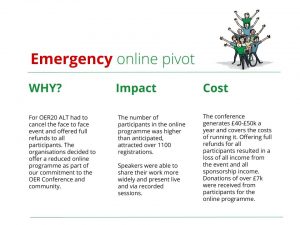
    I have blogged about every OER Conference I have been to, and this year’s was a very special one. So I want to try and continue the tradition, but what can I say about the cancelled conference that happened online with 1100+ people?

    There is plenty to discover and reflect on about OER20 – and this post captures some of the voices, and includes links to content and resources. I’d also encourage you to have a look at the #OER20 hashtag on Twitter and if it is expertise about running events online you are after… then we are collating resources from ALT and others on this resources page for the community. We have also put together a slide deck (and webinars) about “How ALT runs events online: Sharing our expertise” https://go.alt.ac.uk/EventsOnline.

    Slide from “How ALT runs events online:
    Sharing our expertise” https://go.alt.ac.uk/EventsOnline

    But I don’t want to write about the business model, the money lost, the ‘blood, sweat and tears’ that it took to make it happen. Instead I want to share my thanks for the openness of OER20:

    Sharing open leadership in a crisis

    In the run up to the event, the global situation changed quickly. Plans made one day, were superseded by events 24 hours later. Risk assessments undertaken on Friday turned into disaster mitigation plans by Monday morning. Taking decisions in the face of uncertainty on such a scale is difficult. And being a CEO IS about taking decisions first and foremost. Colleagues from across the globe shared examples of the statements they published, actions they took, plans they made – putting our usually relatively quiet CEO networks into overdrive. I am grateful to everyone who shared their work so freely to help us help each other ‘rescue’ our events in the face of a global crisis.

    Yes, academic conferences are certainly not at the top of the list of priorities amidst a pandemic, but professional bodies like ALT serve thousands of individuals at the forefront of keeping learning, teaching and assessment going – and the exchange of information that conferences provide still plays a role in supporting the work they do even in a crisis. Also, there are hundreds of people who have invested time, money and resources into planning trips, who are, in some cases, already on route. Hundreds of individuals who deserve clarity and support from organisations like the one I run.

    Precarious circumstances become more challenging when uncertainty increases across sectors and OER20 supports the involvement from many in precarious circumstances through scholarships, bursaries, practical support and so forth. Sharing information and best practice with other organisations enabled us to find the best approach we could, supporting individuals and our community, ultimately enabling us to deliver some of the event online. The work we are doing now, sharing what we have learnt from the experience, is hopefully useful to others who are facing similar decisions in the weeks and months ahead.

    Sharing joy and tears in the open

    Many contributed much to making OER20 happen. To each of you, thank you. For me personally, there were two moments that really captured both the joy and the sadness of the times in very unique ways.

    One was a live online session led by Frances Bell celebrating the FemEdTech Quilt of Care and Social Justice. You can catch both the recording of the session and the accompanying video via the conference page. I have contributed to the quilt project both personally and professionally and yet the power of the live session really took me by surprise. I don’t think any webinar moved me to tears along with half the audience before this. It was a moment of connecting with fellow collaborators across the globe that was so special and made the distances and isolation between us, the crisis we are all weathering, palpable.

    The other session was the evening’s #OER20 #KaraOERoke Night. I don’t think I had laughed more than that in weeks. It was very special, but also fun and incredibly moving to see conference participants and their families join in with the Frozen song, reviving classics and demonstrating their singing ability with everything from Motörhead to Kate Bush. Those moments, whether online or in person, are unforgettable.

    Sharing care in openness

    Rarely has a conference theme turned out to be quite so prophetic as OER20’s The Care in Openness. Little did we know in April 2019 that pedagogies of care would take centre stage in a global pandemic by the time the conference came to be. As it turned out, care was to be central to everyone’s life in April 2020.

    We talked a lot about care at OER20, care for students, care for staff, care in institutions, care for each other, care in every aspect of life. What we demonstrated most however is that we all need more of it.

    From babies and children taking part in conference sessions, to sharing the event’s ‘official’ pyjama dress code, to dropping in and out of taking part whilst caring for family and friends, pausing to rest and sleep – everything about OER20 reminded me that things were about as far from ‘business as usual’ as conferences can get. In some ways, and for obvious reasons, it was heartbreaking and horrible, to witness how the world was changing and disrupting our community. In other ways OER20 felt hopeful and provided moments of respite, a small measure of solace. And that is most precious in times like these.

    Thank you.
    Thank you to everyone who helped make it happen.
    Thank you for creating openness in a crisis.
    Thank you for caring.