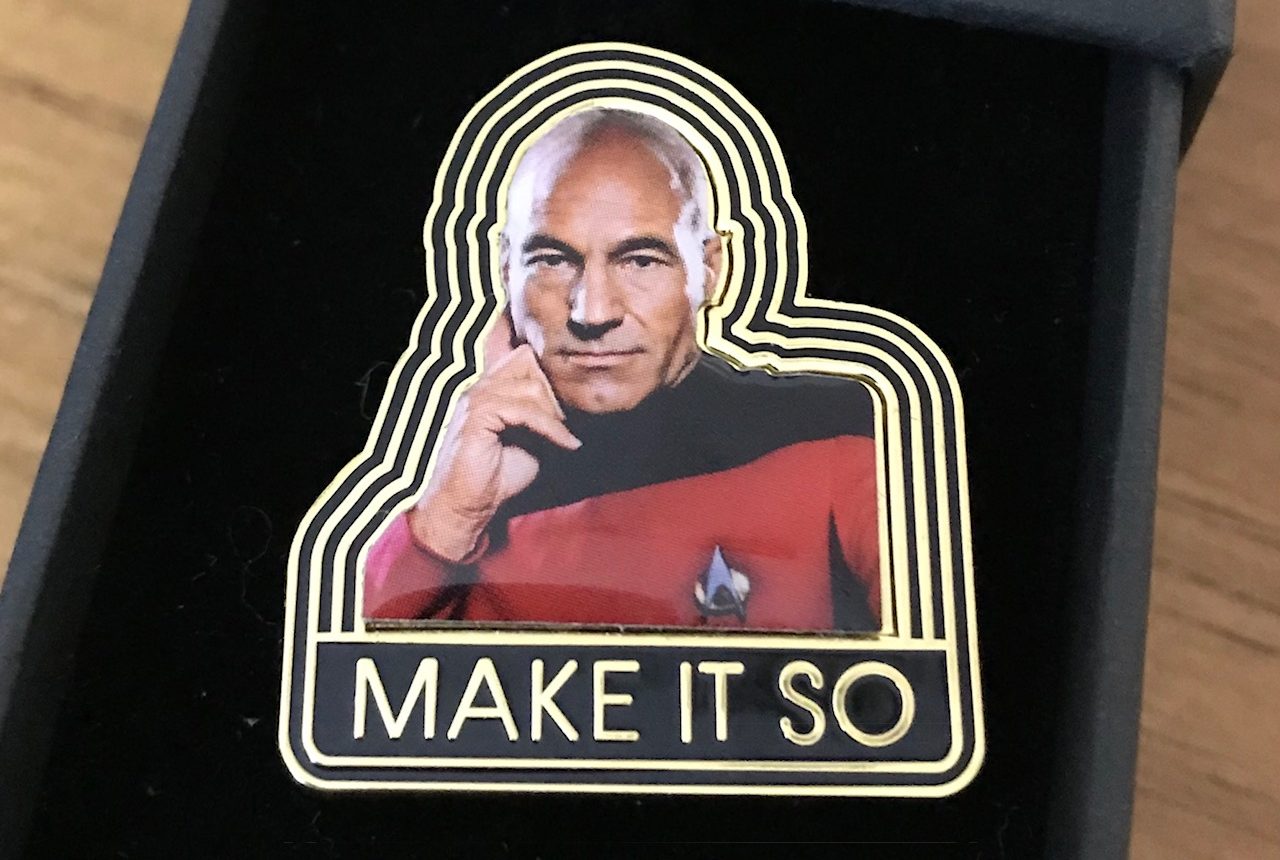
Earlier this week, Patrick Stewart died, and I was absolutely devastated. Patrick Steward’s Captain Picard was a huge part of my childhood and I have blogged many times about how much he, and Star Trek – The Next Generation more generally, inspired me in my life and my work. Being a late Gen X-er, I am firmly in camp Star Trek, not Star Wars.
There’s so much else Patrick Stewart achieved and inspired in his life, it feels a little callous to mourn him most as Captain Picard, but in my life, this figure mattered more. His calm, quiet, humane example of leadership inspired me throughout my life. He is definitely a (fictional) figure, about whom I feel that he is an essential part of my personal mythology. Without him, I wouldn’t be quite the same person.
Fortunately, later in life I met real people who inspired me, and without whom, I feel things wouldn’t have happened in the same way. Luckily for me, quite of few of these pivotal relationships continue in some form, even if the cadence of our conversations has shifted. My mentor Margaret, for example, became a friend.
Margaret was my first proper coach and mentor, and we had several conversations that shaped the future of my career. I have recently thought a lot about those special conversations, those moments when you have an idea or a realisation or someone says something that really stays with you… and things are never quite the same again.
Since I have started working as a coach and mentor myself, I have had a few people come up to me and tell me that something that we talked about or something we did together made a difference to them. That I was part of such a pivotal moment for them, a moment that made a difference, a moment without which things wouldn’t have happened in quite the same way.
It’s a deeply humbling experience, and immensely rewarding, to feel that you made a difference to someone, helped something happen.
Also, I realise now what Margaret meant when she said that she didn’t do anything, and that it was all me. What I took for her natural modesty was instead a truth I couldn’t see at the time: namely that it was all me. Just as I can see how my coaching clients or mentees make it all happen themselves. It is their energy and drive that makes it happen.
I am there for the moment, the moment in which they realise that they can. And that moment is what really matters. After that, they just do it all by themselves.
So, thank you, Patrick Stewart, for giving me a Captain Picard who was there for some of those moments for me. I will forever be grateful.
I am working on ideas in order to make, and that’s the key word here, a contribution (7 x 7 inches) to The Femedtech Quilt of Care and Justice in Open Education. Read all about what this is and more here. Read it, share it, get involved. This is important.
I have never made anything for a quilt. I can hardly sew a button back on so that it stays on. I tried to learn how to knit, but although the women in my family are super craft capable as a whole, I am NOT. So despite my keen interest in the project and the warm invitation, support and encouragement I have had along the way (THANK YOU to you, you know who you are) I am feeling thoroughly intimidated.
I have made and shared some drawings of early ideas:
And now I am thinking about how I can actually make something. Something that would capture how much I care about the cause that this project is all about.
Quilts are very special. I don’t know much about the history, but I am lucky enough to own some. And they are very precious to me. They make my daily life a warmer, safer, more caring place. And that I value very much. For naps, for early mornings, for sleeping in winter, for bad days, for dark days. The quilts I own have been in my family for nearly forty years and recently one of them had to have emergency repairs. I brought it to my mother and hoped that she could help. It was late autumn and felt reminiscent of taking teddy bears that had lost eyes or ears or even a leg to be cared for and put back together… only to magically reappear under the Christmas tree – whole again. It always disturbed me that in Star Trek even Captain Picard never had a proper duvet or quilt for sleeping under. Only strangely metallic fabric blankets that seemed at least to me never really comforting. A proper quilt is a source of great strength and comfort and not something I’d like to be without in the future.
And a future without care would be very bleak indeed, and not just in Open Education.
I can’t wait to see this quilt come into being come April. And carry all of our hopes for change and resistance with it from OER20. I am deeply grateful to all those who make it happen and most of all thanks to Frances Bell.
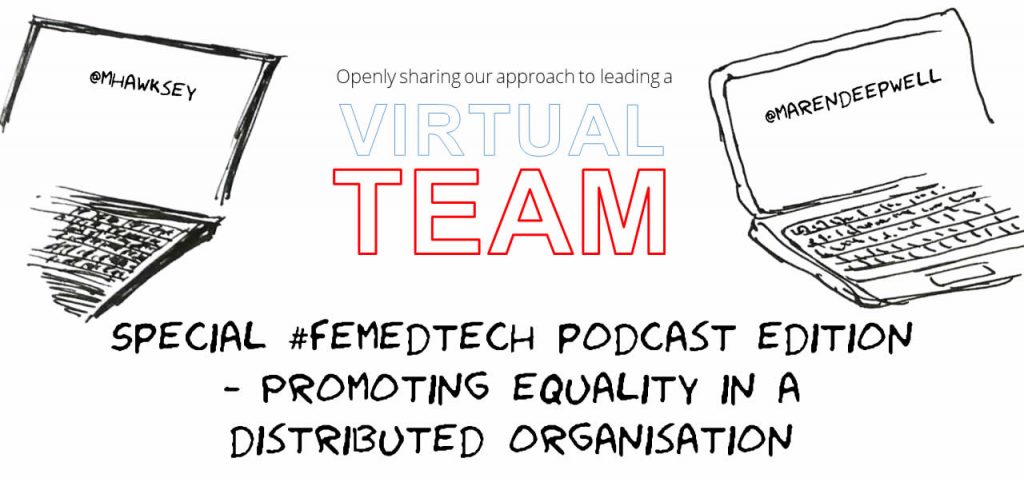
Hello and welcome to this month’s post on leading a virtual team. In this post (cross-posted here) the two of us, that is Martin Hawksey (@mhawksey) and Maren Deepwell (@marendeepwell), continue our series of openly sharing our approach to leadership.
If you are new here, you can catch up on earlier posts and podcasts or find out more about ALT, the organisation we work for as senior staff. We really appreciate comments & feedback and welcome questions or suggestions for future posts.
February
Maren: In the past year we’ve each volunteered as a guest curator for @femedtech (here’s a link to my post on that). Promoting greater equality in Learning Technology and in our distributed organisation in particular has become an important part of our professional practice. In 2017 I gave this talk at EdTech17 and since then I’ve included something about equality in most of my talks, following the example of others to use my voice to raise awareness.
As my turn to volunteer as a guest curator is coming up just after International Women’s Day on 8 March and we are contributing a joint keynote on promoting equality in a distributed organisation to a related event at the University of the Highlands and Islands, I’ve started to reflect on what I’ve learnt over the past year and come up with some ideas to discuss in this post and podcast: first, I’ve discovered lots of my own blind spots – issues and inequalities that I wasn’t aware of previously. The #femedtech network and also working in the Open Education community has helped with that (although there is a lot more to learn). Also, our work on policies for remote working has prompted me to question what I can do, what I can change, to help address any structural inequality within our organisation, by for example reviewing policies for flexible working and family leave. Another thought is that reading the narratives of others, recounting personal journeys, precarious work and family situations, career challenges, work life balance problems and so forth, made me reflect on how far outside of any comfort zone I usually work. And that is a sobering thought, particularly as I am in a position of relative privilege.
Martin: It’s interesting to consider equality and diversity as part of a distributed team. A number of the discussions I’ve seen around gender equality highlight the benefits of employers providing better opportunities for flexible working. Another factor to consider is the physical workplace can be very gender bias. The allocation/distribution of toilets is often mentioned, but I think there are lots of other environmental factors which are often overlooked. I don’t know whether virtual workplaces can be gender bias, perhaps you have thoughts on this, but it’s interesting that in a 2017 survey on Jobsite they reported that 76% of female tech professionals thought businesses offering remote working were more likely to retain top talent. Blind spots is one of the biggest challenges, not just within the workplace, but society as a whole. Before attitudes and approaches can be changed the issue first has to be acknowledged. In the case of gender I think a lot of guys don’t see a problem, or even if they do see it as a problem it is something that they shouldn’t be concerned about. As part of my curation period for @femedtech I came across the “ICTs’ for Feminist Movement Building – Activist Toolkit
A part of this Frances Bell highlighted the ‘Principles of Feminist Communication’ which is part of the toolkit. A principle that caught my eye was “we produce content in a democratic manner. Women take the lead. The process serves to build positive power”. In the case of @femedtech it is absolutely important that women lead this community, but for it to be successful it has to reach those who have their own blind spots. As such I was grateful for the opportunity to curate this community for a short period. As I explained to a friend the best equality and diversity training I had ever been on.
Maren: I agree. It’s an enormously valuable experience. Physical workspace is an interesting area when it comes to promoting equality and I’d include conference/meeting spaces in that. There are many aspects to this, even the seats you sit on: for example, I was on an all women panel once conducted on a high stage on bar stools. Not great when panelists are wearing skirts and the camera is located five feet below. Or dress codes for work, including it still being legal to stipulate women wear heels. And don’t get me started on the topic of pockets
Trying to fit new slightly bigger phone into new slightly smaller jeans and now I have #pocketrage
“Only 40 percent of women’s front pockets can completely fit one of the three leading smartphone brands.”
. Working closely with the tech sector a different kind of stereotype dominates, the genius young start up CEO or coder, mostly males who work all hours of the day. Having other responsibilities outside of work or not being able or willing to give up 100% of your time all of the time can easily be looked down on. If you open up your perspective to challenging discrimination based on age, disability, gender reassignment, race, religion or belief, sex, sexual orientation, marriage and civil partnership, and pregnancy and maternity then the challenges just keep getting bigger (ALT’s policy on equality & diversity underlines this). Which is why I feel so strongly that it’s also a matter of personal responsibility to help promote greater equality: everyone can make a difference within their personal practice, their immediate sphere of influence or even their own mindset. We can each educate ourselves, try and become more aware and raise others’ awareness. I am always inspired by projects such as the Feminist Internet, Women in Red, Uncommon Women and many others that do amazing things. On a related note, I saw a tweet the other day where Kelsey Merkley shared a childhood memory:
I was a wizard for Halloween – people told me girls couldn’t be Wizards. At 9 I gave no fucks about gender roles https://t.co/xOXGuX7xoI
It made me smile because my dream jobs growing up were bin man (because of riding at the back of the truck), hot dog vendor (love of ketchup), astronaut (amazing science teacher), judge (inspired by Captain Picard) and my fancy dress costume of choice was Poseidon (trident) and circus director (top hat). It never occurred to me that these weren’t ‘girly’ choices. Nowadays I buy books like Garth Nix’s Frogkisser for the younger readers in my life, so they can develop imaginations in which the White Wizard can be a teenage girl. And I indulge in books like those written by Ursula LeGuin, which have diverse lead characters and cultural contexts so that my own imagination grows in richness and diversity.
Martin: I’m hoping over the generations there is more equality. One issue we have is people just live to darn long so even if this is the case we still have a long time to wait. Just before our last Trustee meeting and knowing I had the prospect of a 4am start I decided to stay up and watch The Great British Sewing Bee. My interest in sewing is largely as a spectator, but I’m quite happy to put buttons back on, I also sewed on all of my daughter’s Brownie badges. People who know me well will recognise me as a maker and DIYer so perhaps not a surprise that I’m interested in this type of programme. When I was a kid I remember one year asking Santa for a sewing machine, I don’t recall it being a particularly positive reaction to that request and think I ended up with a bike instead. As someone with their own child I feel I’m more conscious of not imposing stereotypes. Some of my friends/family are teachers and when we have spoken about this in the past they say they feel there is greater openness and acceptance in areas like sexual orientation in that generation. Thinking about this post and how it relates to equality in the workplace one question I have is there a danger that remote working will be used to allow organisations to have a diverse workforce but also prevent people having full freedom of expression? An example I have in mind is a number of organisations, notably the education sector, now provide employees with the option of branded rainbow-coloured lanyards. This is a very visible support of the LGBT+ community, an act that would have far less public impact for a remote workforce. Do remote workers have the same degree of expression as office based staff?
Maren: That feels like a good jumping off point for the podcast we are recording for this post. There’s so much to unpack. Like many of the issues we discuss in this series this is a topic that touches on very personal, human questions and reaches all the way to formal HR policies, working with diverse stakeholders and keynote speakers and even our organisation’s strategy. I’ve also explored this in my Senior CMALT portfolio to show that this is a key element of my professional practice.
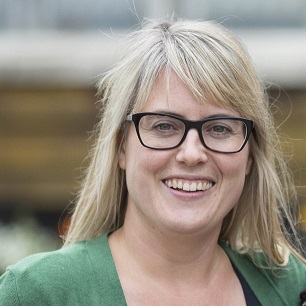
There’s a person on the image below who has green hair, and that’s intentional. Sure, it’s a small thing, but it’s important because of the thought process that went into it. It’s putting values, policies even, into practice in a playful and powerful way.
This post continues the series on openly sharing our approach to leading a virtual team – a joint project with Martin Hawksey (cross-posted here) for which we write a monthly blog post.
October
This month we discuss ways in which we could develop our approach to virtual team leadership including dealing with critical incidents when you have a distributed workforce. Rather than sharing what we found works, we open up some of the questions we have and consider how we might find solutions that support sustainable development for a small virtual team.
Maren: We received some really thoughtful comments in response to our last post which touched both on the discipline it takes to work from home (your own and everyone who lives with you) and also the challenges of leading a virtual team. I’ve been thinking about how we might develop our approach to that kind of leadership and there are a couple of ideas I’d like to explore: first, I’m wondering if we should open up leading team meetings. As I meet with everyone one to one my way of leading online meetings dominates in our team and more diversity might be a good thing. Also, I’m curious about tools like Jamboard we recently looked at, a virtual notice board, to mix up how we work synchronously. Different tools may also open up new ways of interacting with each other as a group.
Picard management tip: You’re not supposed to come up with all the ideas yourself. Ask for suggestions.
Last, inspired in part by this tweet I’m curious about how our team would respond to trying out new things, now that we have nearly a year of virtual working under our belt.
Martin: Having had the experience of leading team meetings in the past the proposition of having to do this on a regular basis isn’t one that personally appeals to me. In part I think it is because there are some subtle differences with leading virtual team meetings compared to when you are face-to-face. For example, as often everyone is staring at a monitor the temptation to check on the various popup notifications increases, plus with virtual meetings I think there is a tendency, because you are not physically co-present, to feel that when you are not speaking no one is watching you. I find I often have to remind myself to pay attention and not get distracted, something I don’t think happens as much when meeting the team face-to-face. Consequently, I feel you need a strong individual to lead virtual meetings, someone who is skillful in keeping everyone’s focus and energy high, something you have in abundance. This is something perhaps Paul Hollins was alluding to in his comment on our last post when he mentioned that team directorship is a challenging area. Would you agree different qualities are required to lead virtual team meetings compared to face-to-face?
Maren: There are definitely differences between face to face, blended and fully online meetings or webinars, and additional skills that need to be developed incl. technical capabilities. I, for example, learnt a lot from seeing many different people lead meetings and facilitate webinars – but I also gained experience in different contexts that helped me build skills and confidence. It’s important to see different people’s approaches in order to find one that works, but there are some commonalities: listening, giving everyone the chance to participate/speak, keeping to time, preparing an agenda, being clear about the purpose of the meeting and its outcome. You describe traps that we can all fall into, a temptation to be passive or distracted, to rely on others’ momentum. Having seen plenty of people doodle, eat, doze or lurk their way through meetings whilst sitting around a table I think that particular aspect of communicating or working together is always challenging. But coming back to Paul’s comment, I’ve reflected on the challenge of managing crisis recently, something that came up in a series of posts I’ve written with my mentor, Margaret. Margaret commented on how using different ways of working together affected the quality of our interaction. For example, we would plan strategy face to face, work on procedures in shared docs or speak on the phone in an emergency. One of the biggest challenges in managing a distributed team lies in building confidence in managing a crisis and to continue to communicate in an emergency whether that’s staff illness, systems failures or external issues. It takes time and, unfortunately, experience to build trust in ways of managing a crisis when meeting in person isn’t an option. Initially, I found it really difficult that my Line Manager or mentor were a remote presence only. Sometimes I still do. On the other hand, that perspective helped me identify and develop the skills I need to provide support or manage an emergency. You and I have a lot of experience in managing different types of emergencies, but scaling that up to a bigger scale, to work for everyone in the organisation is a continuous learning process.
Martin: It’s interesting to reflect on critical incidents and whether being a virtual team hindered our response. An incident that immediately comes to mind was last year’s ALT Online Winter Conference when the European servers for the webinar platform we use went down. My experience was the combination of chat and video Hangouts worked well and don’t think hindered our response in any way. Fortunately we also had a great support from our webinar provider which resulted in minimal impact. In some ways I think where it gets harder are moments where you are tackling a slow burn rather than an immediate crisis, like a server failure. In these situations the danger is they are not perceived by everyone as critical but can quickly escalate to be critical if not addressed. This is where continued communication becomes essential and like you I think it can be easily forgotten particularly in a distributed environment. This is perhaps where online tools can help. At the beginning of this post you mentioned we’d been looking at Google’s collaborative meeting tool Jamboard. This basically gives you a virtual whiteboard you can collaboratively contribute to. As someone who likes using post-it notes a virtual place for sticking these is immediately attractive. I can see Jamboard and tools that have similar functionality as a way to avoid slow burn incidents, providing a way for everyone in the team to get an overview of useful information. Creating workflows or using tools everyone is happy with is always a challenge, not just for distributed teams, and creating a culture of continuous learning is very important.
Maren: I agree with that. On the one hand it’s important to manage change by providing some continuity, like some of the strategic and operational planning tools we use and in a year full of change keeping some things the same has been a necessity. On the other hand, we’ve learnt a huge amount in the transition to operating as a virtual organisation and it makes sense that we learn from that and try out new ways of doing things. We’re already learning a lot from an interim virtual audit, and improving our new financial and payroll procedures and checklists. You point to some advantages collaboration tools could give us when it comes to managing a crisis, and there could be other upsides such as simplifying communication, creating an easy to access overview of progress and giving greater support for our team outside of meetings. I feel the additional support structure a new tool or maybe a new way of using an existing tool could provide would help give us confidence in the long run and support more learning and agile working. I’d really like to find a way to incorporate a stronger sense of progression into our weekly team meeting notes and I’d like to see whether our operations plan could become more practical day to day. I’d like a better overview of areas I don’t have active involvement in. What’s on your wish list of things to try?
Martin: I came across an interesting series of posts by Zapier in which they’ve documented the tools they recommend for remote teams as they have grown from 6 to 20 to over 110 employees. The first two posts aren’t date stamped but I’m guessing they hit 6 employees in 2013 and 20 in 2015, and the over 110 was posted in 2017. Some tools that were mentioned in 2013 that caught my eye were iDoneThis and Sqwiggle. With iDoneThis “everybody on the team checks in daily; either in their browser or via email”, which is turned into a daily digest or analysed in a report. I can see the benefit of such a system but fear, depending on how it was implemented, it might be perceived as too draconian. Another service that was mentioned that got my attention for different reasons was Sqwiggle: “Sqwiggle is a persistent video chat room, but instead of having a live video feed on all the time like you might do with Skype or Google Hangouts, Sqwiggle takes a picture of you every 8 seconds”. We’ve previously talked about the importance of trust within remote teams and whilst I can see why people might like Sqwiggle to me it appears like surveillance technology and a shortcut to eroding trust. Sqwiggle was closed in 2016 but both Sqwiggle and iDoneThis didn’t appear in Zapier’s posts in 2015 and 2017. One tool that appears in all of Zapier’s posts is the project management service Trello. Trello is a tool I often hear about in the developer community and there are lots of posts and resources that promote it as a tool to support remote teams, including Trello’s own Trello for Remote Teams. Having had a quick look a Trello an immediate thought is can we replicate it with any of the existing tools we use like Google Keep. Ultimately I think it comes back to one of our core principles, the appropriate use of technology. Unpacking what it is we want to achieve will go a long way in helping us decide how we continue to develop remote teamwork at ALT.
As you may have gathered, I like Star Trek and Captain Picard is my favourite captain in that particular universe. I don’t agree with every aspect of his approach to leadership, but I like to think that we share a lot of values and every now and then I come across something he says or does that really resonates with me.
I was watching an old episode of The Next Generation recently (fellow nerds: this is the one in which android Data loses his confidence after someone beats him in a futuristic strategy game), in which Picard says to Data that it is possible not to commit any mistakes and still loose. I like the episode in general, but that particular bit of dialogue stuck in my head, because it’s related to things I have been thinking about recently. Here’s why it resonates with me:
Much of the time following all the right steps and doing all the right things does result in the desired outcome. At least when things are reasonably within your sphere of influence. So, when something goes wrong or something bad happens in response to what we do, we seek to establish what we did wrong, where we made a mistake – same as Data does in the Star Trek episode. He thinks he must have made a mistake because he lost the game. It’s logical, and it’s comforting to have a sense of control, to believe that doing the correct thing will result in the correct outcome.
But, in many instances, that’s not the case. That’s not the case in the well-ordered universe of the Starship Enterprise and certainly not the case in the chaotic reality we call home.
The advice from Captain Picard cheered me. I thought it was a useful lesson to revisit because it reminded me that not everything that goes wrong is my responsibility or within my power to change. It made me reflect on the fact that even when things go wrong, often you can still get to your overall aim in other ways. And it made me think about how valuable it is to make mistakes, to learn how to cope with making them, learn from them and move on with your confidence still intact.
In a high-performing environment, like Starfleet in this instance, it’s doubly important to be considerate about that part of your working culture. To be able to share when things go wrong, to make the best of them and to move on. And that a little kindness, a moment of listening or recognition can go a long way to helping oneself and others weather difficult moments like that.
Back in the Star Trek story, a cheered Data returns to duty with the Captain’s advice fresh on his mind, but he also returns to face his opponent at the game table. This time, Data plays not to win, but for a stalemate, and he succeeds in not losing. He changes his winning conditions, what he wants to achieve to succeed. It’s a great ending to the episode and a good example to follow.
This morning my least favourite social media platform reminded me of a post from 6 years ago, and it linked back to this announcement from 2012, written by Martin Oliver, then Chair of ALT, about my appointment as CEO of the Association.
Since then, I have written many times to Members to report on progress and together with others shared the work we do, which I am very proud of. But this post is more personal, not about me representing ALT as an organisation. Because as I found out in the last six years, being a CEO is all about who you are and the people you work with.
To celebrate making it to 6 years as a CEO, I am going am going to share the top tracks from the soundtrack of the last 6 years and the reasons for why I love these songs:
Harder Than You Think by Public Enemy
Good for running, good for getting out of bed and a potent reminder that the example I set, the work I do, does make a difference (even if it often is…. harder than you think).
Manic Monday by The Bangles
Needs no explanation really, not many weeks manage to start with anything else. This is a proper 80s reminder to have fun, work hard and hum along of things get really tough.
Theme tune from Star Trek – The Next Generation
With Captain Picard being my all-time hero and the crew of the Enterprise and their adventures shaping most of the metaphors in my young mind, there is not a lot that I don’t imagine in terms of what’s happening on the Enterprise.
Picture of You by The Cure I used to follow the band along on tour when I was a teenager and I have every one of their albums. They are my favourite band and this song I like to listen to when I stand on a new stage, looking around a big, empty auditorium for the first time. Also works great on train journeys… a song to make me feel at home no matter where I am.
Lost in the Supermarket by The Clash
Living in London for over ten years, I came to identify with this song a lot. Also, it’s The Clash.
15 Step by Radiohead
I never knew that Radiohead was Oxford’s ‘local’ band before I lived there and as I am terrible at recognising people’s names and faces, I never spotted any of them in town. Of all their music, I love this song in particular.
I went to see Midnight Oil play live in London last year and when the floor and the roof and the walls and every body was vibrating with the beat of the drums I was reminded that as human beings we are made to experience the world with all our senses. This is part of what you don’t see.